


The Big Picture |

- 10 Tuesday PM Reads
- The Debt – One More Time
- FOMC minutes, many believe in more
- S&P 500 Index At Inflection Points
- ECRI’s Achuthan: Jury Still Out on Recession
- Don’t Miss: The Big Picture Conference ~ Oct. 11, 2011
- Confidence falls but follows UoM
- Panasonic Lumix DMC-ZS10 14.1 MP Digital Camera
- Apple’s Creative Destruction of Competitors
- Double Dip Recession Or Year 5 Of 2007 Recession?
| Posted: 30 Aug 2011 01:00 PM PDT My afternoon reading material:
What are you reading? ~~~
|
| Posted: 30 Aug 2011 11:00 AM PDT The Debt – One More Time ~~~ There has been a consistent flow of thoughtful comments on our recent commentaries comparing US and European budget deficit and related problems. Two issues have been raised. One respondent argued that comparing the US with Europe, and citing Ireland's most recent expenditures at 67% of GDP, was misleading. The ballooning of Ireland's government expenditures was due to the rescue of its beleaguered banks. Putting aside the fiscal cost of bailing out banks or the wisdom of doing so, it is true that singling out Ireland was probably extreme. Ireland ran surpluses from 1999 through 2007, during which time its economy prospered. It went into deficit in 2008 by 7% of GDP, which doubled to 14.3% in 2009. The percentage then skyrocketed to 32.4% in 2010. To be sure, Ireland is an extreme example, but the rest of Europe ran deficits continually from the inception of the EMU in 1999. Those deficits grew to 6.8% of GDP in 2009 and 6.4% in 2010, with expenditures accounting for about 50% of GDP. Several people correctly said that comparing the US federal debt situation with that of the EU understates the role of government in the US relative to Europe. Most European nations provide services that our combined federal, state, and local governments provide. So ignoring the role of state and local revenues and expenditures omits an important additional government burden on GDP in the US. The reason I did not initially consider state and local government expenditures is that the debate on the debt ceiling was a federal issue, and actions by congressional leaders would not affect state and local revenues and expenditures directly. Additionally, all states but Vermont have some form of a balanced-budget requirement, and rely upon the $2 trillion municipal securities market for financing, a market in which Cumberland is well versed. We don't believe that market whose is likely to be impacted one way or another by US federal government surpluses, deficits or debt financing needs. Regardless, the point is well taken; and fortunately, the data are readily available to make the needed comparison. Without going into a lot of additional statistics, combined US federal, state, and local expenditures accounted for an average of 35% of GDP from 1952 to 2010, with a standard deviation of about 4 percentage points. Of that 35%, an average of 6 % was due to state expenditures and another 9% was due to local expenditures. Beginning in 2001 combined federal, state and local expenditures exceeded 36% and then climbed steadily to a high of 45% in 2009. In every year, combined US government expenditures were significantly below those of Europe. You will remember European expenditures have averaged slightly over 50% of GDP, and have increased three percentage points since 1999. Looking at the combined federal, state, and local spending for the US suggests that the burdens of government are large, increasing, and may soon achieve the danger levels that are currently plaguing Europe. The issue becomes even more critical when one adds in the effects of outstanding debt burdens on an economy. Reinhart and Rogoff, in a recent paper in the American Economic Review, "Growth in a Time of Debt," that built upon their seminal book This Time It Is Different, argued that once a nation's outstanding debt to GDP ratio exceeded 90%, growth was significantly reduced. That point that debt was bad for growth was amplified by Cecchetti, Mohanty and Zampolli, in their Jackson Hole paper delivered on Friday, Aug. 26. For public debt, they concluded that the critical range was between 80 to 100% of GDP. It so happens that their data also indicate that the current debt to GDP ratio for the US is 97 % and it is well on its way, if not already, to exceeding the 100% danger zone. These comparisons only make the need to get the US federal fiscal situation under control even more urgent and critical. We may be closer to a European-type fiscal crisis than we care to think, and we certainly can't afford the diddling and politics that will surely surround the congressional super committee's deliberations. If our politicians are incapable of credibly addressing this issue promptly, then the voters will hopefully see that they get out of the way. ~~~ Bob Eisenbeis is Cumberland's Chief Monetary Economist. Prior to joining Cumberland Advisors he was the Executive Vice President and Director of Research at the Federal Reserve Bank of Atlanta. Bob is presently a member of the U.S. Shadow Financial Regulatory Committee and the Financial Economist Roundtable. His bio is found at www.cumber.com. He may be reached at Bob.Eisenbeis@cumber.com. |
| FOMC minutes, many believe in more Posted: 30 Aug 2011 10:36 AM PDT In response to the FOMC’s concern with the lackluster economic recovery and the mostly benign outlook on inflation (some were more concerned about inflation), members on Aug 9th discussed doing more. They discussed selling short term maturity debt they own and buying longer term debt with the proceeds. They talked about lowering the interest rate paid on bank reserves to encourage bank lending (.25% rate is certainly no impediment) and they debated the only thing they followed thru on, that of explicitly defining the time frame of an ‘exceptionally low’ fed funds rate. The 1st and 3rd options were meant to lower further the level of long term interest rates as many on the committee still believe that even lower rates will somehow help. Some didn’t want more because they didn’t think it “would likely do much to promote a faster economic recovery” and “that providing additional stimulus at this time would risk boosting inflation without providing a significant gain in output or employment.” The majority of members “agreed that the economic outlook had deteriorated by enough to warrant a Committee response at this meeting.” Remember that this is only 5 weeks after the end of QE2 that they felt the need to act again. Some members even wanted more and will likely use the Sept meeting to push for it. Bottom line, after hearing from Bernanke on Friday, Evans and Kocherlakota today and Fisher and Plosser (dissenters) after Aug 9th, we got a good read of what the Fed is thinking and it seems that the majority still want more. |
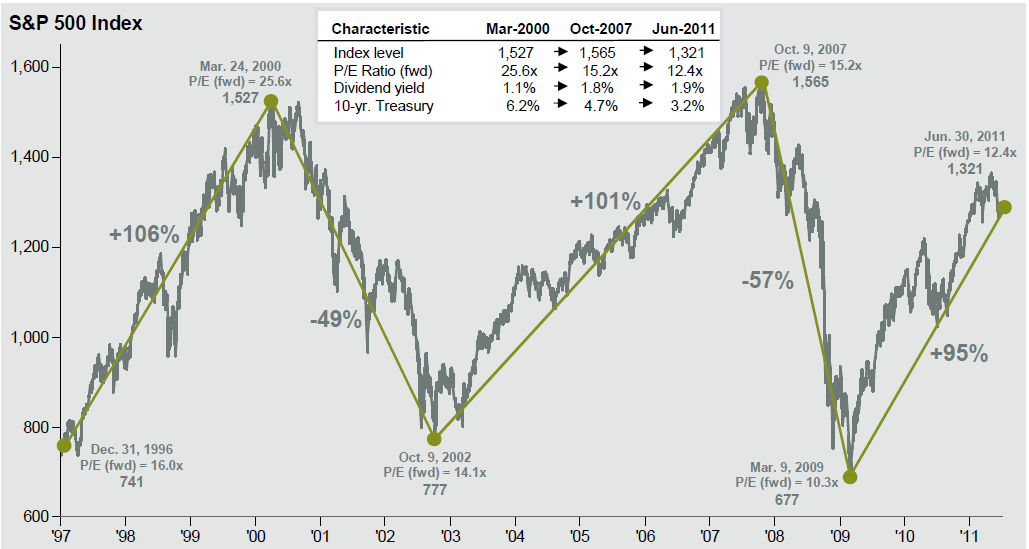
| S&P 500 Index At Inflection Points Posted: 30 Aug 2011 09:00 AM PDT
Source: BLS, FactSet, J.P. Morgan Asset Management. Source: JP Morgan funds |
| ECRI’s Achuthan: Jury Still Out on Recession Posted: 30 Aug 2011 08:00 AM PDT ECRI's Achuthan: "No Upturn Yet…More Weakness" Ahead, But Jury Still Out on Recession |
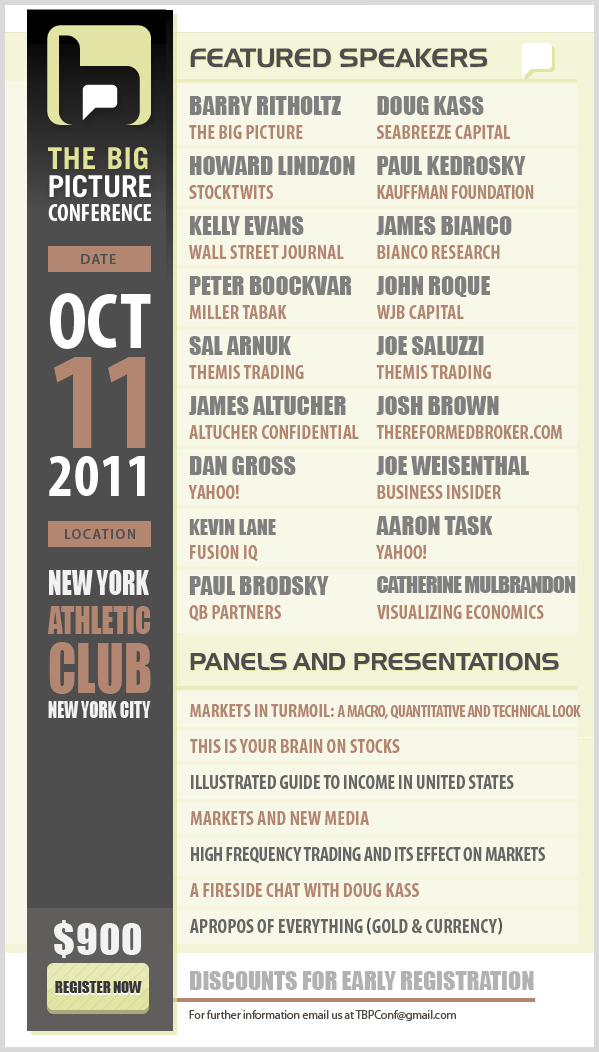
| Don’t Miss: The Big Picture Conference ~ Oct. 11, 2011 Posted: 30 Aug 2011 07:30 AM PDT |
| Confidence falls but follows UoM Posted: 30 Aug 2011 06:43 AM PDT Following the weak Aug UoM confidence figure, the Aug Conference Board Confidence figure was very weak as well at 44.5 (lowest since Apr ’09), well below expectations of 52 and down from 59.2 in July. Almost the entire decline from July was in the Expectations component which plunged 23 pts. The Present Situation fell just 2.4 pts. The answers to the labor market questions were disconcerting as those that said jobs were Plentiful fell .4 pts to a 5 month low and those that said jobs were Hard To Get rose 4.3 pts to the most since Nov ’09. Business Conditions Present Situation was little changed but the Outlook fell sharply. Those that plan to buy a home within 6 months fell 1.2 pts to the lowest since Dec. Those that plan to buy a car rose 1 pt to a 3 month high. One bright spot was those who plan to take a vacation which rose to the most since Dec (get away from it all?). One year inflation expectations were unchanged at 5.8%, still above the 10 yr average of 5.1%. Bottom line, August was an extremely tumultuous month as we all know and the confidence data is a rational response to the economic fears that became global. With this said, there is many times a difference between how consumers feel and how they act. |
| Panasonic Lumix DMC-ZS10 14.1 MP Digital Camera Posted: 30 Aug 2011 06:42 AM PDT
~~~ I have an earlier version in Black, and I have been very happy with it. Its normally $379, but is on sale for $249. This was a one day Gold Box sale from Amazon on Sunday when I had no electricity, but it seems to have carried forward, perhaps as a hurricane bonus. |
| Apple’s Creative Destruction of Competitors Posted: 30 Aug 2011 06:15 AM PDT One of the things that seems to have gotten lost in the avalanche of Steve Jobs coverage has been the impact he has had on technology investors. I refer not to the entire technology sector as an investable asset, but rather, the utterly crushing effect Apple has had on specific competitors as Jobs remade entire industries. It is creative destruction writ large.
Starting with the iPod, consider the companies and franchises that the Apple juggernaut has demolished in its wake. Yes, we know the original Mac was hugely influential, ripped off by Microsoft. AAPL was marginalized as a PC player, only kept alive by a $150m MSFT investment in the a 1990s so as to retain a weakened competitor in the OS space. Today, the triple threat of iPod/iPhone/iPad has left behind a wake of confounded business models, overwhelmed managements, and bereft shareholders. Let’s look at who has been hurt — and helped — by the elegant interface monster from Cupertino: > Destroyed • HP: The printer business may still have some ink left, but the iPad has gutted HP’s PC operations. It has reached the point the company is considering selling the $40 billion revenue division and leaving the PC industry. HP’s tablet entry, the $499 Touchpad, was a disaster — Best Buy was sitting on over 200,000 unsold units. None were selling until the priced was slashed 80% to $99. (Sure, they may lose $200 on each one, but HP makes it up in volume!) • Dell: About Apple, founder Michael Dell once famously stated “What would I do? I’d shut it down and give the money back to the shareholders.” When Apple’s market cap passed Dell’s back in 2006, Steve Jobs reminded employees of that barb via email. Today, Apple’s profits ($29B) alone are actually larger than Dell’s entire market capitalization. • Motorola: See Google, below • Research in Motion/Blackberry: For a very long time, RIMM “owned” the enterprise market for mobile email and text messaging via their “Crackberry.” They are an instructive example of how a leader can get toppled by an innovative competitor. Topping out at $144 per share in 2008, the RIMM now trades in the $20s, with no solid answer to the iPhone. The NYT’s David Pogue just called their latest entry, the BlackBerry Bold 9900, too little, too late. • Nokia: Not too long ago, Nokia had better than a 50% market share in the mobile phone market. Today? Just 15%, and forced to abandon their own OS in favor of Microsoft’s also ran Mobile OS. • Ericsson: I’m sorry, but the name doesn’t ring a bell.
Damaged • Microsoft: Once a vicious and hated monopolist, Mister Softee is currently run by a Steve Ballmer. Bill Gates’ old pal is in so far over his head it would be funny if it wasn’t so pathetic. Under Ballmer’s reign, Microsoft has become vulnerable. They have missed just about every major trend in technology over the past decade. Ballmer famously said he wouldn’t let his kids use an iPod or Google, missing (amongst many other tech trends) a entire computing shift. As recently as 2 years ago, he claimed Linux was a bigger competitor to Microsoft than Apple. Perhaps a different CEO might have had a strategic counter to Jobs, but Ballmer was not that guy. They still are a cash cow, but that is likely to dissipate over the next decade. • Sony: Once owned the portable music space, but their Walkman was replaced by the iPod, and their well regarded Vaio laptops are getting suplanted by iPads. They have a huge consumer electronics, film, and television business, but are being slapped by the Koreans below and Apple above. Intel: A mixed bag to say the last. Intel is powering Macs and has some chipsets in other Apple products, but their PC business appears to be suffering. Challenged Google: A juggernaut in its own right, GOOG acquired Android and turned it into a legitimate competitor to the iPhone. But they don’t sell the OS — they give it away for free, and retain the search rights (their bread & butter). It was smart to expand into mobile so as to not get eclipsed in that space, but it also created another set of headaches: Patent exposure. Apple not only dominates the space, but they also acquired a huge trove of Nortel patents so as to insulate themselves, and challenge all comers. This forced Google to pay up for a comparable portfolio, grabbing (former Apple partner) Motorola for $12.5B. The jury is still out as to whether this will insulate some of the obvious Apple inspired tech on the Android . . . AT&T: Was desperate enough to let Apple dictate terms for the iPhone, thereby changing the entire industry. When iPhone calls got dropped in large numbers Apple may have saved them from an ignominious demise. Benefitted Sharp: Apple invested a billion in Sharp to insure a steady supply of laptop LCDs. Corning (GLW) – ‘Gorilla’ Touchscreen Glass is the supplier to not only iPod touch/iPhones/iPads, but the entire industry. the i-line and its inspirations has been a boon to Corning. Sprint: WSJ reporting they will get iPhone 5 in October) Foxconn: Manufacturer of many Apple products (but still has not resolved its worker suicide issues). STMicroelectronics Makes the Accelerometer, Gyroscope in iPods Qualcomm (QCOM) – Wireless baseband chips in iPhone4 and to be in iPhone 5 ~~~ Hat tip Josh Brown, John Melloy, |
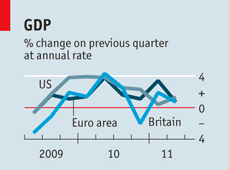
| Double Dip Recession Or Year 5 Of 2007 Recession? Posted: 30 Aug 2011 05:30 AM PDT
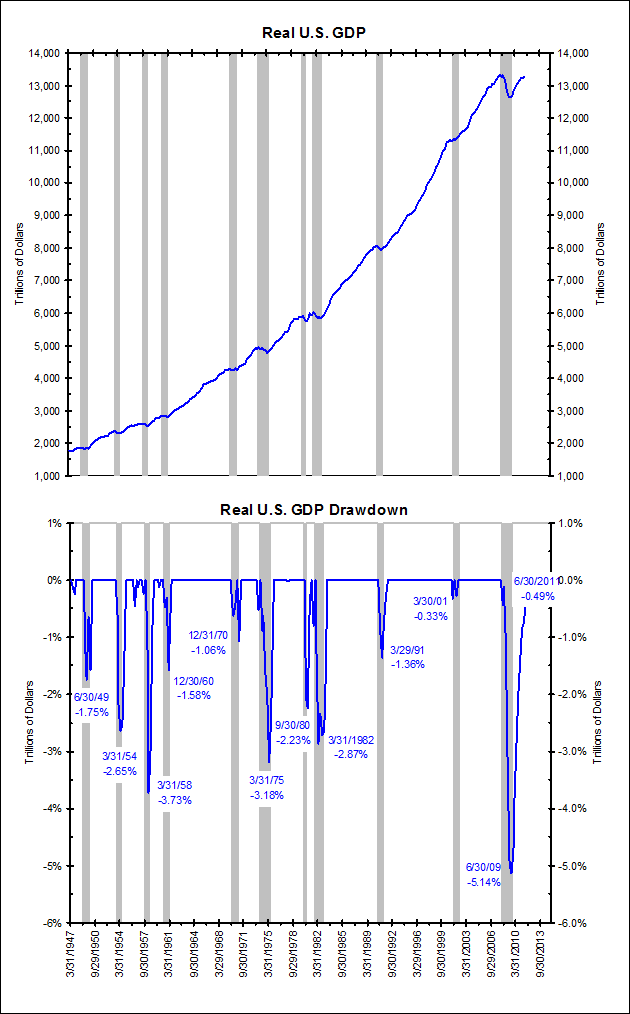
The Economist – The West's economy: How to avoid a double dip Rich countries need to squeeze their economies less hard and get serious about growth Anyone who managed to switch off during the summer holiday has faced a rude shock on his return. The world economy is in much worse shape than it was only a few weeks ago. Growth has slowed sharply in both America and Europe. Even the emerging world has lost some of its sizzle. Global share prices have dropped by around 15% since early July. Consumer confidence has slumped. All this has led to a grim, and sudden, reassessment of growth prospects, especially in the rich world. Forecasts for 2012 have been slashed. The odds of a double-dip recession have risen sharply on both sides of the Atlantic. In 2008 the world economy was saved from depression by a bold and co-ordinated plan to shore up banks and counter the slump with fiscal and monetary stimulus. Today there is no boldness (the euro-zone crisis is the epitome of politicians doing too little too late). There is no co-ordination. And, to the extent that policies have a common theme, it is the wrong one: politicians across the rich world are taking too short-term a view of fiscal austerity—a bout of budget-cutting which will only increase the risk of another recession. Comment In the past we have noted that Martin Feldstein, one of the members of the business cycle dating committee, was the holdout in calling the end of the Great Recession. The committee works by consensus and Feldstein was not sure that the current economic expansion would make a new high. He relented and the Great Recession's end was dated June 2009. The official call was made on September 20, 2010. For the moment, it looks like his first instincts were partially correct as a case can be made that the "Great Recession" never really ended. The NBER has dated every recession back to 1854. A recession is a peak to trough in economic activity where the expansion off the trough results in a new high in real economic activity. This has been the case in every recession/depression/panic ever dated. Even the 1937 peak in economic activity (which began the 1937 recession) was above the 1929 peak (which started the Great Depression). As the two following charts show, real GDP and personal income had their biggest falls since the end of WW2 (see the second panel of each chart highlighting the drawdowns). More importantly, neither real GDP nor personal income have made a new high in economic activity. If the economy continues to falter, then this is not a "double dip" but rather a continuation of the Great Recession. Now to be clear, the ultimate trough most likely already occurred in June 2009, which is how recessions are dated (peak to trough). However, the recession does not truly end until economic activity makes a new peak. For the moment, that has not happened. One could argue that August 2011 is the 44th month since the Great Recession began (December 2007). Only the Great Depression (which lasted 43 months from August 1929 to March 1933) and the Panic of 1873 (65 months from October 1873 to March 1879) took longer to make a new peak in economic activity.
˜˜˜
The New York Times – Gretchen Morgenson: The Rescue That Missed Main Street For the last three years we have been told repeatedly by government officials that funneling hundreds of billions of dollars to large and teetering banks during the credit crisis was necessary to save the financial system, and beneficial to Main Street. But this has been a hard sell to an increasingly skeptical public. As Henry M. Paulson Jr., the former Treasury secretary, told the Financial Crisis Inquiry Commission back in May 2010, "I was never able to explain to the American people in a way in which they understood it why these rescues were for them and for their benefit, not for Wall Street." The American people were right to question Mr. Paulson's pitch, as it turns out. And that became clearer than ever last week when Bloomberg News published fresh and disturbing details about the crisis-era bailouts. Based on information generated by Freedom of Information Act requests and its longstanding lawsuit against the Federal Reserve board, Bloomberg reported that the Fed had provided a stunning $1.2 trillion to large global financial institutions at the peak of its crisis lending in December 2008.
|



| You are subscribed to email updates from The Big Picture To stop receiving these emails, you may unsubscribe now. | Email delivery powered by Google |
| Google Inc., 20 West Kinzie, Chicago IL USA 60610 | |



0 comments:
Post a Comment