


The Big Picture |

- Can We Build Our Own Economy From the Ground Up?
- Last Call: The TBP Influence List
- 10 Monday Afternoon Reads
- Market lift off lows
- 10 Tips for Making Beautiful Slideshow Presentations
- How to Focus in the Age of Distraction
- Big Bank Chart
- Read It Here First: Rising Market Volatility
- The Long-Term Case for Stocks
- 10 Monday AM Reads
| Can We Build Our Own Economy From the Ground Up? Posted: 12 Sep 2011 10:00 PM PDT The Economy Is Stuck In a Depression … For Most AmericansThe mainstream economy is stuck in depression. See this, this and this. More accurately, there are two economies:
Alan Greenspan agrees:
Put another way, the top .1% are currently acting like parasites, stealing the money from the rest of the population. Moreover, the giant insolvent banks – which are receiving trillions in bailouts, guarantees and opportunities – are not lending to Main Street, while the smaller banks are (even though the smaller banks are being unfairly penalized by the Fed.) And perhaps most importantly, consumer confidence – and Americans' confidence that their government is doing the right thing to fix the economy – is extremely low. Why? Largely because the rule of law has broken down, and fraud is so rampant – and is actually sanctioned by the government – that it has become "the business model" of Wall Street. And see this. In short, people no longer trust the economic system, which makes an economic recovery impossible. So people aren't spending, but are instead "keeping their powder dry" until the rule of law and free markets are restored. People know – either consciously or below the surface – that we have socialism for the rich, and that the little guy doesn't have a chance. See this, this, and this. Under such circumstances, people will not spend. Is There A Solution?We can't get out of this depression until trust is restored and consumer spending occurs again. Trust and spending won't happen unless the rule of law is followed. But the government refuses to enforce the rule of law or to prosecute most of the Wall Street fraud, partly because Washington D.C. has been bought and paid for by Wall Street. So we're stuck in a seeming catch-22. But maybe we can build our own economy. Yes Magazine has a new article out entitled:
We – collectively – have enough money in our personal stashes to be able to grow a vibrant economy. If we held our own money, we wouldn't need the big banks. Public banking could also really help us obtain credit to grow our local businesses and economies. But the big banks (and Federal Reserve itself) are exerting tremendous pressure to kill any public banking movement. Local currencies and barter are also becoming huge trends. As John Stossel noted in March:
But the government at times cracks down ruthlessly on alternative currencies … going so far as to label them a form of "domestic terrorism". Moreover, there is a growing consensus that – since there is simply too much debt in the world to repay (much of it fraudulently incurred) – the debt should simply be written down. See this and this. However, the bondholders are fighting that idea with tremendous lobbying efforts. So the large organizations – perhaps with the best of motives – are trying to keep us trapped in the dysfunctional, debt-based system. Re-Building Local Communities of TrustAs professor of social anthropology – and debt expert – David Graeber points out, we don't really need debt and money as such:
If Graeber is right in his claim that modern ideas of money and debt came from warfare and slavery, if the large banks and their "bought and paid for politicians" continue to block public banking, and if the IRS is going to tax barter transactions and block alternative currencies, what can we do to escape the clutches of the wealth-extracting system we currently have? Graeber hints at one possibility:
In other words, in communities or webs of human interaction which are small enough that people can remember who gave what, we might be able to set up alternative systems of money and credit so we can largely "opt out" of the status quo systems of money and debt measurement. I'm not arguing for becoming Luddites and living in mud huts (but that is fine, if you wish to do so). Nor am I suggesting that we all have to become selfless saints who give away all of their possessions without any reasonable expectation of something in return. I am arguing that it might be possible to empower ourselves – and create our own systems for keeping track on a local or people-centered basis, and create our own vibrant economies using the resources we have – by moving away from the national and global systems dominated by the biggest banks and oligarchs, and towards a system where we "spend" resources and goodwill into our local communities in a way in which trust is built from the ground-up, and the energy of trade and commerce can be re-started. Postscript: Mainstream economists will argue that we need a universal, fungible type of money in order to trade on a global basis. But because currencies are now unpegged from anything in the real world and are traded on the currency markets, their values fluctuate wildly in the modern world. In other words, one of the essential characteristics for money – that they represent a universal, fixed yardstick – has disappeared. And fiat currencies have a very short lifespan. So how valuable are they, really, for anyone but forex speculators? |
| Last Call: The TBP Influence List Posted: 12 Sep 2011 05:15 PM PDT As noted each of the previous two evenings, I found the Bloomberg finance 50 sort of milquetoast. Instead, I solicited you the home viewer to suggest a more significant group of influential people — who affect your thinking, your trading and your outlook. The categories:
Add your suggestions and I will pull together a list based on reader votes, plus a little of our own secret sauce. Please use the comments to suggest as many folks in each category as you like . . . > Previously: TBP50: Who Influences YOU the Most? (September 11, 2011) Meh! Bloomberg Market's 50 Most Obvious (September 10, 2011) |
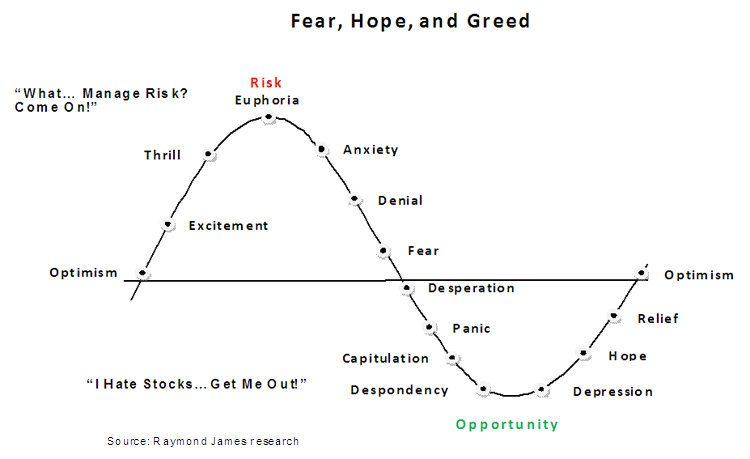
| Posted: 12 Sep 2011 01:30 PM PDT Here is my train reading for the ride home:
What are you reading?
Source: Jeff Saut, Raymond James |
| Posted: 12 Sep 2011 12:06 PM PDT Market lifted on this headline, *ITALY IN TALKS WITH CHINA FUND TO BUY BONDS, FT SAYS |
| 10 Tips for Making Beautiful Slideshow Presentations Posted: 12 Sep 2011 12:00 PM PDT As someone who makes presentations on a regular basis, and does not like most powerpoints, I found this PPT presentation excellent: |
| How to Focus in the Age of Distraction Posted: 12 Sep 2011 11:49 AM PDT |
| Posted: 12 Sep 2011 09:30 AM PDT |
| Read It Here First: Rising Market Volatility Posted: 12 Sep 2011 08:15 AM PDT The front page of today’s New York Times is a very interesting if rather familiar article on the increase in market volatility:
Ooops, my bad, that was my column published August 19th in the Washington Post, titled Smacked by big market swings, investors should alter their outlook. The NYTimes piece from today is called Market Swings Are Becoming New Standard, and it begins like this:
That’s also good stuff, but for investors, it is rather late to the party. And that is the key to our Read It Here First series. I am not suggesting that Louise Story in any way copped my piece. Hey, Volatility is out there, you would have to be blind to miss 500 point swings in the Dow. But the point I want to make is that market practitioners/bloggers have advantages over Old Media in spotting these trends. Its always fun to beat the big guys to the punch on these things. Indeed, we had almost a full month head start. Other researchers, bloggers and strategists who cover markets do get to see their work bubble up eventually to the front page of the NYTimes. We have been looking at “influence” a lot lately, and it is gratifying to see the new media community influencing the debate (even if we have to use old media to do it!) > Previously: Stock Market Volatility, Bank of America, Investing (August 9th, 2011) Sources: Smacked by big market swings, investors should alter their outlook |
| Posted: 12 Sep 2011 07:00 AM PDT Richard Sylla, economic historian and professor of economics at New York University’s Stern School of Business, talks with WSJ’s E.S. Browning about his formula for predicting market performance. Source: A Long-Term Case for Stocks |
| Posted: 12 Sep 2011 06:30 AM PDT Lots of interesting reading to start the week:
What are you reading? via Indexed |


| You are subscribed to email updates from The Big Picture To stop receiving these emails, you may unsubscribe now. | Email delivery powered by Google |
| Google Inc., 20 West Kinzie, Chicago IL USA 60610 | |



0 comments:
Post a Comment