.

{2} GoogleTranslate (H)

English French German Spanish Italian Dutch Russian Portuguese Japanese Korean Arabic Chinese Simplified

Our New Stuff

{3} up AdBrite + eToro

Your Ad Here

Sunday, September 25, 2011

The Big Picture

The Big Picture


Conservative Concern: Runaway Inequality Will Destroy Economy

Posted: 24 Sep 2011 10:30 PM PDT

Conservatives and Liberals Agree: Unparalleled Levels of Inequality Is Killing Our Economy and Society

Leading economists agree that rampant inequality leads to unstable economies and depressions, and makes the middle and lower classes poorer.

While the stereotype is that liberals care about inequality and conservatives don't, that is actually a myth.

As Canada's conservative National Post – Canada's 9th biggest newspaper – noted Wednesday:

According to the voice of Canada's business establishment: "High inequality can diminish economic growth if it means that the country is not fully using the skills and capabilities of all its citizens or if it undermines social cohesion, leading to increased social tensions. .

***

A mounting body of research shows that, left unchecked, a growing income gap affects the rich, the poor and everyone in between.

***

No matter your political leanings, most people understand that endless concentration of income, wealth and power is bad for the economy. After all, businesses rely on rising purchasing power of the many, not the few, to deliver growth and profits.

***

No one knows the tipping point, but lock enough people out of the promise of gains and at some point, instead of stability and growth, you get social unrest.

***

History has shown us, time and again: When too much is controlled by too few, something has to give. Continuously rising inequality is unsustainable.

Everyone has a stake in fixing this. And the fix has no political colour.

(The Post is correct about the potential for social unrest.)

Moreover, IMF economists have demonstrated that inequality increases a nation's debt. Because conservatives are passionate about reducing debt, reducing inequality is a conservative value.

And as I noted in February:

Renowned behavioral economist Dan Ariely (Duke University) and Michael I. Norton (Harvard Business School) recently demonstrated that everyone – including conservatives – thinks there should be more equality.

Their study found:

Respondents constructed ideal wealth distributions that were far more equitable than even their erroneously low estimates of the actual distribution. Most important from a policy perspective, we observed a surprising level of consensus: all demographic groups—even those not usually associated with wealth redistribution such as Republicans and the wealthy—desired a more equal distribution of wealth than the status quo.

Ariely comments:

Taken as a whole, the results suggest to us that there is much more agreement than disagreement about wealth inequality. Across differences in wealth, income, education, political affiliation and fiscal conservatism, the vast majority of people (89%) preferred distributions of wealth significantly more equal than the current wealth spread in the United States. In fact, only 12 people out of 849 favored the US distribution. The media portrays huge policy divisions about redistribution and inequality – no doubt differences in ideology exist, but we think there may be more of a consensus on what's fair than people realize.

How could the media portrayal regarding this issue be so wrong?

Well, for one thing, as a study the Pew Research Center found, the corporate media tends to take Wall Street's view on economics. Indeed, the media is largely set up to spout propaganda which supports the view of the powers-that-be. The financial sector has been by far the biggest beneficiary of government policies over the past 10 years or so. So the media tends to defer to Wall Street's own arguments against equality.

***

Everyone agrees that a system which uses the power of the state to reward the fraud and gambling of the largest banks and biggest corporations through socialism for the rich and capitalism for everyone else is not free market capitalism, and is downright anti-American.

As I noted last November:

Conservatives tend to view big government with suspicion, and think that government should be held accountable and reined in.

Liberals tend to view big corporations with suspicion, and think that they should be held accountable and reined in.

Irreconcilable difference?

Not really.

Specifically, a Rassmussen poll conducted in February found:

70% [of all voters] believe that the government and big business typically work together in ways that hurt consumers and investors.

(and see this).

Remember that the government helped and encouraged the giant banks to get even bigger, and then has hidden their insolvency and shielded them from the free market, and helped them grow even during the severe downturn.

In return, the big banks and giant corporations have literally bought and paid for the politicians.

Conservatives might call it "socialism" and liberals might call it "fascism" – they are the same thing economically.

But all Americans – conservatives and liberals alike – can agree that it is not capitalism, and it is not American.

As I pointed out in December:

Conservatives hate big unfettered government and liberals hate big unchecked corporations, so both hate legislation which encourages the federal government to reward big corporations at the expense of small businesses.

As an example, both liberals and conservatives are angry that the feds are propping up the giant banks – while letting small banks fail by the hundreds – even though that is horrible for the economy and Main Street.

The Dodd-Frank financial legislation … enshrines big government propping up the big banks … more ore less permanently.

Many liberals and conservatives look at the government's approach to the financial crisis as socialism for the rich and free market capitalism for the little guy. No wonder both liberals and conservatives hate it.

And it's not just the big banks. Americans are angry that the federal government under both Bush and Obama have handed giant defense contractors like Blackwater and Halliburton no-bid contracts. They are mad that – instead of cracking down on BP – the government has acted like BP's p.r. spokesman-in-chief and sugar daddy.

They are peeved that companies like Monsanto are able to sell genetically modified foods without any disclosure, and that small farmers are getting sued when Monsanto crops drift onto their fields.

They are mad that Obama promised "change" – i.e. standing up to Wall Street and the other powers-that-be – but is just delivering more of the same.

They are furious that there is no separation between government and a handful of favored giant corporations. In other words, Americans are angry that we've gone from capitalism to oligarchy.

So if both liberals and conservatives hate something, it doesn't necessarily mean it's a compromise. It may mean that they feel disenfranchised from a government that is of the powerful and for the powerful.

In other words, while many conservatives are against raising taxes on the wealthy, they are overwhelmingly for stopping the use of the power of the state to increase inequality. See this, this and this.

This is an area of agreement between people of good faith on the left and on the right. As Robert Shiller said in 2009:

And it's not like we want to level income. I'm not saying spread the wealth around, which got Obama in trouble. But I think, I would hope that this would be a time for a national consideration about policies that would focus on restraining any possible further increases in inequality.

If we stop bailing out the fraudsters and financial gamblers, the big banks would focus more on traditional lending and less on speculative plays which only make the rich richer and the poor poorer, and which guarantee future economic crises (which hurt the poor more than the rich).

Indeed, if we break up the big banks, it will increase the ability of smaller banks to make loans to Main Street, which will level the playing field.

Moreover, both conservatives and liberals agree that we need to prosecute financial fraud. As I've previously noted, fraud disproportionally benefits the big players, makes boom-bust cycles more severe, and otherwise harms the economy – all of which increase inequality and warp the market.

And as I noted last April, prosecutors could claw back ill-gotten gains from the criminals and use that money to help the economy:

The government could use existing laws to force ill-gotten gains to be disgorged (see this and this) [and] fraudulent transfers to be voided …

The bottom line – as conservative blogger Michael Rivero writes – is that too much inequality kills the market:

For an economic system to be a system, money must flow freely at all levels and in all corners. When those in charge of the system decide to so order the mechanisms of the financial sector to drive the money into a single huge pile, the system cease to be a system and a crash becomes inevitable. One might as well force all the blood in your body to stay in the brain. The end result is the same; death for the body.

He's right.

10 Weekend Reads

Posted: 24 Sep 2011 01:30 PM PDT

Some interesting reads for Saturday afternoon:

• Market Rout Claims New Victim as Investors Dump Gold, Silver to Pay for Losses (WSJ) see also Gold Rush Wanes as Hedge Funds Sell (NYT)
• Is stock market replaying decade of the 1930s? (Market Watch) see also Art Cashin: Eye Of The Storm (WSJ)
• Greek Crisis Comes 24 Centuries After First Default (Bloomberg)
• 'Buffett Rule' Is More Complicated Than Politics Suggest (NYT)
• China, Driver of World Economy, May Be Slowing (NYT)
• Bank Mortgage Kickback Scheme Thrived Amid Regulatory Inaction (American Banker) see also Countrywide protected fraudsters by silencing whistleblowers, say former employees (I Watch News)
• Amazon's Next Kindle May Challenge IPad's Reign (Bloomberg)
• Particles Moved Faster Than Speed of Light? (National Geographic) see also Speedy Particles Put Einstein to the Test (WSJ)
• Suit Throws Open Window Into Mets Owners' Holdings and History (NYT)
• R.E.M. In the Real World – Rolling Stone’s 1987 Cover Story (Rolling Stone)

What are you reading?

>

Meltdown: Secret History of the Global Financial Collapse

Posted: 24 Sep 2011 11:30 AM PDT

I haven’t seen this yet, but some people have call this a “great documentary” that explains the FINANCIAL MELTDOWN.

Part I

Parts II, III and IV after the jump

Part II

Part III

Part IV

Faster Than Light Neutrino Particles ?

Posted: 24 Sep 2011 09:24 AM PDT

Results “challenge one of the cornerstones of the whole of physics,” scientist says

An experiment indicates tiny particles called neutrinos traveled faster than the speed of light

Physics professor: “It’s very, very remarkable if it’s true”

Neutrinos are subatomic particles, part of the elemental building blocks of the universe

~~~
Scientists: Particles appear to travel faster than light
Laura Smith-Spark,
CNN 12:32 AM EST, Sat September 24, 2011

http://www.cnn.com/2011/09/23/world/europe/switzerland-science/index.html

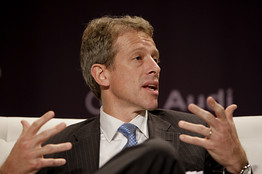
Notes From the Bloomberg Markets 50 Summit (Dalio, Ross, Block, Gensler, Tilson…)

Posted: 24 Sep 2011 08:00 AM PDT

From Andrew Horowitz of the (The Disciplined Investor:

~~~

Last week I attended the Bloomberg Markets 50 Summit in New York. The setting for the event was the transformed Great Hall of the Community House at St. Bartholomew's Church. The room was full of "jackets and ties" from all of the major brokerages, hedge funds and others involved in the fine art of investing.

The Bloomberg Staff were more than accommodating, friendly and informed. Everything was on a tight schedule as the event was being televised, so timing was to the second for the start at 9:55am. First a few words from Dan Doctoroff, president and CEO of Bloomberg to start off the morning and then he introduced the moderator and  first panel of speakers.

The even was structured as a panel discussion, where the various speakers were comfortably seated on a lush white couches. Each panel had a topic and the moderators would ask for their insights on a specific topic. Overall the day was full of excellent and topical commentary and opinion focused on items that ranged from the European Crisis to Hedge Funds.

I was able to get some one-on-one time with Carson Block of Muddy Waters to discuss some of his recent findings in China. Nassim Taleb, famed author of Black Swans was not so kind and only could spend a minute or two. Stephen Roach, who just about tells you that he is always right, spared some time to talk with me about the rampant food inflation in Asia. I congratulated the John Chambers, the Managing Director and Chairman of Standard & Poor's Global Sovereign Rating Committee for the work they are now doing in keeping the world's government's honest. We spoke about the continuing problems and specifically addressed the outlook for France. I asked about the recent AAA rating and what is the outlook. Of course he could not provide specifics, but mentioned that everything is up for review and nothing is permanent. I got the feeling that there is more to this story…

After the formal discussion/panel with Gary Gensler, Chairman of the Commodity Futures Trading Commission, I was able to have a few moments to ask him about the oversight of the CME. In particular, I questioned him about the recent plunge in Gold and Silver prices for no apparent reason, when later that same day a margin hike was announced. Was this leaked and is the CFTC looking at these? He replied that he was unfamiliar with the specific situation that I was referring to (was he kidding I thought?) but that they are "more interested" with leaks of government data prior to the official release. Take a listen to the actual recording of that conversation – HERE.

As for an overview of the day, it was interesting to see that there was a high level of disapproval of what the White House and Congress has been up to. That makes sense as this was a group of business and investment pros and they are in the cross-hairs of the government's ambitious business-unfriendly programs.There was also a rather palpable negativity about the U.S. equity markets due to the current financial crisis unfolding in Europe. While there were a few panelists that had some upbeat comments, overall there was a lack of bullishness that I had expected from this group.

What follow are the notes that I took during the day. These are in no way a complete transcript of the panel discussions, but provide highlights of what I believed were the important points.

9:00am – 9:40am -Bernanke's Balancing Act

Bruce Kasdan

Bernanke may not have much that he can do and that getting the committee to move will be a process. The next meeting with surely give us TWIST and then SHOUT, which is a more vocal communication. The FED is on the move it has a lot of problems in the economy it is dealing with. Expect more, not less in the future

Don Brownstein

The economy is clear. What should be done… Fed needs to be accommodative, but perhaps temporize too much, The big problem is that the transmission mechanism, is dysfunctional. That is typical after this kind of banking crisis. Better to get something that gets under the car and fixed the transmission The most evident is the need to get the banks lending. Region banks have not been as easy going as they would like to be. Maybe the foot soldiers should be listening to the Generals more closely. Somehow we need to get the banks to lend

Glen Hubbard: Fiscal or?  Bernanke policies are limited. It is a fiscal need at this point. Investment has been slowed down due to regulations, no housing boom and the markets. there is a clear need to have a fiscal policy that allows for the benefit to

Bob Doll

When asked; Is Fed trying to boost stocks? Mr. Doll replied that Fed is trying to install confidence. We need to get out of this confidence bear that we are in That is why in Jackson Hole he tried to extend the confidence by putting in a long term interest rate assumption so that some of the questions are cleared up.

General discussion about whether it is fiscal or monetary policy, generally all see that that there is a combined effort and that interest rates have low enough at this point. We are in a time that there is a slippery slope if we hope that Congress comes in and does what they have to. Communications tools need to be used and can me quite powerful as Congress and the Administration is impotent. All appear to agree that we are in need of stimulus and help.

Perhaps the biggest issue is the lack of leadership and the inability for them to lead. The most concerning is that there is also a crisis of confidence that started and is continuing. It is the combination of the lack of leadership as well as the concern that the FED is not doing all it can (?really).  The things that are being down are not helping. There is a general agreement that the plans and other stimulus measures have not done anything and are not going to do much in its current forms. If nothing is done on the fiscal side, there will be a drag of about 2% of GDP.

Demand is weak as there is no confidence but also because there is not enough stimulus on a short term basis. There are things that can be done, but are not. The overall political situation at this time is at best, un-encouraging.

9:40am – 10:20am – Euro Breakup or The United States of Europe

David Blanchflower

Discussion about the the coordinated action and that is the coordinated action is the news This is perhaps why Juergen Stark resigned last week. This is a really big deal. It also calls into question of depth of the problem. In other words, is the situation so deep that there needed to be a coordinated action.  This is clearly a liquidity problem.

Austerity is supported by governments but the evidence is that Austerity has failed as confidence is collapsed, growth has failed and there is discontent. Riots and a great deal of  increased unemployment has shows that there has been the wrong path followed.

Is there a way to have an orderly default of a sovereign nation? If Greece can leave the Euro quickly is unlikely. There are basis problems as little as the inability for Greece to transact. There will be major lawsuits etc. Leaving the Euro will be unlikely for Greece in the short term. Default is more likely and that may need to be done.

Dino Koss

When you have banks that are unable to get funds and in particular US dollars that is a problem. Banks have been seeing a liquidity problem and the amount f swap lines between the US and Europe and therefore it is already available. For right now, this was a necessary liquidity problem, though it is not a final solution. The action today was a short term fix to somewhat recapitalize the banks, for a period. Perhaps months. There needs to be another mechanism to bring these banks up to the Basel standards.

Annalisa Piazza

What needs to happen next? Has the ECB overstepped it bounds.

The ECB is going to have to do something and the move today was helping the markets short term, and in the end they may look to put together treaties. In the near future they need to cut rates to help confidence. In the next few months the ECB etc will need to buy Spanish bonds as well as other over the next couple of years. The Euro is under pressure but no one can afford a breakup of the Euro. Any country that will leave would be hurt terribly. Asia could not afford to have a breakup of the Euro or the EuroZone. This is a long-term project to save the area and this will take years.

There is no growth in EuroZone and the fiscal austerity needs to be done in individual countries an then the stimulus for area can

John R. Taylor

This does not get at any of the major problems underlying the situation. Just yesterday there was a few of the banks that could not get funding. So the was more a requirement.

With the recent coordinated action in Europe, what to do? STAY AWAY. This is a horrifically poisonous environment. If your strategies have to be in Europe, it is difficult as we really have not grappled with the true solution. They cannot create growth if there is austerity and no growth.  The Swiss will be able to do well with the caveat that the Swiss believe that Europe will solve their problems, but that is unlikely.

10:20am – 10:40am  – A Conversion with Ray Dalio

Ray Dalio

If it was not unexpected that we saw this last crisis, what is next? The biggest problems is that we are not having a conversation at the highest level that discusses the machine. Even though that the we make decisions, we need to know how the economic machine works.  We need to have a quality conversation about how the economic and political machines work and then we can create better decisions.

Even though there will be choices made, even after choices are made, they may not be the best for everyone. For example lets imagine that you earn $100,000 per year and have no debt. You can go to a bank and get $10,000 loan. That is okay and you can spend and then if you do it over and over again and then there will be a time that you can no longer pay the debt service. Then you can lower interest rates and when there is no more room there… problems.

Credit can be created in countries and the same cycle as above will persist. How much of the money that is being spent by ECB to do a restructuring and other measures to fix things. One of the most important things now is to understand what is going on and make some important plans, rather than waking up every day to a new surprise.

On printing money: It is quite a handy thing to have. If you are a creditor with a linked policy then you have problems in that there are extremes that are created. For example Greece is a creditor and they cannot adjust and they are their economy is going to crash, if on the other hand you have those that are linked and needs to print then you have a bubble like China.

What is working for Bridgewater? Dalio says the he writes the daily so that he knows that he knows what he is doing wrong. If you diversify and don't rely on only one things to make your year, but many ideas go into the  Ray Dalio code and his template for the economy is available to download HERE. (pdf).

10:40am – 11:15am  – The Next Hot Hedge Fund Strategy

Elana Ambrosiadou

There have been quite a high degree of rotation and changes in the area of trading. This year has been the fastest change from asset classes and rotation than ever seen. Had to develop and adapt to keep up with the fast moving. They needed to bring on more team members (50+) in the last year to help with development and tweaking.

Carrrie McCabe

The whole world is changing rapidly and the volatility and the long-only is an old tired idea.. The best way to diversify is active management, hedge funds.

James Metcher

Has a very dire view of the world. Since the end of the 2nd world war, things have shifted from one extent to another. We do not make things, we buy them. We are intervening in a way that is negative and if you look at things going on: Currency debasement, soverign risk, devloped markets not rish and powerful, we do not manufacture, Japan's demographic is troubling, fractious Congress, housing prices still falling, FED flooded money and money did not get into the wrong place. This thesis has pushed him to buy some gold, but still diversified.

Best trade idea this year: Currencies (not dollar) trade.  Put spreads, since we are in a bear market, playing the short side as a bias.

Whitney Tilson

It has been a rough year for long-short and in particular for T2Partners. He said it is one of the most difficult times (2011 in particular) years for his style and he has been told by others that do the same things as they do. He is looking for companies with good fundamentals that have dividends. The high degree of correlation of stocks and markets it is causing problems for stock pickers.
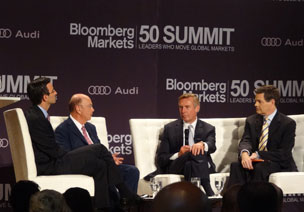

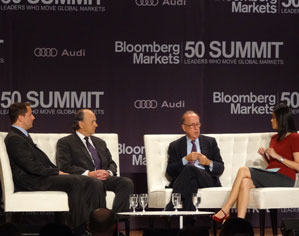
Tilson looks to go against the crowd and this year he has been early, way too early. It is crazy to be buying treasuries for 2 to 3 percent when high quality stocks can yield close to the same thing.

Best investment over the past year: NONE. Not much working this year. Last year, four positions/trades drove 15-20% of returns. Biggest holding now is Berkshire Hathaway.

11:15am – 11:35 am – A Conversation with Gary Gensler

When are regulations going to be written? 3 years since the crisis, 15 months from the Dodd-Frank act. This summer they finished proposals and received 25,000 comments from the public, buy about a dozen of the regulations have been finalized. They are not trying to do any of this against a clock, but they understand that they need to bring up transparency in markets and make the SWAP markets more transparent.

Regarding the Dodd-Frank law too cumbersome? Gensler, says that he believes that related to derivatives, is working. The rule writing process is open, we are a big country and we are a democracy. Therefore CFTC is listening and the tradeoff is is the time that it is taking longer. By and large this marketplace is unregulated.

Gensler has had about 1,000 meetings and they are posted on site. Large investors have an active desire to get to discuss issues with CFTC. It is a good part of the process to get all thoughts out in the open in order to put together a good package of regulation.

The new rules will shift from big firms to investors and from sell-side to buy-side?

1:50pm – 2:40pm – Austerity and Other Growth Obstacles

Peter Orzag

There is a structural problem right now. The hard slog of economic activity, fiscal problems that are not sustainable. Backstop rules, commissions that cn put on policy that Congress can overrule as well as stabilizes.

We are in for a period of years for a hard slough as it was a big slowdown.  If we are in a wold that has an "L" shape recovery , there needs to be a ball thrown long at housing and ignoring the housing situation should be done at own peril. While the idea of increasing taxes on the hogher earners, the problem is so large that a rise in taxes may be needed across the board.

In terms of austerity, it is not wise to discuss austerity without employment and visa-versa.

Here is an idea: Any deficit cutting measure should take 50% vote and maybe deficit increase would require 70% vote.

There may be something to privatizing some of the government agencies, as an example the FAA. They are terrible at decision making and moving to outside of government will allow for a better process etc.

In order to save the banks in EuroZone, the need for a much bigger form of TARP is what is needed. Perhaps a 3X the EFSF is needed. This would have Germany putting in a disproportional amount of money and France would need to do so, which would lead to a potential downgrade of France.

Top Priority: Direct jobs perhaps something that was done during the depression as I am very concerned that tere is a new generation that may not have jobs and that are discouraged as there is not much for them in the future.

Wilbur Ross

Somehow there is a problem as government is working against business and has been creating an environment against some. If we continue on this way, there could be a social warfare. The idea of subsidizing borrowers is really a bad idea. There should be affordability.

While it is nice to talk about deficit cutting, it has been done in the past and look where we are again. There needs to be a more permanent solution.

Ireland is one area that he believes may have some of the solutions as they are cutting and keeping some growth. He is invested in the Bank of Ireland.

People in Washington don't think more than 10 minutes ahead. With regard to the debt ceiling debate, there was a difficult time and there was some good that came out of it as the politicians may have had a wake up call.

Top Priority: Fix budget, accept the fact that there is going to be a recession, fix the deficit. Instead of renovating schools, we should work on what is being taught. The dumbing down of the American population is one of the biggest issues as we will not have people that can do work and will have to bring in outside employees from other countries.

Ralph Schlosstein

Our country needs to consider getting more globally competitive. More money should be spent on R&D and educations not on transfer payments. Whatever is done , we need to keep our eye on the debt and other structural problems. With a high unemployment rate there is a tremendous impetus for the politicians to do something. Obviously.

The laws that have been put in place after those companies that put together those bad loans, have made it very difficult .

There is a real lack of clarity about the current economic situation and adding that to confidence we see why there is hesitancy for lenders and people – both who are pulling back from risk right now, creating a dampening affect on growth.

We need stimulus or at least some form of economic support right now, There is a general morass and lack of any confidence in any of the measures and government approaches.

The timing was bad for the GOP to take up its hard line during the debt ceiling debate.

3:00pm – 3:40pm – Can China Hurt You?

Carson Block

My own experience of China is that the idea of the Chinese consumer is overblown. Many large and high end retailers show good sales, but we are seeing this form a narrow amount of people in the upper class.

Micro analysis of macro issues Several years ago, came to realize that many economists are being used and China uses government statistics. Collection and dissemination is difficult to gather at best. Like the sub-prime, when some of the guys that got this right met and learned about all of the sub-prime business and being in China and the region might well be something that is a beneficial.

Sino-Forest is the 5th fraud that we have exposed. There is systemic problems all around, and that is due to the basic structure of the game. Essentially the China markets are our capital markets on steroids.

Muddy Waters came to be known due to the internet. Five years from now we will have much better research and that would be outside the investment banks, The internet is enabling the opportunity to get more info etc…

One thing that is under-appreciated is that the real threat to social stability is the farmers. The governments real concern is the well educated an the financially secure as they have knowledge of how the system works.



Stephen Roach

The trends in China are not perfect, but taking info that are derived from a a fundamental view on a few stocks(Block) and trying to extrapolate to economic is not worthwhile. But China is very focused on the infrastructure.

Integrity of data, for those of that do macro, to be able to triangulate to check it against other areas. When you look at China, Korea, Taiwan and around Asia, you can easily see that China has become the major trading partner versus the U.S. over the past few years. China is not a fiction that was created by a bunch of imaginary writer, they are not perfect, but they have created a very powerful economic models that is a fluid and organic process.

Roach asks Carson about the potential scope of the problem. Is it at the level of what was going on with the likes of Enron etc? Carson answered that the situation is different in that it is a developing country and  there is a different view of money and wealth. Somehow the developed countries have been enabling as we are desirous of investing in China as it is "China".

Wage inflation is occurring in China is from a very low base. The average level of manufacturing wages today is about 5-6% of what is being paid today in the U.S. For the most part it has the same extreme as compared to other developing nations.

James Rickards

The fear in the eyes of China is the fear of the Treasury and how they are going to cut the U.S. dollar in half over the next few years. The nominal value of China's money that are held in U.S. bonds is essentially eventually going to be a $1.5 trillion transfer of money from China to the U.S.

Been very critical of the China real estate market, there are discussions that there are 20% down on homes and that it is properly lent, but the facts seem to be much different. Money that is being lent is actually from the shadow banking system and there re many houses that are owned are vacant. There are definitive problems in the area. (Steven Roach disagreed and said that it is micro analysis that does not make the clear macro story. Carson agreed with James)

The one child per rule has a odd skew on the population. Due to this there is some social problems that have been created and some of these are due to adverse selection. The adverse selection leads to bad behavior and worse outcomes. The Government has some good controls on social measures such as firing squads and other types that will may be able to corral the social behaviors.

4:20pm – 5:00pm – Investing in the Arab Spring

Angus Blair

There was a major desire to get back basic social request. Just after the end of the revolt, there was a reluctance for anyone to take bribes, but soon after there was the same old thing again.

Ian Brenner

It has become horribly clear that there is something uncompetitive of the economies of Tunisia and Egypt. Most of the young people did not have th ability to get anywhere. You have to wonder in Egypt if the military will ever give up control. But, even so there is nothing tat I say that means that there will not be investment opportunities, but….

We are going to see that these NEMA countries are going to have to go to the international countries to help with build out and expansion, Therefore there will be little worry that there will be contracts that will be ripped up or just cancelled.

Edmund Phelps

When we get to Egypt, the first point is that you have to rebuild investor confidence. That means that contracts have to be respected. Elections have to do well so that tourism will be restarted. There will probably be a weak coalition government that will e backed by the military, but that all needs to happen as there is a major amount of investor fear. This needs to get improved over the next few months.

It was significant that the interim government turned down the $20 billion from international agencies to build infrastructure. It is the feeling that the past money borrowed were not good investments. There was a great deal of pain in paying bak the money in the past.

There needs to be more than just infrastructure. It needs to be small firms in tech or otherwise that makes the growth possible.

5:00pm – 5:40pm – The Next Black Swans

Nassim Taleb

The system has consumer between $2-3 trillion of compensation over the past 5 years. The great bank robbery. There are rules that we had for centuries, the problem is that the modern version of capitalism that we have (of which Adam Smith did not like) does not have consequences.

We are not made for information, we are not made for randomness, we are not cut for this world. 2 options, heuristics and try to play with them or 2) change the world. Either the world will self-correct or destroy itself. All we need is common law (heuristic). If we want to simplify the system, look at what Swede did in 1991, they cleaned house in 90 days. Then reset the system.

Thinking requires effort and a high expenditure of energy. Heuristics – we don't know that we are using heuristics and have the illusion that we are thinking when we are not thinking.

Laszlo Birinyi

Greatest concern is the systemic risk in the market. It is getting worse. Money flows was used for a long time and there were predictable in that you could see how the situation was evolving. But, now with all of the newer trading etc, has obscured all.

We filter out extreme stories. The press has not done a good job of providing the news and there are so many sites where info is available.

Daniel Kahneman

Thinking fast and slow (new book) We think that we do things for reason,  what is happening is profoundly counter-intuitive. We continually underestimate the extremes. People believe they can predict the future as they have seen some pattern in the past.  Comments like we are blind to our blindness (we perceive the world in a much more simpler sense than it really is)

~~~

Source: My Notes From the Bloomberg Markets 50 Summit (Dalio, Ross, Block, Gensler, Tilson…) (The Disciplined Investor)

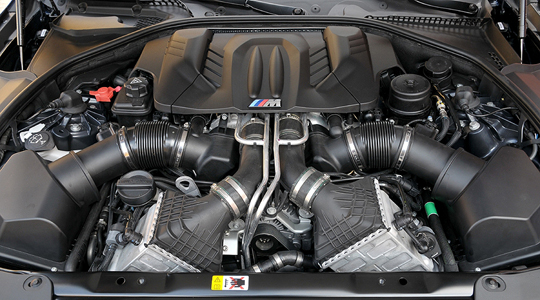
BMW M5

Posted: 24 Sep 2011 06:00 AM PDT

b6 b5 b4 b3 b2 b1 b8 b7

Source:
Driven: BMW M5
Classic Driver, September 23, 2011

The King Report: Parsing the Fed

Posted: 24 Sep 2011 05:00 AM PDT

As expected the Fed announced that it would extend the maturity on its portfolio. It will buy $400B of US debt with maturities of 6 years to 30 years; and it will sell $400B of 3 years or less US debt.

32% of the Fed debt purchases will be 6-8 years; 32% will be 8-10 years; 4% will be 10-20 years; and 29% will be 20-30 years. The Fed essentially targeted and will monetize the expected amount of US Treasury new debt issuance in coming quarters.

The most important point of the FOMC Communiqué is the Fed greatly lowered its current economic assessment and now asserts that "there are significant downside risks to the economic outlook."

The Fed said "economic growth so far this year has been considerably slower than the committee expected. Indicators suggest a deterioration in overall labor market conditions in recent months, and the unemployment rate has moved up. Household spending has flattened out…"

The second most important point about the FOMC is: the Fed has spent one of its few remaining symbolic bullets. Only QE 3.0 [any type of monetization] and lowering the IOER remain.

All the Fed did was a partial appeasement of market expectations. There was no reduction in IOER.

The extension of the Fed's portfolio is a craven submission to the demands of a few Street pundits to do something, anything. It will accomplish nothing good for US consumers or the US economy.

As we have been screaming for the past several weeks, the Fed did NOT do a reenactment of Operation Twist, which stated purposes were to drive short rates higher and long rates lower.

The odds of QE 3.0 diminish as the election approaches; so the Fed could be out of the market unless a big bank bursts or a major systemic problem appears.

Stocks tanked after several minutes of jerking around because the extension of the Fed's holding is innocuous and even though the Fed sees 'significant' economic risks there is little hope of any new Fed action unless something really bad occurs. The prop that kept sellers constrained and some traders and investors in stocks, the possibility that the Fed will 'do something', has been removed.

Furthermore, trapped stock, commodity and economic bulls that unfathomably thought QE 3.0 would be enacted due to the extension of the scheduled September FOMC meeting to two days, to allow for a fuller discussion of policies, don't have that canard to use anymore. And they were dead wrong anyway.

Bill Gross called for the Fed do to Operation Twist in early June, as QE 2.0 was about to end. Then parrot-like pundits and commentators joined the chorus and called for Twist. The Fed appeased them.

One wonders if Gross or some pundit calls for the Fed to start practicing voodoo and other Street pundits parrot that call, will the Fed announce that it will start practicing voodoo to satisfy Street expectations.

The DJ Transportation Average cratered 5.27% on Wednesday. Land transportation companies led the
way. This is another indication of economic duress.

Weekly and monthly technical indicators suggest stocks are in bear market mode.


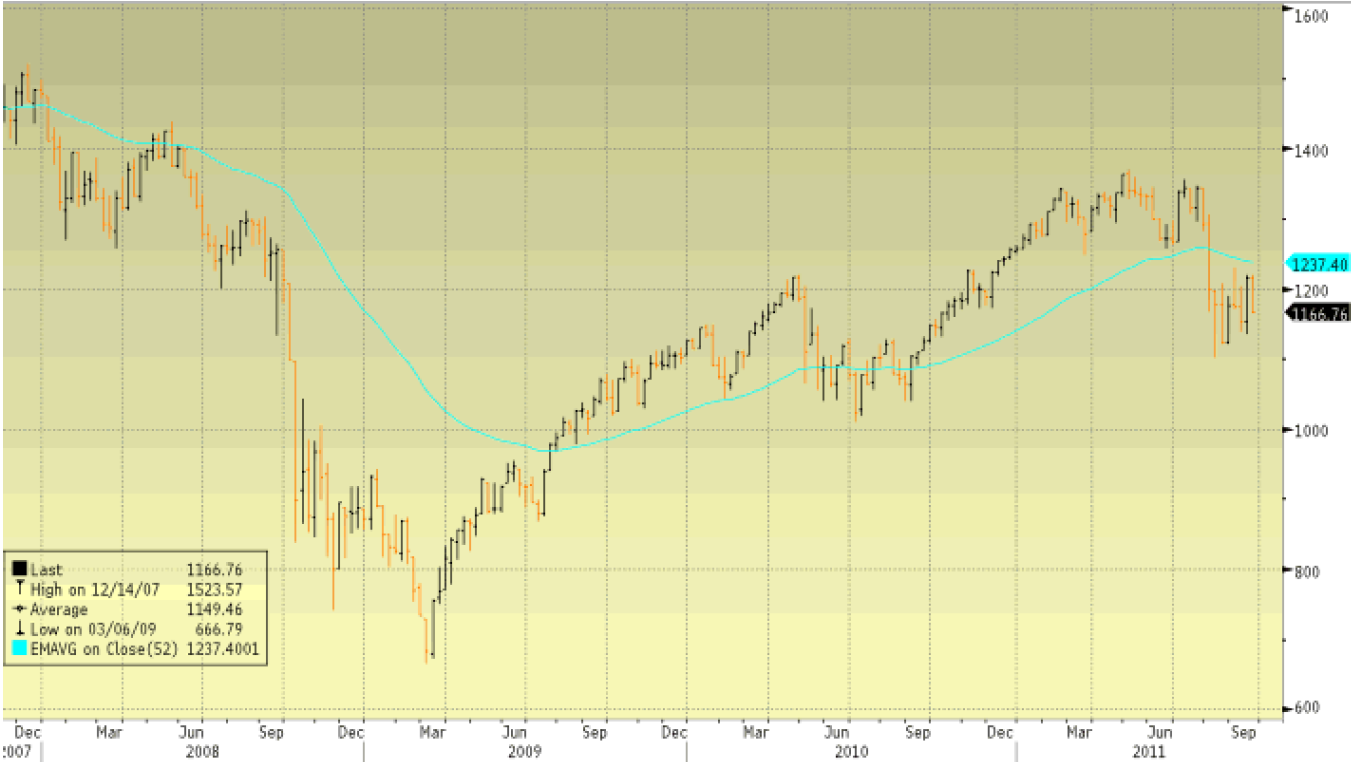
S&P 500 Index, weekly – below downward sloping 52-week moving average for six weeks

S&P 500 Index, monthly – MACD on rare monthly sell signal, last triggered in December 2007

Please note the very ominous descending triple top formation, on the highly significant monthly basis.

"The race is not always to the swift nor the battle to the strong, but that’s the way to bet." Damon Runyon

The Dollar Index formed a similar pattern that marked a significant top in 2001-2002.


Dollar Index, weekly – descending triple top marked a significant, if not generational, dollar top

Analysis: Fed’s twist moves hurts company pension plans

Lower rates mean the future benefits have a higher present value, ballooning the defined benefit funds’ liabilities. Pension consultants estimate a 1.0 percent drop in rates increases liabilities by 10 percent to 15 percent.
(Reuters)

The bottom line

Stocks are in a bear market; the global economy is teetering; Europe is imploding; the global banking system is dysfunctional; most sovereign debt no longer is 'risk free'; nations have spent trillions trying to prevent the collapse of socialism and crony capitalism; central banks have monetized trillions trying to paper over collapsing living standards, unaffordable government spending and zombie banks.

So pray tell, what will possibly spark an economic rebound? Lower rates? Government deficit spending? Consumers taking on more debt? Trillions have been spent on a miserable economic dead cat bounce.

The only solution is a massive purge and then the restructuring of government, banks and consumer balance sheets and spending habits.

The facts are clear. The [perceived] painless fixes are exhausted. The trends are clear. Why should one bet any other way? We're going with the swift and strong until proven otherwise.

~~~

Source:
The King Report,
M. Ramsey King Securities, Inc.
September 22, 2011

Tangled Up In Blue

Posted: 24 Sep 2011 03:49 AM PDT

At dinner last night, our friend Giselle mentioned she was starting to get into Dylan. When I said Tangled Up In Blue was one of my favorite songs, she stunned us by saying she hadn’t heard it yet.

Astonishing!

Its off of Blood on the Tracks (Wikipedia discussion, CD/MP3 at Amazon)

Here is Dylan’s live acoustic version, and a few surprising covers :

~~~

Bob Dylan

~~~

Jerry Garcia Band

More videos, lyrics after the jump


~~~

KT Tunstall

~~~

The Indigo Girls

~~~

Early one mornin’ the sun was shinin’,
I was layin’ in bed
Wond’rin’ if she’d changed at all
If her hair was still red.
Her folks they said our lives together
Sure was gonna be rough
They never did like mama’s homemade dress
Papa’s bankbook wasn’t big enough.
And I was standin’ on the side of the road
Rain fallin’ on my shoes
Heading out for the east coast
Lord knows I’ve paid some dues gettin’ through,
Tangled up in blue.

She was married when we first met
Soon to be divorced
I helped her out of a jam, I guess,
But I used a little too much force.
We drove that car as far as we could
Abandoned it out west
Split up on a dark sad night
Both agreeing it was best.
She turned around to look at me
As I was walkin’ away
I heard her say over my shoulder,
We’ll meet again someday on the avenue,
Tangled up in blue.

I had a job in the great north woods
Working as a cook for a spell
But I never did like it all that much
And one day the ax just fell.
So I drifted down to new orleans
Where I happened to be employed
Workin’ for a while on a fishin’ boat
Right outside of delacroix.
But all the while I was alone
The past was close behind,
I seen a lot of women
But she never escaped my mind, and I just grew
Tangled up in blue.

She was workin’ in a topless place
And I stopped in for a beer,
I just kept lookin’ at the side of her face
In the spotlight so clear.
And later on as the crowd thinned out
I’s just about to do the same,
She was standing there in back of my chair
Said to me, don’t I know your name?
I muttered somethin’ underneath my breath,
She studied the lines on my face.
I must admit I felt a little uneasy
When she bent down to tie the laces of my shoe,
Tangled up in blue.

She lit a burner on the stove and offered me a pipe
I thought you’d never say hello, she said
You look like the silent type.
Then she opened up a book of poems
And handed it to me
Written by an italian poet
From the thirteenth century.
And every one of them words rang true
And glowed like burnin’ coal
Pourin’ off of every page
Like it was written in my soul from me to you,
Tangled up in blue.

I lived with them on montague street
In a basement down the stairs,
There was music in the cafes at night
And revolution in the air.
Then he started into dealing with slaves
And something inside of him died.
She had to sell everything she owned
And froze up inside.
And when finally the bottom fell out
I became withdrawn,
The only thing I knew how to do
Was to keep on keepin’ on like a bird that flew,
Tangled up in blue.

So now I’m goin’ back again,
I got to get to her somehow.
All the people we used to know
They’re an illusion to me now.
Some are mathematicians
Some are carpenter’s wives.
Don’t know how it all got started,
I don’t know what they’re doin’ with their lives.
But me, I’m still on the road
Headin’ for another joint
We always did feel the same,
We just saw it from a different point of view,
Tangled up in blue.back to top

A Word About Precious Metals Margins

Posted: 24 Sep 2011 03:21 AM PDT

There has been a bit of misinformation and faux outrage about the CME margin requirements for Gold, Silver, and other precious metals, as well as Copper.

I do not think people understand what this means, and why the CME is doing this.

To begin with, commodities are purchased with futures contracts, which offer enormous leverage to speculators. As of this Monday, the minimum cash deposit for trading gold futures will be $11,475 per 100-ounce contract — at $1700 per ounce, that is a $170,000 position. The leverage is nearly 15 to 1. Stocks and bonds, for comparison, trade at 2 to 1 maximum leverage using firm margin. At 15-1, a less than 7% move against you wipes out your capital entirely.

Put it in other terms, if you have $100,000 to speculate with, you can purchase $200,000 worth of stock, or using the same $100k, you can buy $1,481,481.48 in gold futures.

Back in Q1 2009, when Gold was $1000 per ounce, you only needed $5,807.70 to buy 100 ozs of gold in futures (worth $100,000); That’s a little more than 17 to 1 leverage. At those levels, a less than 6% move against you wipes out your capital.

Hence, as Gold has been purchased by more speculators who are highly leveraged, the exchange is trying to ensure that these gold traders have sufficient posted cash as a margin of safety in case of any significant move against them.

Given the vertical spike in Gold prices the past few months, this is merely prudent risk management. Call it managing margin and counter-party risk — something we haven’t seen in other non exchange traded items like CDS or CDOs. Had they been exchange traded with margin rules, perhaps the 2008 collapse would not have been as significant as it was.

~~~

The recent history of CME margin changes for Comex 100 Gold Futures is after the jump.

^^^^^^^^^^^^^^^^^^^^^^^^^^^^^^^^^^^^^^^^^^^^^^^^^^^^^^^^^> Following are the percentage changes in the Comex 100 Gold Futures <0#GC:> initial and maintenance margins since 2009  (in U.S. dollars per contract)  EFFECTIVE DATE   MARGINS FOR      INITIAL    MAINTENANCE   PCTCHANGE Sep 26, 2011     Spec...Tier 1   11,475.00   8,500.00      +21.4 Aug 25, 2011     Spec...Tier 1    9,450.00   7,000.00      +27.3 Aug 11, 2011     Spec...Tier 1    7,425.00   5,500.00      +22.2 Jun 20, 2011     Spec...Tier 1    6,075.00   4,500.00      -10.0 Jan 21, 2011     Spec...Tier 1    6,751.35   5,001.00      +11.1 Nov 16, 2010     Spec...Tier 1    6,075.00   4,500.00      +05.9 Apr 30, 2010     Spec...Tier 1    5,738.85   4,251.00      -14.9 Mar 02, 2010     Spec...Tier 1    6,747.30   4,998.00       -- Feb 12, 2010     Spec...          6,747.30   4,998.00      +24.9 Dec 15, 2009     Spec...          5,402.70   4,002.00      +20.1 Aug 21, 2009     Spec...          4,499.55   3,333.00      -16.7 Jan 22, 2009     Spec...          5,398.65   3,999.00      -07.0 Jan 08, 2009     Spec...          5,807.70   4,302.00       -- (Reporting by Soma Das in Bangalore; Editing by Bob Burgdorfer)  Source: Reuters
.

0 comments:

Post a Comment

previous home Next

{8} chatroll


{9} AdBrite FOOTER

{8} Nice Blogs (Adgetize)