When students covered their eyes with their clothing, police forced open their mouths and pepper-sprayed down their throats. Several of these students were hospitalized. Others are seriously injured. One of them, forty-five minutes after being pepper-sprayed down his throat, was still coughing up blood.
Let's stipulate that there are legitimate questions of how to balance the rights of peaceful protest against other people's rights to go about their normal lives, and the rights of institutions to have some control over their property and public spaces. Without knowing the whole background, I'll even assume for purposes of argument that the UC Davis authorities had legitimate reason to clear protestors from an area of campus — and that if protestors wanted to stage a civil-disobedience resistance to that effort, they should have been prepared for the consequence of civil disobedience, which is arrest.
I can't see any legitimate basis for police action like what is shown here. Watch that first minute and think how we'd react if we saw it coming from some riot-control unit in China, or in Syria. The calm of the officer who walks up and in a leisurely way pepper-sprays unarmed and passive people right in the face? We'd think: this is what happens when authority is unaccountable and has lost any sense of human connection to a subject population. That's what I think here.
Less than two months ago, it seemed shocking when one NYPD officer cavalierly walked up to a group of female protestors and pepper-sprayed them in the eyes. The UC Davis pepper-sprayer doesn't slink away, as his NYPD counterpart did, but in every other way this is more coldly brutal. And by the way, when did we accept the idea that local police forces would always dress up in riot gear that used to be associated with storm troopers and dystopian sci-fi movies?
Richard Rhodes passes along these “ridiculously simple” trading rules, given to him by “a great trader some 15 years ago.”
Follow these rules, breaking them infrequently, and you will make money year in and year out.
The rules are simple. Sticking to them is what’s difficult.
“Old Rules…but Very Good Rules”
The first and most important rule is – in bull markets, one is supposed to be long. This may sound obvious, but how many of us have sold the first rally in every bull market, saying that the market has moved too far, too fast. I have before, and I suspect I’ll do it again at some point in the future. Thus, we’ve not enjoyed the profits that should have accrued to us for our initial bullish outlook, but have actually lost money while being short. In a bull market, one can only be long or on the sidelines. Remember, not having a position is a position.
Buy that which is showing strength – sell that which is showing weakness. The public continues to buy when prices have fallen. The professional buys because prices have rallied. This difference may not sound logical, but buying strength works. The rule of survival is not to “buy low, sell high”, but to “buy higher and sell higher”. Furthermore, when comparing various stocks within a group, buy only the strongest and sell the weakest.
When putting on a trade, enter it as if it has the potential to be the biggest trade of the year. Don’t enter a trade until it has been well thought out, a campaign has been devised for adding to the trade, and contingency plans set for exiting the trade.
On minor corrections against the major trend, add to trades. In bull markets, add to the trade on minor corrections back into support levels. In bear markets, add on corrections into resistance. Use the 33-50% corrections level of the previous movement or the proper moving average as a first point in which to add.
Be patient. If a trade is missed, wait for a correction to occur before putting the trade on.
Be patient. Once a trade is put on, allow it time to develop and give it time to create the profits you expected.
Be patient. The old adage that “you never go broke taking a profit” is maybe the most worthless piece of advice ever given. Taking small profits is the surest way to ultimate loss I can think of, for small profits are never allowed to develop into enormous profits. The real money in trading is made from the one, two or three large trades that develop each year. You must develop the ability to patiently stay with winning trades to allow them to develop into that sort of trade.
Be patient. Once a trade is put on, give it time to work; give it time to insulate itself from random noise; give it time for others to see the merit of what you saw earlier than they.
Be impatient. As always, small loses and quick losses are the best losses. It is not the loss of money that is important. Rather, it is the mental capital that is used up when you sit with a losing trade that is important.
Never, ever under any condition, add to a losing trade, or “average” into a position. If you are buying, then each new buy price must be higher than the previous buy price. If you are selling, then each new selling price must be lower. This rule is to be adhered to without question.
Do more of what is working for you, and less of what’s not. Each day, look at the various positions you are holding, and try to add to the trade that has the most profit while subtracting from that trade that is either unprofitable or is showing the smallest profit. This is the basis of the old adage, “let your profits run.”
Don’t trade until the technicals and the fundamentals both agree. This rule makes pure technicians cringe. I don’t care! I will not trade until I am sure that the simple technical rules I follow, and my fundamental analysis, are running in tandem. Then I can act with authority, and with certainty, and patiently sit tight.
When sharp losses in equity are experienced, take time off. Close all trades and stop trading for several days. The mind can play games with itself following sharp, quick losses. The urge “to get the money back” is extreme, and should not be given in to.
When trading well, trade somewhat larger. We all experience those incredible periods of time when all of our trades are profitable. When that happens, trade aggressively and trade larger. We must make our proverbial “hay” when the sun does shine.
When adding to a trade, add only 1/4 to 1/2 as much as currently held. That is, if you are holding 400 shares of a stock, at the next point at which to add, add no more than 100 or 200 shares. That moves the average price of your holdings less than half of the distance moved, thus allowing you to sit through 50% corrections without touching your average price.
Think like a guerrilla warrior. We wish to fight on the side of the market that is winning, not wasting our time and capital on futile efforts to gain fame by buying the lows or selling the highs of some market movement. Our duty is to earn profits by fighting alongside the winning forces. If neither side is winning, then we don’t need to fight at all.
Markets form their tops in violence; markets form their lows in quiet conditions.
The final 10% of the time of a bull run will usually encompass 50% or more of the price movement. Thus, the first 50% of the price movement will take 90% of the time and will require the most backing and filling and will be far more difficult to trade than the last 50%.
There is no “genius” in these rules. They are common sense and nothing else, but as Voltaire said, “Common sense is uncommon.” Trading is a common-sense business. When we trade contrary to common sense, we will lose. Perhaps not always, but enormously and eventually. Trade simply. Avoid complex methodologies concerning obscure technical systems and trade according to the major trends only.
According to the Supreme Court, money is now speech and corporations are now people. But when real people without money assemble to express their dissatisfaction with the political consequences of this, they're treated as public nuisances and evicted.
If you're an ordinary citizen, and you get caught on video dousing people with noxious gas like Bologna did, you get summarily locked up. But when you're an NYPD commanding officer…like Bologna was at the time of his attack, you get essentially a free pass.
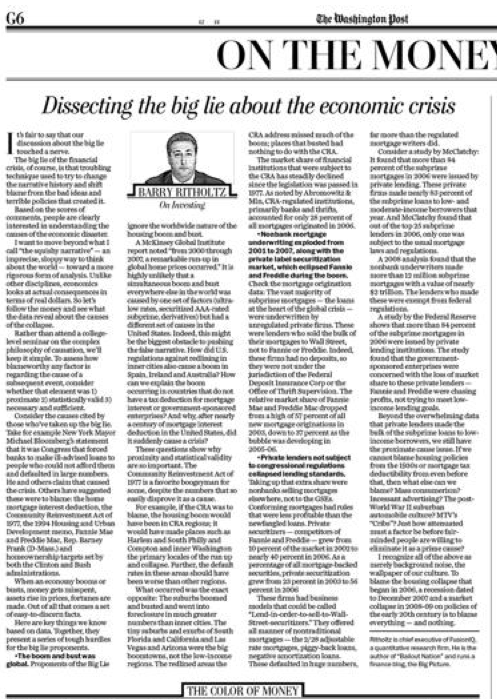
My Sunday Business Washington Post column is out. This morning, we look at part II of the Big Lie (Part I examined the actual factors that led to the crisis) in this part, we look at the data and factors that disprove the elements of the Big Lie.
“I want to move beyond what I call "the squishy narrative" — an imprecise, sloppy way to think about the world — toward a more rigorous form of analysis. Unlike other disciplines, economics looks at actual consequences in terms of real dollars. So let's follow the money and see what the data reveal about the causes of the collapse . . .
Consider the causes cited by those who've taken up the big lie. Consider New York Mayor Michael Bloomberg's statement that it was Congress that forced banks to make ill-advised loans to people who could not afford them and defaulted in large numbers. He and others claim that caused the crisis. Others have suggested these were to blame: the home mortgage interest deduction, the Community Reinvestment Act of 1977, the 1994 Housing and Urban Development memo, Fannie Mae and Freddie Mac, Rep. Barney Frank (D-Mass.) and homeownership targets set by both the Clinton and Bush administrations.”
No graphics this week — so I created a run of charts to illustrate the facts in the main article. > click for ginormous version of print edition
Some longer form reading to kick off your Sunday AM. Pour a cup of joe, grab your favorite chair & iPad, and have at it:
• PIMCO blows a kiss to Fed Chief: Ben Bernanke, The Decider (Pimco) • How Wall Street Occupied America (The Nation) see also Bloomberg’s Long War Against Protests (The Atlantic Cities) • This is your brain on Credit: Researchers Show Using Credit Card Induces Euphoria (Red Tape) • The American-Western European Values Gap (Pew Global) • These guys don’t screw around! Chinese Fund Managers Sentenced to Death after Cheating Investors out of $1 Billion USD (The China Money Report) • Millionaires ask Capitol Hill: Please tax me more! (Boston.com) • NPR, Ayn Rand, And The Zombies From Outer Space (Stonekettle Station) see also 100,000 'Atlas Shrugged' DVDs Recalled for Perfectly Hilarious Reason (Gawker) • The Palinization of the GOP (Washington Post) • Nook's Specs Are Exaggerated, Again (NYT) see also Kindle Fire: An open letter to Jeff Bezos (The Register) • 2M nanorods crammed into cancer cell (Futurity)





0 comments:
Post a Comment