


The Big Picture |

- A Majority of Americans (Including Both OWS and the Tea Party) AGREE on the Most Important Issues … We Just Don’t Realize It
- Visualizing the Agency of the Future
- Mid-Week PM Reads
- Bond/Stock Relationship Echoing 2008?
- Chanos Says China Bank System `Extremely Fragile’
- Expanding Manhattan Into The Sea
- What Science Lovers Link to Most
- Slipping Toward Recession in Europe
- Extreme Money by Satyajit Das
- 10 Mid-Week Reads
| Posted: 23 Nov 2011 10:30 PM PST I have repeatedly demonstrated that – despite the false divide-and-conquer tactics of the mainstream parties and mainstream media – the overwhelming majority of Americans agree on the most important issues facing our country. See this. NO MORE BAILOUTS!As I've noted since 2008, Americans are united in their overwhelming disapproval for bailouts to the big banks. This has remained true right up to today. As Rassmussen found only last month (as summarized by KXLF news):
As the Washington Post's Greg Sargent notes, the recent proposal from lobbyists to the American Bankers Association recommending ways to co-opt the Occupy movement accurately stated:
(Except that it is the majority of Americans – not "extremists" on either side of the aisle – that share this anger). The "Tea Party" movement was centered on the protesting government bailouts of the giant banks, before it was hijacked by the mainstream Republican party, Sarah Palin, Neocons and others. See this, this, this, this and this. Ron Paul said last month at a GOP debate:
And one of the most common sayings of Occupy Wall Street protesters is:
END CRONY CAPITALISM!I noted last year:
PROSECUTE WALL STREET FRAUD!I pointed out a year ago:
Indeed, Rasmussen found last month:
Economists agree. END – OR AT LEAST REIN IN – THE FEDERAL RESERVE!As I pointed out last month, Americans are not happy with the Federal Reserve:
Economists agree. RESPECT THE CONSTITUTION AND OUR LIBERTY!As I noted in September, Americans want our freedom back:
END PERPETUAL WAR!Americans want to put a stop to perpetual warfare:
And a CBS News poll from November 11th found:
MAKE ELECTIONS FAIR!I noted last year that Americans want fair elections:
KEEP POISON OUT OF OUR FOOD AND WATER!I noted last year that Americans want safe food and water:
IF THE AMERICAN PEOPLE AGREE ON THESE CORE ISSUES, WHY AREN'T OUR DEMANDS BEING HEARD?If Americans from across the spectrum agree, why aren't these desires being implemented by our politicians? Because our politicians are bought and paid for … lock, stock and barrel. And the powers-that-be are good at using the age-old divide and conquer trick to keep us weak, divided and fighting at each others' throat … instead of for what we actually want. But ultimately, the main reason that we are impotent is that we don't realize that the overwhelming majority of Americans want the same things we do. Indeed, most Americans – conservatives and liberals – are fed up with both the mainstream Republican and Democratic parties. This is not surprising, given that neither party is addressing the core demands of the American people as a whole. Sure, liberals and conservatives will always disagree on some things. But if we realized how many core beliefs we share, we would unite to take our country back from those who disagree with fundamental American values. |
| Visualizing the Agency of the Future Posted: 23 Nov 2011 02:00 PM PST Visualizing the Agency of the Future View more presentations from JESS3 |
| Posted: 23 Nov 2011 01:30 PM PST Holiday travel train reading:
What are you reading? |
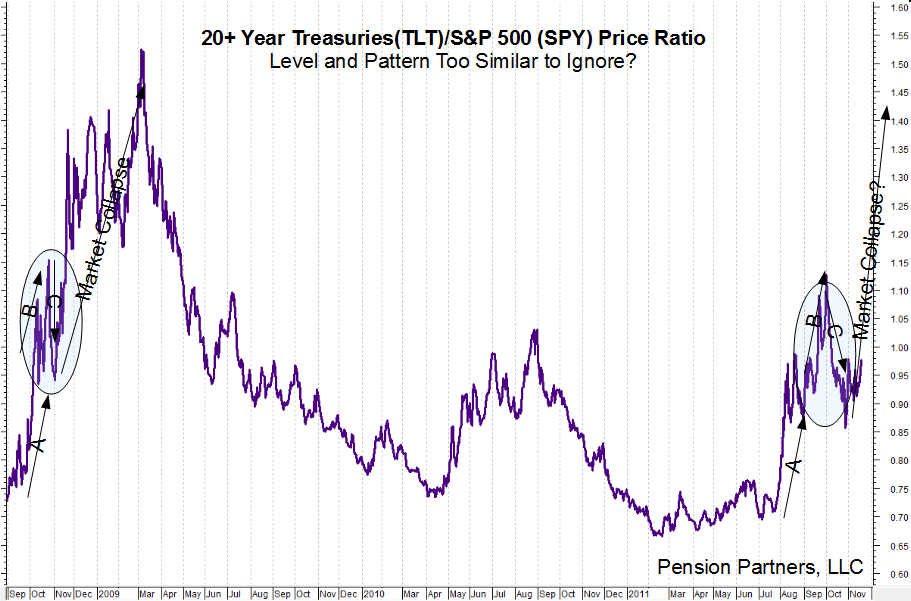
| Bond/Stock Relationship Echoing 2008? Posted: 23 Nov 2011 11:45 AM PST Michael A. Gayed, CFA is Chief Investment Strategist at Pension Partners LLC, where he structures portfolios. In 2007, he launched his own long/short hedge fund, using various trading strategies focused on taking advantage of stock market anomalies. Michael earned his B.S. from New York University, and is a CFA Charterholder. ~~~ One of the most glaring disconnects that continues to persist this year is the optimism of equities relative to the depressed bond market. I call the bond market depressed because yields on U.S. Treasuries are at levels that one should not see unless headed into a contractionary and potentially deflationary economic cycle. The reasoning behind such low yields is a function of slow growth in the U.S. and of course continued upheavel and concern over Europe. Despite the fact that the bond market is generally more right more often than the stock market, equities, as proxied by the S&P 500, have actually held up relatively well all year despite massive day to day swings. Rather than look at the bond and stock market in isolation, its important to look at their relationship to each other to see if there is a conscious or unconscious message investors are sending. To that end, take a look below at the price ratio of the 20+ Year Treasury Bond ETF (TLT) relative to the S&P 500 (SPY). As a reminder, a rising price ratio means the numerator/TLT is outperforming (up more/down less) the denominator/SPY.
When the trend of the price ratio is up, it means bonds are outperforming equities. This generally only happens in recessions/deflationary enviornments as fixed income becomes more valuable than equities. The opposite occurs in a downtrend (equities perform better than bonds when the enviornment favors growth/increased inflation). I have annotated the chart to stress that both the level and pattern of the price ratio is reminiscent of the latter part of 2008 post-Lehman as the credit seize up took hold of financial markets. Is the intermarket relationship of bonds/stocks foretelling a repeat of 2008 is imminent? Note that if the TLT/SPY ratio spikes as it did into the March 2009 low, it likely would be driven largely by a shrinking denominator (stock market declines) – suggesting that the bond market’s perceived paranoia about the future may indeed be correct. And because the stock market tends to act with a lag, we may be headed for a December to Remember… What do you think?
|
| Chanos Says China Bank System `Extremely Fragile’ Posted: 23 Nov 2011 11:25 AM PST Billionaire short seller Jim Chanos, founder of hedge fund Kynikos Associates Ltd., spoke to Bloomberg TV’s Betty Liu this morning about China’s banking system and outlook for the Chinese economy and real estate market. Excerpt transcript after jump “I think we probably came back a little bit more bearish….Our concerns about what we saw in Australia: an economy clearly tied to China has hitched its wagon to the tail of the tiger. In terms of the general complacency, what we heard over and over from investors and clients and potential clients is, ‘yes, yes, there are some excesses, but the government will figure out a way. That the government is this all-knowing, omniscient basic entity that will not prevent me from losing money.” Jim Chanos whether the Chinese government has money: “[The Chinese government] doesn’t [have money], and that’s the problem. The banking system in China is extremely fragile, and that’s one of the messages we wanted to get to people.” “In fact, because what happened the last two crises, in ’99 and ’04, when non-performing loans went crazy in China without even a recession, the Chinese banking system was not re-capitalized like ours was, it was papered over. Going into this credit expansion, Chinese banks are sitting on lots of bonds from the so-called asset management companies set up in 1999 and 2004, and they are keeping them on the books at par, at full value. In the case of Agricultural Bank of China, which we’re short, those restructuring receivables are equal to over 100% of their tangible book. The Chinese banking system is built on quicksand, and that’s the one thing a lot of people don’t realize. When they talk about the foreign reserves of $3 trillion, what everybody forgets is there’s liabilities against that.” “Everybody seems to think it is a free and clear open checkbook. It’s not. That is what we have been trying to tell people. Focus on the lending system over there, because everything occurs through the banking system.” On the Chinese economy: “Property prices and transactions are really beginning to decelerate. We saw that starting in August, that’s continued into November. Transactions are down 40% to 50% year over year in the tier 1 through 3 cities. Prices are down. In some cases, we’ve seen riots in sales offices, where people are amazed that prices could actually go down. There’s lots of indicators on the side. There’s a growing sense that the Chinese government will ease. We point out that credit this year will grow between 30% and 40% of Chinese GDP. If that's tight, I’d hate to see it ease.” On the scenario in which Chanos would cover his shorts in China: “At some point, we will cover our shorts. [The scenario would be] a system where the banking system would have to be recapitalized again, most likely. You would see a flood of RMB in the system, and a realization that the growth by fixed asset model has got to change. Mr. [Stephen] Roach and others are convinced that the Chinese customers will pick up the slack. And at some point, he and she will. But the transition is going to be the real tough part. And right now, the consumer continues to decline as a percent of the Chinese economy. That is, I think, flies right in the face of what most people think will happen.” |
| Expanding Manhattan Into The Sea Posted: 23 Nov 2011 10:30 AM PST NYT:
Source: |
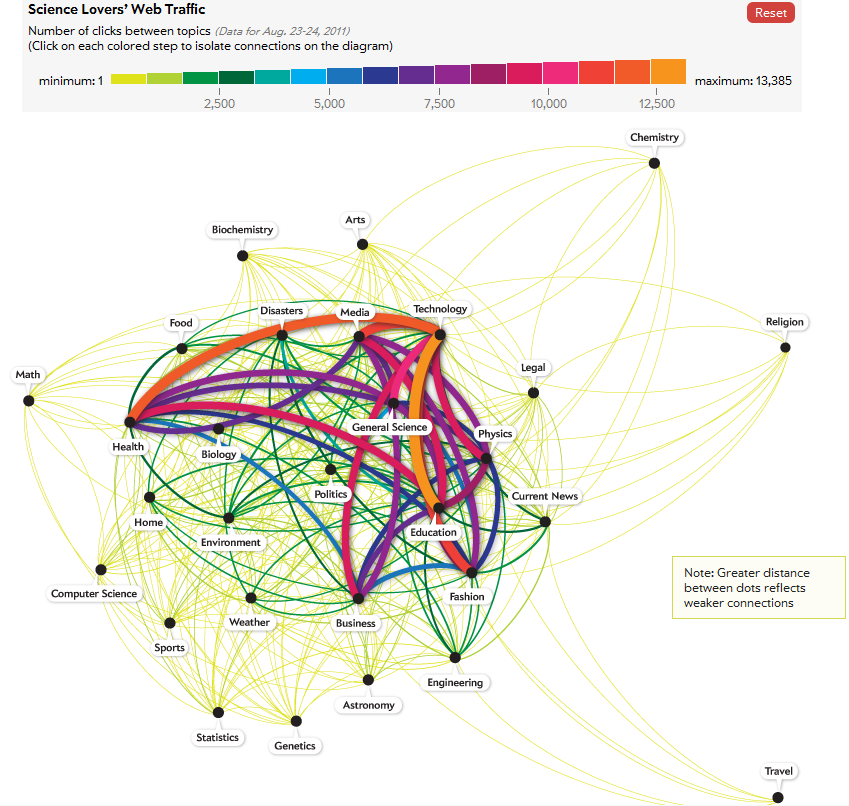
| What Science Lovers Link to Most Posted: 23 Nov 2011 09:30 AM PST Click for interactive chart:
Source: |
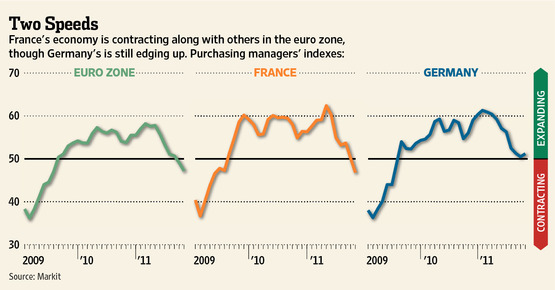
| Slipping Toward Recession in Europe Posted: 23 Nov 2011 09:15 AM PST
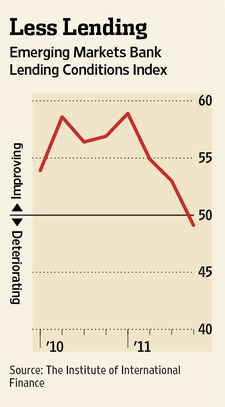
the Economy, and Financial Markets MacroTides.newsletter@gmail.com Investment letter – November 20, 2011 Happy Thanksgiving! Hope your Thanksgiving is spent with family and friends, with much to be thankful for. Slipping Toward Recession in Europe In our March 2007 letter, we noted that in the Federal Reserve's January 2007 survey of lending standards, more U.S. banks had increased their lending standards than at any time since 1991. This was a big deal since it meant that banks had effectively tightened monetary policy, even though the Federal Reserve was likely to keep monetary policy, and the Federal funds rate unchanged at 5.25%. We thought higher lending standards would gradually cause the economy to slow by the end of 2007. Any slowing in the economy would hurt employment and cause housing prices to fall more, which would make banks even more cautious. By the time the Federal Reserve lowered rates in response to the slowdown in the economy, banks would respond by increasing their lending standards further. We felt the reduction in the availability of credit would more than offset the stimulus from lower rates, leading to more slowing in the economy, and more declines in home values. We expected a classic vicious cycle of weakness begetting more weakness to develop. As we know, the decline in the value of mortgage paper, and the large dose of leverage on mortgage debt, led to a full blown liquidity crisis when Lehman Brothers failed in September 2008. We've reviewed these events since the trend in credit availability and liquidity in Europe, since the spring of 2010, is following the script that unfolded in the U.S. during 2007 and 2008. According to the European Central Bank's recent lending survey, banks throughout Europe increased lending standards in the third quarter, and given recent events, have likely increased them even more in the fourth quarter. This is going to have a negative impact on economic activity in the European Union for at least the next six to nine months, as the availability of credit is restrained. The decline in the value of mortgage debt on U.S. bank balance sheets in 2007 and 2008 resulted in an even deeper contraction in credit availability that pushed the U.S. into a recession in January 2008. European banks are holding a significant amount of sovereign debt on their balance sheets, loans to corporations and consumers throughout the Euro-zone, and remnants of U.S. mortgage debt predating 2007. As the value of these holdings lose value, the asset side of their balance sheet shrinks. This will cause future lending and credit availability to contract leading to a recession in Europe. All of this is very reminiscent of how events unraveled during 2008 in the U.S.
One of the primary goals of the European Union was fostering trade between the member countries within the Union. Most of the trade financing was done by European banks, which loaned money to companies throughout Europe and Eastern Europe. U.S. banks supply less than 35% of the credit used by U.S. corporations, but European banks provide up to 80% of the funding needs of European corporations. This means the European economy is far more dependent on bank lending for growth. With lending likely to remain constrained well into 2012, many of the countries in the EU will slip into recession in the first half of 2012, even if there is no Lehman Brothers meltdown. The default rate on corporate and consumer loans will rise and negatively impact banks in Europe.
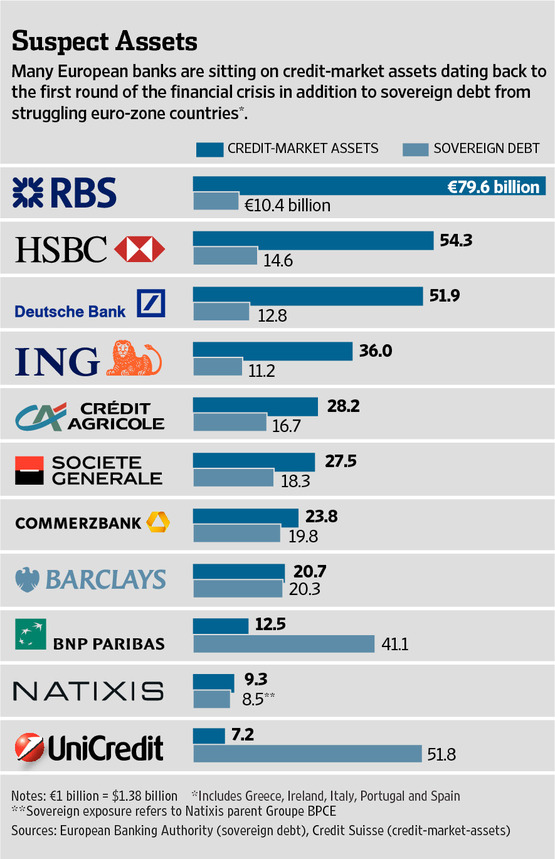
After the financial crisis in 2008, U.S. banks were aggressive in moving shaky sub-prime loans and C.D.O.'s on U.S. residential real estate off their balance sheets. Since 2007, Bank of America, Citigroup and JP Morgan have off loaded over 80% of the troubled assets, according to an analysis by Credit Suisse. It may be hard to believe, but European banks are still holding way too much of these suspect assets. (Chart pg. 3) According to research by JP Morgan, the four largest banks in France still have 70% of the real estate related loans they had in 2007. Needless to say, these holdings have not fared well, as U.S. residential and commercial real estate values continue to fall.
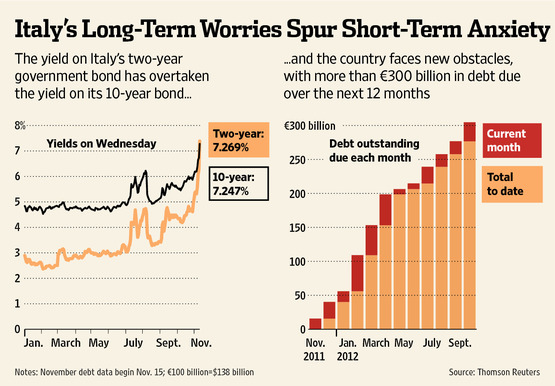
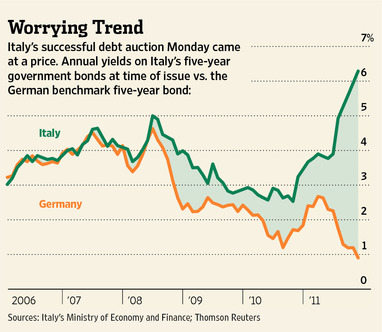
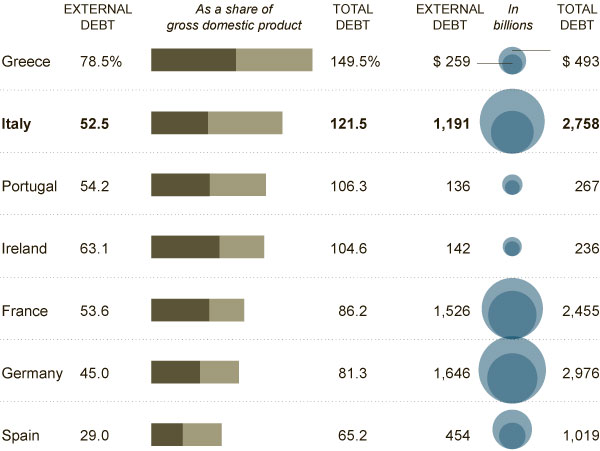
As we have discussed previously, Italy should be Europe's poster child for having too much debt and too little growth. Over the last 10 years, the world's eighth largest economy, and third largest in the E.U., has grown a scant .28% annually, while amassing a debt to GDP ratio of 120%. Italy's debt load of $2.6 trillion is the fourth largest in the world. With annual debt service of $110 billion, annual debt service was a manageable 5% of GDP. Italy's average cost of funds was 4.2%, until recently. In recent days, the Italian bond market has plunged, causing 5 year yields to soar from 2.3% at the end of 2010 to 6.3%, with 10 year yields topping 7.2%. In 2012, Italy must roll $420 billion (E300 billion) of its debt, roughly 16% of its outstanding debt. If Italy's average cost of funds rises above 6% over time, it will be extremely difficult to grow its economy, and its debt to GDP ratio could also rise to Greece like levels in coming years.
The collateral damage from the slowdown in Europe is having a negative impact on most of the small eastern European countries like the Czech Republic, Poland and Hungary, who derive more than half of their export volumes from other countries in the Euro-zone. The recession that is likely to grip most of the countries in the European Union will cause youth unemployment rates to rise and sow discontent among workers both young and old. As austerity measures are implemented and pensions reduced, divisiveness between countries will grow and become problematic. All For One, One For All When the Euro was launched in January 1999, it was hoped that the European Union would one day be the largest economy in the world. In 2010, according to IMF data, total GDP in the E.U. reached $16.2 trillion, compared to $14.9 trillion in the U.S., and $5.9 trillion in China. The European sovereign debt crisis has exposed numerous fissures within the 'Union'. At some point Germany will be forced to make a choice if the situation unravels. Their choice will depend on whether they believe intervention by the ECB will ultimately succeed, and the cost to Germany to back stop the ECB. If Germany does not believe ECB quantitative easing will contain the crisis, they may surprise everyone and choose to not allow the ECB to expand its balance sheet. As the strongest country in the E.U., it would be in Germany's best interest to let the weakest members fall apart, while using its resources to fortify its banks. This strategy would allow Germany to weather the crisis and emerge faster and stronger than any other country within the European Union. This may seem like a form of economic warfare because it is. As the European banking system implodes, the 'All for one, one for all' spirit on which the E.U. was launched will disintegrate into every country for itself. Emerging Markets, China, Brazil, and India
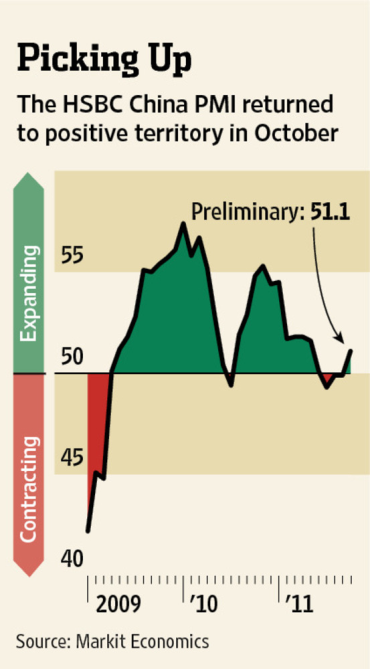
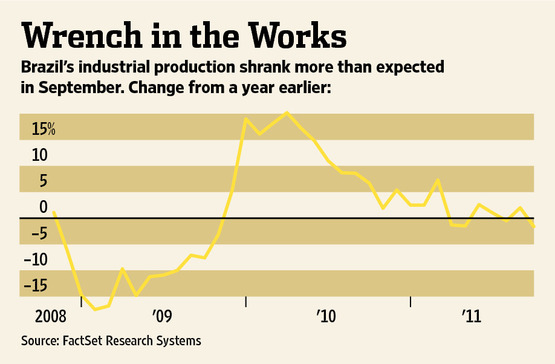
Industrial output was up 13.2% in October in China from a year ago, but it's the slowest annual rise in a year. The HSBC China Purchasing Managers Index rose to 51.1 in October, but is well down from the highs of 2009 and 2010. As we have discussed previously, Chinese state-owned banks loaned $3 trillion to stimulate growth in the wake of the financial crisis in 2008 in the last two years. This amounts to more than 50% of China's $5.9 trillion of GDP. It is unlikely that bankers in China will prove any smarter than their U.S. or European counterparts. This run away lending boosted land values, real estate values, and no doubt expanded China's export capacity. Europe is China's largest export customer, so demand from Europe will be weaker as Europe slips into a recession. Exports from Guangdong province, which accounts for a quarter of China's export trade, have dropped like a stone. In October, Guangdong's overall exports fell 8.7%, versus a gain of 26% in the first half of 2011. If the U.S. slows as we expect, Chinese companies dependent on exports will be saddled with a glut of export capacity. This will result in a surge in bad loans for China's state owned banks. And there are signs that the real estate bubble in China is beginning to deflate, which will only create more bad loans. Sometime in 2012, we will be reading stories about banking problems in China. Taiwanese manufacturing activity fell at its fastest rate in almost three years in October, according to its Purchasing Manufacturer's Index, while South Korean output continued to shrink as well. In Brazil, industrial production fell 2% in September compared to August. Output in 16 of 27 sectors contracted, led by a 9% decline in automobile production and other durable goods, and a 5.5% drop in factory machines. This prompted Brazil's central bank to lower rates for a second time since August 31 from 12.5% to 11.5% to "mitigate the effects" of a slowing global economy. The Reserve Bank of India raised its benchmark rate to 8.5% on October 25, its 13th increase in 19 months to dampen inflationary pressures, which has been hovering near 10% for months. The cumulative impact from higher rates and the global slowdown will cause India's economy to slow in coming months. The central bank expects GDP growth to slow to 7.6% in the year beginning in March, from 8.5% last year. That's probably optimistic. Will the U.S Decouple from Europe? In late 2007, many economists and investment strategists expected the global economy would not be affected by a slowdown in the U.S. Since few were expecting a recession to develop in the U.S., the forecast was that Europe and Asia would decouple from the U.S. and continue to enjoy reasonable growth. We didn't agree with that assessment, and in our March 2008 letter stated "The combination of weaker credit creation and slower velocity spells R-E-C-E-S-S-I-O-N."
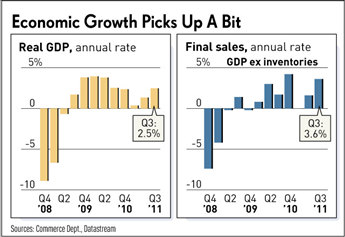
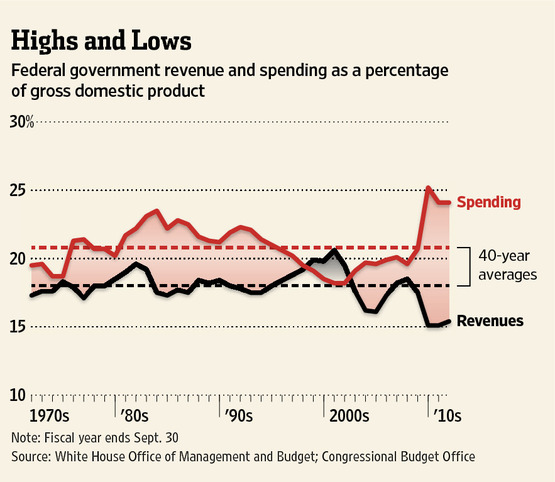
These reports have enabled most economists and strategists to stop worrying about a double dip in the U.S. Complacency about the U.S. economy's prospects going into 2012 has replaced the palpable fear of another recession most felt just three months ago. The table is now set for most investors to be surprised when the economy slows in the first half of 2012, renewing concerns about a double dip in the process. According to Standard & Poors, 46% of the sales for the 500 companies in the S&P come from outside the U.S., with 14% coming from Europe. Growth, however, isn't just slowing in Europe, but also in Brazil, China and India, which were previously very strong. The 54% of S&P sales in the U.S. will also be impacted if growth slows as we expect. And for those who think U.S. banks will either benefit or be able to sidestep Europe's banking crisis, consider this statistic. A recent Congressional Research Service report estimated that American bank exposure to German and French banks totaled more than $1.2 trillion. While our banks may be in better shape than their European counterparts, they are hardly a picture of health. Finally, world GDP in 2010 was 63 trillion, according to the International Monetary Fund. Of that total, the E.U., United States, China, Japan, Britain, Brazil, and India comprise more than 70% of world GDP, with the E.U. and the U.S. contributing almost 50%. Growth in every one of these countries is slowing, and much of the E.U. will be in a recession in 2012. The notion that the U.S. will be able to decouple from the global slowdown that will intensify in 2012 is pure fantasy. Congressional Smoke, Mirrors, and Government Statistics We have no idea whether the Congressional Super Committee will come up with a plan to reduce the deficit by $1.2 trillion or more, before the November 23 deadline. Even if they do patch together a deal, it will be a total sham, because it will be based on the wildly optimistic assumptions by the Congressional Budget Office. The CBO is the non-partisan entity that provides baseline projections for GDP growth and tax revenue, and will 'score' the impact of any Super Committee deficit reduction plan. According to the CBO, the U.S. economy will average 3% annual growth between 2012 and 2021. You will also be heartened to know, there will be no recessions during this period either. Tax revenue as a percent of GDP is the lowest since 1950, and spending is near its highest level. The gap between spending and tax revenue will be difficult to close, take a long time, and impose hardships that will be difficult to bear for millions of Americans. If our motivation to persevere flags in coming years, all we will need to do is look at Greece and Italy for a glimpse of what the future may hold for US. Stocks As the stock market approached its low on October 4, sentiment was lopsidedly negative. The spread between the percent of bulls and bears in the weekly Investors Intelligence survey showed 11.9% more bears than bulls, and the American Association of Individual Investors registered a plurality of 22.7% more bears. The rally in the stock market and modest improvement in the economy have caused sentiment to shift dramatically. In the most recent Investors Intelligence survey there were 14.8% more bulls, while the AAII report last week showed bulls outnumbered bears by 20.1%. Technically, the rally has been on low volume, as the 5 day average of total volume has dropped 34% since the October 4 low, and the 21 day average is off by 23%. This suggests the rally was been more supported by a decline in selling pressure, rather than a high level of buying conviction. The market has also sold off sharply on higher volume, whenever there has been a piece of bad news that increased selling. This is not a good sign, especially since we believe there is more bad news to come.
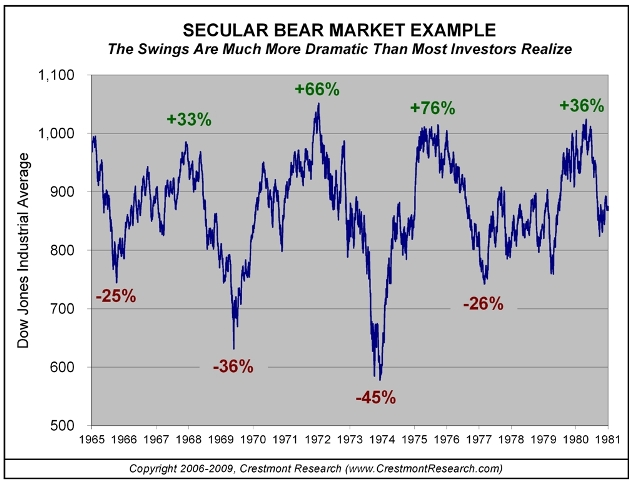
We believe the U.S. stock market is in a secular bear market that could last until 2014-2016, and could prove similar to the secular bear market that held the DJIA in a broad trading range during 1965-1982. This secular bear market could extend until 2020 or longer, since it is associated with the largest financial crisis in history that is global in its nature. The fiscal and monetary challenges we're facing are unprecedented, and may require more time to work through than the 17 years of the 1965-1982 experience. Our investment model suggests the cyclical bull market from March 2009 has ended, and a new bear market has begun. If this macro analysis is correct, one or more declines of 25% to 35% will occur during the next five years, before the current secular bear market ends. Given the European banking crisis and the fragility of the recovery in the U.S., it is not hard to see the S&P 500 falling to 1040 or 950 in 2012. In addition, to lowering exposure to the stock market, investors should consider allocating a small portion of their portfolio to the Prudent Bear fund or the inverse S&P 500 ETF SH. Both would rise in value as the market declines. Bonds As long as the 10-year Treasury yield holds below 2.45%, we view it as a warning sign of further banking problems in Europe, and coming economic weakness in the U.S. Since hitting a low of 1.70% on September 23, the high has been 2.41% on October 27, when Europe's plan was announced. Investors should buy TLT, which is the ETF that mirrors the yield on the 20-year Treasury bond. It traded as high as $125.03 on October 4, just as the stock market was making its low. We think it will trade above $125.03. Add to the position if it drops below $115.00. There is a gap at $112.85 that may be filled, before the move to a new high begins. Dollar In our May letter we recommended going long the Dollar via its ETF (UUP) at $21.56, and in our July 31 Special Update, we suggested adding to the UUP position below $20.91. A close above $22.62 should constitute a breakout, and set the stage for a rally above $24.00 in coming months. Gold We would recommend buying the gold ETF GLD if it falls below $154.00, using $140.00 as a stop. Macro Tides
|
| Posted: 23 Nov 2011 07:30 AM PST
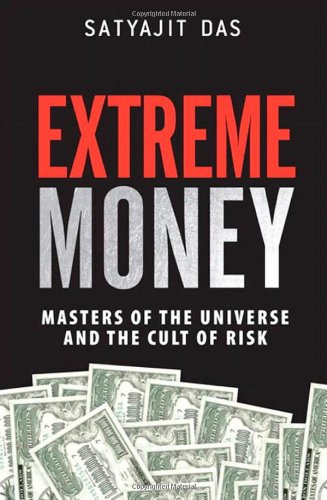
The book was named to the longlist for the 2011 FT and Goldman Sachs Business Book of the Year award. It reviews how the human race created money and finance, and then how our invention recreated us. Das explains how this happened and what it means. FT.com Review:
More Reviews: Interview with Satyajit Das (Amazon)
Extreme Money: Masters of the Universe and the Cult of Risk Source: |
| Posted: 23 Nov 2011 07:00 AM PST Some reading to end your holiday shortened week:
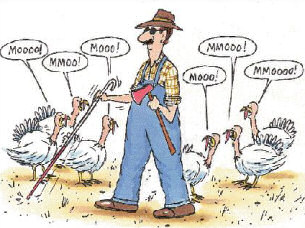
What are you reading? > Clever, clever Turkeys
|





| You are subscribed to email updates from The Big Picture To stop receiving these emails, you may unsubscribe now. | Email delivery powered by Google |
| Google Inc., 20 West Kinzie, Chicago IL USA 60610 | |



0 comments:
Post a Comment