


The Big Picture |

- At Hedge Funds, Breakeven is the New Black
- The Senate Just Voted Against The Afghanistan War. Here’s The Good, The Bad, And The Ugly.
- Prosecuting Wall Street
- USD-EUR currency exchange rate and the Ellsberg paradox.
- It’s Beginning to Look A Lot Like…1971 [updated]
- The Social Content Quiet Giant
- The Eurozone as illustrated by Andrew Rae
- Beware the Black Friday Retail Hype
- ECB to surprise next Thursday?
- 1959 Ferrari 250 GT Spider California (for sale)
| At Hedge Funds, Breakeven is the New Black Posted: 05 Dec 2011 02:00 AM PST Daily HFRX Indices
Source: Hedge Fund Research | ||||||||||||||||||||||||||||||||||||||||||||||||||||||||||||||||||||||||||||||||||||||||||||||||||||||||||||||||||||||||||||||||||||||||||||||||||||||||||||||||||||||||||||||||||||||||||||||||||||||||||||||||
| The Senate Just Voted Against The Afghanistan War. Here’s The Good, The Bad, And The Ugly. Posted: 04 Dec 2011 10:00 PM PST By leading anti-war activist David Swanson, author of Day Break and War Is A Lie, who runs the websites DavidSwanson.org and WarIsACrime.org (formerly AfterDowningStreet.org) [Preface by Washington's Blog: If you assume that we should stay in Afghanistan, read this. And our apologies to the Department of Homeland Security.] The Senate just voted against the Afghanistan war. Here's the good, the bad, and the ugly. THE GOOD The U.S. Senate on Wednesday voted by voice vote to pass an amendment that concludes thus:
This would be an extremely weak demand from a peace group, but coming from that seat of militaristic corruption, the U.S. Senate, it stands a good chance of actually being acted on by President Obama, and acted on in a meaningful way, such as withdrawing in 2012 rather than by November 2014 instead of December 2014. It is also vague enough that it can be built on with something stronger in the coming months without any contradiction. This amendment came from Senator Jeff Merkley of Oregon, where Portland has seen a strong Occupy movement. Of course, the whole country has seen a burst of activism. The amendment had bipartisan support. And its rhetorical value, which is most of its value, cannot be undone by a conference committee or a veto. THE BAD Three more years of a campaign of mass murder is not an acceptable policy. The Senate has merely asked for something better than the current plan. And the emphasis is on "merely asked." The Senate is funding the war in the same bill in which it is asking its executive to do its job. The constitutional role of Congress is to make decisions and enforce them with the power of the purse. Here the Senate is asking the President to decide what to do, but to decide something not quite as bad as his current plan. There is no indication that if the President refuses, funding for a longer war will be cut off. Congress recently stated its opposition to a war in Libya while funding it. Individual senators and House members swore they opposed the War on Iraq while funding it for several years. The President himself did that when he was a senator. There is also no indication of whether a new president, should we have one, would be bound by the current president's plan. Also missing is any requirement that all U.S. forces depart, as opposed to, say, remaining as "trainers". What would help would be a pivot from this bill to a better one in the House. The Senate has now opposed endless war in Afghanistan. In the House there is a bill with 64 cosponsors that would end the war by ceasing to fund it. That bill, HR 780, would be a serious step forward. And it need only pass the House if those who vote for it follow through by voting against all war funding. THE UGLY The Merkley amendment is not helped by the assorted whereas clauses that precede the concluding resolution:
Really? This is your antiwar statement? The majority of people in the United States tell pollsters they disagree with this, and they have good reason. "Bringing justice" by bombing people is not just. Overturning foreign governments by force, even horrible ones, is not benefitting the world.
Really? Skillfully? Ten years to extrajudicially murder one man, at a cost of hundreds of billions of dollars, many thousands of innocent lives, a further devastated nation, and increased hostility toward our own? I'd hate to have seen that done less skillfully.
You're joking, right?
Is that a retraction?
Honor? Invading someone else's country? Kicking in doors? Imprisoning? Murdering? Cutting off fingers as trophies? Where is the honor in this?
There are the same problems and much worse in Afghanistan. The question isn't where you spend the money, but on what you spend the money.
The pipeline is up and running? The bases are permanent? The natural resources have been exhausted? The nuclear weapons are positioned? The campaign funders have satisfied their need for profits? The troops have begun moving into Iran?
Are you f—ing serious? The best defense against terrorism isn't ceasing to kill people and occupy their countries? The best approach is to use troops to provoke yet more hostility but to do so in multiple places?
What about withdrawal and reparations? | ||||||||||||||||||||||||||||||||||||||||||||||||||||||||||||||||||||||||||||||||||||||||||||||||||||||||||||||||||||||||||||||||||||||||||||||||||||||||||||||||||||||||||||||||||||||||||||||||||||||||||||||||
| Posted: 04 Dec 2011 05:21 PM PST Two high-ranking financial whistleblowers say they tried to warn their superiors about defective and even fraudulent mortgages. So why haven’t the companies or their executives been prosecuted? Steve Kroft reports. Read Story: Prosecuting Wall Street Prosecuting Wall Street, Part 1 ~~~ | ||||||||||||||||||||||||||||||||||||||||||||||||||||||||||||||||||||||||||||||||||||||||||||||||||||||||||||||||||||||||||||||||||||||||||||||||||||||||||||||||||||||||||||||||||||||||||||||||||||||||||||||||
| USD-EUR currency exchange rate and the Ellsberg paradox. Posted: 04 Dec 2011 05:15 PM PST USD-EUR currency exchange rate and the Ellsberg paradox. > "Suppose you have an urn containing 30 red balls and 60 other balls that are either black or yellow. You don’t know how many black or how many yellow balls there are, but that the total number of black balls plus the total number of yellow equals 60. The balls are well mixed so that each individual ball is as likely to be drawn as any other. You are now given a choice between two gambles." For the rest see: http://en.wikipedia.org/wiki/Ellsberg_paradox. For historical reference see: Ellsberg, Daniel, "Risk, Ambiguity, and the Savage Axioms," The Quarterly Journal of Economics (Nov., 1961). A variation of the Ellsberg paradox now drives the euro-dollar currency exchange rate. Here is the outline and the options with regard to certainty, the likely outcomes that may be forecast, and also Knightian uncertainty (the unknown unknowns). For information about Frank Knight's theory see: Knight, F.H. (1921) Risk, Uncertainty, and Profit. Boston, MA: Hart, Schaffner & Marx; Houghton Mifflin Company. Thank you to Wikipedia. What is certain? If you take 1350 US dollars today, you may exchange them for 1000 euros. Actually you need a million in a round-lot trade to get close to the exact market exchange rate, but the pricing of the USD-EUR is pretty transparent in the spot market. Nearly certain is the USD-EUR price tomorrow, which is most likely going to be very close to the price today. Less certain but still estimable is the price next week. And as time goes by, the estimation has a wider margin for error. That said, we can still forecast the USD-EUR with some degree of probability. We can estimate the outcome, bearing in mind the Ellsberg paradox with regard to drawing a red ball from the urn. Under Ellsberg the odds that you will draw a red ball in the initial draw from the urn are 1 out of 3. Once you draw a ball, the odds change for the next draw, since only 89 balls are left. In the USD-EUR currency exchange-rate estimate for today, the assumption is that the euro survives until tomorrow. As time horizon extends, that assumption becomes increasingly problematic. We cannot obtain a probability distribution on the eventual outcome of the Eurozone crisis. We can list the various outcomes, which range from Eurozone is preserved and strengthened to full dismemberment. Many pundits project that the euro will dismember. Others say that Greece will be out and that this or that other country may also be out. They suggest that a smaller Eurozone can survive. They offer one- and two-year timeframes. They believe that a core Eurozone will continue. All these scenarios are speculation. Part of the estimation of the USD-EUR exchange rate includes the probabilities of euro dismemberment or partial dismemberment. Erwan Mahé noted as much in the research piece we quoted a few days ago. See www.cumber.com for reference. The piece is entitled "Measuring Europe's Contagion." The Ellsberg problem of estimation with Knightian uncertainty in play comes about when you need to find a break-up value for the euro. I get many emails forecasting a decline in the value of the euro. I'm not so sure. Others forecast all types of doom if and when Greece defaults. I'm not so sure. Let's look at this issue. Under the euro dismemberment scenario, Greece defaults and reverts to a new drachma. The devaluation is fierce. The country then experiences high, dislocating inflation and low capital formation. The banking system has been undermined. Government instability is coupled with destruction of remaining wealth and capital. Greece suffers for a generation. They brought it on themselves, and they pay the ultimate economic price of policy failure. Italy is the next suspect. My friend and co-author of our book on Europe, Vincenzo Sciarretta, wrote me about the growing burden upon Italy. "Taxes in Italy will be 125 billion euro higher than before the crisis (on an economy of some 1600 bn). Starting next year and the following one, public spending before interest rises from some 39% in 2000 to 46% of GDP in 2010. Then there’s another large part of the economy which is formally private, but the management is chosen in Rome, ENI, ENEL, Finmeccanica and the like. All politicians of all parties have shared the idea that higher taxes are 'necessary'. The idea of cutting spending has not emerged yet. When Italy was known as the 'Italian Miracle back in the '50s and '60s, the tax burden was about 25% and the country was a locomotive." Greece is a small part of the Eurozone, so small that it will barely be missed. Italy is 18%, exceeded only by France (20%) and Germany (27%). Spain is fourth at 12%. Now let's think about what a post-euro dismemberment looks like. The new German deutschmark soars. I have seen estimates of a 20%, 30%, or even 50% gain in strength. The Swiss franc would no longer be linked, and soar as well. Netherlands, Finland, Austria, and others would be much more valuable in the FX market, while the peripheral south would go the other way. Greece would certainly set the low point. And the new Italian lira is an unknown unknown. We could try to estimate what the exchange rates would be. We could use debt-to-GDP and/or income levels and/or labor productivity measures. GDP per Capita, External debt to GDP, inflation, government fiscal performance, ratios of fiscal performance—all these have statistical problems when used to forecast things like Eurozone credit spreads. My thanks to Kasper Bartholdy and Saad Skiddiqui, Credit Suisse, December 1. Conclusion: we could use a whole variety of methods to guess. But the effort to be precise is a futile one. This is uncertainty as Frank Knight envisioned it. This is the application of the yellow-black ball decision in the Ellsberg paradox: we do not know the probability of drawing either yellow or black as an outcome when making a single draw from the urn. But we do know that the USD-EUR currency exchange rate now carries some amount of Ellsberg paradox risk premium in its pricing. We do not know how much. We disagree with those who argue there is no premium. When we look at the monetary dynamics that ultimately influence the foreign exchange rates, we see the USD-EUR rate fairly consistent during this crisis. The yen has strengthened against both. Over longer time periods, currency exchange rate changes are partially explained by comparisons with central bank actions. So far this is not fully applicable to the USD-EUR. To compare, consider that the proportional change of the Federal Reserve's balance sheet (It tripled) is much larger than that of the European Central Bank (It doubled). See the charts at the bottom of the homepage on www.cumber.com to compare them. Ellsberg's paradox is at work. It is not transparent but it does exist. That is why we are underweighting Europe today and waiting for this to play out. We are investment advisers. We are willing to take risk when we can make educated guesses at the probabilities attached to the various outcomes. In the Ellsberg paradox we know there is an initial one in three chance to draw a red ball. We know it is two out of three to draw a non-red ball. If the market misprices that risk, we know what to do. But in the unknown unknown Knightian realm, it is more dangerous to play. That is why we are underweight Europe. That is why we are avoiding the periphery. We will leave for a quick trip to Europe on Thursday night. The trip follows our Thursday morning (8:30) panel at the ETF conference hosted by IndexUniverse at the New York Stock Exchange. In Paris, five private meetings on the status of events will include Europe-based money managers, consultants on Europe and central bankers. It is a fast trip but absolutely necessary. Avec nos amis, we hope to find a good French meal (et le bon vin) along the way. One postscript is in order. Several Eurozone countries are now using the Emergency Lending Assistance (ELA) programs. This is very hard to track since the reporting is by each national central bank and has a time lag. ELA is an obligation of the National Central Bank and, hence, the country behind it. It is not a liability of the ECB. This a monetary variation of the Ellsberg paradox. The latest estimate I've seen is 130 bn euro; Greece alone is 40 bn. This form of credit is expanded nation-by-nation without timely transparency. In some cases, the recipient may be an insolvent domestic commercial bank. In this model, we have no Ellsberg paradox red balls; there are 17 separate national yellow and black balls. Hence, forecasts of monetary policy outcomes are in the Knightian realm. For details see: http://www.nber.org/~wbuiter/sonofela.pdf. ~~~ David R. Kotok, Chairman and Chief Investment Officer | ||||||||||||||||||||||||||||||||||||||||||||||||||||||||||||||||||||||||||||||||||||||||||||||||||||||||||||||||||||||||||||||||||||||||||||||||||||||||||||||||||||||||||||||||||||||||||||||||||||||||||||||||
| It’s Beginning to Look A Lot Like…1971 [updated] Posted: 04 Dec 2011 04:00 PM PST The Global Macro Monitor posted several pieces earlier in the year about the Presidential Stock Cycle. See here, here, and here. The third year of a first term President is the strongest year in the cycle. The table illustrates that if the S&P500 doesn't close at 1257.64 (closed Friday at 1244.28) or higher, President Obama will be the first post-war "Investor in Chief" to have a S&P500 down year in the third year of his first term. >
> It's also beginning to feel a lot like 1971. We had thought earlier in the year the market would trade more like 1991, also a year of macro swans, including a major credit crunch and the first gulf war. After trading up early that year, the market moved in a relatively tight range and ramped hard at the end of the year, 10.5 percent in last 14 trading days. We also thought the volatility band would expand this year, but not as much as it has. Bespoke had a great piece out last week showing that since August 1st the S&P500 has had eight declines of 5 percent or more and eight advances of 5 percent or more. Contrast that to several stretches in the 1990′s where the S&P500 went more than a year without a rally or decline of 5 percent. The S&P500 now appears to be tracking the 1971 analog, also the third year of a first term President. Ironically, 1971 was a year of similar currency turmoil as President Nixon officially ended the gold standard and the Breton Woods international monetary system in the middle of August. The IMF was also at the center of the global volatility. During the massive run on gold, then Treasury Secretary John Connally and Under Secretary for Monetary Affairs Paul Volcker advised President Nixon to let the dollar float, effectively rendering the greenback a full blown fiat currency. This caused panic in the global markets until other countries let their currencies go. History is rhyming now with the current Euro and sovereign debt crisis. Let's also hope Santa brings us a similar December ramp in the S&P500 as he did in 1971 and 1991. The results of the EU summit at the end of the week and the stability of money demand in the Euro core if the ECB chooses to monetize will, in our opinion, largely determine if Santa Claus or the Grinch shows up this December. We'll worry about This is our best guess, which often diverges from reality as it unfolds. And that, folks, partially explains why markets are so volatile as they move from perception to reality and back to perception. Stay tuned.
| ||||||||||||||||||||||||||||||||||||||||||||||||||||||||||||||||||||||||||||||||||||||||||||||||||||||||||||||||||||||||||||||||||||||||||||||||||||||||||||||||||||||||||||||||||||||||||||||||||||||||||||||||
| The Social Content Quiet Giant Posted: 04 Dec 2011 02:00 PM PST The Social Content Quiet Giant View more presentations from SlideShare Pro | ||||||||||||||||||||||||||||||||||||||||||||||||||||||||||||||||||||||||||||||||||||||||||||||||||||||||||||||||||||||||||||||||||||||||||||||||||||||||||||||||||||||||||||||||||||||||||||||||||||||||||||||||
| The Eurozone as illustrated by Andrew Rae Posted: 04 Dec 2011 08:00 AM PST Awesome illustration of the Eurozone by Andrew Rae: >  Map via NYT Source: | ||||||||||||||||||||||||||||||||||||||||||||||||||||||||||||||||||||||||||||||||||||||||||||||||||||||||||||||||||||||||||||||||||||||||||||||||||||||||||||||||||||||||||||||||||||||||||||||||||||||||||||||||
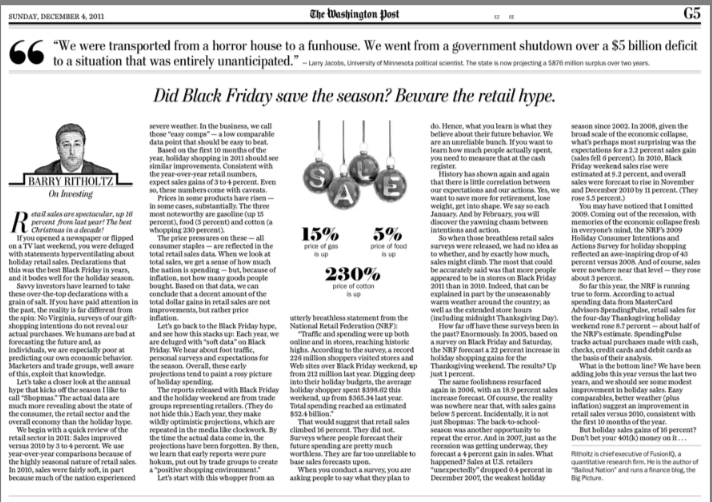
| Beware the Black Friday Retail Hype Posted: 04 Dec 2011 06:00 AM PST
> My Sunday Washington Post Business Section column is out. This morning, we look at retail sales, inflation, and forecasts: Did Black Friday save the season? Beware the retail hype. The key takeaway is that sales improved over last year consistent with the first 10 months of 20121 — but the insane forecasts from the usual trade groups are as they have always been — wildly, exuberantly, too optimistic. Here’s an excerpt from the column:
> My favorite part of the piece is where I compare the past 5 years of Shopmas NRF forecasts versus actual sales. I won’t spoiul the ending, but suffice it to say, hilarity ensues!
> > Source: WP 12.4.11 Retail (PDF) | ||||||||||||||||||||||||||||||||||||||||||||||||||||||||||||||||||||||||||||||||||||||||||||||||||||||||||||||||||||||||||||||||||||||||||||||||||||||||||||||||||||||||||||||||||||||||||||||||||||||||||||||||
| ECB to surprise next Thursday? Posted: 04 Dec 2011 05:30 AM PST Kiron Sarkar lives in London and Ireland where he works as a money manager. His full bio follows below. ~~~ Next week is critical for the Euro Zone. The EU leaders meet on 8/9th December to finalise (hopefully) their proposals for the future of the Euro/ Euro Zone. They need to agree a firm plan to achieve a credible and verifiable fiscal union, with automatic sanctions for transgressors. The absolute necessity to find a solution is even more important, as the EFSF is clearly a failure, in that its “firepower” will not reach the E1tr + previously suggested – closer to half that size is the current gossip doing the rounds. I cannot stress how important this summit is, not only for Europe, but globally. By way of an example, the rumour on Friday that Spain would be downgraded (inevitable) caused a significant sell of of the Euro – the rumour was denied by Fitch who stated that there was no IMMEDIATE threat of a downgrade – whilst not yet, it will happen, probably relatively soon, is how I read Fitch’s statement. In a way, it’s the last chance saloon for the Euro and the Euro Zone. The Market is in no mood to give Euro Zone politicians any more time/breathing space. Whilst, a comprehensive and fully implemented policy is impossible to be delivered by the 9th, the Euro Zone can do much – significant parts of the plan have been either leaked or reported in the media and are very much along the lines set out in my recent blogs. However, more on this in a later note. Equally important is next Thursday’s ECB’s decision. Personally, I believe there is a better than reasonable, though not (as yet) a good chance, that the ECB will surprise and cut interest rates by 50bps (down to 0.75%, from 1.25% presently) rather than just the 25bps, a number of analysts expect. A cut below 1.00% will have a significant impact, as the Market has believed that a 1.0% ECB minimum rate is sacrosanct – certainly true in the past. The ECB is to publish it’s forecasts for growth and inflation (to include 2013 projections) on Thursday – expect a significant downgrade of growth, combined with weaker inflation forecasts – a perfect scenario to reduce interest rates, significantly. You will recall that at the last ECB meeting, Draghi justified his decision to reduce interest rates by 25bps by referring to forecasts, as opposed to Trichet’s previous habit of taking decisions based on current data. Based on that, I believe that the ECB will be far more proactive in the future. Last week, Draghi stated (at the EU parliament) that the ECB is ready to act in cases of both inflation or deflation and/or if inflation is below it’s target of “at or close to 2.0%” – a message, I believe the Market has missed – Suggests a dovish position to me and certainly favours the argument for a more aggressive 50bps cut by the ECB next Thursday. The only argument against, that I can see, is that Euro Zone politicians would not have announced details of their “fiscal compact” at that time, as the key decisions will be announced a day later – on the 9th December.
Mr Stark, an ECB board member, (previously, “Mr Stark raving bonkers”) has also seen the light and has made a number of (surprisingly) dovish statements – he must now be regretting his decision to resign in protest at the recent ECB bond buying. Basically he was WRONG at the time, though most would not regret his departure – there is no place for dogmatic individuals, who are learning on the job, particularly at this very serious time. Another previous hawk, Mr Nowotny, is also becoming dovish. However, he has become embroiled in a bribery scandal. Hmmmmm. One insight – isn’t it amazing how quickly Mr Trichet’s ludicrous monetary policy has unraveled – thank God. I continue to believe that Mario Draghi is much more switched on and understands markets far, far better than that imbecile Trichet. However, don’t expect Mr Draghi to be communicative – he is, very much, a back room player – fixing The Market remains cautious – no great surprise, given the history of the Euro Zone. However, with Mrs Merkel discovering religion – check out her speech to the German parliament yesterday, (which I reported in my previous blog) – and assuming continued German “control” of the process, I remain cautiously optimistic – pretty weasely words I will admit, but like you, experience has taught me to extremely cautious in all matters relating to the Euro Zone. Will the ECB do more, such as announce a significant bond buying programme, QE or, for that matter, lending money to either the IMF and/ or certain Euro Zone central banks to on lend to Euro Zone Sovereigns? – lending to Euro Zone central banks is a possible alternative, given likely objections by US republicans to IMF funding – see below. Well, one or more of the above would be great, but, on balance, to early to be delivered I expect. I would guess that the ECB would prefer to wait for the “fiscal compact” that Mr Draghi has proposed needs to be put in place, before embarking on further monetary easing. However, a deterioration in Market sentiment in the early part of next week could force a change in the ECB, I must admit. Mr Geithner is to visit the Euro zone next week, ahead of the 8/9th Dec EU summit. He is to meet a number of senior players, including Mario Monti, Sarkozy and Mr Rajoy, (the Spanish PM elect), together Interesting developments. President Obama is very keen for a positive settlement of the Euro Zone crisis – he fears an implosion of the Euro Zone as negative for the global/ US economy and therefore his re-election chances. On the other hand, the republicans would prefer a weaker global/US economy. The FT suggests that the republicans will fail in their measures to block IMF support to Europe. The republicans claim that US taxpayers money will be at risk. However, in reality, the IMF, makes money on its lending, its loans ranks in priority to all other creditors and if they are not repaid, you are talking about a scenario which involves a melt down of the global economy, in which case all bets are off. The republican strategy is also pretty risky politically in the US, I would guess. A number of US political strategists refer to an US unemployment rate of 8.5% as being the tipping point – above it will be better for the republicans and below, for the democrats. Fridays non farm payrolls, included the results of the household survey, which reported unemployment at 8.6% (forecast 9.0%) and the lowest level since March 2009 – surprising given the November employment gains (120k), together with hours worked and average earnings were either below forecasts and/or unimpressive. In addition, half of the November employment gains were attributed to the retail sector (hiring for black Friday) and temp placements. On a more positive note, Sept/Oct payrolls were revised upwards by 72k. However, it appears that more individuals are leaving the employment Market (nearly 500k), confirmed by the lower employment participation rate (64.0% from 64.2% previously – a near 25+ year low), which explains the lower unemployment rate. The risks are high, but I believe that Euro Zone politicians understand that, including, most importantly, the Germans. As a result, the odds favour a positive outcome – however, I will watch very, very carefully – it is the Euro Zone after all. Lower Euro Zone interest rates and a more accommodative ECB monetary policy is negative for the Euro – basically, short term interest rates will converge with that of the US, removing that support for the Euro. Threats of further downgrades of Euro Zone countries (likely re Spain and France) will also weigh on the currency. Furthermore, continuing problems (including further debt write offs/defaults) with Greece are inevitable, as is the certainty that Portugal will have to impose haircuts (in the order of 40%) on it’s debt – it’s current financial position is unsustainable. By contrast, US economic data continues to improve, whilst Euro Zone data suggests that a number of countries are facing recession, if they are not there already. Personally, I believe there is a good chance that the Euro will decline much further – to below US$1.20 in the next 3 – 6 months. For full disclosure purposes, I am short the Euro against the US$. A much weaker Euro is negative for China (as Europe is it’s main trading partner) and suggests to me that the Chinese have a lot further to go in terms of monetary easing. The impact on inflation will have to be watched. Will they go for faster currency appreciation (bad for exports, but better for domestic consumption) to control inflation – far too early to tell, but certainly a possibility. Whatever, the Chinese authorities have no easy choices. All of the above is equity negative, but in the short term, I expect a further rally, on some sort of resolution of the Euro Zone crisis and the inevitable introduction of QE. ~~~~ A qualified UK accountant, Kiron joined the M&A dept of N M Rothschild in London. He was then appointed head of M&A of Rothschild (Hong Kong). On his return to the UK, he was a founding member of the Rothschild international privatisation team. Subsequently headed up the Central and Eastern European ("CEE") team – rated No 1 in 4 out of 5 years (Privatisation International). On leaving Rothschild, he worked as privatisation adviser to the UK Governments Know How Fund, which was established to advise Governments in CEE on policy, privatisation, economic, financial, regulatory and other issues. Subsequently European Head of Media, Tech and Telecoms at CIBC World markets. Following CIBC, Kiron advised on telecoms and energy deals in CEE. Kiron has acted as a lead adviser in respect of over US$150bn of deals and has worked globally in both developed and emerging markets. | ||||||||||||||||||||||||||||||||||||||||||||||||||||||||||||||||||||||||||||||||||||||||||||||||||||||||||||||||||||||||||||||||||||||||||||||||||||||||||||||||||||||||||||||||||||||||||||||||||||||||||||||||
| 1959 Ferrari 250 GT Spider California (for sale) Posted: 04 Dec 2011 05:00 AM PST This could very well be the most beautiful sports care ever designed: featuring 1959 Ferrari 250 GT Spider California. The Paris-based auction house Artcurial has just announced that its forthcoming Rétromobile sale will include several, highly desirable GTs from the 50s and 60s, the most significant being the ex-Roger Vadim 1959 Ferrari 250 GT Spider California. Vadim apparently had an appreciation of beauty, as he later married Brigitte Bardot. If you have an extra $4-5 million dollars lying around, this is the way to go. Simply stated, this is one of the most gorgeous Spider’s ever produced: >
Source: | ||||||||||||||||||||||||||||||||||||||||||||||||||||||||||||||||||||||||||||||||||||||||||||||||||||||||||||||||||||||||||||||||||||||||||||||||||||||||||||||||||||||||||||||||||||||||||||||||||||||||||||||||






| You are subscribed to email updates from The Big Picture To stop receiving these emails, you may unsubscribe now. | Email delivery powered by Google |
| Google Inc., 20 West Kinzie, Chicago IL USA 60610 | |



0 comments:
Post a Comment