.

{2} GoogleTranslate (H)

English French German Spanish Italian Dutch Russian Portuguese Japanese Korean Arabic Chinese Simplified

Our New Stuff

{3} up AdBrite + eToro

Your Ad Here

Thursday, December 29, 2011

The Big Picture

The Big Picture


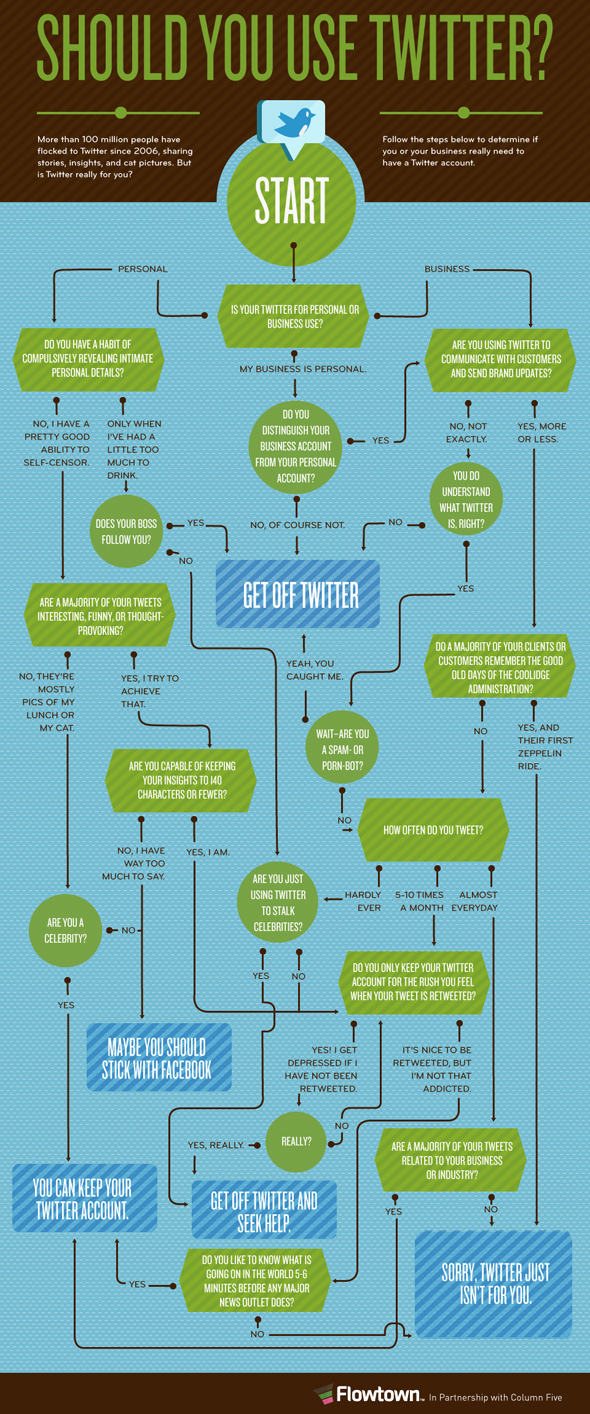
How To Decide If You Or Your Business Should Use Twitter

Posted: 29 Dec 2011 01:30 AM PST

The Coming War on General Computation

Posted: 28 Dec 2011 10:00 PM PST

Cory Doctorow:

The last 20 years of Internet policy have been dominated by the copyright war, but the war turns out only to have been a skirmish. The coming century will be dominated by war against the general purpose computer, and the stakes are the freedom, fortune and privacy of the entire human race.

The problem is twofold: first, there is no known general-purpose computer that can execute all the programs we can think of except the naughty ones; second, general-purpose computers have replaced every other device in our world. There are no airplanes, only computers that fly. There are no cars, only computers we sit in. There are no hearing aids, only computers we put in our ears. There are no 3D printers, only computers that drive peripherals. There are no radios, only computers with fast ADCs and DACs and phased-array antennas. Consequently anything you do to “secure” anything with a computer in it ends up undermining the capabilities and security of every other corner of modern human society.

What is the Best Portfolio Tracking Software/Sites?

Posted: 28 Dec 2011 04:30 PM PST

Someone asked me a great question the other day: What is the best software or website sites to track your portfolio?

I had to answer “I don’t know.” There are lots of good pro options — in the office, we use Bloomberg ($1600 per month) and Morningstar ($500 per month).

But what are the decent free or reasonable consumer grade sites to track your investments? I have played with Marketwatch, Yahoo finance, Wiki Invest — but since I have everything on TD (our analytics are elsewhere), I never really got a feel for the strengths and weaknesses of each of these.

~~~

So, let’s consider this an open thread — what are your favorite portfolio management tools?

10 Mid-Week PM Reads

Posted: 28 Dec 2011 01:05 PM PST

My afternoon reads:

• 2011: The Year in Financial Blogging (The Reformed Broker) see also Bloggers as Marginal revolutionaries (Economist)
• Whistleblower documents illuminate case against BNY Mellon (Reuters)
• How wealth of members of Congress has TRIPLED in 25 years – while average U.S. family has suffered a DROP in their worth (Daily Mail) see also America's inequality need not determine the future of Britain (FT.com)
• No, There’s No Life At Mers (Stop Foreclosure Fraud)
• The Great Economic Divide Makes Everyone Poorer (Fiscal Times) see also No One Is Above the Law (Economix)
• 7 Downloads to Kick-Start Your Tablet Adventure (WSJ)
• Insights on the writing of Steve Jobs (Fortune)
• Twitter more popular than Facebook in 2011 (ZDNet)
• How SOPA 2.0 Sneaks In A Really Dangerous Private Ability To Kill Any Website (Tech Dirt)
• Solitude and Leadership (The American Scholar)

What are you reading?

>

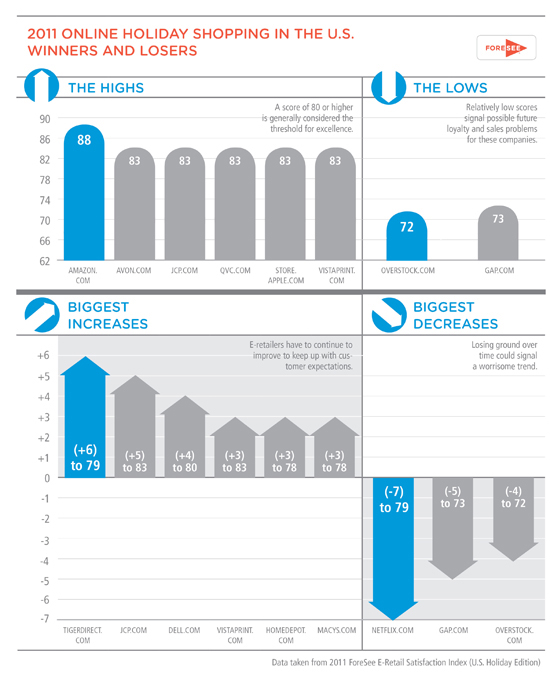
Winners & Losers for Customer Service in Holiday Season 2011

Source: ForeSee

Emerging Markets, ETFs and Dividend Stocks Rule in 2012

Posted: 28 Dec 2011 12:00 PM PST

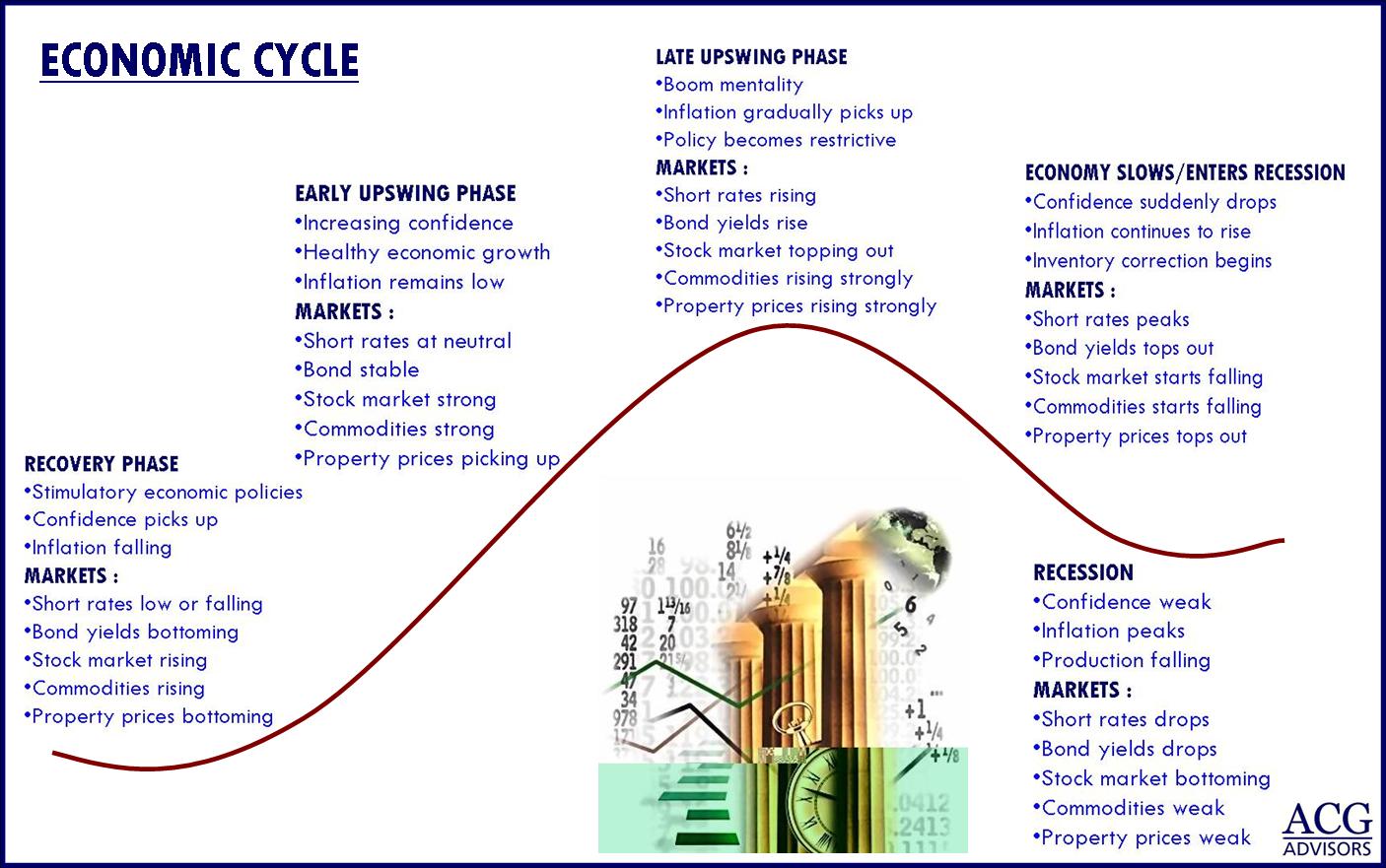
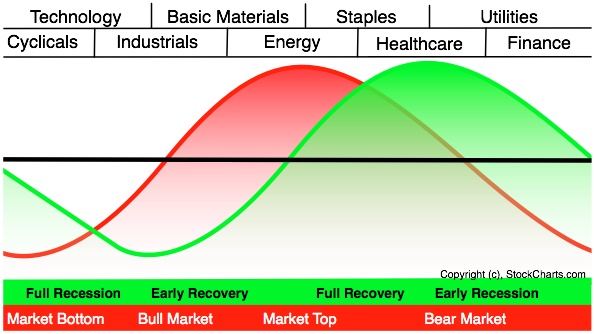
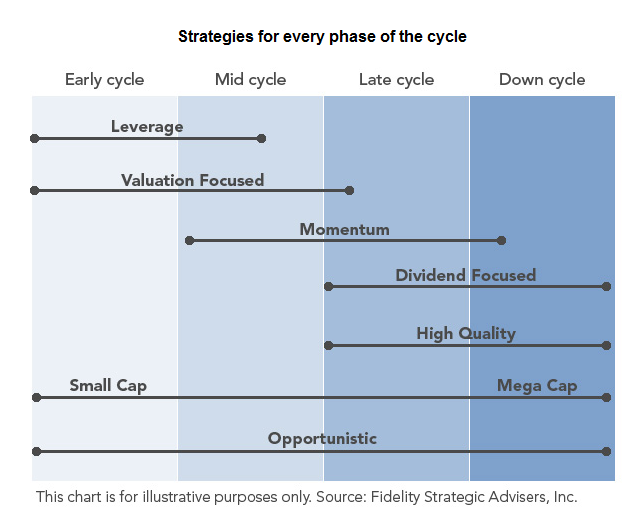
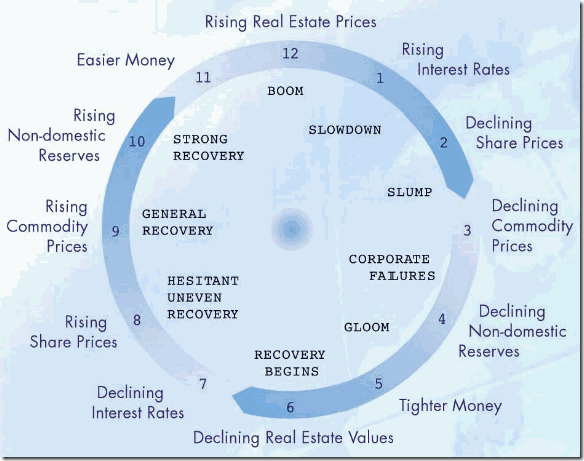
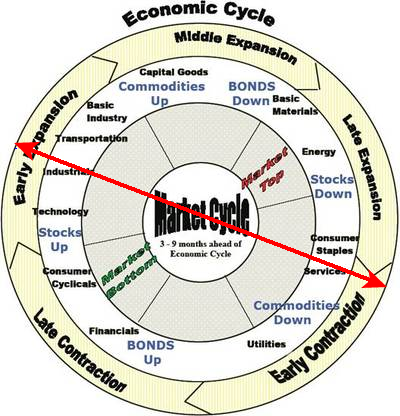
Economic Cycles and Investing

Posted: 28 Dec 2011 09:00 AM PST

Last week, we ran this series of Sentiment charts.

Today, I want to share with you a few interesting economic cycle charts:

>

~~~

~~~

~~~

~~~

~~~

~~~

Stop payment! A homeowners’ revolt against the banks

Posted: 28 Dec 2011 06:58 AM PST

Stop Payment

Clouded Title: The Gross Illegality of MERS

Posted: 28 Dec 2011 06:34 AM PST

"What's happened is that, almost overnight, we've switched from democracy in real-property recording to oligarchy in real-property recording. There was no court case behind this, no statute from Congress or the state legislatures. It was accomplished in a private corporate decision. The banks just did it."

-Christopher Peterson, a law professor at the University of Utah, on the “wholesale transfer of mortgages to a privatized database” and why it’s no coincidence more Americans are being foreclosed upon than any time since the Great Depression.

>

The quote above is from an article in the January 2012 Harper’s. It’s ostensibly about the ongoing battle between Homeowners and Bankers (PDF is online at Scribd, Think Tank, but not for long).

The print edition is illustrated with the artwork of Amy Casey (Housing as a Recurring Dream (Nightmare), previously showcased here)

What makes the article so remarkable is it has one of the most powerful anti-MERS arguments I have ever read in the mainstream media. In addition to the quote above, there is this:

At the heart of the clouded-title problem is a Virginia-based company, recently much in the national news, called Mortgage Electronic Registration Systems. MERS was created in 1995 as a privately held venture of the major mortgage-finance operators, chief among them the government-sponsored mortgaging entities Fannie Mae and Freddie Mac. Its stated purpose was to manage a confidential electronic registry for the tracking of the sale of mortgage loans between lenders, which could now place loans under MERS's name to avoid filing the paperwork normally required whenever mortgage assignments changed hands. No longer would the traffickers in mortgages have to document their transactions with county clerks, nor would they have to pay the many and varied courthouse fees for such transactions. Instead, MERS was listed in local recording offices as the "mortgagee of record," the in-name-only owner, a so-called nominee for the lender, so that MERS would effectively "own" the loan where the public record was concerned, while the lenders traded it back and forth.

This centralized database facilitated the buying and selling of mortgage debt at great speed and greatly reduced cost. It was a key innovation in expediting the packaging of mortgage-backed securities. Soon after the registry launched, in 1999, the Wall Street ratings agencies pronounced the system sound. "The legal mechanism set up to put creditors on notice of a mortgage is valid," as was "the ability to foreclose," assured Moody's. That same year, Lehman Brothers issued the first AAA-rated mortgage-backed security built out of MERS mortgages. By the end of 2002, MERS was registering itself as the owner of 21,000 loans every day. Five years later, at the peak of the housing bubble, MERS registered some two thirds of all home loans in the United States.

Without the efficiencies of MERS there probably would never have been a mortgage-finance bubble.

After the housing market collapsed, however, MERS found itself under attack in courts across the country. MERS had singlehandedly unraveled centuries of precedent in property titling and mortgage recordation, and judges in state appellate and federal bankruptcy courts in more than a dozen jurisdictions—the primary venues where real estate cases are decided— determined that the company did not have the right to foreclose on the mortgages it held.

In 2009, Kansas became one of the first states to have its supreme court rule against MERS. In Landmark National Bank v. Boyd A. Kesler, the court concluded that MERS failed to follow Kansas statute: the company had not publicly recorded the chain of title with the relevant registers of deeds in counties across the state. A mortgage contract, the justices wrote, consists of two documents: the deed of trust, which secures the house as collateral on a loan, and the promissory note, which indebts the borrower to the lender. The two documents were sometimes literally inseparable: under the rules of the paper recording system at county court-houses, they were tied together with a ribbon or seal to be undone only once the note had been paid off. "In the event that a mortgage loan somehow separates interests of the note and the deed of trust, with the deed of trust lying with some independent entity," said the Kansas court, "the mortgage may become unenforceable."

MERS purported to be the independent entity holding the deed of trust. The note of indebtedness, however, was sold within the MERS system, or "assigned" among various lenders. This was in keeping with MERS's policy: it was not a bank, made no loans, had no money to lend, and did not collect loan payments. It had no interest in the loan, only in the deed of trust. The company—along with the lenders that had used it to assign ownership of notes—had thus entered into a vexing legal bind. "There is no evidence of record that establishes that MERS either held the promissory note or was given the authority [to] assign the note," the Kansas court found, quoting a decision from a district court in California. Not only did MERS fail to legally assign the notes, the company presented "no evidence as to who owns the note."

Similar cases were brought before courts in Idaho, Massachusetts, Missouri, Nevada, New York, Oregon, Utah, and other states. "It appears that every MERS mortgage," a New York State Supreme Court judge recently told me, "is defective, a piece of crap." The language in the judgments against MERS became increasingly denunciatory. MERS's arguments for standing in foreclosure were described as "absurd," forcing courts to move through "a syntactical fog into an impassable swamp."
(emphasis added)

I was so thrilled with this piece, I subscribed to Harper’s Magazine thru Amazon ($10)

>

Source:
Stop payment! A homeowners’ revolt against the banks
Christopher Ketcham
Harpers, January 2012
http://harpers.org/archive/2012/01/0083752

Stocks in ’12, pre printing/post printing

Posted: 28 Dec 2011 05:01 AM PST

The easier part of Italy’s bond auctions this week took place earlier today as they sold a 2 yr zero coupon bond and a 6 month bill. Both though were priced at yields well below one’s sold last month. The 2 yr ytm came at 4.85% vs 7.81% in Nov and the 6 month bill yields 3.25% vs 6.5% one month ago. Whether the catalyst for the sharp drop in yields over the past 4 weeks was due to the ECB 3 yr lending facility remains to be seen but a good test of the appetite for Italian debt will be tomorrow’s bond sales that have maturities past 3 yrs (up to 10). Looking at 2012 with respect to Europe, it is inevitable to me that Europe will have a tough recession, not mild that many believe. Their banking system is literally shrinking and while foreign banks will fill some of the void, it won’t be enough over the next 6-12 months. European companies source 80% of their loans from banks and the credit dearth will be obvious, notwithstanding ECB longer term funding facilities. Slower economic growth will then lead to further stress on sovereigns and the ECB will then be left with the political choice of presiding over economic pain that will ultimately lead to debt restructurings (the healthy long term solution) by not sterilizing bond purchases or they will print and print and try to inflate their way out. With respect to stocks in 2012, it may simplistically come down to this, pre printing action and post printing action. Sell the former and buy the latter. I didn’t mention the Fed in this discussion but be sure, QE3 will come along when the travails of Europe hit the US economy. II: Bulls 50.5 v 48.4, highest since May, Bears 29.5 v 30.5

The New Bentley Continental V8

Posted: 28 Dec 2011 05:00 AM PST

Bentley_Continental_GT_V8_01pop Bentley_Continental_GT_V8_02pop Bentley_Continental_GT_V8_03pop Bentley_Continental_GT_V8_04pop Bentley_Continental_GT_V8_05pop Bentley_Continental_GT_V8_06pop Bentley_Continental_GT_V8_07pop Bentley_Continental_GT_V8_08pop

Source:
The new Bentley Continental V8
Classic Driver, December 2011

.

0 comments:

Post a Comment

previous home Next

{8} chatroll


{9} AdBrite FOOTER

{8} Nice Blogs (Adgetize)