The "corporate psychopaths" at the helm of our financial institutions are to blame [for the financial crisis].
Clive R. Boddy, most recently a professor at the Nottingham Business School at Nottingham Trent University, says psychopaths are the 1 percent of "people who, perhaps due to physical factors to do with abnormal brain connectivity and chemistry" lack a "conscience, have few emotions and display an inability to have any feelings, sympathy or empathy for other people."
As a result, Boddy argues in a recent issue of the Journal of Business Ethics, such people are "extraordinarily cold, much more calculating and ruthless towards others than most people are and therefore a menace to the companies they work for and to society."
How do people with such obvious personality flaws make it to the top of seemingly successful corporations? Boddy says psychopaths take advantage of the "relative chaotic nature of the modern corporation," including "rapid change, constant renewal" and high turnover of "key personnel." Such circumstances allow them to ascend through a combination of "charm" and "charisma," which makes "their behaviour invisible" and "makes them appear normal and even to be ideal leaders."
***
Until the last third of the 20th century, he writes, companies were mostly stable and slow to change. Lifetime employment was a reasonable expectation and people rose through the ranks.
This stable environment meant corporate psychopaths "would be noticeable and identifiable as undesirable managers because of their selfish egotistical personalities and other ethical defects."
For Wall Street — a rapidly changing and highly dynamic corporate environment if there ever was one, especially when the firms transformed themselves from private partnerships into public companies with quarterly reporting requirements — the trouble started when these charmers made their way to corner offices of important financial institutions.
They "largely caused the crisis" because their "single- minded pursuit of their own self-enrichment and self- aggrandizement to the exclusion of all other considerations has led to an abandonment of the old-fashioned concept of noblesse oblige, equality, fairness, or of any real notion of corporate social responsibility."
***
He says the unnamed "they" seem "to be unaffected" by the corporate collapses they cause. These psychopaths "present themselves as glibly unbothered by the chaos around them, unconcerned about those who have lost their jobs, savings and investments, and as lacking any regrets about what they have done. They cheerfully lie about their involvement in events, are very convincing in blaming others for what has happened and have no doubts about their own worth and value. They are happy to walk away from the economic disaster that they have managed to bring about, with huge payoffs and with new roles advising governments how to prevent such economic disasters."
Mr Boddy is not alone. In Jon Ronson's widely acclaimed book The Psychopath Test, Professor Robert Hare [the world's leading expert on psychopathy] told the author: "I should have spent some time inside the Stock Exchange as well. Serial killer psychopaths ruin families. Corporate and political and religious psychopaths ruin economies. They ruin societies."
***
A senior UK investment banker and I [were] discussing the most successful banking types we know and what makes them tick. I argue that they often conform to the characteristics displayed by social psychopaths. To my surprise, my friend agrees.
He then makes an astonishing confession: "At one major investment bank for which I worked, we used psychometric testing to recruit social psychopaths because their characteristics exactly suited them to senior corporate finance roles."
Here was one of the biggest investment banks in the world seeking psychopaths as recruits.
***
A 2,200-page report by Anton Valukas, the Chicago-based lawyer hired by a US court to investigate Lehman's failure … revealed systemic chicanery within the bank; he described management failures and a destructive, internal culture of reckless risk-taking worthy of any psychopath.
So why wasn't Mr Fuld spotted and stopped? I've concluded it's the good old question of nature and nurture but with a new interpretation. As I see it, in its search for never-ending growth, the financial services sector has actively sought out monsters with natures like Mr Fuld and nurtured them with bonuses and praise.
***
Take Sir Fred Goodwin of RBS, for example. Before he racked up a corporate loss of £24.1bn, the highest in UK history, he was idolised by the City. In recognition of his work in ruthlessly cutting costs at Clydesdale Bank he got the nickname "Fred the Shred", and he played that for all it was worth. He was later described as "a corporate Attila", a title of which any psychopath would be proud.
Psychopaths Have Different Brain Chemistry from the Rest of Us
Vanderbilt researchers have found that the brains of psychopaths have a dopamine abnormality which creates a drive for rewards at any cost, and causes them to ignore risks.
Abnormalities in how the nucleus accumbens, highlighted here, processes dopamine have been found in individuals with psychopathic traits and may be linked to violent, criminal behavior. Credit: Gregory R.Samanez-Larkin and Joshua W. Buckholtz
The brains of psychopaths appear to be wired to keep seeking a reward at any cost, new research from Vanderbilt University finds. The research uncovers the role of the brain's reward system in psychopathy and opens a new area of study for understanding what drives these individuals.
"This study underscores the importance of neurological research as it relates to behavior," Dr. Francis S. Collins, director of the National Institutes of Health, said. "The findings may help us find new ways to intervene before a personality trait becomes antisocial behavior."
"Psychopaths are often thought of as cold-blooded criminals who take what they want without thinking about consequences," Joshua Buckholtz, a graduate student in the Department of Psychology and lead author of the new study, said. "We found that a hyper-reactive dopamine reward system may be the foundation for some of the most problematic behaviors associated with psychopathy, such as violent crime, recidivism and substance abuse."
Previous research on psychopathy has focused on what these individuals lack—fear, empathy and interpersonal skills. The new research, however, examines what they have in abundance—impulsivity, heightened attraction to rewards and risk taking. Importantly, it is these latter traits that are most closely linked with the violent and criminal aspects of psychopathy.
"There has been a long tradition of research on psychopathy that has focused on the lack of sensitivity to punishment and a lack of fear, but those traits are not particularly good predictors of violence or criminal behavior," David Zald, associate professor of psychology and of psychiatry and co-author of the study, said. "Our data is suggesting that something might be happening on the other side of things. These individuals appear to have such a strong draw to reward—to the carrot—that it overwhelms the sense of risk or concern about the stick."
To examine the relationship between dopamine and psychopathy, the researchers used positron emission tomography, or PET, imaging of the brain to measure dopamine release, in concert with a functional magnetic imaging, or fMRI, probe of the brain's reward system.
"The really striking thing is with these two very different techniques we saw a very similar pattern—both were heightened in individuals with psychopathic traits," Zald said.
Study volunteers were given a personality test to determine their level of psychopathic traits. These traits exist on a spectrum, with violent criminals falling at the extreme end of the spectrum. However, a normally functioning person can also have the traits, which include manipulativeness, egocentricity, aggression and risk taking.
In the first portion of the experiment, the researchers gave the volunteers a dose of amphetamine, or speed, and then scanned their brains using PET to view dopamine release in response to the stimulant. Substance abuse has been shown in the past to be associated with alterations in dopamine responses. Psychopathy is strongly associated with substance abuse.
"Our hypothesis was that psychopathic traits are also linked to dysfunction in dopamine reward circuitry," Buckholtz said. "Consistent with what we thought, we found people with high levels of psychopathic traits had almost four times the amount of dopamine released in response to amphetamine."
In the second portion of the experiment, the research subjects were told they would receive a monetary reward for completing a simple task. Their brains were scanned with fMRI while they were performing the task. The researchers found in those individuals with elevated psychopathic traits the dopamine reward area of the brain, the nucleus accumbens, was much more active while they were anticipating the monetary reward than in the other volunteers.
"It may be that because of these exaggerated dopamine responses, once they focus on the chance to get a reward, psychopaths are unable to alter their attention until they get what they're after," Buckholtz said. Added Zald, "It's not just that they don't appreciate the potential threat, but that the anticipation or motivation for reward overwhelms those concerns."
Has anyone tested the heads of the too big to fails for this dopamine abnormality?
What are the odds that they have it? And if they have it, what are the odds that they will voluntarily start acting responsibly, especially given the broken incentive system?
Experts also tell us that many politicians also share traits with serial killers. Specifically, the Los Angeles Times noted in 2009:
Using his law enforcement experience and data drawn from the FBI's behavioral analysis unit, Jim Kouri has collected a series of personality traits common to a couple of professions.
Kouri, who's a vice president of the National Assn. of Chiefs of Police, has assembled traits such as superficial charm, an exaggerated sense of self-worth, glibness, lying, lack of remorse and manipulation of others.
But — and here's the part that may spark some controversy and defensive discussion — these traits are also common to American politicians. (Maybe you already suspected.)
Yup. Violent homicide aside, our elected officials often show many of the exact same character traits as criminal nut-jobs, who run from police but not for office.
Kouri notes that these criminals are psychologically capable of committing their dirty deeds free of any concern for social, moral or legal consequences and with absolutely no remorse.
"This allows them to do what they want, whenever they want," he wrote. "Ironically, these same traits exist in men and women who are drawn to high-profile and powerful positions in society including political officeholders."
***
"While many political leaders will deny the assessment regarding their similarities with serial killers and other career criminals, it is part of a psychopathic profile that may be used in assessing the behaviors of many officials and lawmakers at all levels of government."
The idea of nobless oblige or trickle-down economics, certain versions of it, is bull," Keltner added. "Our data say you cannot rely on the wealthy to give back. The 'thousand points of light'—this rise of compassion in the wealthy to fix all the problems of society—is improbable, psychologically."
Those in the upper-class tend to hoard resources and be less generous than they could be.
Given that many in Congress and top government posts are multi-millionaires, the study might help explain why politicians seem only to work to make themselves wealthier and to help their wealthy buddies.
We will remain disempowered if we assume that the super-elites are "like us". Unless we learn to spot "wolves in sheep's clothing", we will continue to fall prey to their scams.
Unless We Remove the Psychopaths from Power, They Will Cause More and More Destruction
The inmates are still running the asylum.
Anyone who knows Jamie Dimon, Lloyd Blankfein or the other Wall Street "leaders" can tell you that they haven't changed a bit since 2008. They are not repentent for their role in the financial crisis. They don't feel bad that the taxpayers have had to bail them out again and again … and that they have used that money to enrich themselves and stick it to the little guy.
Mr Ronson reports: "Justice departments and parole boards all over the world have accepted Hare's contention that psychopaths are quite simply incurable and everyone should concentrate their energies instead on learning how to root them out."
But, far from being rooted out, they are still in place and often in positions of even greater power.
As Mr Boddy warns: "The very same corporate psychopaths, who probably caused the crisis by their self-seeking greed and avarice, are now advising governments on how to get out of the crisis. Further, if the corporate psychopaths theory of the global financial crisis is correct, then we are now far from the end of the crisis. Indeed, it is only the end of the beginning."
"Who you are speaks so loudly I can't hear what you're saying."
Its like a thief who has been arrested 5 times for burglary. Even though he says all the right things to the judge at sentencing, the judge is still going to throw the book at him.
If the thief is appointed to head a government commission on corruption, do you think people will have confidence in the commission or its proposed actions?
***
[Those in power] may be saying nice things about fixing the economy, shoring up the financial system and helping American citizens, but people don't believe them anymore. They've been proven liars one too many times.
***
The only thing that can restore confidence in the economy and the financial system is to replace the whole lot of them (tar and feather them) with honest leaders who will do what's best for the people.
Forget the "toxic debt" that the talking heads keep referring to. The only way to restore confidence is to get rid of the "toxic leaders" who caused the mess.
Remember, Mubarak pretended that he was going to offer concessions or negotiate several times. But the protesters would have none of it. They demanded Mubarak leave.
The same government despots (Bernanke and the rest of the knuckleheads at the Fed, Geithner, and various other Goldman alums and proteges of Robert Rubin) and the same Wall Street manipulators (Blankfein, Dimon, etc.) are still on their thrones causing mischief. Nothing will change while these guys are still in charge.
Why can't Americans – like the Egyptians – demand that the bums be thrown out?
While America's protesters don't need to give any list of official demands (see this, this and this), breaking up the unholy alliance which is destroying our country and removing vampires from both government and Wall Street who are most responsible for blocking reform is a perfectly good demand all by itself. As Gordon Duff – senior editor at Veterans Today – says, it's "time for regime change" in the U.S.
Postscript: The fact – as discussed above – that top leaders may have psychopathic characteristics may be helpful in assessing questions such as:
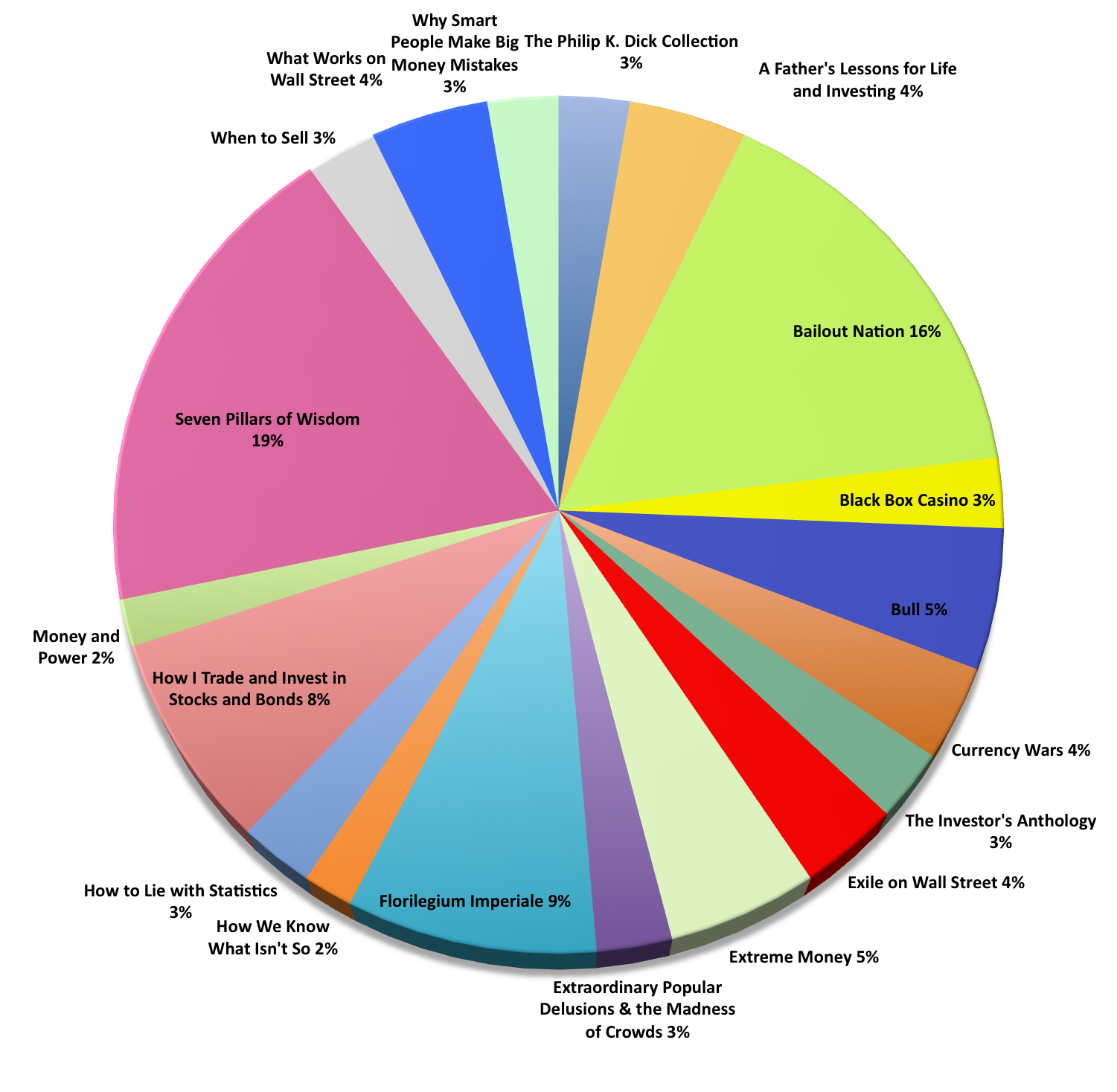
I always find it interesting to see which books TBP readers are buying.
In addition to throwing off minor referral revenue, the Amazon embed code lets me track every click from these links — how many people look at the page, how many books gt collectively purchased.
Its anonymous — I don't know who bought what — but there's lots of data on the various books generated.
These were the most popular TBP books for December:
• Why do stock prices rise every January? New year optimism. (Washington Post) • Top Economists of 2011 (Making Of An Economist) • How to Build Your Financial Dream Team (WSJ) • Back Bill Black, 2012 (Capitalism Without Failure) • A 2×2 Grid to Understanding Some of the Ideological Concerns of Privatization, Especially as it Pertains to Parking (Rortybomb) • The Science Behind New Year's Resolutions (and How to Use It to Achieve Yours) (Life Hacker) • Dave Barry's Year in Review: The 2011 Festival of Sleaze • Why Placebos Work Wonders (WSJ) • The YouTube Laugh Factory: A Studio System for Viral Video (Wired) • Who Is Rick Santorum? (The Atlantic)
"Bank of America Corp. may face billions of dollars more in liability for faulty mortgages if a judge agrees with insurer MBIA Inc. that the lender must buy back loans even if the errors didn't cause a borrower's default…If New York Supreme Court Justice Eileen Bransten and judges in similar cases across the country rule that the issue of "causation" doesn't apply — meaning it's enough to show that the loan was improperly made — it "could significantly impact" Bank of America's potential costs, the bank said in a regulatory filing this month…
Such court defeats may add as much as $9 billion to what Bank of America owes bond insurers, according to hedge fund Branch Hill Capital, which is betting against its stock and has invested in MBIA. A victory for Armonk, New York-based MBIA may also strengthen claims by mortgage-securities investors…"You don't have to wait until you're in a severe accident before you return the car with bad brakes," said David Grais…
The decision may intensify settlement talks between bond insurers like MBIA and other banks that issued securities based on faulty mortgages, according to the head of insurer Assured Guaranty Ltd., which is demanding money from lenders including UBS AG and Credit Suisse Group AG…
"If they lose that case, then our certainty of getting reimbursed becomes a lot higher," Dominic Frederico, Assured's chief executive officer, said in an interview…
Since the start of 2010, Bank of America's cushion for future losses on repurchases of mortgages that never matched their promised quality has ballooned from $4 billion to $17.8 billion even as it made payments in settlements with debt guarantors such as Fannie Mae and Freddie Mac, the government- supported mortgage giants…
Its reserves and guidance on how much more it may need are based on several assumptions, though, including the company's view that losses will only have to be reimbursed if it can be proven "that the alleged representations and warranties breach was the cause of the loss," the bank said in the Aug. 4 filing with the Securities and Exchange Commission. If courts disagree, "it could significantly impact" the estimate of as much as $5 billion in additional liabilities…
"It could change the playing field," MBIA Chief Executive Officer Jay Brown said on an Aug. 10 conference call with analysts and investors when asked about the causation issue. It could "have a very significant effect on the ability to rescind or obtain recessionary damages," he said. "So, it can affect the view of both parties as to the likely outcome of the trial."…
In December, Justice Bransten denied Bank of America's bid to prevent MBIA from using reviews of samples of loans in the case, rather than requiring reviews of every individual mortgage in dispute. The ruling may add to the threats facing Bank of America by encouraging suits, according to the SEC filing…
Bank of America needs to set aside between $10.6 billion and $44.4 billion more to cover losses on soured mortgages sold to or insured by others, said Chris Gamaitoni, a Compass Point Research and Trading LLC analyst…
MBIA's lawyers at Quinn Emanuel Urquhart & Sullivan LLP are also arguing that insurance law should allow it to win against Bank of America on breach-of-contract and fraud claims without proving causation…The causation issue alone may add $8 billion to $9 billion of liabilities from bond insurers, said Manal Mehta, a partner at Branch Hill Capital in San Francisco…
"That is probably as important as the statistical sampling ruling," Mehta said. "It would take away one of Countrywide's key defenses and significantly accelerate the timetable for litigation."…Bank of America, in its talks with 22 of the world's largest debt investors, argued that any loan repurchase would require loss causation be proven, according to a filing in New York state court of an expert opinion by Brian Lin, a managing director at RRMS Advisors. Those negotiations led to the proposed $8.5 billion settlement…
Lin said a settlement between $8.8 billion and $11 billion would be reasonable, relying in part on an assumption that investors would be successful in getting Bank of America to repurchase only 40 percent of misrepresented loans…
Lin was hired by Bank of New York Mellon Corp., the bonds' trustee that is seeking approval for the accord."
In light of the Iowa caucuses today, I thought this powerful Anti-Iraq War advert from Ron Paul was worth showing: >
>
It is important to separate hunting down terrorists who attack our country and deserve justice (which Ron Paul is 100% for), and not confuse justice with occupying entire countries for a decade under the guise of the “War on Terror” or “Spreading Democracy”. Terrorists are individuals and small groups, so why are we picking fights with entire nations? BILLIONS for Defense, NOT A PENNY for Empire.
This speech is called “Imagine” and it was given by Ron Paul on March 11, 2009. The original text of the talk is below:
Imagine for a moment that somewhere in the middle of Texas there was a large foreign military base, say Chinese or Russian. Imagine that thousands of armed foreign troops were constantly patrolling American streets in military vehicles. Imagine they were here under the auspices of “keeping us safe” or “promoting democracy” or “protecting their strategic interests.”
Imagine that they operated outside of US law, and that the Constitution did not apply to them. Imagine that every now and then they made mistakes or acted on bad information and accidentally killed or terrorized innocent Americans, including women and children, most of the time with little to no repercussions or consequences. Imagine that they set up checkpoints on our soil and routinely searched and ransacked entire neighborhoods of homes. Imagine if Americans were fearful of these foreign troops, and overwhelmingly thought America would be better off without their presence.
Imagine if some Americans were so angry about them being in Texas that they actually joined together to fight them off, in defense of our soil and sovereignty, because leadership in government refused or were unable to do so. Imagine that those Americans were labeled terrorists or insurgents for their defensive actions, and routinely killed, or captured and tortured by the foreign troops on our land. Imagine that the occupiers’ attitude was that if they just killed enough Americans, the resistance would stop, but instead, for every American killed, ten more would take up arms against them, resulting in perpetual bloodshed. Imagine if most of the citizens of the foreign land also wanted these troops to return home. Imagine if they elected a leader who promised to bring them home and put an end to this horror.
Imagine if that leader changed his mind once he took office.
The reality is that our military presence on foreign soil is as offensive to the people that live there as armed Chinese troops would be if they were stationed in Texas. We would not stand for it here, but we have had a globe-straddling empire and a very intrusive foreign policy for decades that incites a lot of hatred and resentment towards us.
According to our own CIA, our meddling in the Middle East was the prime motivation for the horrific attacks on 9/11. But instead of re-evaluating our foreign policy, we have simply escalated it. We had a right to go after those responsible for 9/11, to be sure, but why do so many Americans feel as if we have a right to a military presence in some 160 countries when we wouldn’t stand for even one foreign base on our soil, for any reason? These are not embassies, mind you, these are military installations. The new administration is not materially changing anything about this. Shuffling troops around and playing with semantics does not accomplish the goals of the American people, who simply want our men and women to come home. 50,000 troops left behind in Iraq is not conducive to peace any more than 50,000 Russian soldiers would be in the United States.
Shutting down military bases and ceasing to deal with other nations with threats and violence is not isolationism. It is the opposite. Opening ourselves up to friendship, honest trade and diplomacy is the foreign policy of peace and prosperity. It is the only foreign policy that will not bankrupt us in short order, as our current actions most definitely will. I share the disappointment of the American people in the foreign policy rhetoric coming from the administration. The sad thing is, our foreign policy WILL change eventually, as Rome’s did, when all budgetary and monetary tricks to fund it are exhausted.
CREDITS: Voice and Music was done by Jeremy Hoop Video animation was done by Nicholas Bozman and MysteryBox. http://mysterybox.us
Protect the rights of others – do not re-upload this video.
After reviewing the economy, inflation, markets, discussing Europe and giving their economic outlook, the FOMC minutes reveal that things didn’t change too much from their previous meeting and it’s why they maintained their existing stance on policy. This comes notwithstanding QE3 talk from Dudley, Yellen, Tarullo and Evans in various speeches before the Dec meeting. While likely these members pushed their case, the minutes say “they believed that any additional actions would be more effective if accompanied by enhanced communication about the Committee’s longer run economic goals and policy framework.” They then went on further about a new communications strategy where members would give their forecasts for the fed funds rate. This new strategy will likely be employed at the Jan meeting. The meeting also discussed the move in Nov to lower the cost of swap lines to foreign central banks where Lacker dissented because he viewed the move “as amounting to fiscal policy.” Bottom line, we know the FOMC has QE3 ready and waiting based specifically on speeches from Yellen and Dudley over the last few months, the two key members of the committee outside of Ben. The question is only when. In terms of enhanced communication from the Fed, its not how they say it, it’s what the actual policy they are conducting that matters. When the History of the Fed book is written, by someone outside of the Fed, the track record of their policy will be the focus, not how they talked about.
“Republicans talk a lot about losing their way during the last decade, and when they do they’re talking about the Bush years. For Republicans, the Bush administration has become the ‘yadda yadda yadda’ period of American history.”
-Jack Pitney, a political science professor at Claremont-McKenna College.
>
Gee, I wonder why this is?
The AP reports on the elephant not discussed at all in Iowa
“While Obama may be overly eager to blame the Bush years for the nation’s problems, GOP presidential contenders seem just as eager to pretend those years never happened.
Taking office in 2001 with a balanced federal budget and a surplus, Bush quickly pushed through sweeping tax cuts that were not offset by spending cuts. The tax cuts have cost about $1.8 trillion, according to estimates by the Congressional Budget Office and the Center on Budget and Policy Priorities.
The Bush tax cuts were set to expire after 10 years, but Obama allowed them to remain in place temporarily in exchange for an extension of unemployment benefits and a payroll tax cut.
The wars in Iraq and Afghanistan launched after the Sept. 11, 2001, terror attacks never were budgeted and have cost taxpayers about $1.4 trillion so far. Obama ordered the last troops out of Iraq in December, but the Afghanistan conflict will extend into 2014.
Bush signed legislation in 2003 enacting a prescription drug benefit as part of Medicare, the government health care plan for seniors — a huge entitlement program projected to cost as much as $1.2 trillion over 10 years.
The Troubled Asset Relief Program, the bank bailout program widely loathed by many conservatives, was another Bush-era program. Congress authorized nearly $700 billion for the program at the recommendation of Bush’s treasury secretary, former Goldman Sachs executive Henry Paulson, in response to the collapse of Lehman Brothers and the subsequent financial crisis in the fall of 2008. As a presidential candidate, Obama supported the TARP bailout, as did his GOP rival, Sen. John McCain.”
Other than that, Mrs. Lincoln, how did you like the play?
> Source: George W. Bush Barely Mentioned In GOP Campaign The Associated Press, January 3, 2012 http://www.boston.com/news/local/massachusetts/articles/2012/01/03/george_w_bush_barely_mentioned_in_gop_campaign/









0 comments:
Post a Comment