


The Big Picture |

- Is The ADP Payroll Number a Trap?
- All The World’s Gold
- Indecision 2012 – Iowa Caucus Hilarious Cable News Coverage
- 10 Thursday PM Reads
- Signs of the Time: ReadyForZero
- Not Even Corp Mgmt Believe Their Own Equity Return Assumptions
- 10 Thursday AM Reads
- QOTD: On ADP
- Jobs data
- Uncle Leo Defends The Cheetah Traders
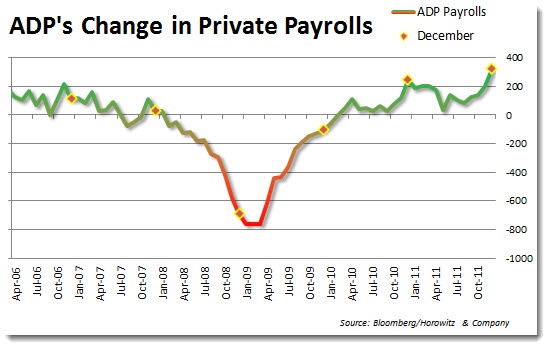
| Is The ADP Payroll Number a Trap? Posted: 05 Jan 2012 10:30 PM PST Is The ADP Payroll Number a Trap? ~~~ From Andrew Horowitz of The Disciplined Investor: There has been a good deal of discussion around the web and other media outlets concerning the rather extreme reading on today's ADP payroll report. The most often cited item is the regular December aberrations that are seen with ADP and potential distortions that have occurred. If we were to only isolate the last two years, it does appear as if the December reports have a signifiant differential from expectations and the NFP report. But that may be simply coincidental. Here is the data over several years with the month of December highlighted.
Looking further back, the month of November is often the peak during the range. That makes sense as hiring is much more common at the end of the year into the holiday season. So, it appears that the grumblings are a bit off base. That does not mean that we will see as huge of a number in Friday's report as ADP and NFP do not often report in lockstep.
But whatever the reason, it is rather impressive to see hiring as robust as it is – considering the state of the global economy. Is this the turning point? Maybe, but it sure does not look like it when all of the economic numbers are put together. That said, over history, turning points have come just when most believe that is will never arrive. |
| Posted: 05 Jan 2012 05:21 PM PST |
| Indecision 2012 – Iowa Caucus Hilarious Cable News Coverage Posted: 05 Jan 2012 05:12 PM PST Stephen Colbert: The Fox News team soldiers on in its Iowa caucus coverage despite the loss of basic mental functions, and CNN debuts its tricky flick technology. ~~~ Jon Stewart: Indecision 2012 – The Corn Identity |
| Posted: 05 Jan 2012 01:30 PM PST My afternoon train reading:
What are you reading? > When in Doubt . . . |
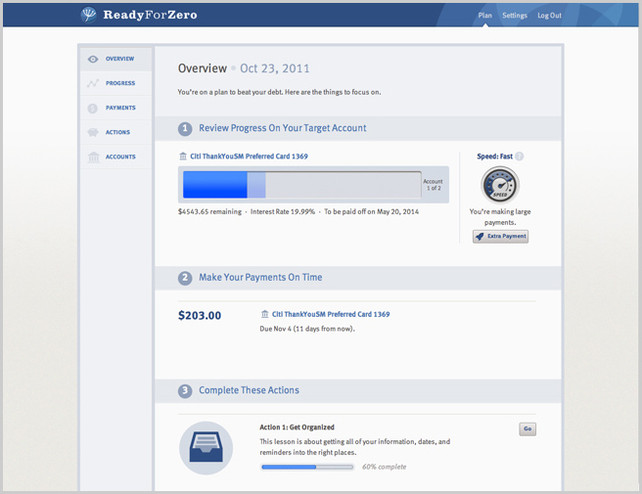
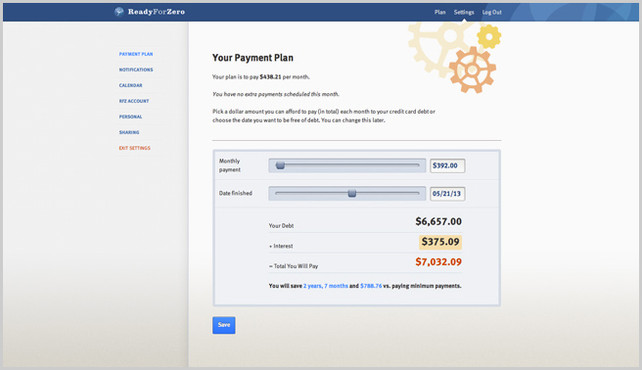
| Signs of the Time: ReadyForZero Posted: 05 Jan 2012 11:31 AM PST File this under “Signs of the Time” — a new free online financial program ReadyForZero designed to “help you manage and reduce debt.” The site lets you aggregate of all of your debt info, create a payment plan, and follow your progress in getting out of debt. Its the weight watchers model — the site’s founders claim you can get out of debt twice as fast:
> Hat tip Fastco Designs |
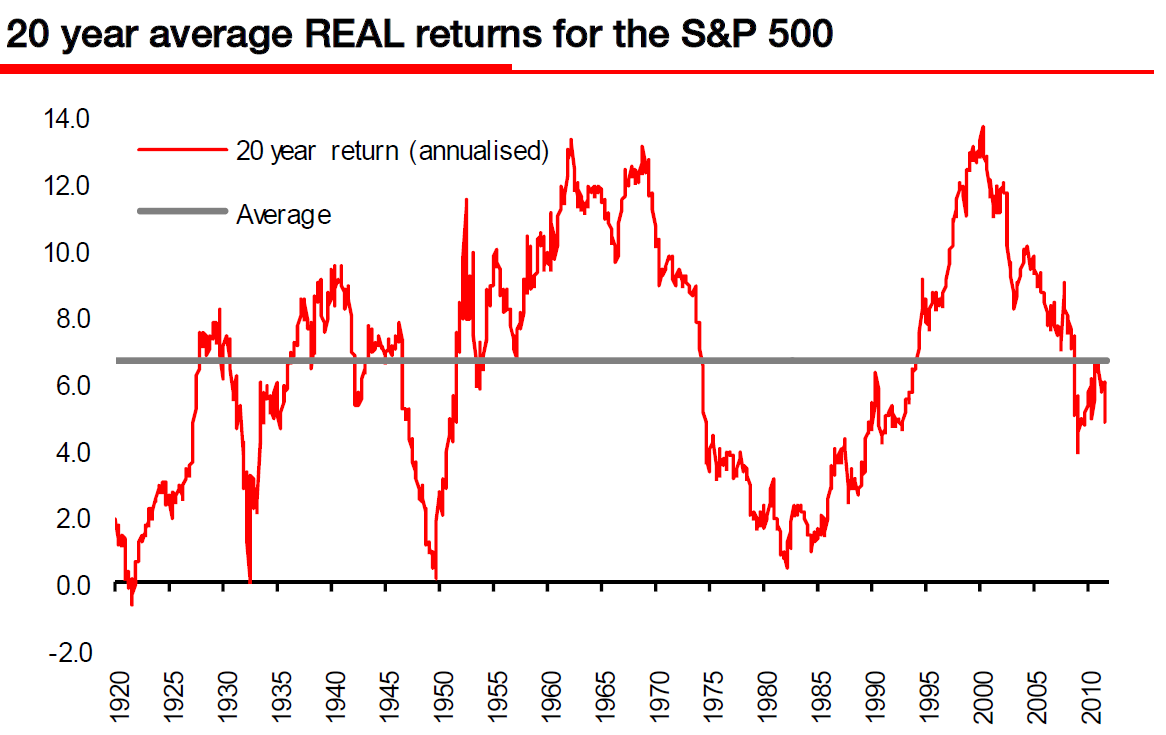
| Not Even Corp Mgmt Believe Their Own Equity Return Assumptions Posted: 05 Jan 2012 08:20 AM PST
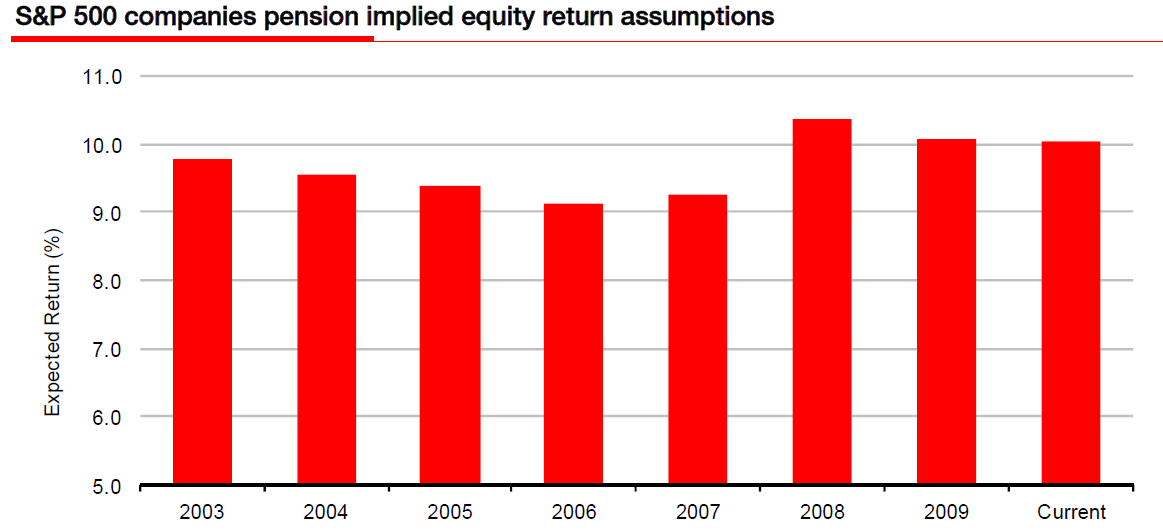
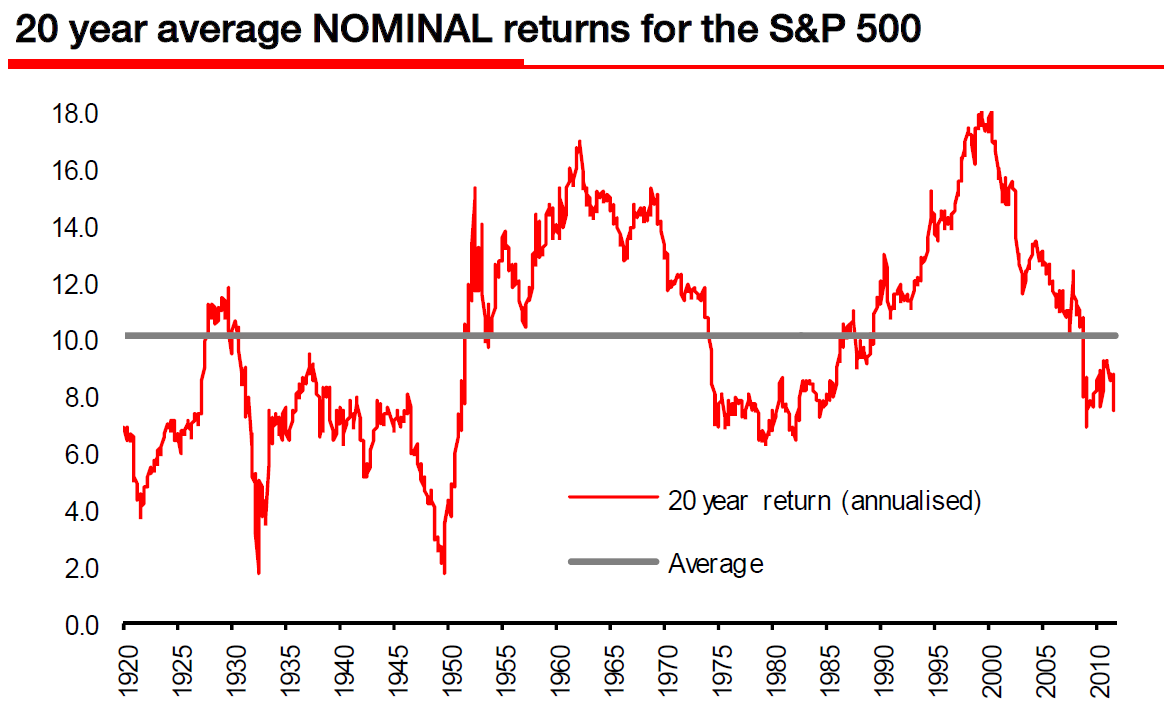
> Last month, I presented to the National Association of State Treasurers. The room had all 50 State Treasurers, lots of Deputy and Asst Treasurers, and staff. I was realistic about how credit crises unwind over long periods of time. The prior panel had the major ratings agency reps, and they had discussed Pension Return Assumptions. Given their utter incompetency, it was no surprise the Ratings firms were okay with expected blended returns of 8%. An audience member asked a question to me about this, and I laughed. I told the Treasurers that the consultants who tell them they should have expected 8% blended returns for the past 5-10 years were dead wrong, and the ones who told them they could expect 8% blended returns for the next 5-10 years were probably high. My joke was to get to 8% required bad math — blended expected returns of 8% requires taking 5% gains in equities and adding 3% gains in bonds (5+3=8). How often do you get to make a wonky accounting joke to a room full of treasurers? But, as it turns out, its even worse on the Corporate side: S&P 500 companies pension funds. They currently assume future equity returns of above 10%, according to their own financial statements. As I made clear to the State Treasures, that is an absurd expectation. Andrew Lapthorne of Société Générale’s Global Quantitative Research group points out how absurd this is:
We have ultra low yields after 3 years of ZIRP and a market that is precisely where it was 11 years ago. Valuation using forward earnings estimates are at best reasonable, and using trailing 10 year and/or CAPE are subject to potential reversals off of an earnings peak. US equity returns may quote possibly be in the single digits over the coming decade. Is this the circumstances that lead to 10% plus blended returns for the next decade? >
> Source: Quant Quickie, 5 January 2012 |
| Posted: 05 Jan 2012 06:35 AM PST My Morning reading material:
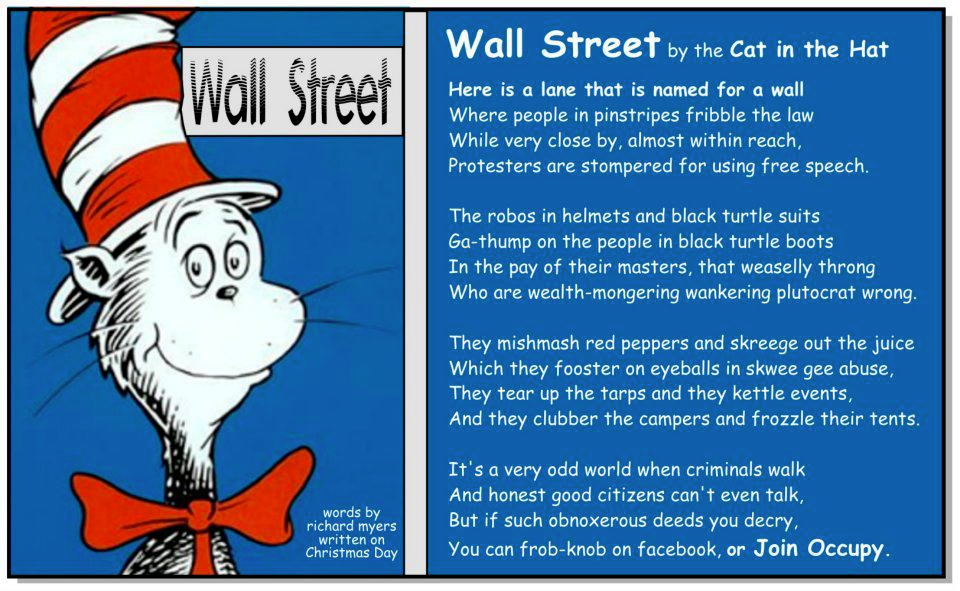
What are you reading? > The Cat in the Hat Comes to OWS
|
| Posted: 05 Jan 2012 06:22 AM PST |
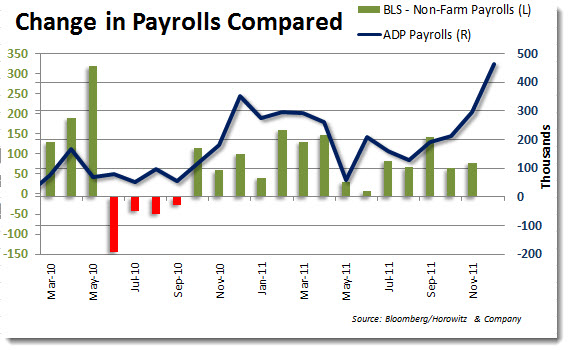
| Posted: 05 Jan 2012 06:20 AM PST ADP said private sector job adds totaled 325k in Dec, a blowout compared to expectations of 178k and compares with 204k in Nov. Job gains were mostly led by small and medium sized businesses in the service providing sector but we also saw job gains of 52k in the goods producing area of which 22k were created in manufacturing and 26k in construction. Bottom line, it’s great news to see this level of job gains in the private sector but Macroeconomic Advisors, which compiles the data, did say December seasonals may have had ‘idiosyncratic’ influences of the report. Dec ’10 also saw a big jump from the prior few months only to fall back in the months after. With this said, tomorrow’s Payroll report is expected to show a gain of 175k in the private sector and we’ll see if economists revise that higher after ADP or take the seasonal computing issues seriously and leave them as is. Initial Jobless Claims totaled 372k, 3k less than expected but last week was revised up by 6k to 387k. The 4 week average did fall to 373k from 377k. Continuing Claims fell by 22k but were 25k above estimates. Extended Benefits were little changed, rising 5k. Bottom line, the 4 week average is down to the lowest since June ’08 and if ADP is accurate, the reduced level of firing’s is being followed up by a faster pace of hiring’s. We’ll of course have to wait until tomorrow’s report for further confirmation as ADP in Dec ’10 reported a 246k private sector job gain while US private payrolls were higher by 167k. Either way, the labor market is improving. With respect to the S&P futures only bouncing modestly in light of the blowout ADP figure, Europe continues to trade weak and US retail comps had many misses in Dec |
| Uncle Leo Defends The Cheetah Traders Posted: 05 Jan 2012 06:16 AM PST Joseph Saluzzi (jsaluzzi-at-ThemisTrading.com) and Sal L. Arnuk (sarnuk-at-ThemisTrading.com) are co-heads of the equity trading desk at Themis Trading LLC (www.themistrading.com), an independent, no conflict agency brokerage firm specializing in trading listed and OTC equities for institutions. Prior to founding Themis, Sal and Joe worked for more than 10 years at Instinet Corporation, pioneers in the field of electronic trading, and at Morgan Stanley. ~~~
Some of the largest high frequency traders were born out of the derivatives industry. The co-founders of GETCO were both involved in the options and futures business on the floor of the CBOE and CME before starting their HFT "market making" firm. It is not surprising that the Futures Industry Association created a splinter group called the FIA Principal Traders Group which is basically a lobbying arm for HFT firms. Check out their list of latency sensitive members . It's also not surprising to us when we see a former executive from a futures exchange stand up to defend HFT. This time around Leo Melamed, former chairman of the CME, (let's just call him Uncle Leo) is at it again and he is standing up for the rights of "cheetah" traders. Uncle Leo is no impartial observer and has a vested stake in the game. He is known to some as the "father of financial futures" and is an advisor to the CME (which of course benefits tremendously from HFT "arbitrageurs"). He is also a consultant to Infinium Capital Management. You may remember Infinium Capital for their recent "computer malfunctions" which caused their algorithms to start buying up crude oil futures. They were fined the whopping sum of $850,000 by the CME for "failing to supervise" their systems for these violations. In his FT article titled Protect HFT cheetahs from regulatory poachers , Uncle Leo talks about the usual evolutionary spirit of HFT, its ability to be that great spread shrinking machine and of course the creator of tons of liquidity. Uncle Leo also does some good old fashioned flag waving in his piece: "Our nation's futures markets are an outstanding example of "American Exceptionalism". They are a crucible for innovation and job creation. They represent an American natural resource. It is the duty of the CFTC not only to keep up with the market cheetahs, but as Teddy Roosevelt admonished in a different context, they must also treat our natural resources "as assets which it must turn over to the next generation increased and not impaired in value". We have never heard the term "job creation" used from HFT defenders. Maybe they are trying a new route since their tired old defenses do not seem to be working. And then to invoke the words of Teddy Roosevelt and compare HFT to "natural resources" is a stretch even beyond what the most twisted, next generation SOES-bandit could ever imagine. While its true that the futures market is critical to the success of our financial markets, it's also true that these markets have been hijacked by the hyper-speed, nanosecond speculator. And what exactly does an HFT trader do to get the title of "an American natural resource"? Uncle Leo tells us that "their principal objective is to take advantage of minute discrepancies in prices." Well, that sure sounds like it benefits every American and we all should be thankful for these scalpers. It sure sounds like scalping minute price discrepancies is healthy for capital formation and job creation. But what happens when times get tough and volatility spikes, where will these "American natural resources" traders be then? We all know the answer to that question but somehow Uncle Leo forgot to tell us about that. |



| You are subscribed to email updates from The Big Picture To stop receiving these emails, you may unsubscribe now. | Email delivery powered by Google |
| Google Inc., 20 West Kinzie, Chicago IL USA 60610 | |



0 comments:
Post a Comment