.

{2} GoogleTranslate (H)

English French German Spanish Italian Dutch Russian Portuguese Japanese Korean Arabic Chinese Simplified

Our New Stuff

{3} up AdBrite + eToro

Your Ad Here

Tuesday, January 10, 2012

The Big Picture

The Big Picture


Job Creators, Internet Architects and Security Experts Hate SOPA

Posted: 09 Jan 2012 10:30 PM PST

Job Creators Hate Internet Bill

I noted last month that SOPA would destroy jobs and the economy.

As Digital Trends points out:

The list of SOPA opponents also includes 425 venture capitalists and entrepreneurs — i.e. job creators. The editorial boards of The New York Times and Los Angeles Times are on the list, as are 39 public advocacy groups, nonprofits and think tanks who believe that SOPA will stifle freedom of speech. These are joined by 61 international human rights groups, and 116 academics and law experts from the nation's top law schools. In short: The list of SOPA critics could not be any more legitimate.

And see this.

Internet Architects and Security Experts Warn Against SOPA

Digital Trends also reports that the creators of the Internet and security experts oppose SOPA:

83 Internet pioneers — we're talking people like Vint Cerf, co-designer of TCP/IP; Jim Gettys, editor of the HTTP/1.1 protocol standards; Leonard Kleinrock, a key developer of the ARPANET; in other words, the very people who built the Internet — who say that SOPA (and the Protect IP Act, PIPA), "will risk fragmenting the Internet's global domain name system (DNS) and have other capricious technical consequences" because of the bills' requirement that Internet service providers block domain names of infringing sites.

In their letter to Congress, this group of Internet founders also argues that SOPA "will create an environment of tremendous fear and uncertainty for technological innovation, and seriously harm the credibility of the United States in its role as a steward of key Internet infrastructure."

***

Former Department of Homeland Security Assistant Secretary Stewart Baker … agrees with the Internet founders when he says that SOPA will "do great damage to Internet security, mainly by putting obstacles in the way of DNSSEC, a protocol designed to limit certain kinds of Internet crime," among other repercussions.

Indeed, the Internet and security experts opposing this horrible legislation include luminaries such as:

  1. Sandia National Laboratories
  2. Ramaswamy Aditya, built various networks and web/mail content and application hosting providers
  3. Mike Alexander, helped implement one of the first EMail systems to be connected to the Internet
  4. Guy Almes, led the connection of universities in Texas to the NSFnet
  5. Alia Atlas, designed software in a core router (Avici)
  6. Fred Baker, former IETF chair
  7. John Bartas, was technical lead on first commercial IP/TCP software for IBM PCs
  8. Steven Bellovin, invented DNS cache contamination attack
  9. Robert Bonomi, designed, built, and implemented, the Internet presence for a number of large corporations
  10. Seth Breidbart, helped build the Pluribus IMP/TIP for the ARPANET
  11. Jon Callas, worked on Internet security standards including OpenPGP, ZRTP, DKIM, Signed Syslog, SPKI
  12. L. Jean Camp, former Senior Member of the Technical Staff at Sandia National Laboratories
  13. Stephen L. Casner, led the working group that designed Real-time Transport Protocol
  14. Bradford Chatterjee, Network Engineer, helped design backbone network for a nationwide ISP
  15. Noel Chiappa, has been working on the lowest level stuff (the IP protocol level) since 1977
  16. Dr. Richard Clayton, designer of Turnpike; Computer Security researcher at Cambridge University
  17. Walt Daniels, IBM's contributor to MIME
  18. Steve Deering, Ph.D., invented the IP multicast feature of the Internet
  19. Esther Dyson, founding chairman, ICANN
  20. David Farber, Principal in development of CSNET, NSFNET, NREN, GIGABIT TESTBED
  21. Stephen Farrell, co-author on about 15 RFCs
  22. Elizabeth Feinler, developed naming conventions for Internet top level domains
  23. Jim Gettys, editor of the HTTP/1.1 protocol standards
  24. John Gilmore, co-designed BOOTP (RFC 951), which became DHCP
  25. Steve Goldstein, Program Officer for International Networking Coordination at NSF 1989-2003
  26. Jack Haverty, Principal Investigator for DARPA projects including first Internet development and operation
  27. Simon Higgs, designed the role of the stealth DNS server that protects a.root-servers.net
  28. Robert M. Hinden, worked on the gateways in the early Internet
  29. Christian Huitema, worked on building the Internet in France and Europe in the 80's
  30. John Kemp, Principal Software Architect, Nokia
  31. John Klensin, Ph.D., early role in design of Internet applications and coordination and administrative policies
  32. Justin Krejci, helped build and run the two biggest and most successful municipal wifi networks
  33. Dave Kristol, co-author, RFCs 2109, 2965 (Web cookies)
  34. Phil Lapsley, co-author of the Internet Network News Transfer Protocol (NNTP)
  35. Anthony Lauck, helped design and standardize routing protocols and local area network protocols
  36. Tony Li, co-author of BGP (the protocol used to arrange Internet routing)
  37. Christopher Liljenstolpe, was the chief architect for AS3561 and AS1221
  38. Jon Loeliger, has implemented OSPF, one of the main routing protocols used to determine IP packet delivery
  39. Alexander McKenzie, participated in design of first ARPAnet Host protocols
  40. David Mercer, formerly of The River Internet, provided service to more of Arizona than any local, national ISP
  41. Samuel Moats, senior systems engineer for the Department of Defense
  42. Keith Moore, was on the Internet Engineering Steering Group from 1996-2000
  43. Lyndon Nerenberg, Creator of IMAP Binary extension (RFC 3516)
  44. David Newman, 20 years' experience in performance testing of Internet infrastructure
  45. Carl Page, helped found eGroups
  46. Craig Partridge, architect of how email is routed through the Internet
  47. John Pettitt, Internet commerce pioneer
  48. Louis Pouzin, designed and implemented first computer network using datagrams
  49. Ryan Rawdon, was on the technical operations team for one of our country's largest residential ISPs
  50. Glenn Ricart, Managed the original (FIX) Internet interconnection point
  51. Peter Rubenstein, helped to design and build the AOL backbone network, ATDN
  52. Larry Stewart, built the Etherphone at Xerox
  53. Robert W. Taylor, founded Xerox PARC Computer Science Lab which designed first Internet protocol
  54. Paul Timmins, designed and runs the multi-state network of a medium sized telephone and internet company
  55. John Vittal, created the first full email client and the email standards still in use today

10 Monday PM Reads

Posted: 09 Jan 2012 01:30 PM PST

My afternoon train reading:

• More U.S. Part-Timers Find Full-Time Jobs (Bloomberg)
• Wall Street’s Big Banks Are the Real Threat to Our Economy (Fox News)
• QE3 or Not? (Tim Duy’s Fed Watch)
• Leading Indicators and the Risk of a Blindside Recession (Hussman Funds) see also How Austerity Is Killing Europe (NY Review of Books)
• Addiction to Prediction (Process Maximus)
• The boy wonder of the MF Global nightmare (Fortune)
• Americans Stumble on Math of Big Issues (WSJ) see also Americans and Innumeracy (The Monkey Cage)
• Montana Supreme Court Defies Citizens United Ruling (Law.com)
• How Many Stephen Colberts Are There? (NYT Mag)
• New Details Emerge On The Porsche 918 Spyder Hybrid Supercar (Motorauthority)

What are you reading?

>

Jim O’Neill Picks the Next BRICs

Posted: 09 Jan 2012 12:15 PM PST

Jim O’Neill, creator of the acronym BRICs 10 years ago, is positive on the prospects of the BRIC economies but also of other “growth” markets such as Turkey and Mexico. He talks to Tracy Corrigan, Editor-in-Chief of The Wall Street Journal Europe.

Jan. 9, 2012

iPad Falls From Edge of Space – and Survives

Posted: 09 Jan 2012 11:41 AM PST

The Digital Living Room

Posted: 09 Jan 2012 11:30 AM PST

Interesting look at the changes coming to your living room, courtesy of, well everyone competing for your entertainment dollar:

>


Hat tip thingsigrab

full graphic after the jump

>

click for ginormous graphic
INFOGRAPHIC: Welcome to the Digital Living Room: How is the TV Landscape Changing?

Global PMI Scorecard: A turn for the better led by the U.S. and China

Posted: 09 Jan 2012 10:30 AM PST

Listen to this article. Powered by Odiogo.com

The acceleration in global economic activity since the lows in October gained traction in December.

The JP Morgan Global Composite Index improved to 53.0 from 52.0 in November after falling to 51.4 in October. While the improvement in the composite PMI could virtually be attributed entirely to a significant improvement in business conditions in the U.S., the improvement in December was more broad based. The U.S. continues to lead the way, though, as my GDP-weighted Composite ISM PMI taking into account the Non-manufacturing Business Activity Index (the basis Markit uses to calculate the composite PMIs) instead of the PMI itself improved further to 55.7 from 55.4 in November. The manufacturing sector experienced accelerated growth increasing to 53.2 from 52.7. The ISM Business Activity Index remained unchanged at a relatively robust 56.2.

China, Brazil and India contributed significantly to the acceleration in global economic activity. China reversed the unseasonal slump in November in both the manufacturing and non-manufacturing sectors while Indian industries accelerated to near robust levels.

The contraction in the Eurozone's private sector eased markedly for the second consecutive month. My calculated GDP-weighted PMI for the Eurozone rose to 48.3 from 47.2 in November and 46.6 in October. After stagnating in November, growth in Germany's services sector is accelerating again while the services sector in France has stopped contracting. Elsewhere in the Eurozone the situation is dire to say the least, with the services sector in Ireland joining the contraction in the other debt-ridden Eurozone countries. However, the contraction in the Eurozone's manufacturing sector, including France and Germany, continues. The acceleration in growth in the U.K.'s services sector from near stagnation in November is noteworthy.

The situation in Australia' manufacturing and services sectors has stabilized while Japan is showing signs of acceleration in growth. The contraction in Hong Kong and Taiwan eased somewhat but the contraction in South Korea's manufacturing sector deepened. In the Middle East, Saudi Arabia's economy remains robust but growth in the Emirate states is faltering.

GDP-weighted/ Composite PMI Direction

Rate of change

Country Dec-11 Nov-11
U.S.*** 52.9 52.2 Growing Faster
U.S. BAI***(note 1) 55.7 55.4 Growing Faster
Eurozone**** 48.3 47.2 Contracting Slower
Germany* 51.3 49.4 Growing From contracting
France* 50.0 48.8 Stagnated From contracting
U.K.**** 52.8 50.8 Growing Faster
Japan* 50.1 48.9 Stagnated From contracting
Emerging Economies
China** 52.6 49.3 Growing From contracting
China S/A** 52.4 49.5 Growing From contracting
Brazil* 53.2 51.5 Growing Faster
India* 54.7 52.3 Growing Faster
Russia* 53.5 54.6 Growing Slower
Hong Kong* 49.7 48.7 Contracting Slower
UAE* 51.7 52.5 Growing Slower
Saudi Arabia* 57.7 58.1 Growing Slower
JP Morgan Global Composite* 53.0

52.0

Growing Faster

Note: ISM Non-manufacturing Business Activity Index used instead of Non-manufacturing PMI.

Sources: *Markit; **CFLP, Li & Fung, Plexus Asset Management; ***ISM, Plexus Asset Management; ****Markit, Plexus Asset Management.

Non-manufacturing/

Services PMI

Direction Rate of Change
Country Dec-11 Nov-11
U.S.** 52.6 52.0 Growing Faster
U.S. BAI*** 56.2 56.2 Growing Steady, robust
Eurozone 48.8 47.5 Contracting Slower
Germany 52.4 50.3 Growing Faster
France 50.3 49.6 Growing From contracting
Italy 44.5 45.8 Contracting Faster
Spain 42.1 36.8 Contracting Slower
Ireland 48.4 52.7 Contracting From growing
U.K. 54.0 52.1 Growing Faster
Japan 50.4 49.5 Growing From contracting
Australia 49.0 47.7 Contracting Slower
Emerging Economies
Brazil 54.8 52.6 Growing Faster
China* 56.0 49.7 Growing From contracting
China S/A* 55.3 51.4 Growing Faster
India 54.2 53.2 Growing Faster
Russia 53.8 54.8 Growing Slower
JP Morgan Global Services 53.2 52.6 Growing Faster

Sources: Markit; CFLP*; ISM**; US Business Activity Index***; Plexus Asset Management.

Manufacturing PMI

Direction

Rate of Change

Country Dec-11 Nov-11
U.S.***** 53.2 52.7 Growing Faster
Eurozone* 46.9 46.4 Contracting Slower
Germany* 48.4 47.9 Contracting Slower
France* 48.9 47.3 Contracting Slower
Greece* 42.0 40.9 Contracting Slightly slower
Italy* 44.3 44.0 Contracting Slight slower
Spain* 43.7 43.8 Contracting Slightly faster
Ireland* 48.6 48.5 Contracting Slightly slower
U.K.* 49.6 47.6 Contracting Slower
Japan* 50.2 49.1 Growing From contracting
Australia* 50.2 47.8 Growing From contracting
Emerging Economies
Brazil* 49.1 48.7 Contracting Slower
China** 50.3 49.0 Growing From contracting
China S/A 50.5 48.3 Growing From contracting
Czech* 49.2 48.6 Contracting Slower
Poland* 48.8 49.5 Contracting Faster
Turkey* 52.0 52.3 Growing Slightly slower
India* 54.2 51.0 Growing Faster
Russia* 51.6 52.6 Growing Slower
Taiwan* 47.1 43.9 Contracting Slower
S Korea 46.6 47.1 Contracting Faster
Global**** 50.4 49.6 Growing From contracting

Sources: Markit*; Li & Fung**; Kagiso***; Plexus Asset Management****; ISM*****.

Did you enjoy this post? If so, click here to subscribe to updates to Investment Postcards from Cape Town by e-mail.

Nonfarm Payrolls: A Tale of Two Charts

Posted: 09 Jan 2012 09:00 AM PST

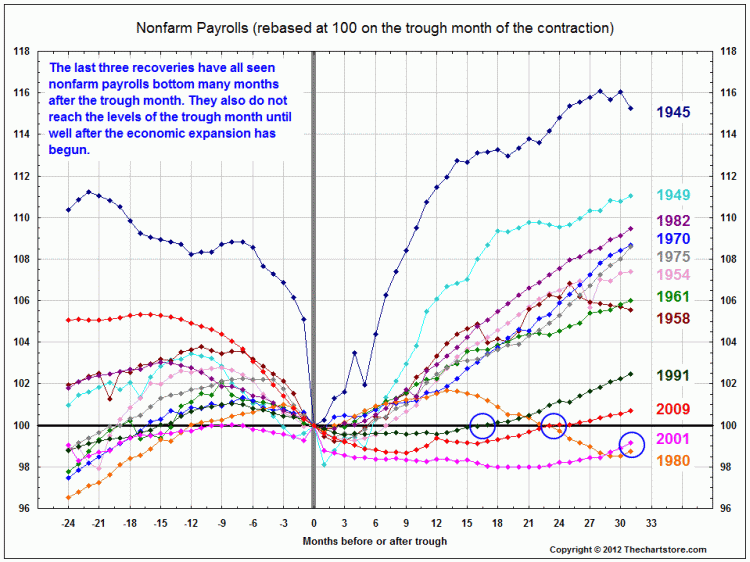
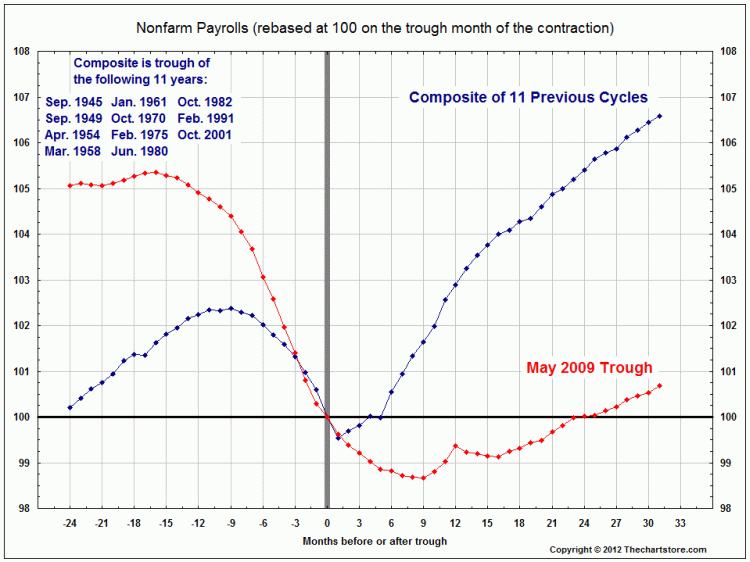
A pair of telling charts, courtesy of Ron Griess of the Chart Store. It is terribly obvious that the post credit crisis employment situation is far uglier than ordinary cyclical recessions.

At least the red line in the chart at bottom is pointing upwards . . .

>

click for ginormous charts

˜˜˜

Make Your 401(k) Work Harder

Posted: 09 Jan 2012 08:00 AM PST

Don’t let your 401(k) languish.

That is the ‘radical” conclusion of the Employee Benefits Research Institute, a D.C. think tank.

Brett Arends of the WSJ gets more specific, and suggests a five-step plan to fix your 401(k):

1. Take control.
2. Cut your costs.
3. Lighten up on U.S. stocks.
4. Look internationally.
5. Review your bond funds.

Most od the 401(k) plans I review unfortunately offer a rather limited range of investment options — few ETFs, too many similar funds. Rolling over your plan into a self-directed individual retirement account allows you many more options for retirement. All you need to do is change jobs or quit.

I have an idea: National 401(k) Roll Over Day — even if you don’t quit! What are the odds of getting that passed . . . ?

>

Source:
How to Make Your 401(k) Plan Work Harder
Brett Arends
WSJ, January 8, 2012
http://online.wsj.com/article/SB10001424052970203462304577138834217346506.html

10 Monday AM Reads

Posted: 09 Jan 2012 07:00 AM PST

My morning reads to start the week

Hardly a contrarian signal: Why stocks will beat bonds over the next 20 years (Market Watch) see also After 12 years, bulls see stocks coming out of rut (LA Times)
• 10 Stocks Analysts Say to Sell (Smart Money)
• The Fed's Sleazy Idea Of "Transparency" (Implode Meter Blog)
• Enron's 'Teflon Lou' (The Daily)
• Unemployment Scars Likely to Last for Years (WSJ)
• Agency vs Principal: The Root Of Some Evil (Epicurean Dealmaker)
• A New Year, the Same Ol’ Pessimism (WSJ) see also Wall Street Is Squeezed by Slowdown in Trading (WSJ)
• A Tech Show Loses Clout as Industry Shifts (NYT)
• Death-by-Smartphone Spurs Camera Makers (Bloomberg) see also Everything you need to know about buying a camera (The Verge)
• Remarkably dry and warm winter due to record extreme jet stream configuration (Wunderground)

What are you reading?

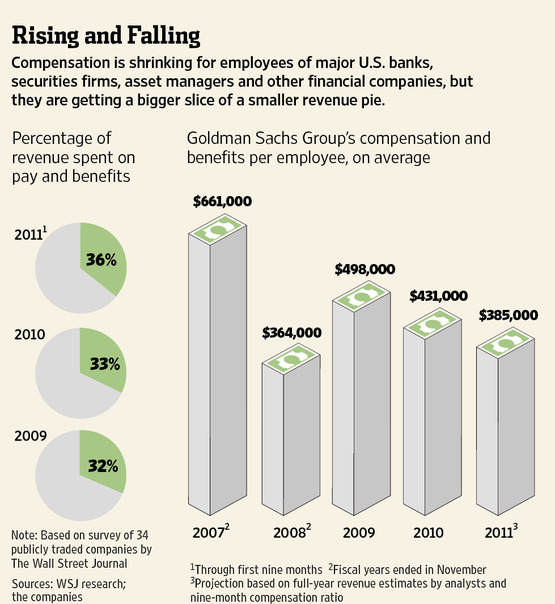
Wall Street Prepares to Take Sharp Pay Cut


Source: (WSJ)

James Bianco: More of the Same in 2012

Posted: 09 Jan 2012 06:31 AM PST


.

0 comments:

Post a Comment

previous home Next

{8} chatroll


{9} AdBrite FOOTER

{8} Nice Blogs (Adgetize)