Anonymous political speech has a special place in American history.
As leading economic blogger Tyler Durden points out:
Anonymity is a shield from the tyranny of the majority. it thus exemplifies the purpose behind the bill of rights, and of the first amendment in particular: to protect unpopular individuals from retaliation– and their ideas from suppression– at the hand of an intolerant society.
***
Though often maligned (typically by those frustrated by an inability to engage in ad hominem attacks) anonymous speech has a long and storied history in the United States. Used by the likes of Mark Twain (aka Samuel Langhorne Clemens) [and the founding fathers in the Federalist Papers], we think ourselves in good company in using one or another nom de plume. Particularly in light of an emerging trend against vocalizing public dissent in the Uunited States, we believe in the critical importance of anonymity and its role in dissident speech. like the Economist magazine, we also believe that keeping authorship anonymous moves the focus of discussion to the content of speech and away from the speaker- as it should be.
Do you have a right to anonymous political free speech?
According to the Supreme Court, you do. According to the Department of Homeland Security, you don't. They've hired General Dynamics to track U.S. citizens exercising this critical civil right.
The history of anonymous political free speech in America dates back to our founding. The seminal essays found in "The Federalist Papers" were written by Alexander Hamilton, James Madison and John Jay under the nom de plume of "Publius" although this was not confirmed until a list of authorship complied by Hamilton was posthumously released to the public. As previously discussed on this blog, the right to anonymous political free speech has been addressed by the Supreme Court. Most notably in the cases of Talley v. California, 362 U.S. 60 (1960) and McIntyre v. Ohio Elections Commission, 514 U.S. 334 (1995). In Talley, Justice Hugo Black writing for the majority said that, "Anonymous pamphlets, leaflets, brochures and even books have played an important role in the progress of mankind. Persecuted groups and sects from time to time throughout history have been able to criticize oppressive practices and laws either anonymously or not at all." In McIntyre, Justice John Paul Stevens writing for the majority said that, "Anonymity is a shield from the tyranny of the majority. [… ] an author's decision to remain anonymous, like other decisions concerning omissions or additions to the content of a publication, is an aspect of the freedom of speech protected by the First Amendment." That seems clear enough in defining that citizens do have a Constitutionally protected right to anonymous political free speech.
"Under the National Operations Center (NOC)'s Media Monitoring Initiative that came out of DHS headquarters in November, Washington has the written permission to retain data on users of social media and online networking platforms.
Specifically, the DHS announced the NCO and its Office of Operations Coordination and Planning (OPS) can collect personal information from news anchors, journalists, reporters or anyone who may use "traditional and/or social media in real time to keep their audience situationally aware and informed."
According to the Department of Homeland Security's own definition of personal identifiable information, or PII, such data could consist of any intellect "that permits the identity of an individual to be directly or indirectly inferred, including any information which is linked or linkable to that individual." Previously established guidelines within the administration say that data could only be collected under authorization set forth by written code, but the new provisions in the NOC's write-up means that any reporter, whether someone along the lines of Walter Cronkite or a budding blogger, can be victimized by the agency.
Also included in the roster of those subjected to the spying are government officials, domestic or not, who make public statements, private sector employees that do the same and "persons known to have been involved in major crimes of Homeland Security interest," which to itself opens up the possibilities even wider.
The department says that they will only scour publically-made info available while retaining data, but it doesn't help but raise suspicion as to why the government is going out of their way to spend time, money and resources on watching over those that helped bring news to the masses." – rt.com
This question about the right to anonymous political free speech is also asked over the background of the Electronic Privacy Information Center filing a FOIA request against the DHS to find out the details of the agency's social network monitoring program.
***
As part of recent disclosures related to the EPIC suit, it is revealed that the DHS has hired and instructed General Dynamics to monitor political dissent and the dissenters. The range of websites listed as being monitored is quite impressive. Notably, jonathanturley.org is not on this list [Howington's essay is a guest blog on constitutional law professor Jonathan Turley's website], but equally of note is that this list is by the DHS' own admission "representative" and not "comprehensive".
***
Some of the more high profile and highly trafficked sites being monitored include the comments sections of The New York Times, The Los Angeles Times, Newsweek, the Huffington Post, the Drudge Report, Wired, and ABC News. In addition, social networking sites Facebook, MySpace and Twitter are being monitored. For the first time, the public not only has an idea who the DHS is pursuing with their surveillance and where, but what they are looking for as well. General Dynamics contract requires them to "[identify] media reports that reflect adversely on the U.S. Government, DHS, or prevent, protect, respond government activities." The DHS also instructed General Dynamics to generate "reports on DHS, Components, and other Federal Agencies: positive and negative reports on FEMA, CIA, CBP, ICE, etc. as well as organizations outside the DHS." In other words, the DHS wants to know who you are if you say anything critical about the government.
Anybody thinking of the name "Goebbels" at this point is not out of line.
Nothing To Do With Security
This has nothing at all to do with keeping us safe:
Remember, widespread spying on Americans began before 9/11.
Interesting discussion at Economix looking at the top economic strata:.
Instead of using income (as the Census does) to measure wealth, what if we looked at Assets instead (as the Federal Reserve's Survey of Consumer Finances does)?. No surprise, the wealth gap as measured by net worth is much more extreme than that measured by income.
- Estimates for top 1% is a household income of about ~$380,000; ~7.5 times median household income.
-Net worth, top 1% = $8.4 million — 69 times median household's net worth of $121,000.
-Wealthiest 1% received 16% percent of income — 8% of salaries and wages, but 36% self-employment income.
-1% controls a third of the nation's financial assets (equities, private investments), and 28% of nonfinancial assets (RE, cars, jewelry, etc.).
-About 90% of the 1 percenters describe themselves as being in excellent or good health, vs 75% for the rest opf the country.
-Nearly half of the 1 percenters own two or more pieces of real estate vs just 5% for the rest of population.-1 in 5 of the wealthiest Americans say they have a boat, plane or helicopter, compared with 1 in 22 in other households.
-75% of wealthy spent less than they earned last year, vs 44% of everybody else.
Fascinating stuff . . .
>
Source: Measuring the Top 1% by Wealth, Not Income ROBERT GEBELOFF and SHAILA DEWAN New York Times, January 17, 2012 http://economix.blogs.nytimes.com/2012/01/17/measuring-the-top-1-by-wealth-not-income/
Less than 24 hours after I noted that we've won a brief respite from SOPA, the bill's chief sponsor said it's back on track for mark up in February.
But a number of the world's most popular websites – including Wikipedia, Twitpic, Reddit, Imgur, Mozilla and WordPress – are "going dark" on Wednesday January 18th to protest the censorship bills (SOPA and PIPA).
In addition, Google and other web titans will place prominent messages on their front pages urging their readers to oppose the draconian bills.
For example, Google has replaced its normal logo with this image (which links to an anti-SOPA page):
(Some popular porn sites like SpankWire.com are doing the same.)
Not all of SopaStrike's information has been confirmed, and we know of at least a couple of these which are incorrect. On other other hand, I predict that thousands of sites will go dark tomorrow which aren't on this list.
It's easy for webmasters to join in the campaign. As SopaStrike notes:
WordPress – which hosts 60 millions blogs, and is the 18th most popular site on the web – sent the following message to its users:
We are making it possible for you to participate in the protest. There are two options: a "Stop Censorship" ribbon and a full blackout. The blackout portion will be in effect January 18 from 8am to 8pm EST, while the ribbon will be displayed until January 24. Here's how to join in:
Go to Settings → Protest SOPA/PIPA in your dashboard.
Select if you want to join the blackout or show a ribbon.
If you choose to join the blackout, you can edit the message that will be shown on your site during the blackout.
Preview what your protest will look like.
Click "Save Changes" button to activate your protest.
That's it! Easy-peasy activism right at your fingertips.
The "Stop Censorship" ribbon will display in the upper corner of your site and links to americancensorship.org. It will display until January 24, 2012 (the Senate vote date).
If you choose to do the blackout in addition to the ribbon, then we will black out your site from 8am to 8pm EST along with the official strike. You can customize the message that will appear on your blacked-out site to tell people why this issue is important to you. Your site will return to just displaying the ribbon after the strike is over.
I hope that a significant number of you on WordPress.com will join in this protest. Publishing freedom is a right we must protect.
And one last pitch: whatever you decide to do about your site, please take a few minutes to head over to americancensorship.org and take action. It only takes a few moments of your time to be an agent of change!
January 17, 2012 FRONTLINE travels to three continents to explore the debate about nuclear power: Is it safe? What are the alternatives? And could a Fukushima-style disaster happen in the U.S.?
January 18, 2012, 12:30 am ET · by Nathan TobeyJoin a live chat about "Nuclear Aftershocks" with correspondent Miles O'Brien, producer Jon Palfreman and guest questioner Spencer Reiss from Wired. You can leave a question now.
January 17, 2012, 9:19 pm ETIn the wake of the disasater at the Fukushima Daiichi power plant, Nuclear Regulatory Commission Chair Gregory Jaczko says the U.S. has "to go forward always with that expectation that an accident can happen, and we have to do the right things to prevent it."
January 17, 2012, 9:18 pm ET"The biggest concern I've had with the Nuclear Regulatory Commission over the years I've been monitoring them is lack of consistency," says David Lochbaum, a nuclear expert with the Union of Concerned Scientists. "They're a little bit slow at solving known safety problems."
January 17, 2012, 9:17 pm ETDespite a contentious relicensing battle, Indian Point Vice President of Operations Joe Pollock insists that the plant is safe — and that it's a boon for the environment and the local community.
• It's a girl: The three deadliest words in the world (Independent) • The Myth of Japan's Failure (NYT) • WTF? The Correlation of Laughter at FOMC Meetings (Daily Stag Hunt) • Dwelling In Uncertainty (Hussman Funds) • About Those Eight Million "Lost" Jobs… (Tim Iacono) • Factbox: What happens if Greece defaults? (Reuters) see also Here's how much Austrian banks are on the sovereign debt hook for (Credit Writedowns) • The Massendowngrade Effect (EconoMonitor) • Google Rallies Opposition to Murdoch-Backed Anti-Piracy Bill (Businessweek) see also Thirty Years Before SOPA, MPAA Feared the VCR (Forbes) • How Stanley Kubrick Invented the Modern Box-Office Report (By Accident) (Moviefone) • Crowded Republican Senate Primary Field Poses Hazards for Party (Bloomberg)
What are you reading?
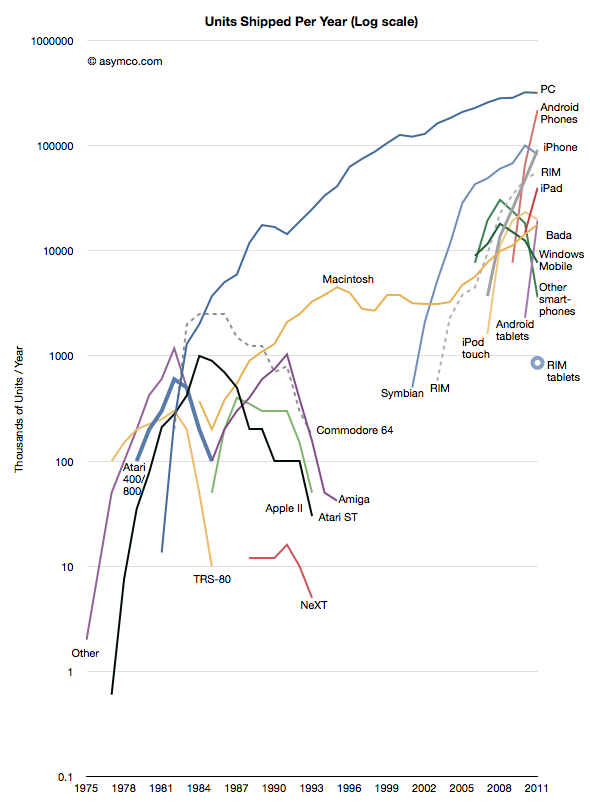
> The rise and fall of personal computing Source:Asymco
Dr Ed Yardeni (who is an all around nice guy) points to the following bit of history, and concludes strong economic recovery is in the offing:
“Real GDP is up 5.5% from the recession trough during Q2-2009 through Q3-2011 to a record high of $13.3 trillion. That initial recovery was roughly half as strong as the average gain of 9.8% over the same period during the past seven recoveries. Since the official start of the latest recovery during July 2009, payroll employment is up only 1.1%, significantly lagging the average 5.1% gain of the previous seven recoveries over the same length of time–though it is on par with the last two "jobless" recoveries.
In the past, recessions were followed by one, not two recoveries. This time, key sectors of the economy haven't participated in the initial economic rebound, but finally may be on the verge of doing so. The second recovery could take off as the pace of hiring quickens, housing activity finally picks up, auto sales head higher, and state and local governments stop retrenching. If so, then the US would finally enjoy the benefits of a broader-based recovery (emphasis added).
I have a somewhat different take: I see the weak recovery as typical of other post credit crisis recoveries. The anemic numbers reflect the inability of the Fed to jump start activity through making borrowing cheaper.
The risk from here is that activity is so soft that it wouldn’t take much to push us back into a recession. Hence, we are pretty aggressively invested, but I am looking for signs that this market is getting tired.







0 comments:
Post a Comment