


The Big Picture |

- Report from Chile
- Succinct Summation Of Week’s Events (01/20/2012)
- SecondMarket: Private Company Market 2011 Report
- Cycles of Financial Crises 1810 to 2010
- Index Funds Don’t Pick Themselves!
- Buffett’s Real Estate CEO on Housing Fix
- 10 Friday AM Reads
- Wait… Spreads Haven’t Decreased After All?
- Earnings reports remain very mixed
- Residential Write Downs, Starts, Remodels
| Posted: 20 Jan 2012 06:30 PM PST Report from Chile ~~~ There are no shortcuts to reach the Alto Puelo Lodge on the Rio Puelo in Chile. You can travel from the Argentine side through Buenos Aires and Bariloche or from the Chilean side through Santiago and Puerto Montt. Either way, the journey is long, but well worth it. Due to the volcanic activity in Chile interfering with Argentine air travel, this trip was routed from the Chilean side. That translated into four different flights: from Philadelphia to Miami, Miami to Santiago, Santiago to Puerto Montt, and the last leg, a charter flight across the Andes Mountains from Puerto Montt to Segundo Corral, a small village with an air strip located near the lodge. This is my fifteenth visit to the Patagonian region. Arriving at the Rio Puelo, I drink in the marvelous scenery and wonder at the natural beauty that has come to be so near and dear to my heart. Pristine water and majestic mountains frame the Alto Puelo Lodge, which at maximum capacity accommodates eight guests. The only lodge in the area, it is a family-owned and -operated business. You can find additional information via the following links: www.patagonia-flyfishinglodge.com; e-mail ericschoenauer@gmail.com. With the sun shining brightly over the clear water, we decided to take a boat out and trek to the head of the lake. There we encountered a large cloud of midges swarming and performing their summer ritual. Beautiful, hungry rainbow trout were standing on their tails, gulping the midges in midair. What a sight to behold. In order to fish a midge hatch, you must pick a fly so small it is nearly impossible to see when it is on the water. Because these are wild Patagonian trout, you need a long leader and you need to cast at a fair distance, approximately 50 to 60 feet. The entire fly is 1/8"-1/4" long, including the eye, the shank of the hook, and the hook itself. In order to get through the eye, you need a very fine leader. In this case, I used a 7x tippet. It is extremely thin and hard to see with these old eyes, let alone to tie a strong enough knot. After several casts, we were able to land the midge imitation in the midst of the cloud. A friendly rainbow trout, gulping his way through a feast of a thousand insects, happened to bite on the midge. With a small tug to set the hook, the fun begins. The water here is deep and clear, and with a fish like this one has to be extremely careful to not "horse" the fish in. When the fish wants to run, you must concede. With the very thin leader, any pressure can break it off. After twenty minutes of many runs and much activity, we were able to get the rainbow trout into the net, take the fly out of his lip, thank him for the exercise, and release him back into the water. These experiences on the Rio Puelo entirely vindicate my 36-hour journey. The real powerhouse on the Rio Puelo is the brown trout. These large demons of the deep turquoise waters are the trophy fish sought by all fly fishermen. We tied on a hopper, our backs against some rock ledges on Lago Puelo, the headwaters of the Rio Puelo. On the third cast, a trout came to take a look. He did not like what he saw. Fifty yards down, against another rocky ledge, a second trout came and took it fast. Unfortunately, this old fly fisherman missed the hook set. The next rock ledge had a notch in the water line. It was a dark, covered area underneath the ledge overhang. These wild fish are very alert to anything not consistent to their habitat. It was a perfect place for a wily, large brown to wait for its next meal. Three false casts and then I was able to flip the grasshopper right into the dark shadow in the notch between the rocks. It landed in the cleft that had taken four million years to form, and within seconds a brown took that fly and gulped it down. A fast hook set, and off he went. The first run out towards the deep part of the lake took me to the backing on the line. A monster, he was hungry and strong from swimming in currents, and ready for battle. The results are in the photo here: http://www.cumber.com/content/special/fish.jpg. After a wonderful, invigorating fight, this fish is released to swim again in Lago Puelo — until my next visit. This remote Chilean valley is a fly fisherman's dream. There is such diversity of fishing here, from calm to windy lakes, to streams and deep rivers with flies rising and hatches. In the midst of this unspoiled landscape sits the Alto Puelo Lodge, a wonderful, welcoming retreat where one can delve into a book or research paper. Let's turn to the economics in Chile. Chile is a booming place, a South American success story. Evidence of their success can be seen in their economic growth and lower unemployment rate. When you look at Chile, no matter how you examine the data for flaws, you find a continually improving account. The Chilean central bank has expressed concern over external events, which is why interest rates were surprisingly reduced during its last meeting. It even explained that its concern originates from the crises in Europe, not from a domestic, anti-inflation central bank policy. We like Chile; we like it as a destination, we like it as an investment, and we like it even more with each return visit. I have asked my colleague Bill Witherell, Cumberland's Chief Global Economist, to summarize our investment position. In our Emerging Markets Model, the overall weight is 4.65%, which is much higher than the 1.52% weight in the Emerging Markets benchmark. In the International model the weight is 2.025%, and in Global MAC it is 2.0%. These compare with the 0.5% weight of Chile in the Vanguard world ex-US ETF. It is important to note that Chile is not included in the EAFE benchmark index. Chile's stock market underperformed in 2011, -20% compared with -18.2% for EEM. As of January 12, 2012, Chile is up 3.9% compared with 4.2% for EEM. David R. Kotok, Chairman and Chief Investment Officer | |||||||
| Succinct Summation Of Week’s Events (01/20/2012) Posted: 20 Jan 2012 12:30 PM PST Succinct summation of week’s events: Positives:
Negatives:
| |||||||
| SecondMarket: Private Company Market 2011 Report Posted: 20 Jan 2012 10:30 AM PST SecondMarket went hog wild with a series of infographics showing their activities for 2011. The only thing you wont find are the actual prices of recent trades — which makes this less of a market or exchange and more of a private equity association. That’s my big caveat with them: Real markets show real prices. Anyway, here are the key data points:
Lots of charts follow . . . >
More charts after the jump
The chart below is a breakdown of SecondMarket's 2011 private company stock transactions by industry.
"Newbies" tracks private companies that started the quarter with fewer than ten watchers and started to gain traction by the end of Q4. The list below includes venture-backed companies that saw an increase in watchers in the fourth quarter. Fab.com, a website that features sales from the world's leading designers and manufacturers topped the Q4 list with 34 watchers. Next was oDesk, which enables both employers and contractors of technical, business and creative services to build successful work relationships across the globe, followed by StumbleUpon. Truecar and Rdio rounded out the Newbies for Q4. |


| New to the report this quarter are the non venture-backed Newbies. The list below includes non venture-backed companies that started the quarter with fewer than ten watchers and saw an increase in watchers in Q4. In-N-Out Burger, a regional chain of fast food restaurants with locations throughout the western U.S., topped the inaugural list of non venture-backed Newbies with 75 watchers. Three breweries based in the Northeast secured second, third, and fourth places; Dogfish Head, Brooklyn Brewery, and Yuengling, respectively. Rounding out the list of non venture-backed companies was Arenal Energy Corporation, a company that evaluates and acquires undervalued oil and gas leasehold property interests. |

| SecondMarket's "VC Scoreboard," introduced in Q2, tracks the ten venture capital firms with the most portfolio companies in SecondMarket's 100 most-watched list. The list below features the top VC firms and the number of their portfolio companies in the top 100. |

Cycles of Financial Crises 1810 to 2010
Posted: 20 Jan 2012 08:30 AM PST
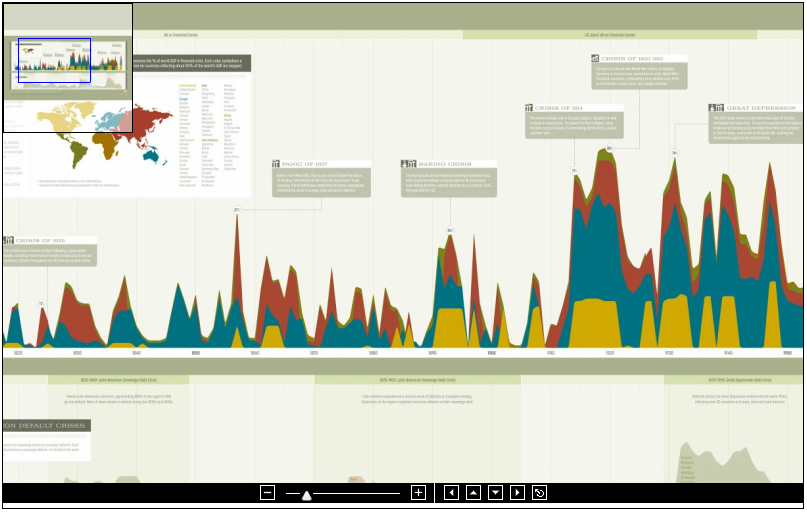
History Shots has a cool new graphic poster for sale looking at the long history of Financial Crises. I can easily see this framed on my office wall:
>
Click to zoom into graphic:
Source: History Shots
>
Cycles of Financial Crises 1810 to 2010
Size: 36 x 18 inches
Price: $32.95
Index Funds Don’t Pick Themselves!
Posted: 20 Jan 2012 07:30 AM PST
I was sitting on Friday’s hilarious Dilbert, expecting to post it Saturday, but so many friends and colleagues mailed it in to me, I was compelled to post it today:
>

Buffett’s Real Estate CEO on Housing Fix
Posted: 20 Jan 2012 07:00 AM PST
Housing has been under a lot of stress but there are some emerging signs of optimism, says Ronald Peltier, HomeServices of America CEO.
Fri. Jan. 20 2012 | 8:17 AM[06:20]
Posted: 20 Jan 2012 06:33 AM PST
Some reads to start off your day:
• Tech Giants’ Revenue Slows (WSJ) see also Google Cools Off, and Stock Drops (WSJ)
• Josh Brown: It's an RIA World, Everyone Else Just Lives in it (WSJ)
• 5 Reasons QE3 Is Off The Table (Pragmatic Capitalism) but see China's Manufacturing Contraction Boosts Case for Monetary Easing (Bloomberg)
• The Man Who Bought North Dakota: Wildcatter Harold Hamm is the biggest winner in biggest American oil find since Prudhoe Bay (BusinessWeek)
• New Normal on Wall Street: Smaller and Restrained (DealBook) see also Morgan Stanley Reducing Senior Pay 20% to 30% (Bloomberg)
• The Top 50 Technology Blogs to Watch in 2012 (The Entrepreneur Blog)
• Unearned, and Taxed Unequally (NYT) see also Why Taxes Aren't as High as They Seem (NYT)
• Legal Twofer:
…..-Montana Supreme Court upholds election spending limits (LA Times)
…..-Tenth Amendment Zealots Block GOP's Medical Malpractice Reform (TPM)
• How USPTO’s recklessness destroys business, innovation, and competition (BoingBoing)
• Concert Info: Who Owns My Ticket? (NYT)
What are you reading?
>
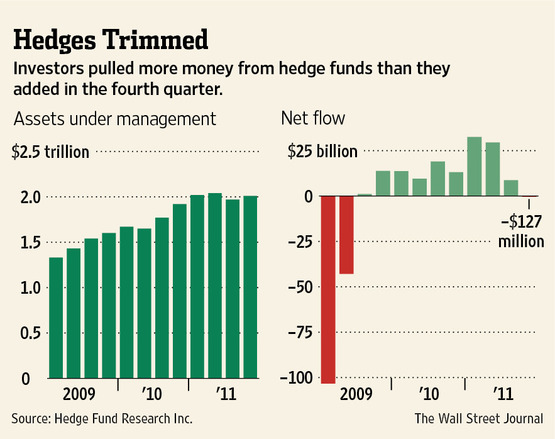
Investors Pull Cash From Hedge Funds
Source: WSJ
Wait… Spreads Haven’t Decreased After All?
Posted: 20 Jan 2012 05:30 AM PST

HFT shrinks spreads and provides liquidity. You've heard it all a thousand times, and more. It's good for you; take your Soma! Honestly, today when investors hear those words, they are wise to the propaganda, and they discount it appropriately. The only "defense" thrown up by the for-profit exchanges' catering to HFT at each and every turn, is that they have done so for our collective good. Because of that platitude!
But what if it weren't true? I mean like really not true; like what if an academic study came out and stuff? What if such a study came out and demonstrated that HFT did NOT shrink spreads after all, because when you take trade sizes into account, effective spreads are in fact quite similar to the past!
We introduce into evidence: The Impact of High Frequency Trading on Stock Market Liquidity Measures, by Soohun Kim and Dermot Murphy. They have examined a somewhat liquid instrument, the S&P 500 ETF, SPY during different time periods. Using four independent models
Glosten and Harris (1988), Sadka (2006), Huang and Stoll (1997), and Madhavan, Richardson and Roomans (1997)
that each calculate the effective spread, all four models underestimate the spreads from 2007-2009 by 41 – 46%. Stated differently, spreads between 1997 and 2009 are actually quite similar when you account for size of trades.
Here are some nice tidbits from the study, although we encourage you to read it, as it is very readable right up until the letters and equations and sigmas and symbol thingies:
"In 1997-2006, the average size of a trade is 2,700 shares (with a standard deviation of 15,000 shares), while in 2007-2009, it is only 400 shares [we insert that the average trade size is now under 200 shares] (with a standard deviation of 6,600 shares). At the same time, the average number of consecutive buys or sells has increased from four to twelve. This corroborates our story that it is becoming increasingly common for traders to split their large orders into many smaller orders, in order to minimize price impact."
"The spread is underestimated because empirical market microstructure models only identify the price impact of a single trade, when we should be identifying the cumulative price impact of many small trades"
"We see that, for the SPY, the average number of seconds between trades has steadily decreased over time, from 67.5 seconds in 1997 to 0.1 seconds in 2009. This decrease is likely because of the sheer increase in the number of transactions over time: on average, there were about 200 buy and sell transactions, each, in 1997, while there were about 250,000 in 2009. The average volume, in shares, has increased from 400,000 shares to 130.0 million shares."
"If we collapse consecutive buy or sell orders into a single transaction by summing over volume, we find that little has changed from the early to late sample periods – the size, variation and distribution of these collapsed trades stays somewhat stable over time."
So, umm yeah. Maybe all along we should have been focusing, not on the size changes in spreads, but rather the size changes of their noses, instead.
Source:
Themis Trading Blog
January 19, 2012
Earnings reports remain very mixed
Posted: 20 Jan 2012 05:08 AM PST
Very mixed still best describes Q4 earnings reports and measured against what’s been seen over the past few years where company’s beat estimates 70-75% of the time, it’s downright disappointing as only about half are exceeding expectations and many that are beating are missing revenue estimates. With this said, I think the game of ‘Beat the Numbers’ is just expectations management and thus nonsense. Ahead of the FOMC meeting Tuesday, today’s WSJ says the possibility of QE3 is in a wait and see mode dependent on the data. Reading past whether QE3 happens or not, the Fed mentality of wanting to print money in the belief that it’s the cure to our economic ills has not been tempered at all by their experiences with it over the past few years. Econometric models and not the marketplace still rule their day. In Europe, a Greek newspaper is saying that an agreement has been reached between the Greek government and its creditors and the Greek 1 yr yield is falling 40 bps after rising 39 bps yesterday. In Asia, China’s HSBC flash manufacturing PMI was little changed in Jan at 48.8 vs 48.7 in Dec. It is though below 50 for 6 out of the past 7 months and the prospect for more easing had the Shanghai index rallying to the best level in 6 weeks ahead of the one week Chinese holiday.
Residential Write Downs, Starts, Remodels
Posted: 20 Jan 2012 05:00 AM PST
There have been some interesting buzz regarding the residential real estate market. I want to put some of it into a broader context. Yes, the usual bottom callers are out yet again, unrepentant and shameless after getting it wrong for 5 consecutive years.
Residential Write Downs: This is resurfacing for the umpteenth time. Today’s version came from HUD secretary Shaun Donovan (via Reuters). A rumored settlement involving $20-25 billion dollars in relief to distressed homeowners from banks involved with robosigning (BAC, WFC, C, JPM, ALLY etc.). The settlement might kick a $20,000 reduction for one million borrowers who are underwater. Those of you who bought a house you could afford and stayed current in your payments do not qualify. And, this settlement does nothing about the rampant fraud and destruction of property rights the banks engaged in.
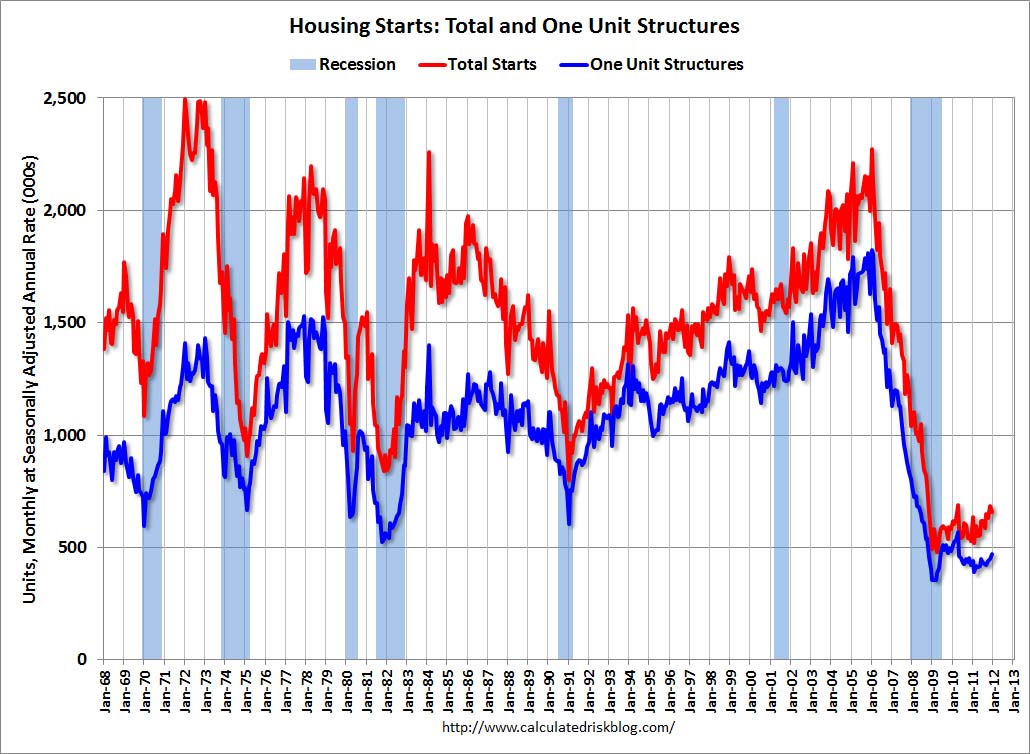
New Home Starts: Total housing starts fell 4.1% in December to an annual rate of 657,000, reflecting a 20.4% decline in construction of multi-family units and a 4.4% increase in single-family starts. Multi-family units has been the one bright spot for builders in a strong rental market. Despite this, 2011 had a record low number of total completions for both single family and total housing units.
Perhaps the warmer than usual weather helped Single-family starts post a 10.2% increase year-to-year. The chart below puts that number into context: The blue line is single family homes, still 75% below the 2005-06 peak and well below prior 40 year lows.
>
click for larger chart
Courtesy of Calculated Risk
>
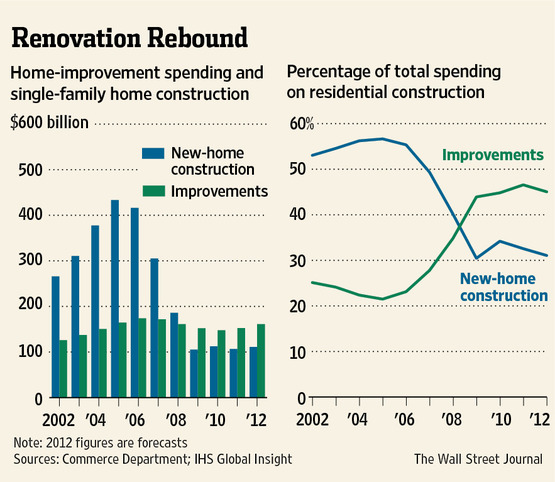
Remodeling Moves Higher: “People are remodeling instead of moving” said David Crowe, chief economist of the painfully obvious at the National Association of Home Builders. The key to this are the huge number of current homeowners who either are unable to sell their currents homes, or if they do, no longer will qualify for a new mortgage, or lack a 15-25% down payment for another purchase in order to move.
During Q3 2011, homeowners took out $5.3 billion in home equity/refinancing. That has been driving some of these renovations. Note that this is more than 90% below the credit bubble peak of $83.7 billion (Q2 2006).
>
click for larger chart
WSJ
>
The bottom line remains: Housing is a dark spot in the economy, and the regular bottom calling we hear is best ignored. One day, housing will once again begin contributing to US economy, but until we see higher Employment and greater household formation, that time is off in the future.
We get Existing Home Sales at 10:00 am.
>
Sources:
One million homeowners may get mortgage writedowns: U.S.
Margaret Chadbourn and Aruna Viswanatha
Reuters, Jan 18, 2012
http://www.reuters.com/article/2012/01/18/us-usa-housing-donovan-idUSTRE80H1LI20120118
Homeowners Stop Waiting to Spruce Up
CONOR DOUGHERTY
WSJ, JANUARY 20, 2012
http://online.wsj.com/article/SB10001424052970204555904577167303887587024.html
| You are subscribed to email updates from The Big Picture To stop receiving these emails, you may unsubscribe now. | Email delivery powered by Google |
| Google Inc., 20 West Kinzie, Chicago IL USA 60610 | |



0 comments:
Post a Comment