.

{2} GoogleTranslate (H)

English French German Spanish Italian Dutch Russian Portuguese Japanese Korean Arabic Chinese Simplified

Our New Stuff

{3} up AdBrite + eToro

Your Ad Here

Sunday, January 22, 2012

The Big Picture

The Big Picture


WHISTLEBLOWER CHANTELLE NICKSON-CLARK OUTLINES ALLEGATIONS OF FRAUD

Posted: 22 Jan 2012 01:00 AM PST

*WHISTLEBLOWER CHANTELLE NICKSON-CLARK OUTLINES ALLEGATIONS OF FRAUD AT EMC (JPM) – the “vast majority of the time the loans that were rejected [byWatterson] were still put in the pool and sold.”

AMBAC vs EMC Whistleblower~1.pdf‎ (222 KB‎)[Open as Web Page]

"With detailed citations to the admissions and testimony of former employees of defendants and Watterson, Syncora and Ambac alleged that defendants' pre-closing representations regarding the quality and scope of the due diligence review were knowingly false and misleading…Defendants knew, but failed to disclose, that their due diligence providers (e.g., Watterson) were not conducting an adequate review of the loans. Id…

Of particular significance here, the pleadings referenced the testimony of another former Watterson contractor who reviewed loans for defendants, and who was deposed in the Syncora matter on August 25, 2010. This contractor testified that Watterson's review was nothing more than a rubber stamp approval to satisfy defendants' objective of purchasing a large volume of loans for securitization. As the former contractor stated, the "vast majority of the time the loans that were rejected [byWatterson] were still put in the pool and sold." See Ambac First Amended Complaint ¶ 127. That testimony mirrored representations made in the press and before the Financial Crisis Inquiry Commission, which the record shows defendants were well aware of when made.1 Defendants also know – from communications with Watterson's counsel concerning an analogous application made before Justice Bransten2 – that in the last three weeks an additional two Watterson contractors have been deposed concerning these same issues…Like the other witnesses, the deponent is a whistleblower who will testify concerning the actual re-underwriting practices undertaken on behalf of the defendants, which were in stark contrast to the practices defendants represented to Syncora and Ambac (and investors). The deponent came forward and met with counsel for Syncora and Ambac in connection with the pending actions to set the record straight. As appropriate and common in preparing for trial,3 counsel for Syncora and Ambac secured an affidavit from the deponent"

5117248v.3
January 19, 2012 Erik Haas
Partner
By Fax

The Honorable Paul A. Crotty
Daniel Patrick Moynihan United States Courthouse
500 Pearl Street
New York, NY 10007
By Fax and Electronic Filing

The Honorable Charles E. Ramos
New York State Supreme Court, Commercial Division
60 Centre Street
New York, NY 10007

Re: Syncora Guarantee Inc. v. EMC Mortgage Corp., No. 09-CV-3106
(PAC) (S.D.N.Y.)

Ambac Assurance Corp. v. EMC Mortgage Corp., Index No.
650421/2011 (N.Y. Sup. Ct.)

Dear Judge Crotty and Justice Ramos:

We represent Syncora Guarantee Inc. ("Syncora") and Ambac Assurance Corporation ("Ambac") (together, "Plaintiffs") in the above-referenced actions. We write in response to defendants' letter dated January 18, 2012, seeking disclosure of an affidavit from a non-party witness who will be deposed in the Syncora and Ambac matters on January 20, 2012. The affidavit is protected from disclosure under the trial preparation and work product privileges, and the very cases defendants cite demonstrate they have not made the requisite showing to overcome such protections.

The deponent is a former contractor of Watterson Prime, LLC ("Watterson"). Defendants represented to Ambac and Syncora (and investors) that defendants had retained Watterson to conduct a thorough "due diligence" re-underwriting of the loans defendants "securitized" in the transactions at issue in the Syncora and Ambac matters. With detailed citations to the admissions and testimony of former employees of defendants and Watterson, Syncora and Ambac alleged that defendants' pre-closing representations regarding the quality and scope of the due diligence review were knowingly false and misleading. See, e.g., Ambac First Amended Complaint ¶¶ 121-38; Syncora Complaint ¶¶ 8, 39-45. Defendants knew, but failed to disclose, that their due diligence providers (e.g., Watterson) were not conducting an adequate review of the loans. Id.

Of particular significance here, the pleadings referenced the testimony of another former Watterson contractor who reviewed loans for defendants, and who was deposed in the Syncora matter on August 25, 2010. This contractor testified that Watterson's review was nothing more than a rubber stamp approval to satisfy defendants' objective of purchasing a large volume of loans for securitization. As the former contractor stated, the "vast majority of the time the loans that were rejected [byWatterson] were still put in the pool and sold." See Ambac First Amended Complaint ¶ 127. That testimony mirrored representations made in the press and before the Financial Crisis Inquiry Commission, which the record shows defendants were well aware of when made.1 Defendants also know – from communications with Watterson's counsel concerning an analogous application made before Justice Bransten2 – that in the last three weeks an additional two Watterson contractors have been deposed concerning these same issues.

Thus, contrary to their claimed ignorance as to the subject of the scheduled deposition, defendants know full well the relevance and nature of the contemplated testimony. Like the other witnesses, the deponent is a whistleblower who will testify concerning the actual re-underwriting practices undertaken on behalf of the defendants, which were in stark contrast to the practices defendants represented to Syncora and Ambac (and investors). The deponent came forward and met with counsel for Syncora and Ambac in connection with the pending actions to set the record straight. As appropriate and common in preparing for trial,3 counsel for Syncora and Ambac secured an affidavit from the deponent. This statement is protected under the work product and trial preparation privileges recognized by state and federal law.

Specifically, state and federal case law have repeatedly affirmed that witness statements prepared in anticipation of and in preparation for trial are protected from disclosure2under the New York Civil Practice Law and Rules ("CPLR") and the Federal Rules of Civil Procedure. See, e.g., People v. Kozlowski, 11 N.Y.3d 223, 245 (N.Y. 2008) (witness statements protected as trial preparation material); Valencia v. Obayashi Corp., 84 A.D.3d 786, 787 (N.Y. App. Div. 2d Dep't 2011) ("Witness statements taken by a party's counsel are subject to the qualified privilege for materials prepared in anticipation of litigation or for trial"); Warren v. New York City Transit Authority, 34 A.D.2d 749, 749 (N.Y. App. Div. 1st Dep't 1970) ("It is quite clear that statements taken from witnesses to prepare for litigation are attorney's work product and protected."); DeGourney v. Mulzac, 287 A.D.2d 680, 680 (N.Y. App. Div. 2d Dep't 2001) ("written statement by a nonparty eyewitness answering questions posed by the plaintiff's attorney . . . immune from disclosure pursuant to CPLR 3101(d)(2) since it constitutes material prepared for litigation"); Sullivan v. Smith, 198 A.D.2d 749 (N.Y. App. Div. 3d Dep't 1993) (written statements of witnesses given to insurance adjuster protected); In re James, Hoyer, Newcomer, Smiljanich and Yanchunis, 2010 N.Y. Slip. Op. 50863U, at *15 (N.Y. Sup. Ct. N.Y. County 2010) ("statements taken from witnesses if taken to prepare for litigation have been deemed attorney work product"); Lopez v. New York City Housing Auth., 2005 N.Y. Slip. Op. 50468U, at *11 (N.Y. Sup. Ct. Bronx County 2005) ("Statements taken from witnesses if taken to prepare for litigation have been deemed attorney work product."); Frawley v. Albrecht, 163 Misc. 2d 630, 634 (N.Y. Sup. Ct. Nassau County 1994) (written and recorded statements given by non-party witness protected); Securities and Exchange Commission v. Treadway, 229 F.R.D. 454, 455-46 (S.D.N.Y. 2005) (witness statement protected under Rule 26(b)(3)(A)); Costabile v. Westchester, 254 F.R.D. 160, 167 (S.D.N.Y. 2008) (same).4

Indeed, defendants' own citations affirm that the deponent's statement is protected from disclosure. Defendants cite first the Miller decision from the Northern District of New York for the proposition that a witness statement is discoverable "absent a claim that the information contained in the statement is privileged or subject to protection as trial preparation material." See Defendants' Letter at p. 2 (citing Miller v. Elexo Land Servs., Inc., No. 09-CV-0038 (GTS/DEP), 2011 WL 4499281, *15 (N.D.N.Y. Sept. 27, 2011)). As defendants concede, Syncora and Ambac have asserted such a claim. Defendants next cite the Sequa decision for the proposition that affidavits are discoverable "where [there was] no indication that affidavits were prepared with the intention that they remain confidential." Id. (citing Sequa Corp. v. Gelmin, No. 91-CV-8675 (CSH), 1993 WL 276081, *4 (S.D.N.Y. July 16, 1993)). As defendants also concede, Plaintiffs have consistently communicated the "intention that they remain confidential."5

5117248v.3

For good policy reasons, the protection afforded to deponent's statement by the trial preparation and work product privileges only may be pierced in very limited circumstances. Under CPLR 3101(d)(2), "materials . . . prepared in anticipation of litigation or for trial by . . . another party . . . may be obtained only upon showing that the party seeking discovery has substantial need of the materials in the preparation of the case and is unable without undue hardship to obtain substantial equivalent of the materials by other means." CPLR 3101(d)(2) (emphasis added). Rule 26(b)(3)(A) of the FRCP contains a similar provision. Defendants have not demonstrated, and cannot show, the "substantial need" or inability to obtain "without undue hardship" the "substantial equivalent" of the deponent's statement, as they must to overcome the privilege and protections afforded under state and federal law.

Rather, the cases hold that an opportunity to depose a non-party witness is the substantial equivalent of a prior statement or affidavit by that witness. See, e.g., Frawley, 163 Misc. 2d at 634 (refusing to pierce the trial preparation privilege and order production of affidavit from non-party witness who was deposed; "[t]his court is not willing to chip away at the privilege in CPLR 3101(d) [and order production of affidavit] solely for the purposes of impeaching a nonparty witness"); Treadway, 229 F.R.D. at 457 ("Defendants are free to question each of the witnesses at their depositions, and at trial, concerning the witnesses' statements to the SEC at various proffer sessions. No case cited by Defendants concludes that parties cannot, by deposing witnesses, obtain 'the substantial equivalent' of earlier attorney interview notes of the same witnesses without 'undue hardship.'"); Costabile, 254 F.R.D. at 167 ("'Substantial need' cannot be shown where persons with equivalent information are available for interrogation and/or deposition."). Defendants cannot show a "substantial need" for the affidavit or any "undue hardship" in view of their opportunity to cross-examine the non-party witness tomorrow.

Simply put, defendants' cries of "ambush litigation tactics" for Plaintiffs' appropriate retention of protected affidavits are unfounded. Defendants have long known from publicly available material and previous depositions of former Watterson contractors the nature of the contemplated testimony. Defendants have had ample time and opportunity to contact the witness and seek affidavits of their own. And defendants were provided with proper notice of, and will have full opportunity to cross-examine the witness at, tomorrow's deposition.

Accordingly, Syncora and Ambac request that defendants' request be denied. Plaintiffs are prepared to submit the affidavit for an in camera review and are available for a telephone conference at the Courts' convenience if necessary.

Respectfully submitted,

Erik Haas

expectation that they will be kept confidential, and Syncora and Ambac have not produced the affidavits, or drafts thereof, to the defendants.

5117248v.3

cc: Counsel for Defendants
Richard Edlin, Esq. (Greenberg Traurig, LLP)
Robert A. Sacks, Esq. and Darrell S. Cafasso, Esq. (Sullivan & Cromwell LLP)
Counsel for Watterson Prime, LLC
Frank Morreale, Esq. (Holland & Knight LLP)

1 See, e.g., Chris Arnold, [Watterson Prime] Auditor: Supervisors Covered Up Risky Loans, National Public Radio, May 27, 2008, available at http://www.npr.org/templates/story/story.php?storyId=90840958; The Financial Crisis Inquiry Commission, The Financial Crisis Inquiry Report: Final Report of the National Commission on the Causes of the Financial and Economic Crisis in the United States 165-69 (2011), available at http://fcic-static.law.stanford.edu/cdn_media/fcic-reports/fcic_final_report_full. pdf; Amended Complaint ¶¶ 1, 5, 8, 164-95, Assured Guaranty Corp. v. EMC Mortgage LLC, No. 10-CV-5367 (NRB) (S.D.N.Y. Nov. 18, 2011).

2 Defendants concede that a due diligence firm made an application to Justice Bransten for the production of affidavits obtained by plaintiffs in MBIA Ins. Corp. v. Countrywide Home Loans, Inc., Index No. 08-602825 (N.Y. Sup. Ct.). But defendants fail to point out that, on January 17, 2012, the court denied the due diligence firm's request absent further briefing on the issue. Further, in light of a whistleblower's testimony that the due diligence firm was attempting to stifle truthful testimony by its former employees by invoking confidentiality agreements that the former employees may have signed (and other means), the court noted that it "is troubled by the allegations of impropriety in requesting or pressuring Clayton [the due diligence firm] witnesses not to speak to third parties [i.e., monoline insurers] regarding their employment at Clayton. The court has full confidence in the attorneys that come before it, and trusts that impropriety is not, and will not be, occurring."

3 Any insinuation by the defendants that it is improper to reach out to such employees is belied by their own actions. Defendants have retained a former employee of Ambac as an expert witness in these litigations and are asserting work product protection over their communications.

4 See also David D. Siegel, New York Practice § 348 (5th ed. 2011) ("[m]ost common example of an item sought by one side but claimed by the other to be litigation material is a statement given by a witness. . . . These statements ordinarily do qualify for the . . . [CPLR 3101](d)(2) immunity, and are hence undisclosable unless the stated conditions are satisfied.").

5 To further clarify defendants' misleading citation to these cases: In Miller, the statement at issue was a "transcribed interview" of the witness, and not an affidavit or written statement. See Miller, 2011 WL 4499281, at *15. Further, in Miller, the court held that the defendant could not use the attorney work product protection because it had failed to notify the plaintiffs of the transcribed interview on its privilege log, and as such, had waived protection. Id. No such waiver exists here. In Sequa, plaintiff had already disclosed another similar affidavit prepared by the same witness, and all drafts thereof, and as such, they could not "establish either that they harbored . . . expectations of confidentiality or that they in fact kept the documents confidential." Sequa, 1993 WL 276081, at *1, *4. Here, the affidavits were executed with expectation that they will be kept confidential, and Syncora and Ambac have not produced the affidavits, or drafts thereof, to the defendants.

In Search of Yield & Dividends

Posted: 21 Jan 2012 12:00 PM PST

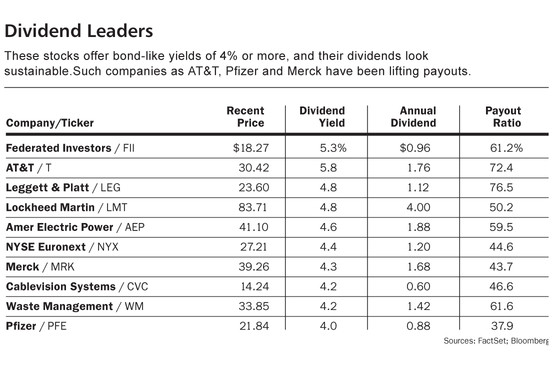
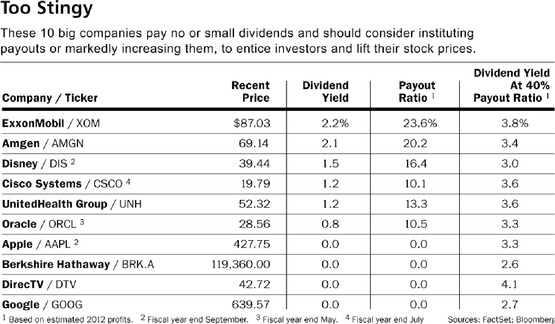
From this weekend’s Barron’s, a look at stocks that do — and don’t — have decent dividends:

“The benchmark Standard & Poor’s 500 index has a dividend yield of just 2%, one of the lowest of any major global market. European stocks yield an average of nearly 5%, and even the historically low-yielding Japanese stock market pays 2.5%.

American companies have the wherewithal to raise dividends because profits are at record levels and the payout ratio—the percentage of profits paid out in dividends—is near an all-time low at 28%. It has averaged 40% over the past 20 years.” (emphasis added)

That is an astonishing stat . . .

>

Strong Dividends

~~~

Too Stingy

>

Source:
In Search of Yield
ANDREW BARY
Barron’s JANUARY 21, 2012
http://online.barrons.com/article/SB50001424052748704900804577170672872489942.html

Colbert: How to Deal with Internet Protests

Posted: 21 Jan 2012 11:53 AM PST

Staring into the Abyss

Posted: 21 Jan 2012 11:00 AM PST

Staring into the Abyss
By John Mauldin
January 21, 2012

~~~

Choices, Debt, and the Endgame
Staring into the Abyss
An Unintended (and Very Negative) Consequence
A Preview of Coming Attractions
Hallucinogenic Data and Other Fun Activities
Gentlemen, Choose Your Disaster
What Europe Should Do
South Africa and Sweden

>

“If we want everything to stay as it is, everything will have to change.”
– from The Leopard by Giuseppe Tomasi di Lamedusa

“The crisis takes a much longer time coming than you think, and then it happens much faster than you would have thought, and that’s sort of exactly the Mexican story. It took forever and then it took a night.”
– Rudiger Dornbusch

>

Europe’s leaders are committed to keeping both the euro and the eurozone as it is. But for it to do so, everything must change, as the wonderful quote from the 1958 Italian novel suggests. This is no easy task, as no one wants a change that will impact them negatively; and there is no change that will allow things to stay the same that does not impact all severely, as we will see. In the third part of a continuing series, we look at the actual options that are available on the menu of choices, or as one group called it, the menu of pain. I offer some guideposts that we should watch for along the way, and end by offering a suggestion as to what Europe should do. As has been the case in this series, I do my best to offend everyone at some point. If by some small, unintended oversight I do not, then wait another week, I will get to you. What else are friends for?

But before we take on Europe, let me quickly tell you to save the date for my annual Strategic Investment Conference, co-sponsored with my partners, Altegris Investments. And what a lineup we have this year. Already scheduled are my friends Dr. Woody Brock, Mohamed El-Erian, Marc Faber, Niall Ferguson, bond-fund star Jeff Gundlach, Dr. Lacy Hunt, David Rosenberg, as well as your humble analyst. And there are a few more blockbuster names we are close to finalizing. Most people who attend think this is simply the best investment conference of the year, and I think this one looks better than ever. It will be May 2-4 in the San Diego area. I will soon give you details about where you can go to register, but for now put it in your calendar. What better way to think about how to invest in these times than to hear some of the best minds in the world, all in one place?

As this letter will suggest, I don’t think this is the year you want your portfolio in typical long-only funds. There is a lot of tail risk this year coming from Europe. For those who are accredited investors and interested in alternative investments like hedge funds and commodity funds, which can help you navigate through these volatile times, let me suggest you go to The Mauldin Circle and register, and my friends at Altegris Investments will give you a call. I am finishing up a new Accredited Investor Letter, and they will send it to you for free as our way of saying thanks for talking with us. Now, let’s jump right in.

Choices, Debt, and the Endgame

We started off this New Year’s series by pointing out that the choices we make today are constrained by the choices we made in the past, and the choices we make in the future will be limited by the choices we make today. Europe chose to create a free trade zone, and then some of the countries proceeded to lock themselves into the gold standard of a single currency, relinquishing the ability to adjust any imbalances in their economies by changes in the prices of their own currencies.

Interest rates for the southern tier of Europe dropped to levels never available to them before, and those countries responded by borrowing ever-increasing amounts of money to finance current spending. Then came the credit crisis, and budgets simply ballooned out of control, and debts began to get to levels that made the bond markets ask for ever-higher rates, as concerns about sovereign defaults began to rise.

This problem was compounded by the fact that European banking institutions were allowed to leverage their purchases of sovereign debt by 30 or 40 to 1 their actual capital. That means even a default by a small country has potentially big ramifications. As it became clear that Greece was in trouble, European leaders at first thought that if Greece was given some time, it could get its budget deficit under control and then once again gain access to the bond market.

In the summer of last year, after dithering through some 40-odd summits, it began to dawn on European leaders that it was not a short-term liquidity crisis they had on their hands but a solvency crisis. A fact that numerous commentators had been pointing out to them for quite some time. And as Greece began shake and bake its way to “austerity,” the very act of cutting deficits pushed the country into recession, which lowered tax revenues and increased expenses, putting the elusive goal of a balanced budget even further off. We should quickly note that this is not just a Greek problem. Spain’s “draconian” cuts have meant that its 6% deficit target for the year has this week been raised to a more likely 8%, making it harder to get back to even.

For country after country, this is the Endgame. It is the end of the Debt Supercycle. Debt has grown to the size that it cannot be sustained. The market will not lend any more money on terms that can be afforded, and any efforts to cut spending and raise taxes will result in an even worse economy, in various degrees of recession, with falling revenues and rising costs.

Europe has three main problems.

1. A growing number of its countries are insolvent or close to it. It is increasingly likely that the only way forward is for defaults of some type, to lessen the burden of debt to a level where it can be dealt with and that will allow the countries the possibility of growth, which is the only real answer to the problems they face.

2. Because of growing fears of multiple defaults (just Greece would be bad enough!) most of the banks in Europe are seen to be insolvent and in need of hundreds of billions of euros of new capital. The interbank market in Europe is in a shambles, and banks park their cash with the ECB, at a lower rate of return, as that is the only institution they trust. They clearly do not trust each other. As an aside, I heard from many sources while I was Hong Kong and Singapore, meeting with readers and friends, that European banks (especially French) are cutting back on their trade lending, which is making normal commerce more difficult. Didn’t we just go through that in 2008?

3. The real problem in Europe is the massive trade imbalances between the peripheral countries and the so-called core countries. Without the ability to adjust currencies, those trade imbalances will render any debt solution moot, as a country cannot balance its budget while it runs a trade deficit and its citizens and businesses also deleverage. I have written about this arithmetic problem on numerous occasions. There must be balance or there must be a mechanism to achieve balance.

One cannot solve one problem without solving all three. Either they all get done or none truly get done. You can kick the can down the road by solving problems 1 and 2, but problem 3 will put you shortly back to square one.

Europe is now trying to address problems 1 and 2. They are talking about a “new treaty” that will require austerity of a real kind, although I understand that Germany has put in a clause that gives it some extra time to achieve its own balanced budget. And the ECB is dispensing euros through the back door to banks, in exchange for anything resembling collateral. Not directly of course, as that is prohibited, but the same thing is being accomplished, despite objections in some quarters, mostly German.

Staring Into the Abyss

It was late in September of 1998. I was flying from New York to Bermuda to speak at a hedge fund conference, and found myself upgraded at the last minute, back in the day when I did not fly that much, so I was feeling rather happy. As the door closed, a patrician-looking gentleman stepped in and came and sat next to me, immediately picking up a file and burrowing into it. I had a book and the Wall Street Journal, so I was content to read.

As soon as we took off, he asked for a scotch. He proceeded, over the next hour, to wage a very aggressive war on the diminishing cache of scotch bottles stored on board. (No, it was not Art Cashin. He doesn’t fly.) It was an arduous campaign, but he was fully committed to winning.

He glanced over to my Journal and noted some headline about the crisis that had occurred the previous week. I had been following the extreme market volatility with interest, but this was in the first decade of the internet, so most of what you came by you still read in print or heard on the phone.

“They don’t really know how close we came,” he shuddered, his eyes showing the first signs of emotion – and fear – I had seen from him. That piqued my interest, and I engaged him, though without touching his precious hoard of scotch. I settled for a nice chardonnay. It turned out he was the second-ranking executive at one of the three largest banks in the country. He had been at the table in the NY Fed boardroom when 14 banks were forced to put in $3.625 billion to keep Long Term Capital from collapsing, with only Bear Stearns declining (one of the reasons they had no friends ten years later). The NY Fed president had essentially called all the heads of the banks, told them to be in the room, not to send proxies, and to bring their checkbooks. There was subsequently a lot of criticism of the Fed, but they did what a central bank is supposed to do in times like that: they made the children play nice in the sandbox. They were the only entity that could force the various monster-ego players to even sit in the same room with each other.

“No one will ever really know,” he said again. But of course, soon everyone did, as Roger Lowenstein wrote the must-read real-life thriller When Genius Failed.

“We walked to the edge of the abyss, and we looked over.” He proceeded to regale me with the stories of the negotiations, as the immensity of what would happen if they allowed the collapse dawned on the group one by one. They all had exposure to LTCM but did not realize the extent of it until it was too late. Looking back, it might have looked something like the credit crisis of 2008 if they had not acted, except it would have happened much faster.

I can tell you that no one in that room wanted to write a $300-million check. It was not good for their careers. Interestingly, after two years the fund was liquidated and the banks got back their capital plus a small profit.

Now, the bankers and leaders of Europe are getting ready to walk to the edge of the Abyss. It will be a long way down, and look like the 7th level of Dante’s Inferno.

Their first real look will come in the next few weeks, as Greece is negotiating aggressively with its lenders as to how much of a haircut they will receive and what sort of guarantees Greece will provide on the remaining debt (they are balking at putting the new bonds in a legal jurisdiction that will have some real bite if they default again, which they will). They are also negotiating with Europe about how much additional real austerity they will have to endure in order to be allowed to take on more debt. If they walk away and there is an uncoordinated default, it will guarantee chaos. Bank collateral will collapse and credit default swaps will be triggered, including many sold by European banks that are already essentially insolvent.

The legal euphemism here is that if debtors “voluntarily” accept a 50% haircut, then no credit default swap protections will be triggered on those positions. But not all parties want to voluntarily take that loss (or an even greater one). If they are forced to do so, then the credit default swaps they bought come into effect. Greece can legislatively force them to take the haircut, but CDS contracts are written in such a way that that action would be seen as a loss, triggering the CDS insurance. The governments involved want everyone to accept, so there is no crisis. The funds simply want as much money as they can get back, and many are playing a very hard-nosed game.

Can the holdouts be enticed with sweeteners that not all may get? Maybe different collateral? Or shorter terms, or …?

The sad thing is that a 50% cut of the private lenders only gets Greece back to what will soon be 120% debt-to-GDP, from the current 170% and rising. 120% (which I consider optimistic) is just another, lesser form of insolvency, as Italy now understands. And if Italy is under pressure at 120%, then it is almost a given that the market would see Greece as still insolvent.

An Unintended (and Very Negative) Consequence

There is at least one unintended consequence arising from the Greek settlement negotiations. Private investors thought they were buying a bond that was “pari passu,” or equal with all other Greek sovereign debt. It now turns out they were buying junior, second-tier, subordinated debt. Something like a second mortgage on a home. You will take the first loss, so you then charge accordingly. But it now seems that the ECB, the IMF, and European public institutions are “more equal” than the private parties and will not have to share in the losses. The private lenders have found out they were taking subordinated risks while only getting senior-rate returns.

It the public lenders were involved in the haircuts, then maybe it would only have to be a 30% haircut, or if it was 50% it would be enough to maybe get Greece to the point where it might have a chance; and the remainder of the debt would be in better shape, rather than this just being the negotiations for the first haircut, with more to follow.

Every private lender in Europe now recognizes they are taking more risk when they invest in a sovereign debt instrument. This will have the effect of pushing rates up in the private market, like they have very recently climbed for Portugal (more on Portugal later).

Europe faces a set of choices. They can lend Greece more money on promises to turn things around, which can’t happen because of (1) the very austerity being imposed and (2) the 10% of GDP trade imbalance with the rest of Europe. But if they don’t lend the money and there is an uncontrolled default, they will get to inspect that Abyss more closely than they would like. It will mean hundreds of billions of euros in losses at their banks, which will have to be bailed out eventually by taxpayers.

Europe is worried about “contagion.” If Greece gets a 50% reduction on its debt, will not Portugal point out that they deserve it more? There have been deep fiscal cuts by the free-market government of Pedro Passos Coelho in an attempt to reduce the deficits, but estimates are that, even with those cuts, the deficit will still be 6%, falling only to 4% in 2013. And that is if things go well.

The market is not acting as if it expects things to go well. Yields on Portugal’s 10-year bonds climbed to 14.39% on Thursday. Credit default swaps measuring bond risk have reached 1270 points, pricing a two-thirds chance of default over the next five years.

While Portugal’s public debt of 113pc of GDP is lower than Greece’s, the private sector has much larger debts and the country’s total debt load is higher, at 360pc of GDP – much of it external debt. Jürgen Michels, Europe economist at Citigroup, says, “Without a sizeable haircut to its debt stock, Portugal will not be able to move into a viable fiscal path. We expect a haircut of 35pc at the end of 2012 or in 2013.”

Ambrose Evans-Pritchard, writing in the London Telegraph (I really like his work), notes:

“Portugal is a troubling case for EU officials, who insist that Greece is a ‘one-off’ case rather than the first of a string of countries trapped in a deeper North-South structural rift. The official line is that Portugal will pull through because it has grasped the nettle of retrenchment and reform.

“Europe’s leaders have vowed that there will be no forced ‘haircuts’ for holders of Portuguese bonds. If the country now spirals into a Grecian vortex as well they will have to repudiate that promise or accept that EU taxpayers will have to shoulder the burden of debt restructuring. While all eyes are on Greece, it is the slower drama in Portugal that will ultimately determine the fate of the eurozone.”

A Preview of Coming Attractions

Let’s turn to some charts from a well-written report called “The European Crisis Deepens,” from the Petersen Institute, by Peter Boone and Simon Johnson. Both authors have a long list of credentials.

The first one is a chart of the cost of five-year credit default swaps. Notice they all are rising. (This is a log chart, so the scale rises by a factor of ten for each level.) Now, notice that Portugal is where Greece was last year. Then pay attention to the fact that Italy is likewise where Portugal was last year. Just thought I would give you a preview of coming attractions, horror-movie edition.

Then they offer us this chart, which compares the labor-unit costs of six countries in Europe. Only Ireland has seen their costs drop, as their labor has accepted pay cuts and productivity has increased. And pay attention to the ever-rising costs of France vs. Germany. This trend suggests France is on a path that Greece took. There are dragons down that path.

And it also illustrates the problem of why it will be so hard for Greece to turn around without being able to resort to a currency devaluation. They have to endure a 30% pay cut relative to core Europe if they want to compete. There will be no volunteers in Greece for such cuts. After two years of IMF and European institutional involvement (meddling?) in Greece, there has been hardly any movement in Greek labor costs.

Greece is not alone. Are you reading of any general pay cuts in the proposed solutions for Italy, where labor costs are now above those of Greece? Likewise, no move in Portugal (not shown in graph). The entire eurozone is out of balance, and no one is making any moves to deal with it or even acknowledge the basic problem.

Hallucinogenic Data and Other Fun Activities

Much of establishment Europe was predicting a positive GDP for the region only a month ago. The recent trend suggests the data they were smoking was hallucinogenic. And given the seriousness of the problem, it must have been primo stuff. Germany was in recession for the 4th quarter of last year and is likely to be there this quarter, which is the technical definition of recession. Clearly, peripheral Europe is in recession, some countries in what looks like it could be called a depression. Below is the Purchasing Manager’s Index for six major countries in Europe. I have added a thick red line at the 50 mark, below which there is negative growth.

Gentlemen, Choose Your Disaster

With all of the above as a backdrop, let’s now see if I can outline the choices Europe faces. First, let’s take Greece, because it is instructive. Greece has two choices. They can choose Disaster A, which is to stay in the euro, cutting spending and raising taxes so they can qualify for yet another bailout; negotiating more defaults; getting further behind on their balance of payments; and suffering along with a lack of medicine, energy, and other goods they need. They will be mired in a depression for a generation. Demonstrations will get ever larger and uglier, as the government has to make even more cuts to deal with decreasing revenues, as 2.5% of their GDP in euros leaves the country each month. There is a run on their banks. Any Greek who can is getting his money out.

Greek voters will then blame whichever political group was responsible for choosing Disaster A and vote them out, as the opposition calls for Greece to exit the euro. Which is of course Disaster B.

Leaving the euro is a nightmare of biblical proportions, equivalent to about 7 of the 10 plagues that visited Egypt. First there is a banking holiday, then all accounts are converted to drachmas and all pensions and government pay is now in drachmas. What about private contracts made in euros with non-Greek businesses? And it is one thing to convert all the electronic money and cash in the banks; but how do you get Greeks to turn in their euros for drachmas, when they can cross the border and buy goods at lower prices, as inflation and/or outright devaluation will follow any change of currency. It has to. That is the whole point.

So how do you get Zorba and Deimos to willingly turn in their remaining cash euros? You can close the borders, but that creates a black market for euros – and the Greeks have been smuggling through their hills for centuries. And how do you close the fishing villages, where their cousin from Italy meets them in the Mediterranean for a little currency exchange? What about non-Greek businesses that built apartments or condos and sold them? They now get paid in depreciating drachmas, while having to cover their euro costs back home? Not to mention, how do you get “hard” currency to buy medicine, energy, food, military supplies, etc.? The list goes on and on. It is a lawyer’s dream.

There is a third choice, Disaster C, which is worse than both of the above. Greece can stay in the euro and default on all debt, which cuts them off completely from the bond market for some time to come. This forces them to make drastic cuts in all government services and payments (salaries, pensions etc.), and suffer a capital D Depression, as they must balance their trade payments overnight, or do without. Then they choose Disaster B anyway.

The only real options are Disaster A or Disaster B. Whether they opt to go straight to the drachma (Disaster B) is only a matter of timing. They will get there soon enough.

Why then do they wait? What’s the point of going through all these motions? Because Europe fears a disorderly Disaster B. For the rest of Europe, it is the Abyss. The Greek hope is that Europe (read Germany) keeps funding them in order to keep back from the edge of the Abyss.

As one European diplomat noted, “There is a growing sense that despite the valiant efforts of Papademos … the reluctant Greek establishment is biding its time to the next elections, banking on the assumption that the world will continue to bail them out, no matter what.”

Europe is getting closer to the point where it must make a decision about what to do with Greece. In theory, the deadline is March 29 for the next round of funding. It is a game with very high stakes and deadly serious players. Can Sarkozy be seen as weak and giving in to Greece, with elections coming up in April? Can Merkel appear to give in and keep her troops in line? There are elections not long after that in Greece. Can Papademos cave in to further cuts and promises on future debt that will be hard to keep and intensely unpopular?

The markets are getting exhausted. There will be no private market for Greek debt at any number close to what is sustainable. Greece will be on European life support for a very long time if they stay in and there is no disorderly default. It will mean hundreds of billions of euros over the decade, debt forgiveness, etc. There are no good choices.

And Europe will all too soon face what to do with Portugal, which will want to dispense some haircuts of its own. Don’t forget Ireland, which is very serious about not paying the debt the previous government took on for its banks in order to pay British, German, and French banks. That is a default that is in the cards. I think “polite” Ireland is just waiting until its $60-billion default is seen as small potatoes, which will not be too long, as Italy must raise almost €350 billion just to roll over current debt. Italy projects that its deficit will be down to 2%, but if Europe goes into recession that projection goes out the window.

The bottom line is that Italy (and most likely Spain at some point) cannot raise the debt it needs at rates it can afford without massive European Central Bank involvement. Rates are already approaching 7% again. That is unsustainable from an Italian point of view. Germany must be willing to allow the ECB to take on massive balance-sheet debt, or Italy will not make it without haircuts. And a mere 10% haircut for Italy dwarfs what is happening in Greece – and doesn’t do much for Italy. If they go for a haircut, it will be much larger. French banks holds 45% of Italian debt. Italy is too big for France to save. They cannot even backstop their banks if Italy becomes a solvency risk. They simply cannot get their hands on that much money without destroying their balance sheet. The most recent downgrade of their debt was just the first of many.

Speaking of downgrades, Egan Jones downgraded Germany from AA to AA- and put the country on negative watch. This is important, as this is what I believe to be the most credible rating agency; and over 95% of the time the other “Big 3″ agencies generally follow their lead, after a period of time. Part of the reason for the downgrade is all the debt that Germany is guaranteeing. Sean Egan was one of the first serious analysts to suggest that Greece would default. He was talking a 95% eventual default a long time ago. (Very nice gentleman, by the way. Or maybe he just left his Darth Vader mask at home when I met him.)

Europe will have to make its choice this year. Either a much tighter, more constrictive fiscal union with a central bank that can aggressively print euros in this crisis, or a break-up, either controlled or not. I don’t think they can kick the can until 2013, as the market will not allow it. Either the ECB takes off its gloves and gets down to real monetization when Italy and Spain need it, or the wheels come off.

The quote at the beginning returns to mind: “If we want everything to stay as it is, everything will have to change.”

Like any long trip, the drive (or flight) seems to take forever, particularly if you are very young or you are an investor. But then suddenly you are there. The LTCM crisis mentioned above took a long time to develop, but then it ended with a bang. One day Lehman or Bear is a big player and the next they are gone. I think this is the year the crisis moment for the euro arrives. Let’s hope they are ready.

What Europe Should Do

When Europe approaches the edge of the Abyss and looks over, the rest of the world gets to take a look, too. We can all be taken to the edge and over. I was reminded while in Singapore and Hong Kong how much we all need Europe to come through this.

Europe has problems that are structural and can’t be fixed with just another treaty or more ECB liquidity. With that in mind, here are my thoughts.

1. The European Union works, mostly much more than less. Keep the free trade zone. There are countries that work just fine that are not in the euro. We live in the world of computers. Currency exchange is a computer operation and relatively easy. And keep working on coordinating with the rest of the world. Take advantage of what you can do together. We are all better off with a united Europe. Until such time as there are stable labor and productivity markets across Europe, don’t press for a single currency. Single currencies don’t insure there will be no conflict. Really integrated free trade and open borders do.

2. Admit the euro just doesn’t work for some countries, and let them leave the eurozone (but stay in the free trade zone, like Denmark and Sweden are now). Establish as orderly as possible a path for a country to revert to its old currency. Yes, there are going to be some very large losses. If you control it, they will be far less than if you don’t. You can set up a two-tier system, just as you did when you created the euro. And pass some laws so everyone isn’t spending the next two decades suing everyone else. Deal with it like adults who want to be friends after the divorce rather than enemies for life. If you have to make up some rules, then make them up. But do it quick. The longer you take, the more it will cost you (and the world).

3. Greece has to be told no. No more loans. No more threats. If they want to stay, then let the market deal with them. I doubt it will be kind, but they have to take responsibility for themselves. Nobody forced them to borrow too much. Cut your losses now. Use the money to salvage your own banks. When (not if) Greece decides to go, help them with some humanitarian aid (medicines and emergency supplies) but stop piling on debt they can’t pay. Work out the terms so they can get on their feet and go on with their lives. Allow them to stay in the free trade zone. And learn your lessons. Be careful whom you lend money to!

4. Sadly, the same goes for Portugal, although with a reasonable and very healthy haircut they may be able to stay.

5. Ireland is not going to pay that bank debt. Get over it. Just let the ECB swallow it. Then Ireland will pay the rest of its government debt and can grow its way out of its problems. They have a positive trade balance. Besides, who doesn’t love the Irish?

6. Italy and Spain are problems. If they stay they are going to need some major ECB help on rates while they get their deficits under control. Either do it or don’t, but don’t keep the world in limbo. Germany needs to make a decision and make it very publicly.

7. I don’t know what to suggest to France. That is the toughest question. They are losing labor competitiveness with Germany and others, and already have taxes that cannot go much higher, large fiscal deficits, poor demographics, and huge future unfunded liabilities in the form of health-care and pension benefits. They have time to get things sorted out if they will use it (like the US). The world surely hopes they do. The concern about the problems of French banks was voiced everywhere in Hong Kong and Singapore. They are integral to world trade in ways that US banks (or others) can’t come close to. They just have the experience and infrastructure in making those trade loans. You can’t build that up in a short time. A problem with French banks would be a problem for world growth, which is already slowing down.

I know the markets are discounting a happy ending to the euro crisis. I just see the substantial “tail risk” and suggest you manage accordingly. Large pensions and foundations may be happy if they end the year where they started. Smaller investors should assess their risk tolerance from the perspective that Europe does not work through its problems.

Next week, we get to the US. If you think Europe has problems…

South Africa and Sweden

I came back to Dallas by way of Tokyo. As I walked to my gate, I noticed a crowd and then lots of cameras. Clearly a celebrity of some import was getting on the plane. I boarded and went to my seat in first class (you’ve got to love system-wide upgrades!). I asked the steward (who I knew from previous flights, which says I have been on too many) who was getting on. It turned out it was Yu Darvish, the best baseball pitcher in Japan, who Nolan Ryan had just signed to pitch for my Texas Rangers. He is young (25), good looking, and quite tall at 6’5″. And he seemed the perfect gentleman, smiling and quite willing to sign autographs. Yes, I got one, but it was for my kids. I’ll just save it for them for a while. The Texas fans are going to love him. He just has that charisma. Let’s hope he can keep his sub-2 ERA when he pitches in The Ballpark. Then they’ll go crazy.

The letter is already too long to write much this time about Hong Kong and Singapore, but I would be hard-pressed to say which city impressed me more. I was blown away. I thought I was prepared, but you really do have to see it for yourself. I am going to spend more time in Asia. And soon, thanks to the team at the Hong Kong Economic Journal. What an honor to work with such a venerable and prestigious paper. (They translate my letters into Chinese and give them a full page each Monday and Thursday, as well as post them online.)

Next week is busy with meetings, writing, and deadlines. Barry Habib comes to Dallas to help launch our new institutional research publication with Bloomberg. Then Wednesday a week I will be with Rich Yamarone (Bloomberg Chief Economist), Dr. Woody Brock, and Mark Yusko at the Annual Dallas CFA Forecast Dinner. We hope to be able to get together the previous night for some fun and maybe a little discussion of the markets (d’ya think?). The panel should be quite entertaining. Then I’m off to Cape Town, South Africa for two days to speak for Rand Merchant Bank at their fixed-income conference. (I will try and stay on Texas time if I can!)

It is time to hit the send button. It is the wee hours of Saturday morning and I am still on Asia time, it seems; but I need to get to bed and try to adjust. Have a great week!

Your hoping Europe works it out analyst,

John Mauldin
John@FrontlineThoughts.com

What do the markets have to do with the election? Not much.

Posted: 21 Jan 2012 06:00 AM PST

What do the markets have to do with the election? Not much.
Barry Ritholtz
Washington Post, January 15 2012

~~~

Just about this time every campaign cycle, the pundits get all excited about what Mr. Market is saying about the election: What does this candidate or that mean for the stock market returns? Will an incumbent victory bode well or poorly? Are stock prices telling voters which candidate will be friendlier to future market returns?

In a word, no. Markets do not rally or sell off because one candidate or the other is more likely to win. This might strike some as a bit radical, but here it is: Markets don't give a flying fig about any of this nonsense.

First, consider the classic "causation/correlation error" — one that pundits make all the time. This occurs when two factors happen at similar times, and an assumption is made that one is causing the other. Correlation errors confuse cause and effect. Typically, a more significant but overlooked factor is driving the outcome.

Here is a classic example: "The incumbent's poll numbers are rising, and the S&P 500 likes it. It has been rallying in response."

Not exactly. There is a third explanation, and understanding this requires thinking about what is common to both incumbent polls and stock markets. Instead of assuming that one is causing the other, we need to look for broader forces that are driving both elements.

Most of the time when an incumbent is doing well in the polls, it is because the economy is doing well enough (or improving fast enough) that it is generating solid corporate earnings, strong hiring and positive consumer spending. That not only drives stocks and markets higher, but also makes voters feel economically secure. This works to the advantage of the sitting president. Note that the opposite is also true: Markets do not do poorly because the challenger is polling well; rather, the conditions that help a presidential challenger obtain victory — weak job availability, unhappiness with the economic conditions, desire for change — are negatives for earnings and the markets.

Don't expect to hear this straightforward reasoning from the punditry. During the silly season, politicos and cranks push all manner of sophistry and ignorance onto an unsuspecting public. We've seen it in the editorial pages, from guests on my pal Larry Kudlow's show, and all over the intertubes. Too many folks blame every twitch of the market as a reaction to the politician they like or dislike the most.

The shorter-term swings are especially nonsense.

Let's consider what is driving day-to-day stock prices: It's not expectations about changing capital gains taxes or broad shifts in health-care spending — issues that arguably can be game-changers in elections.

Rather, large hedge funds and high-frequency traders are the biggest participants short-term. The machine-driven mathematical traders have no interest in politics; their stock purchases are held for milliseconds, and their buying is driven by quantitative formulas that have nothing to do with any candidate. Hedge-fund managers certainly are not making bets dependent on the outcome of elections 10 months hence. They are more concerned with monthly, weekly and even daily performance. The technical factors driving what they do are far removed from whatever is happening on the campaign trail.

These simple facts never seem to get in the way of the op-ed writers at various journals who seem to favor arguments along these lines: "Worries about possible policy changes are weighing on markets ahead of the year's presidential elections. Candidate X's rise in the polls is a risk that is giving the stock market jitters. Stock prices are wobbling, all leading to uncertainty. (And the markets hate uncertainty.)"

This analysis — to use the word loosely — is misleading and flawed. Investors should avoid misconstruing information from polling and extrapolating it toward markets. Here are some other arguments to watch out for:

Misplaced credit and blame: Presidential blame and credit for the markets is greatly exaggerated. The U.S. chief executives get far more credit than they deserve for good markets, economies and business cycles. They also get more blame when the economy is weak than is reasonable or fair. This is true regardless of which party wins the White House, or where the economy is in its cycle.

The Obama bull market: Perhaps you don't buy my arguments. Then you must obviously be rooting for an incumbent victory. Why is it that? Consider how the markets did under George W. Bush, the most recent "pro-business president." Then imagine how markets probably reacted to the anti-business socialist from Kenya.

I have some disappointing news those of you who believe in such utter silliness: The S&P started at 850 the day Obama was sworn in; last week it hit 1292 — a better than 50 percent gain over three years. (If that's anti-market, I'll have some more, please.) In 2001, when Bush was sworn in, the S&P stood at 1343. He left at 850 — a decline of about 37 percent.

If you buy into the foolishness that presidents drive markets, than given his giant stock gains, Obama is your guy.

Anthropomorphizing markets: Politicos make another analytical error in the language they use: Markets "prefer" one candidate over another; polls are validated by short-term rallies; a disliked candidate's latest stump speech is what drove the last sell-off. It is a trick used to frame issues, and it is disingenuous at best. Indeed, with these silly claims, pundits manage to combine all of the analytical errors discussed above.

Perhaps it helps to think of markets as future discounting mechanisms. Whenever an economy is slowing, markets price in the possibility of worse profits and sales. (My experience is this occurs three to six months in advance.) Markets are imperfect, subject to excesses of crowd behavior, but they get the big picture correct eventually. When the economy is improving, you will see that reflected in improving stock prices, often in advance of the stronger economic data.

Weak job creation and slow sales both affect equity prices, the electorate and the incumbent party's election fortunes. When folks are content with the status quo and feel secure in their financial futures, they vote for more of the same; when they are not, they vote for change. Thus, the cause is the weakening economy and its discontents thereto. The effect is the rise of candidates claiming to be change agents — and the fall of those representing the status quo.

The underlying conditions that lead to strong equity markets — robust growth, job creation, brisk consumer spending, income gains, tame inflation, etc. — also work to aid the incumbent. It is not that markets like incumbents, it is that both markets and incumbents do better when the overall economy is doing well.

Putting the day-to-day noise into the larger context of quarters and years will help make you a better, smarter investor.

~~~

Ritholtz is chief executive of FusionIQ, a quantitative research firm. He is the author of "Bailout Nation" and runs a finance blog, the Big Picture. Twitter: @Ritholtz.

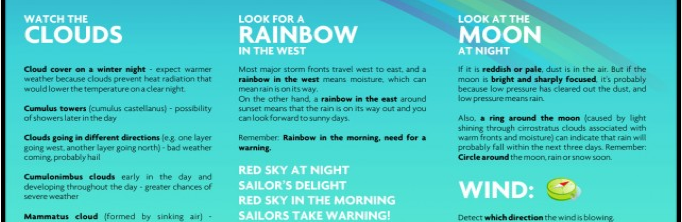
How to Forecast Weather

Posted: 21 Jan 2012 05:00 AM PST

We first looked at this back in 2010, but with sailing weather a mere 3 months away, its time to bring this back:
>

>
Full graphic after the jump

>
click for giant version

via Daily Infographic

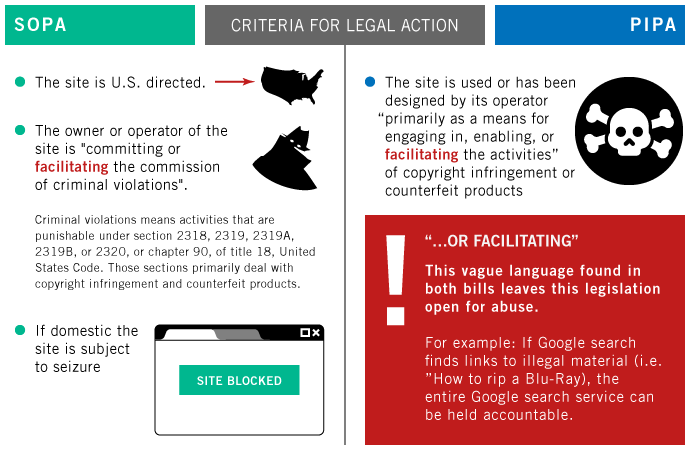
Technical Examination SOPA & PIPA

Posted: 21 Jan 2012 04:17 AM PST

From Lumin Consulting, via Search Engine Journal, we see this Technical Examination SOPA & PIPA:

>

click for full graphic

>
SOPA & PIPA Technical Examination

Brought to you by Lumin Interactive and Condor Consulting

.

0 comments:

Post a Comment

previous home Next

{8} chatroll


{9} AdBrite FOOTER

{8} Nice Blogs (Adgetize)