


The Big Picture |

- How Coffee Changed America
- Breaking Down Google’s Earnings by Industry (2011)
- Will the Collapse of the Shanghai Composite Drag On?
- Buying the 49er Breakout….
- Weekend Reads
- Oh dear, Greece yet again
- Insider Trading vs Financial Crisis Prosecution
- iEconomy Shifts Labor Trends
- Two Books and Two Fish
- Fat Cats and Starving Dogs; Happy Foxes and Sad Sacks
| Posted: 23 Jan 2012 02:00 AM PST |
| Breaking Down Google’s Earnings by Industry (2011) Posted: 23 Jan 2012 01:30 AM PST |
| Will the Collapse of the Shanghai Composite Drag On? Posted: 22 Jan 2012 10:30 PM PST
Christopher Wood's excellent Greed & Fear piece wrote this past week,
Stock trading in mainland China will be closed all of next week and Monday through Wednesday in Hong Kong for the New Year holiday as the country effectively shuts down during this period. We will be monitoring labor demand from Chinese factories when workers return from the holiday and will watching how the Shanghai trades with respect to further monetary measures. The index has reclaimed the 50-day moving average and it does look and feel like a break above the upper bound of the Shanghai's classic downward channel is in the cards when the market reopens. Disciplined traders will, of course, wait for confirmation before acting, but, a break-out would further boost confidence in risk markets and commodities. Interesting Economist cover this week with a series of articles on state sponsored
multinational corporations as the new model for capitalism. We find it interesting, however, that China is attempting to prop up equities by deregulation and lifting restrictions on foreign investors. This while developed markets become more and more distorted with massive We're now wondering if markets will ever clear again. Conventional metrics are tossed aside and market signals will become increasingly difficult to discern and read as the interventions drag on in this Year of the Dragon – and the Draghi! Asset bubbles, anyone? Who said this business was easy. (click here if charts are not observable) |
| Posted: 22 Jan 2012 02:00 PM PST Though the Giants are closer to the New York Fed's printing press, which can make magic happen, fix almost anything, and more powerful than steroids, we're buying the 49er breakout. We do confess, however, our affinity for the team of the town we once lived and our love for Eli, but the fundamentals and technicals are just too strong for San Francisco. First, adding 1 (more victory) to 49 sums to 50, which is a key Fibonacci ratio level. This is somewhat neutralized as the Giants will be playing in their 31st postseason, an NFL record, and their 19th championship game, which also sums to 50. Second, the 49er 50-day moving average broke above its 200-day generating the classic Golden Cross buy signal this week. This is especially powerful when it moves through such a tight channel as the Golden Gate and we expect this combination to generate an explosive third wave in the fourth quarter, which could really give a boost to team confidence. Niner fans are well trained and can do an excellent wave on all three levels. Finally, quarterback, Alex Smith, who has done nothing for 49er investors for several years had his breakout performance last week against the Saints. This was confirmed on Friday by a breakout move of another long-term dog, Microsoft, which was up almost 6 percent. Thus, we are picking the 49ers to beat the Giants by 6 points. Conversely, Eli Manning is a bit overbought, coming off a career season and his first 300-yard postseason game, throwing for 330 yards against the Packers last week. This looks like the formation of a Long Island Top to us. The only real risk we see to a 49er victory is that Greece and its creditors don't strike a deal by kickoff. S&P futures could fall sharply and expectations that the Fed will announce a QE3 next week might give the Giants a boost. This may be offset a bit as we believe next week's close of the Shanghai Composite and Hang Seng in the first part of the week due to the New Year holiday is 49er positive. Now how's that for some Moneyball? We dare you to prove us wrong if the 49ers win, especially by 6 points. Cheers to a hard hitting injury free game. TV and Radio Calls of Vernon Davis’ Touchdown vs. Saints 1/14/12 (click here if video is not observable) |
| Posted: 22 Jan 2012 01:30 PM PST For those of you not watching Football, some weekend reading material:
What are you reading? |
| Posted: 22 Jan 2012 11:00 AM PST News reports this Sunday suggest that negotiations between Greece and its private sector bondholders on PSI have broken down yet again – apparently negotiations have been suspended, following renewed demands by the IMF/Germany, in particular, for a lower coupon (2.0% was reported by the FT) on new debt to be issued as part consideration for the cancellation of existing debt. Assuming a notional haircut of 50% (65%+ in NPV terms) on some E200bn of existing debt held by the private sector, the IMF had (optimistically) forecast last October that Greek debt would remain around 120% by 2020. Since then, the IMF have leaked that their previous debt/equity projections were optimistic and that they will have to be revised higher – in particular, they cite that the Greek economy has deteriorated much further. The IMF and Germany are rightly concerned that the amount of the haircut currently proposed on private sector bondholders is insufficient to make Greece’s debt sustainable, a real problem for the IMF as it has to justify its continued participation in further bail out funds for Greece on the basis that the country’s debt will be sustainable – impossible given the current proposed “agreement”. Last week, reports from official sources and bondholders suggested that a deal had been agreed – the situation has changed over the weekend. Negotiators from the IIF (who represent the majority of the private bondholders) have left Athens. Greece is quite happy to commit to a 4.0% coupon on the new bonds to be issued as part consideration for the the cancellation of the existing debt – they know that they will never meet their obligations and are only interested in accessing additional bail out funds, and ECB funding as long as possible. In addition, they realise that a default makes their banks, pension funds etc, etc totally insolvent. They will agree to anything on the basis that it sucks in the EU/Euro Zone/IMF further and postpones their inevitable default. Furthermore, the Greeks are just waiting for the outcome of the next elections (may be postponed from Spring to June this year), at which time the current opposition (who will win) claim that they will renegotiate current agreements – some hope. The Euro Zone is adamant that it does not want to trigger CDS’s – hence this ludicrous “voluntary agreement”. However, I have to question whether this position is feasible for much longer. It is alleged that certain Hedge Funds have built up a position in Greek debt, which enables them to block a potential deal and thereby profit from a hard default ie triggering CDS’s. The Greeks in response have threatened to enact legislation in respect of debt issued under Greek law, which (retrospectively) introduces Collective Action Clauses (“CAC’s”). These CAC’s would force minority bondholders to agree to the terms of a restructuring which have been agreed by a (to be specified) majority (by value) of bondholders. However, some of the relevant Greek debt is subject to UK law, which requires between 66% and 75% of bondholders (by value) to agree to a restructuring, for the deal to become binding on remaining bondholders. There is just not enough information to analyse the situation – in particular, the % of bonds held by the recalcitrant Hedge Funds is unknown – however, the kind of Hedge Fund’s that play this game are generally pretty sophisticated and, presumably, would not have gone into this without having a blocking percentage. The Euro Zone Finance Ministers meet next Monday – a “voluntary” restructuring deal was supposed to be presented to these Ministers for them to sign off on and thereby enable the 2nd Greek bail out fund to come into force. The time, effort and, in addition, vast sums of money wasted on Greece is a joke, indeed criminal. We all know that Greece will default – it is not an “if”, but a “when”. Personally, I believe it would be much better to let Greece default (and certainly Portugal – Ireland may just make it, but its touch and go) and build a credible defence around the other Euro Zone countries, which are simply too big to fail. The EFSF/ESM lacks the resources for this task, unless the E500bn currently being discussed is leveraged up to a minimum of E2tr by the ECB, in my humble view. However, the ECB and Germany have rejected this idea – well great, but what’s your REALISTIC solution boys !!!!, other than the standard nonsense – the problem is that they have none. Euro Zone member states will not contribute more funds. The only other credible alternative is for the ECB to buy Euro Zone Sovereign debt.The above options have been and remain the only viable choices available, unless the Euro Zone wants a break up, which will be far, far costlier. I am not sure how long this game can go on for – as you know, I have assumed no longer than the 1st Q of this year. However, I admit that the Euro Zone has dragged this whole sorry saga for longer than I would have thought possible. The ECB’s unlimited 3 year LTRO (with much lower collateral requirements) has helped enormously and the next at the end of February is likely to be taken up by banks in size. That deals with banks liquidity issues over the next few years, even if a number of banks are effectively insolvent if they mark to market their assets – however, no one will propose that this occurs. Importantly, the ECB’s LTRO buys time for banks to recapitalise themselves, given the cheap and quite possibly even cheaper funding. Banks will, off course, have to write down the value of their bond holdings in the event of a restructuring and/or default, though most (ex Greek and Portuguese banks) should be able to cope with a restructuring/default of those countries – if it extends much beyond these countries, they really do have a problem. However, the bottom line is that Euro Zone Sovereign debt problems remains and remains and …….No solution looks imminent. Analysts believe that a deal will be reached between the Greeks and bondholders. Given the constant changes, who knows. However, a failure to reach an agreement in Greece (resulting in a default) will certainly negatively impact the markets as threats of contagion return (Portugal will be the next – it will certainly have to restructure its debt in any event), though the 3 year LTRO is a real game changer and, I suppose, future ECB LTRO’s could be extended to say 5 years or more, with the consequential positive impact on medium term Sovereign bond yields – as has been the case for short term Sovereign debt yields, following the recent 3 year LTRO. However, I continue to believe that the ECB will ultimately be forced into a QE programme – probably dressed up as an anti deflation measure, as Euro Zone inflation falls below 2.0%. The ECB’s mandate is to maintain Euro Zone inflation “below, but close to 2.0%”. Furthermore, at his first meeting, Mario Draghi reduced rates by 25 bps on the basis of projections for inflation, which certainly differed from previous ECB practice, where interest rates were based on inflation levels prevailing at the time ie the ECB could move sooner rather than later. Euro Zone inflation is declining and will continue to decline – base effects make this a virtual certainty. As a result, I would argue that the ECB can introduce QE, whilst sticking to its mandate. My friends at Credit Suisse estimate that QE, which should devalue the Euro, will result in 0.7% (real) improvement in Euro Zone GDP for every 10c reduction in the value of the Euro. Could sort out the otherwise (certain) recession in the Euro Zone this year. Finally, don’t you just wish that Greece go away !!!. Off to the wedding in the morning, so no blogs next week. |
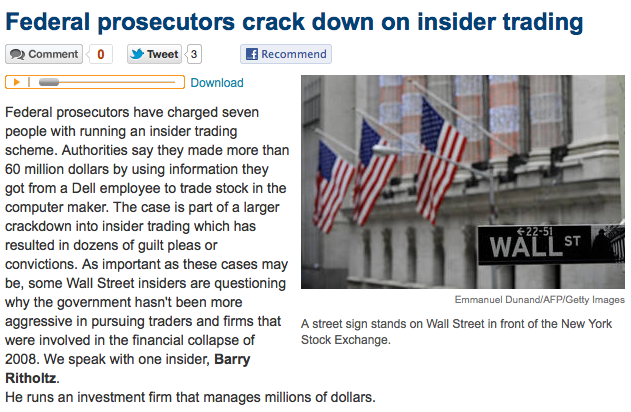
| Insider Trading vs Financial Crisis Prosecution Posted: 22 Jan 2012 10:30 AM PST |
| Posted: 22 Jan 2012 09:00 AM PST Today’s must read MSM piece is a 4500 word beastie, ostensibly about the iPhone, but actually about the broader technological trends that drive the economy, especially regarding employment. It reveals what happens when we shift low cost jobs overseas — the impact is a variety of more sophisticated, higher paying technological jobs follow as well. The video “iPhone Economy” is especially informative. In the print edition, there is a fantastic graphic showing the change in Manufacturing versus Service Jobs; unfortunately, it is nowhere to be found on line (not even Economix), but I will make discreet inquiries. Meanwhile, its your reading assignment for today. > Source: |
| Posted: 22 Jan 2012 07:00 AM PST Two Books and Two Fish Admiring the untamed Chilean landscape and simultaneously using a wifi connection, I marvel at the interconnectedness that exists in this modern world. We are heartened by the initial unemployment claims data and the somewhat benign inflation data. We are watching markets and current world news. We see Perry drop from the Presidential race; we see the Iowa caucus final count award Rick Santorum the victory. Gingrich wins South Carolina. The news is as current here as it is in our Florida office. By my next trip, upgraded wifi speed and a Skype app will make the Alto Puelo Lodge a functioning mobile office. We return fully current on the news. We thank many readers for the wonderful emails that came to us in response to our previous report from Chile. The fly fishing comments from fellow fly fishermen from around the world were heartwarming and are most sincerely appreciated. Even the questions about "photoshopping" the fish brought good laughs and the reward of sharing the experience with others. The Alto Puelo Lodge is truly a wonderful place. In particular, we enjoyed an email that came to us from Missoula, Montana. Chris Squires, a mother, aged 60, with an 18-year-old daughter who wants to be a fishing guide, wrote eloquently about fly fishing and contemplating the world. She captured the very essence of this annual ritual visit to the Patagonian valley when she wrote, at the conclusion of her letter, "Fishing is a good way to let thoughts settle." Chris is right, and so our second report from Chile will discuss two fish, two books, and their interconnection. Our tale of two tails will commence shortly. But first, let us discuss a book. First book Frank Knight's seminal work Risk Uncertainty and Profit delves deeply into the differences and nuances between risk and uncertainty. He suggests that risk is something that is examined and derived by measuring the past, using statistical analysis and other methods in order to assign probabilities of outcomes. The presumption is that the past is prologue for the future; therefore, risk can be quantified with these methods. Knight's work introduces the notion of uncertainty framed in the context of human behavior. Knight's criticism of economists, forecasters, and those engaged in business operations is that they confuse risk and uncertainty. He goes on to discuss how various types of organizations function and how individuals collectively operate in circumstances of elevated risk or uncertainty. His work is challenging and may be considered out of date by many who are caught up in quantitative processes. He was an economist who went beyond mathematical equations and thought about economics in the terms of human behavior and social interaction. "With the introduction of uncertainty, the fact of ignorance in necessity of acting upon opinion rather than knowledge into this Eden-like situation, its character is completely changed. With uncertainty absent, man's energies are devoted altogether to doing things; it is doubtful whether intelligence itself would exist in such a situation; in a world so built that perfect knowledge was theoretically possible, it seems likely that all organic readjustments would become mechanical, all organisms automata…. "With uncertainty present, doing things, the actual execution of activity, becomes in a real sense a secondary part of life; the primary problem or function is deciding what to do and how to do it…. "When uncertainty is present and the task of deciding what to do and how to do it takes ascendency over that of execution, the internal organization of productive groups is no longer a matter of indifference or a mechanical detail." Frank Knight has captured the essence of action when uncertainty is present. The process by which one decides what to do and how to do it takes primacy over the mechanics of implementation. Sitting on the Alto Puelo deck, we realize that this is what makes us human; this is what makes life interesting. This is what makes economics a social science, not a quantitative, scientific, exact process. Source: Frank Hyneman Knight, Risk Uncertainty and Profit (Memphis: General Books, LLC, 2010)
First Fish The Rio Puelo drops down several sets of rapids below the Alto Puelo Lodge. The runoff at the bottom of the second set makes a hard right turn. The speed of the water and the ebb and flow of the seasons have carved out a large section of the bank. As the river turns, it causes a back eddy to flow into a deep pool. The back eddy circles around slowly, collecting flotsam from the river in a swirl about 50 feet across. Insects come down the tumult of the rapids and get caught in the back eddy, along with everything else. In the easy currents of this back eddy, rainbow trout glide in and wait for a nymph or a fly, and feed in this turquoise green, sunny environment. A rainbow trout was feeding on a stream of insects that were floating through the back eddy of the pool. We watched from a distance; she would rise and fall, come up for an insect, go back down into the mild current, and come up again. We tied a small elk hair caddis imitation on the end of a 6-weight tippet, a very thin leader but necessary in order for it to be out of the vision of the trout. In order to float the fly to the trout, I cast the fly upstream and place it so that it will float to the fish as a natural fly would do. The cast was about 40 feet. The fly was placed about 10 feet in front of the trout; and gradually, with some mending of the line, it floated naturally, the trout rose and took the fly, the hook was set, and the fight commenced. Nano, our Chilean guide and an expert fisherman, got very excited when he realized that the trout was on a very light leader. "Be careful!" he warned. The result is here: Rainbow Trout. The rainbow trout was released and gave a wonderful start to the morning, as it was the first cast. Yes, it was going to be an extraordinary day. Pools and feeding fish are assessable. In Frank Knight's world, they are predictable. Uncertainty is in the choice of the fly. Skill involves decisions of presentation and execution, and so we connect the first book with the first fish, with the result that in this case we consider a combination of good execution and good luck. Second Book James Rickards' Currency Wars: The Making of the Next Global Crisis is a good read from the deck of the Alto Puelo Lodge. The afternoon breeze is soothing, and the air is deliciously sweet and pure. The sun is bright on this summer day in Patagonia. The morning fishing was marvelous, and lunch was exquisite. Chapter ten, entitled "Currencies, Capital and Complexity," describes the risk of strategies of devaluation of a currency. In the earlier sections of his book, Rickards recites history, from Roman times to modern times, and how devaluation in many instances led to tragic outcomes. He argues that the central banks of the world are now engaged in competitive devaluations, and that devaluations lead to a modern form of war. He discusses the thinking that goes into devaluations. He is harshly critical of some of our present leaders who have represented themselves as favoring devaluation, either through implication or public expression. Rickards adds the issue of behavioral economics to complexity, and he discusses how these interactions elevate risk, because increased complexity makes economic processes more dangerous when they fail, just as they are more beneficial to society when they succeed. He writes, "What Bernanke, Geithner, and like-minded behavioralists in policy positions fail to see is something Merton might have easily grasped – the positive feedback effect that arises from framing without substance. If the economy is actually doing well, the message requires no framing and the facts will speak for themselves, albeit with a lag. Conversely, when reality consists of collapsing currencies, failed banks and insolvent sovereigns, talk about green shoots has at best a limited, temporary effect. The longer term effect is a complete loss of trust by the public." Rickards is warning about impending difficulties. His concluding chapter outlines options and how they might unfold, and it is a thought-provoking read. Chapter 11, entitled "End Game: Paper, Gold or Chaos?", outlines processes at work in the International Monetary Fund and in the interconnected central banking systems of the world that are leading to increasing devaluation of currencies. He traces the origins of the IMF and the collapse after Bretton Woods; and the results show that the US dollar comprises "over 61% of identified reserves, while the next largest component, the euro, weighs in at just over 26%." He notes how the IMF is attempting to gradually institutionalize special drawing rights (SDR), and he notes how the development of the SDR as a world monetary substitute on an institutional level is currently underway as a new process. He talks about the risk to this approach in the 2012 election and what would happen with a Congress and a President in 2013 if some contributions were made or limits on contributions to the IMF were created by Congress. SDR borrowing capacity is a huge issue now. He points out some of the work done by Geithner to assemble larger entities into informal groups, in which decisions are made without direct consultation with political constituencies and certainly without consultation with the taxpayers who support those constituencies. Rickards also sponsors the notion that a gold standard is necessary. He rejects the attack on gold as a "barbarous relic." Rickards notes clearly in his arguments that "gold is not a commodity. Gold is not an investment. Gold is money par excellence." He notes that gold is "truly scarce." I am not sure whether gold is the answer to the current woes in our economic circumstances, and I am not sure that the current expansion of central bank balance sheets will lead to an immediate inflation. In fact, that has been a warning we have heard the last four years, and we at Cumberland have rejected it in the near term. By doing so, we were able to take advantage of the tremendous decline in interest rates, and our bond portfolios were rewarded for that decision. However, we are approaching levels of interest rates that are creating concern. How long will they remain this low? How much more expansion of central bank balance sheets will occur? What are the multipliers attendant to the monetary-base calculations for various currency blocks around the world? Readers may look at the Cumberland website for updated graphic depictions on central bank balance sheets and on interest-rate spreads. Look at the two chart stacks at Cumber.com for details. Frank Knight described the difference between risk and uncertainty and developed the concept of organizational structure in which the process of deciding what to do and how to do it becomes the critical element in dealing with uncertainty. James Rickards talks about that process in the context of central bank policy and the monetary dynamics involving the euro, the British pound, the Japanese yen, and the US dollar. He focuses on possible outcomes of that decision-making process. He talks about the uncertainty that awaits us and about the various scenarios that could befall us. Currency Wars, with its last two chapters, is an exciting book to read and ponder on the Rio Puelo. Frank Knight's classic work provides the framework for such thought, and Chris Squires' quote from her email frames the connection between contemplative reading, thinking and digesting of ideas, and a fly rod. Source: James Rickards, Currency Wars: The Making of the Next Global Crisis (New York: Penguin Group, 2011) Second Fish When you take the Rio Puelo down below the first rapids and before the second rapids with the big rainbow pool, there is a feeder stream that flows in from the left side. It brings food from the mountains down into the river, and joins the larger flow. In the abundance of swirling water, trout can easily find a meal. The place to take the boat is below the location where the feeder stream comes in, and then bring the boat back, positioning and anchoring it so that the cast can be executed so that the fly will float into position where the two streams meet. Trout will hold in that water searching for a meal. In this case, the meal was a "matuka." The matuka is the name for a fly with a gold bead head, a green and black feathered tail, and a reddish-orange thorax. I guess the insect it most closely resembles is an oddly shaped caterpillar or worm. In any case, the trout like it. In order to cast in this environment you have to throw the fly as far as you can across the fastest-moving water. You have to use sinking line; in this case, it was an Orvis 250 Depth Charge. You also need a heavyweight rod; in this case, it was an 8-weight. In order to shoot the weighted line out as far as possible, you make one false cast, taking a stack of line off the reel; and then you attempt to fling the line across the river and allow it to swing so that the fly floats naturally into the desired space. A monster brown trout lay in waiting. The fight was twenty minutes in length, the tippet was 4x, several runs went to the backing, and the proof is here: Brown Trout. Nano, our fishing guide, again demonstrated his knowledge of the river and provided expert consulting. Two books. Two fish. A great week at the Alto Puelo Lodge on the Rio Puelo. For more information, please visit patagonia-flyfishinglodge or email ericschoenauer -at- gmail.com. With this, I am on my way back to my desk. ~~~ David R. Kotok, Chairman and Chief Investment Officer |
| Fat Cats and Starving Dogs; Happy Foxes and Sad Sacks Posted: 22 Jan 2012 05:35 AM PST This weekend, I saw Margin Call on DVD. Jeremy Irons plays a CEO of a small Goldman Sachs like company. A young analyst at the firm discovers that their highly-leveraged, massive mortgage bets are based on a VAR formula that’s flawed. It failed to consider volatility ranges beyond historical distributions. With the market swinging, his calculations show a 25% move in the underlying holdings will wipe the company out and then some. Irons ends up giving a speech to Kevin Spacey towards the end of the film — no spoilers here — its just a fascinating digression, that goes something like this:
Its a great film (IMDB) — if you have not seen it yet, move it to the top of your Netflix queue . . . |

![What Industries Contributed to Google's Billion in Revenues? [INFOGRAPHIC]](http://www.wordstream.com/images/google-earnings.png)


| You are subscribed to email updates from The Big Picture To stop receiving these emails, you may unsubscribe now. | Email delivery powered by Google |
| Google Inc., 20 West Kinzie, Chicago IL USA 60610 | |



0 comments:
Post a Comment