


The Big Picture |

- Supreme Court Building Covered in Giant Dollar Signs
- An Open Letter To Mark Zuckerberg About Why It Doesn’t Matter Where You List Your Stock
- No Rick Santelli and Zero Hedge, One Million People Did Not Drop Out of the Labor Force Last Month
- Succinct Summation Of Week’s Events (02/03/12)
- NYAG Sues MERS, BAC, JPM, WFC
- IPOs: From Netscape To Facebook
- In response to Floyd Norris’ defense of the virtues of unitary executives managing capitalism
- Tearing Apart January 2012 NFP data
- 10 Friday AM Reads
- Payroll data a great surprise, do we really need more QE?
| Supreme Court Building Covered in Giant Dollar Signs Posted: 03 Feb 2012 03:05 PM PST To mark the second Citizens United anniversary, we lit up the Supreme Court with giant dollar signs to send a message: rights are for PEOPLE, not corporate “persons.” |
| An Open Letter To Mark Zuckerberg About Why It Doesn’t Matter Where You List Your Stock Posted: 03 Feb 2012 01:30 PM PST February, 2012
> Dear Mark Zuckerberg, Congratulations on your IPO filing. We understand that you are faced with a difficult decision soon on where to list your stock. You have probably heard from your bankers that the NASDAQ exchange is for tech savvy companies like Google and Apple and the NYSE is where the blue chip companies like GE and Caterpillar choose to list. You may think that the NASDAQ market is more of an electronic exchange where dealers place competing bids and offers to help facilitate institutional client trades. You may look at financial television and see scenes from the NYSE and think that the NYSE market is more of a floor based auction model where your stock would trade at a "post" on the exchange. You may be thinking that regardless of which exchange you pick, your stock will help investors create wealth for themselves by investing in your company for the long-term. We hate to break the bad news to you but the fact is, in today's market, it doesn't matter where you list. Your stock is about to become one of the biggest casino chips on Wall Street. Ever hear the terms rebate arbitrage or latency arbitrage? Ever hear of colocation? Do you know what an exchange private data feed is? How about an actionable IOI or a dark pool? We bet you have probably never heard of these terms (maybe you have been too busy coding lately or ducking those Winklevoss twins). These terms are really what stock trading is all about nowadays. Your stock will now be traded by high frequency traders who have an average holding period of 22 seconds. The majority of them won't care about your earnings, or your new "likey like" button that you just launched. They won't care about how many gazillion users you just signed up or how many eyeballs are on your site. They will only care about flipping your stock for a very small profit – millions of times per day. They will only care about getting paid a rebate 1/3 penny per share to "add liquidity" in your stock. They are not looking to invest in Facebook, they are looking at it as a tool to help them make money in their high speed arbitrage world. Before you make your decision on where to list, also keep in mind that one third of your stock will be traded in dark pools that are off-exchange and away from the public's eye . Know that even though the spread in your stock will be one penny (most of the time), your stock will not necessarily be liquid. Sure your stock will trade a lot of volume, but this is not the same as liquidity. Know that when your stock starts to move around intraday by 3-5%, there will be no one to call to ask what is going on. You may be thinking now, how did this happen? How did the stock market get so screwed up? What ever happened to the goals of capital raising and investor protection? Well, it's a long story. One that is much too long for this letter. Maybe if you have some time, give us a call and we'll explain what happened. Best of luck on the IPO. If you pick the NYSE, know that the podium looks much bigger on television. Sincerely, ~~~ Joseph Saluzzi (jsaluzzi-at-ThemisTrading.com) and Sal L. Arnuk (sarnuk-at-ThemisTrading.com) are co-heads of the equity trading desk at Themis Trading LLC (www.themistrading.com), an independent, no conflict agency brokerage firm specializing in trading listed and OTC equities for institutions. Prior to founding Themis, Sal and Joe worked for more than 10 years at Instinet Corporation, pioneers in the field of electronic trading, and at Morgan Stanley. |
| No Rick Santelli and Zero Hedge, One Million People Did Not Drop Out of the Labor Force Last Month Posted: 03 Feb 2012 01:15 PM PST SilverOz is an MPA specializing in local economic development and have worked in local economic development for a mid-sized midwestern county for over 10 years. He has personally worked on/managed projects that have totaled over $500 million in direct investment into the county. ~~~ So today following an otherwise pretty darn good jobs report, we get the usual perma-pessimists at Zero Hedge and Rick Santelli over at CNBC proclaiming that the report showed a drop of over 1 million people from the labor force in one month. Of course, as ususal, both Santelli and Zero Hedge have a real reading comprehension problem and completely missed that this million+ people isn’t some new January phenomenon, but a result of the BLS using the 2010 census data to have more accurate data. In other words, the changes in the Household Survey to the various measures had taken place over the years prior to 2010, but for simplicity’s sake, the BLS incorporates these changes into one month (which they clearly point out). The relevant text from the report is below (bold is mine): “Effective with data for January 2012, updated population estimates which reflect the results of Census2010 have been used in the household survey. Population estimates for the household survey are developed by the U.S. Census Bureau. Each year, the Census Bureau updates the estimates to reflect new information and assumptions about the growth of the population during the decade. The change in population reflected in the new estimates results from the introduction of the Census 2010 count as the new population base, adjustments for net international migration, updated vital statistics and other information, and some methodological changes in the estimation process. The vast majority of the population change, however, is due to the change in base population from Census 2000 to Census 2010. In accordance with usual practice, BLS will not revise the official household survey estimates for December 2011 and earlier months. To show the impact of the population adjustment, however, differences in selected December 2011 labor force series based on the old and new population estimates are shown in table B. The adjustment increased the estimated size of the civilian noninstitutional population in December by 1,510,000, the civilian labor force by 258,000, employment by 216,000, unemployment by 42,000, and persons not in the labor force by 1,252,000. Although the total unemployment rate was unaffected, the labor force participation rate and the employment-population ratio were each reduced by 0.3 percentage point. This was because the population increase was primarily among persons 55 and older and, to a lesser degree, persons 16 to 24 years of age. Both these age groups have lower levels of labor force participation than the general population.” So Rick/Zero Hedge, unless you would like to argue that the population of the United States also grew by 1.5 million in one month (since that is from the exact same report/revision you quoted), I think both of you should retract your extremely misleading statements about those not in the labor force increasing by over a million in January and simply admit that you are either too stupid or too focused on selling a particular world view to read the data correctly. At the very least, a reputable financial news organization like CNBC needs to set the record straight on data like this as while Mr. Santelli is entitled to his own opinion, he is not entitled to his own facts, and the fact is 1 million people did not drop out of the labor force in January 2012. |
| Succinct Summation Of Week’s Events (02/03/12) Posted: 03 Feb 2012 12:30 PM PST Succinct summation of week’s events: Positives:
Negatives:
|
| Posted: 03 Feb 2012 12:20 PM PST A.G. SCHNEIDERMAN ANNOUNCES MAJOR LAWSUIT AGAINST NATION'S LARGEST BANKS FOR DECEPTIVE & FRAUDULENT USE OF ELECTRONIC MORTGAGE REGISTRYComplaint Charges Use Of MERS By Bank Of America, J.P. Morgan Chase, And Wells Fargo Resulted In Fraudulent Foreclosure FilingsServicers And MERS Filed Improper Foreclosure Actions Where Authority To Sue Was QuestionableSchneiderman: MERS And Servicers Engaged In Deceptive and Fraudulent Practices That Harmed Homeowners And Undermined Judicial Foreclosure ProcessNEW YORK – Attorney General Eric T. Schneiderman today filed a lawsuit against several of the nation's largest banks charging that the creation and use of a private national mortgage electronic registry system known as MERS has resulted in a wide range of deceptive and fraudulent foreclosure filings in New York state and federal courts, harming homeowners and undermining the integrity of the judicial foreclosure process. The lawsuit asserts that employees and agents of Bank of America, J.P. Morgan Chase, and Wells Fargo, acting as “MERS certifying officers,” have repeatedly submitted court documents containing false and misleading information that made it appear that the foreclosing party had the authority to bring a case when in fact it may not have. The lawsuit names JPMorgan Chase Bank, N.A., Bank of America, N.A., Wells Fargo Bank, N.A., as well as Virginia-based MERSCORP, Inc. and its subsidiary, Mortgage Electronic Registration Systems, Inc. The lawsuit further asserts that the MERS System has effectively eliminated homeowners’ and the public’s ability to track property transfers through the traditional public records system. Instead, this information is now stored only in a private database – which is plagued with inaccuracies and errors – over which MERS and its financial institution members exercise sole control. Additional defendants include BAC Home Loans Servicing, LP, Chase Home Finance LLC, EMC Mortgage Corporation, and Wells Fargo Home Mortgage, Inc. "The banks created the MERS system as an end-run around the property recording system, to facilitate the rapid securitization and sale of mortgages. Once the mortgages went sour, these same banks brought foreclosure proceedings en masse based on deceptive and fraudulent court submissions, seeking to take homes away from people with little regard for basic legal requirements or the rule of law," said Attorney General Schneiderman. "Our action demonstrates that there is one set of rules for all – no matter how big or powerful the institution may be – and that those rules will be enforced vigorously. Only through real accountability for the illegal and deceptive conduct in the foreclosure crisis will there be justice for New York's homeowners." The financial industry created MERS in 1995 to allow financial institutions to evade local county recording fees, avoid the hassle and paperwork of publicly recording mortgage transfers, and facilitate the rapid sale and securitization of mortgages. MERS operates as a membership organization, and most large companies that participate in the mortgage industry – by originating loans, buying or investing in loans, or servicing loans – are members, including JPMorgan Chase, Bank of America, Wells Fargo, Fannie Mae, and Freddie Mac. Over 70 million loans nationally have been registered in MERS System, including about 30 million currently active loans. Through their membership in MERS, these companies avoided publicly recording the purchase and sale of mortgages by designating MERS Inc. – a shell company with no economic interest in any mortgage loan – as the “nominal” mortgagee of the loan in the public records. Instead, MERS members were supposed to log mortgage transfers in the MERS private electronic registry. The basic theory behind MERS is that, because MERS Inc. serves as a “nominee” (or agent) for most major lenders, it remains the “mortgagee” in the public records regardless of how often the loan is sold or transferred among MERS members. Thus, although MERSCORP has only about 70 employees, MERS Inc. serves as the mortgagee of record for tens of millions of loans registered in the MERS System. MERS has granted over 20,000 "certifying officers" the authority to act on its behalf, including the authority to assign mortgages, to execute paperwork necessary to foreclose, and to submit filings on behalf of MERS in bankruptcy proceedings. These certifying officers are not MERS employees, but instead are employed by MERS members, including JPMorgan Chase, Bank of America, and Wells Fargo. MERS’ conduct, as well as the servicers' use of the MERS System, has resulted in the filing of improper New York foreclosure proceedings, undermined the integrity of the judicial process, created confusion and uncertainty concerning property ownership interests, and potentially clouded titles on properties throughout the State of New York. In fact, several New York judges have questioned the standing of the foreclosing party in cases involving MERS loans and the validity of mortgage assignments executed by MERS certifying officers. The lawsuit specifically charges that the defendants have engaged in the following fraudulent and deceptive practices: • MERS and its members have deceived and misled borrowers about the importance and ramifications of MERS’ role with respect to their loan by providing inadequate disclosures. • The MERS System is riddled with inaccuracies which make it difficult to verify the chain of title for a loan or the current note-holder, and creates confusion among stakeholders who rely on the information. In addition, as a result of these inaccuracies, MERS has filed mortgage satisfactions against the wrong property. The lawsuit seeks a declaration that the alleged practices violate the law, as well as injunctive relief, damages for harmed homeowners, and civil penalties. The lawsuit also seeks a court order requiring defendants to take all actions necessary to cure any title defects and clear any improper liens resulting from their fraudulent and deceptive acts and practices. The matter is being handled by Deputy Bureau Chief of the Bureau of Consumer Frauds & Protection Jeffrey K. Powell, Assistant Attorney General Clare Norins, and Assistant Solicitor General Steven C. Wu, under the supervision of First Deputy Attorney General Harlan Levy. |
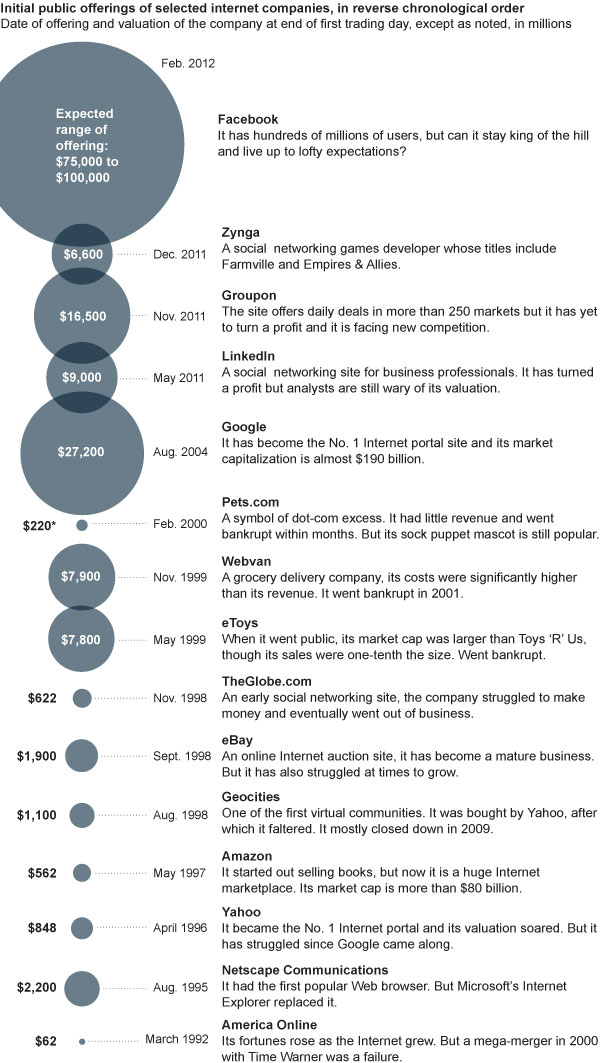
| IPOs: From Netscape To Facebook Posted: 03 Feb 2012 09:30 AM PST In case you were unaware, IPOs are terrible investments — at least most of the time. The lottery ticket dreams keeps hope alive that this next one is going to be a giant winner. Hopes are pinned on the giant Facebook IPO, coming out at an expected 100 X earnings and 30 X revenue. Its going to take extrordinary growth to justify those prices, especially for people who buy stock in the open market at higher than IPO prices. > Click to enlarge: |
| In response to Floyd Norris’ defense of the virtues of unitary executives managing capitalism Posted: 03 Feb 2012 07:54 AM PST Mr. Norris: It so happens our friend, Thane Rosenbaum, interviewed Larry Summers last night at the 92nd Street Y in New York. When asked about a gold standard, Summers recoiled and shrieked “a gold standard is the creationism of economics!” The crowd got a big chuckle out of that. So you seem to be in popular company with your February 3rd piece, “In a Focus on Gold, History Repeats Itself” (http://www.nytimes.com/2012/02/03/business/in-rise-of-gold-bugs-history-repeats-itself.html?_r=1&ref=business). The stock of money does not need to be managed higher by policy makers to accommodate a growing economy, as Keynesian and Monetarist economists argue and as you seem to agree. Were the money stock (global money stock, not just US dollars) to grow at 1.5% per year (annual growth of the gold stock), all that would mean is that the price level of all aggregate global goods and services could rise only 1.5% per year (more or less). Of course, price levels within the bucket containing all-things-not-money would still shift based on preference. The point is economies could and would grow as much as they should, not as much as they were willing to leverage themselves. All things equal, the price of gold in paper currency terms rises with paper money growth and falls with unreserved credit growth. Its “exchange rate” to US dollars is simply a function of its relative scarcity, like any other currency exchange rate. It’s not as complicated or as emotional as you and most economists suggest. All the unreserved credit in the world today (unreserved because there is not enough base money with which to repay it, by a factor of about 7 times for US bank assets only), suggests strongly that global central banks will have to manufacture more of their currencies. Thus, the strong bid for gold today. In fact, some would argue the current price of gold in USD terms is way too low in the current environment given the enormous leverage already in the system and the amount of money that has to be manufactured in the future to de-lever it. Based on this metric we believe gold is undervalued by as much as five times presently, even without any further Fed printing. It might interest you to know that, using this metric, gold in 1980 became extremely overvalued and so it should have fallen, and obviously it did. Sadly for your readers you did not consider relative value vis-à-vis gold’s proper benchmark – the gap between unreserved credit and base money. So, there are some secular reasons to like gold at current prices and even to believe in a disciplined monetary system. If the fervency of gold bugs annoys you so much, why not just suggest that your fellow world improvers abolish capital gains taxes on physical bullion and let us crazy gold bugs save in a currency we think will maintain its purchasing power better? We will go away quietly and let you and Mr. Summers amass debt-based “savings”. Maybe a little balance is in order? Kind regards, Paul Brodsky & Lee Quaintance Paul Brodsky
~~~ This material is not an offer to sell or a solicitation of an offer to purchase securities of any kind. This report may contain forward-looking statements within the meaning of the Private Securities Litigation Reform Act of 1995. Forward-looking statements involve inherent risks and uncertainties, and we might not be able to achieve the predictions, forecasts, projections and other outcomes we may describe or imply. A number of important factors could cause results to differ materially from the plans, objectives, expectations, estimates and intentions we express in these forward-looking statements. We do not intend to update these forward-looking statements except as may be required by applicable laws. Return figures herein are estimated net of all fees and charges. Any comparisons have been obtained from recognized services or other sources believed to be reliable. No part of this document may be reproduced in any way without the prior written consent of QB Partners. Past performance may not be indicative of future results. |
| Tearing Apart January 2012 NFP data Posted: 03 Feb 2012 07:30 AM PST Despite the cries of the permabears and Rick Santelli, this was unequivocally a strong NFP report. The headline numbers were 243,000 net jobs, as unemployment dipped to 8.3%. The Labor Pool increased — suggesting that the improvement was not the usual employee retirement and discouraged worked giving up looking for work. When we go beneath the headlines, we usually see the data’s warts — not this time. Across the board this was a surprisingly strong report. BLS called described job growth as “widespread in the private sector, with large employment gains in professional and business services, leisure and hospitality, and manufacturing.” As noted earlier, no single month matters as much as the overall trend — and the trend is unequivocally upwards for the better part of 3 quarters now. Lets go to the details:
The Negatives?
The one dark spot is the nagging, persistently long-term unemployment data. I suspect that is as much due to secular trends than cyclical recovery and is unlikely to improve anytime soon. All told, its tough not to like this NFP report. Markets surely do, with the Dow up 140. > Sources: Did Economy Really Create 500,000 Jobs? |
| Posted: 03 Feb 2012 06:30 AM PST Here’s a look at what I was reading before I started taking apart the BLS NFP data (more on that later):
What are you reading? > Banks Depleting Earnings Backstop |
| Payroll data a great surprise, do we really need more QE? Posted: 03 Feb 2012 05:59 AM PST The US economy added a net 243k jobs in Jan, 257k of which was in the private sector and both are well above expectations of 140k and 160k respectively. Revisions to the two prior months were up by 60k and the unemployment rate fell to 8.3% from 8.5% as while 508k people joined the labor force, a whopping 847k jobs were added in the household employment survey. The U6 unemployment rate fell to 15.1% from 15.2%. Manufacturing added 50k jobs, 38k more than expected and construction saw gains of 21k. Job gains were also seen in retail, business services, education/health, and leisure/hospitality. Total government employment fell by a net 14k. The avg workweek was 34.5 vs est of 34.4 and the avg duration of unemployment did tick down to 40.1 from 40.8. Remaining a negative, the participation rate fell to a new low of 63.7% from 64.0% and avg hourly earnings rose just 1.9% vs CPI at 3.0% and the PCE at 2.4%. Bottom line, this is the best payroll gain since May ’10 with an amazing gain in the household survey and the internals of the report also look mostly positive. If only Bernanke gave his testimony after today’s report, we’d see whether he would have stuck to the 2014 time frame for zero rates and the possibility of more QE. In terms of market reaction, while today is just one number subject to multiple revisions, we’ll see whether the initial enthusiasm will last if there is less of a possibility of more QE, arguably the main factor keeping this market so levitated over the past few months. |

| You are subscribed to email updates from The Big Picture To stop receiving these emails, you may unsubscribe now. | Email delivery powered by Google |
| Google Inc., 20 West Kinzie, Chicago IL USA 60610 | |



0 comments:
Post a Comment