


The Big Picture |

- How Virii Go Viral
- Quick Look at Guidance & Earnings Revisions
- The Not So Golden Years, Revisited
- Low Yields Everywhere
- How the FDIC Can End TBTF
- Is Austerity Always The Best Policy?
- Eurozone policy action is coming?
- Visualized Economic Markets
- 10 Sunday Reads
| Posted: 03 Jun 2012 03:00 PM PDT “Contagion,” a film by Warner Bros. and Participant Media, looks at the consequences of an infectious virus that is creating havoc in the human population. But, how do viruses affect humans and what causes worldwide pandemics? Watch this video to get the answer and learn more about how to stay prepared at http://www.takepart.com/contagion Hat tip Brain Pickings |
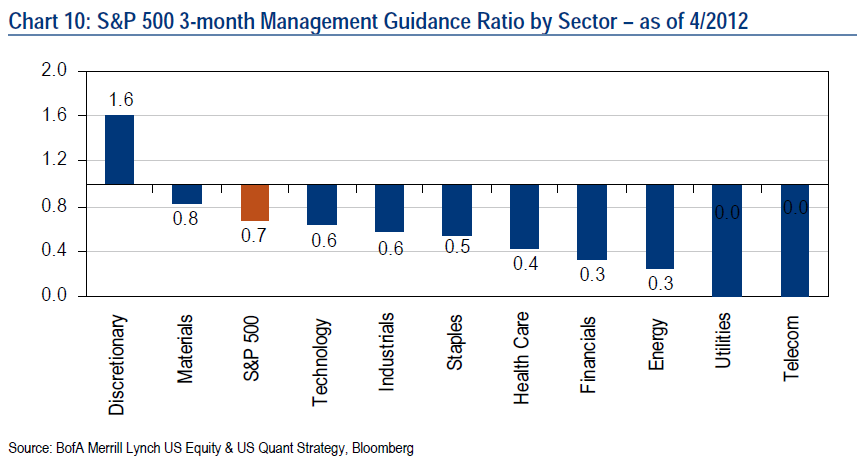
| Quick Look at Guidance & Earnings Revisions Posted: 03 Jun 2012 01:00 PM PDT A few interesting charts from Merrill looking at revisions:
Click to enlarge: ˜˜˜
˜˜˜
|
| The Not So Golden Years, Revisited Posted: 03 Jun 2012 09:00 AM PDT Over the years, debate has waxed and waned over the effects of the minimum wage and/or immigration policy on employment, particularly teen/youth employment. When the issue flared up most recently, a couple of years ago, I posted a rebuttal to that argument here, my point being that it was – at least this time around – crappy demographics and a lousy economy that had older workers staying in – and re-entering the labor market to seek – jobs far longer than we’d seen previously:
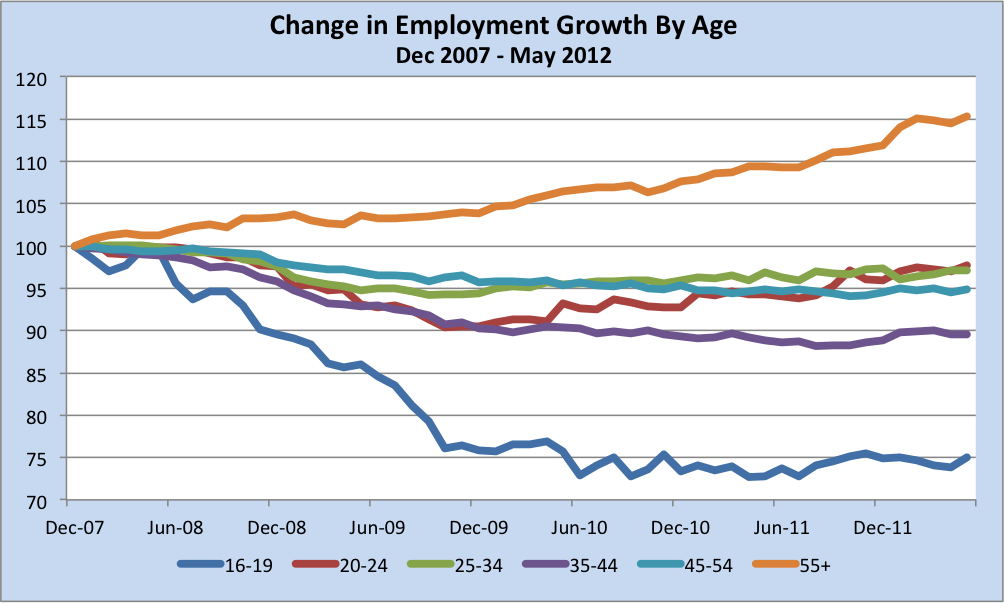
A short while after that post appeared, BR got a request to reprint from the folks at Cengage Learning/Greenhaven Press, who asked if they could include the article in their academic Opposing Viewpoints series of books. I obviously consented to allow the piece to be reprinted, and the book was recently published (specific URL for the volume on Minimum Wage is here). I’m flattered that I’ve now had a piece published, a first for a me. I’m also very appreciative to BR – as he well knows – for his willingness to give me a little corner of his soapbox, and hope I provide some value-add to TBP readers. (My stipend for the piece went to a local humane society.) That said, why not revisit the issue of youth employment and see where we now stand? Here is how employment growth (or lack thereof) has evolved, by age cohort, since the beginning of the Great Recession:
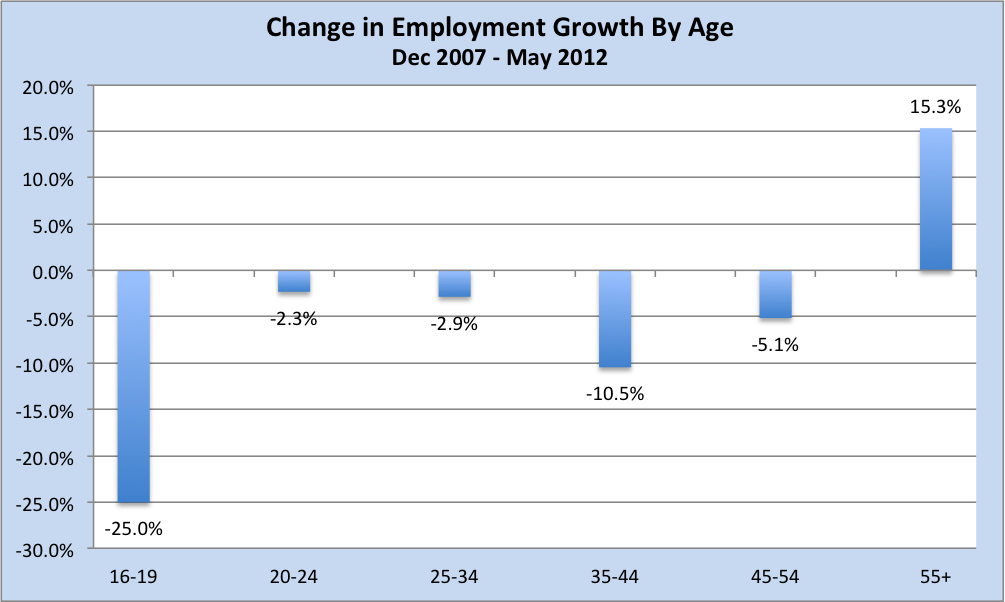
(Source: St. Louis FRED, Series LNS12000012, LNS12000036, LNS12000089, LNS12000091, LNS12000093, LNS1202423) And here’s a different look at the exact same data, an update of the chart I ran two years ago:
Very coincidentally, as I was working on this post, David Rosenberg commented on this very topic, including a variant of the chart immediately above. Rosie’s take on the situation (Breakfast with Dave, May 29, 2012):
Precisely. With the benefit now of some hindsight – I made my original argument in real-time – I think it’s clear that it has been, in fact, demographics and a crappy economy that accounts, for the most part, for our youth unemployment problems. (Finally on this topic, Rosie notes that the older cohort “has not seen an erosion in its participation rate or in its employment-to-population ratios.”) Shifting gears now to make sure I cover as much of the waterfront as I can, several unrelated tidbits: I wish I had authored this brilliant piece by Mark Dow, which really resonated with me. As the old saying goes, “If the only tool you’ve got is a hammer…” Mr. Dow’s piece is spot-on in every regard. With interest rates in many parts of the world hitting all-time record lows, I’d be remiss if I didn’t give a shout-out to the inflation hawks of the past few years. To those who foretold a spike in interest rates and hyper-inflation – Jerry Bowyer, Arthur Laffer, the Wall St. Journal, et. al., – here’s to you. An object lesson in putting ideology over analysis. (As an aside on bonds, rates, equities…well…this.) There appears to be some tin foil hat commentary, to which I won’t link, to the effect that DOL is cooking the books because the weekly Unemployment Insurance Claims revisions are almost always higher in the hope of making the Obama economy look better than it is. The thinking appears to be:
A few comments:
Finally, I highly recommend to all It’s Even Worse Than It Looks by Thomas Mann & Norman Ornstein, two long-time congressional scholars, on the roots and current status of our calamitous dysfunction in Washington. See their April WaPo op-ed piece here. You may not have heard of their new book because, sadly, as Greg Sargent points out, the duo are being totally ignored by the Sunday talk shows. @TBPInvictus
|
| Posted: 03 Jun 2012 08:00 AM PDT
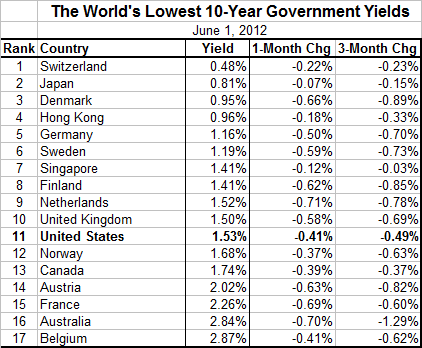
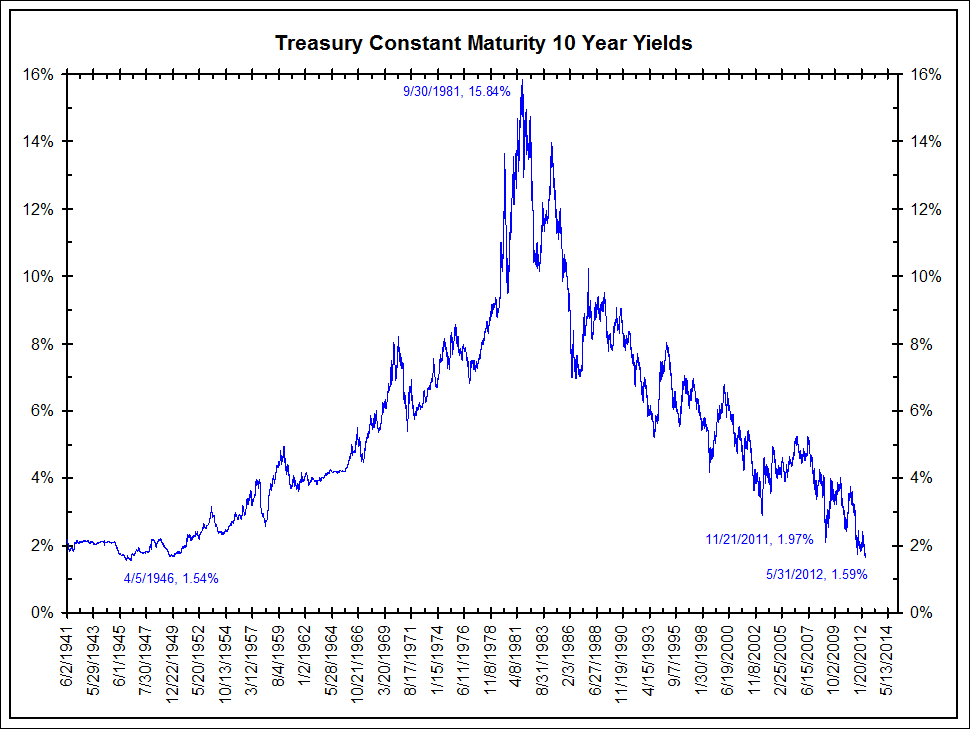
Comment The table above was constructed right before the payroll report. It shows a snapshot of the lowest 10-year yields on the planet. The US has the 11th lowest 10-year yield. The Swiss yield of 0.48% is the lowest 10-year ever recorded anywhere. So while we will all stop and stare in awe at the US 10-year note, there are numerous 10-year yields lower around the world showing how intense the flight to quality bid has become. Bloomberg.com – Yielding to Panic
The Financial Times – German 2-year bond yield turns negative Comment What is the longest maturity to ever record a negative yield? Yesterday the Swiss 5-year note went negative. 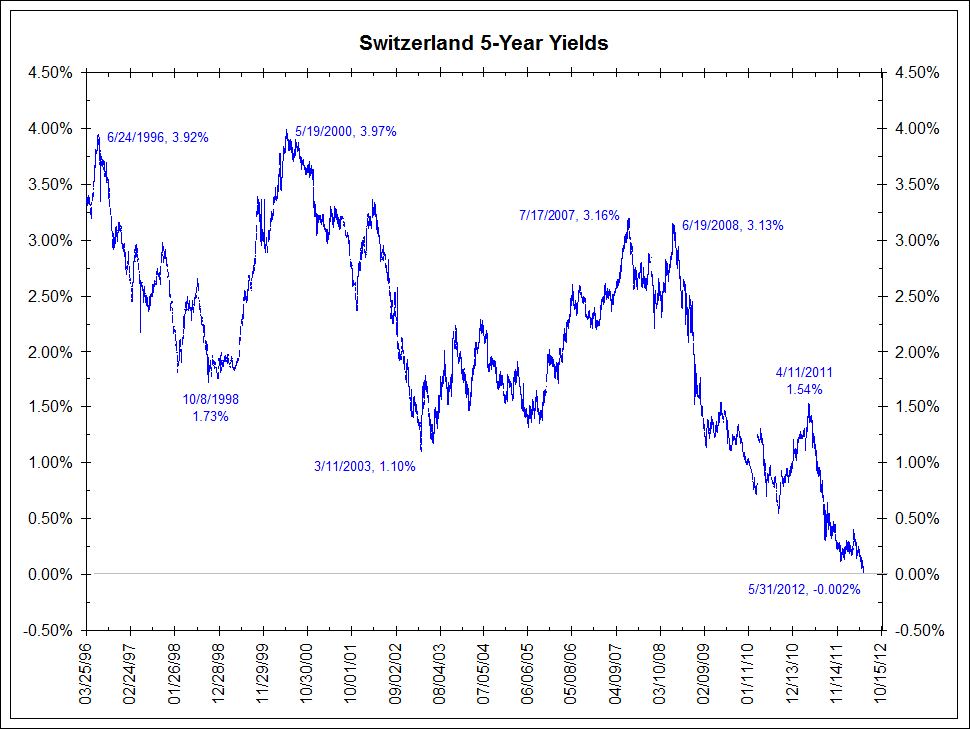 Source: Bianco Research |
| Posted: 03 Jun 2012 06:00 AM PDT
> My Sunday Washington Post Business Section column is out. This morning, we look at How the FDIC can curb banks' reckless speculation. The print edition had the catchier headline How the FDIC could put an end to too big to fail. The piece stems from my frustration with the current state of Banker-owned politics. Rather than just sulk, I decided to slip off to the future to see if we made any progress reigning in reckless taxpayer-backed financiers. It turns out that, after things got much worse, a simple rule change by the FDIC fixed Too Big To Fail and a host of other issues. Here’s an excerpt from the Washington Post:
The full FDIC letter form Chairman Hoenig follows . . .
Source: June 3 2012 Washington Post column (PDF) |
| Is Austerity Always The Best Policy? Posted: 03 Jun 2012 05:00 AM PDT |
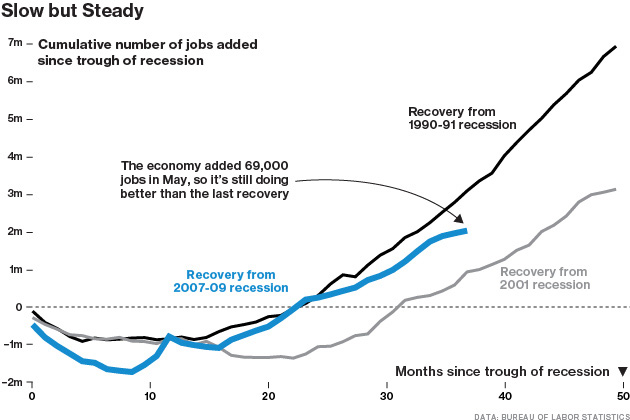
| Eurozone policy action is coming? Posted: 03 Jun 2012 04:00 AM PDT May was indeed a terrible month for equities. Asian, European and US markets declined by 8%, 7% and 6% respectively. The dreadful PMI numbers in China and Europe, combined with the much, much weaker than expected US May non farm payrolls data (well below the most pessimistic analyst expectations) and other economic data, confirms that the global economy is contracting – indeed contracting rapidly. Brent is trading below US$100 and looks weak. Copper is lower, but probably has been shorted to such an extent that it fell just 4.0% last week. On the other hand, sovereign bond in the major markets are surging to levels, I would certainly argue, which suggest a major bubble is, indeed, has formed, as the fear trade continues. Will June offer any reprieve to equity investors?. I remain of the view that government policy is and will remain the key driver in respect of market performance – indeed for very many years to come, given the financial (debt) crisis, which has morphed from a private sector debt crisis into a major government problem. The Chinese have denied that they will introduce a major stimulus programme. They are convinced that the spending splurge in 2008/9 further distorted their economy even more than it was. They are, off course, completely right. Most analysts forecast that Chinese GDP growth will exceed 8.0% this year, a view I believe is fundamentally wrong. Personally, I believe that for China to reach 7.0% this year, without some sort of policy action, is going to be a stretch. The Chinese do not want to announce a major stimulus programme, which just pushes up commodity prices, resulting in higher inflation. However, I for one, believe that Credit Suisse is right in that the Chinese will undertake a smaller (Yuan 1tr to Yuan 2tr) programme – indeed, you could argue that recent announcements indicate precisely that. GDP at 7.0%, in Chinese terms, is close to (probably at) a hard landing scenario. With the major personnel changes to the Chinese leadership later this year, China will want to ensure stability, particularly given the recent political problems surrounding the dismissal of Mr Bo. Essentially they have no choice. The Xinhua News Agency reported that China would not introduce a major stimulus programme, which the market (in my humble view, wrongly) has taken to mean that they will not introduce a stimulus programme at all. I continue to believe that he Chinese will introduce a smaller programme and, indeed, it is starting already. One of the big issues is the value of the Yuan. Most believe that the Yuan is grossly undervalued. As you know, I believe that the (until recently) strength of the Yuan is coming to an end – indeed, the Yuan declined by 1.0% in May against the US$. I believe that trade and current account data will confirm that the build up of forex reserves is coming to an end and, indeed, may well reverse as soon as this year or, more likely, next at the latest. Capital flight is occurring at a rapid pace and FDI slowing dramatically. Finally, China is seriously concerned about the rise of the Yuan against the Euro. China has had to increase wages to encourage domestic consumption (unsuccessful to date) and to avoid social tensions, which does not lend it to remain the low cost producer of goods for the world much longer. Furthermore, legislative, regulatory, business practices and government policies will make investors increasingly nervous in respect of further investments into China. This is happening already. The thought that China (and indeed the BRIC economies) could decouple from the global (particularly in the developed) economies is well, lets be polite, wrong. I have been bearish on China for over three years. However, I believe that there may be some upside at present levels, as the government does indeed introduce a smaller stimulus programme, accompanied by easier monetary policy, including further reductions in RRR’s and a cut in interest rates, now that inflation is declining, especially with a lower oil price. However, the upside will not translate into the significant (though I do believe there is some upside) gains experienced a few year ago, for example in the commodity sector – my way of playing China. The economies in the other BRIC countries are deteriorating as well. India announced the lowest GDP growth for years and with a declining oil price (well below the US$117 that Russia needs to balance its budget) I don’t see much upside there. Brazil, well there is clear evidence that the economy is slowing rapidly. All the currencies in these economies are weak and, in my humble view, should weaken further – they are not masters of their own destiny. Europe, especially the Euro Zone (“EZ”) remains a basket case. The sheer incompetence is staggering, particularly at a political level. Having said that, I believe that the time for the politicians to act is coming and coming fast. Mr Draghi, probably the only sensible guy in the EZ, warned EZ politicians last week that they had to act – indeed, it was a pretty desperate plea, as he can see serious problems that are mounting. His reiterated, quite vigorously, that the EZ governments needed to act, rather than rely on the ECB – clearly right. He stated that the ECB could not “fill the vacuum of the lack of action by national governments on the structural problem” and that countries needed to give up some of their sovereignty. Personally, I believe some kind of policy action by the EZ governments (essentially Germany) is likely this month. Upcoming French Parliamentary (the 1st round is next Sunday, with the 2nd a week later) and Greek general elections (17th June), in particular, will be a major focus in coming weeks. In France, if the UMP succeeds in denying the socialists a victory, a period of “cohabitation” will ensue, relieving Monsieur Hollande of his crazy and undeliverable promises. Indeed, a victory for the socialists will be bad news, as Monsieur Hollande will be under huge pressure to deliver on his impossible promises, which will create further tensions with Germany. The second round of the French Parliamentary elections is on the 17th June, the same date as the Greek national elections. Recent polls suggest that support for Mr Tsipras, the radical Greek anti bail out terms candidate, seems to be ebbing and I continue to believe that a coalition comprising New Democracy and Pasok, possibly with another party (not Syriza clearly) is the most likely outcome. No more polls will be published from now on, though details of private polls will leak. However, even if Syriza is defeated, the one thing we do know is that Greece will never deliver. Taxation revenues have collapsed as Greeks refuse to pay. However, the Greeks want to remain in the Euro and expect to be bailed out – if they believe that, I would suggest they lay off the ouzo from now on. I remain of the view that Greece will have to exit the Euro. At present, they remain in as Merkel (being inherently cautious) is concerned about contagion risks, which clearly is a major threat. However, I believe that she will lose the argument, which suggests to me that the EZ will be forced to enact policies to avoid contagion spreading to Spain, in particular. By the way, don’t forget about Cyprus (an EZ country) – its in deep trouble as well. . Spain remains the key (current) risk to the EZ. The Spanish PM wants the EZ to bail out Spanish banks and for the ECB to buy sovereign debt, but does not want any EZ oversight – basically cloud cuckoo land stuff. He will be forced to change his mind. Indeed, a report in the UK’s Sunday Telegraph newspaper states that the Spanish PM, Mr Rajoy, has called for EZ countries to abandon their sovereignty over fiscal issues and letting a central authority mange them. He states “the EU needs to reinforce its architecture. This entails moving towards more integration, transferring more sovereignty, especially in the fiscal field”. Basically, he has caved in – why did it take so long !!!!. The Germans repeat that they are opposed to using the ESM to finance EZ banks directly, a position which is unsustainable – they will have to as there is no alternative. To even start to get the EZ to recover, its banks need to be recapitalised, especially as very many are insolvent. The private sector will not provide the necessary financing, which leaves governments as the only option – it is thought that Spanish banks alone may need up to E100bn, though quite frankly these are guesses. In reality, the situation is inevitably worse. However, existing shareholders/bondholders will be forced to take the first hits this time around – quite rightly in my view. A run of banks in peripheral EZ countries is happening. The Bank of Spain reported that E97bn of deposits exited Spanish banks in the first quarter this year, with E66.2bn exiting in March. The problems increased into April and May, which suggests that deposit flight will have increased. This is unsustainable. The deposit flight is being met through ECB arrangements which, in effect, mean that German, Dutch, Finnish and Austrian Central Banks are financing these capital outflows. As a result, these countries are further entangled into this whole mess and makes it impossible for them to take a hard line – the losses they would sustain if for example Spain exited the Euro would be enormous. As a result, it is only a matter of time, in my humble view, that the ESM (which will be up and running on 9th July, according to a Bloomberg report) is used to recapitalise peripheral banks – a banking licence could well be granted to the ESM to expand its resources, as the funds available to the ESM at present are simply insufficient for its purposes. There is also talk of an EZ wide deposit insurance scheme, which would certainly stop deposit flight, but has a number of serious practical difficulties. It is clear that Germany wants to instill fiscal disciple into the EZ - clearly right and, indeed, understandable. The German economy is faring well, in particular the domestic German economy. The better performance of Germany allows Mrs Merkel to take more time to act in respect of the problems in the EZ – a worsening German economy will force her to respond with policy actions much sooner. However, recent PMI data signals a rapid global slowdown, particularly in the EZ (including Germany), which will impact the German export driven economy. Yes, exports to emerging markets have risen, but the thought that this will compensate for the rapid decline in exports to the rest of the EU and I suspect the US, is fanciful. It may take some three to six months for this effect to show up in the wider economic numbers, but it will. A slowdown in Germany will put far more pressure on Germany to act. After all, Mrs Merkel faces a general election in late 2013. To date the CDU has fared badly in regional elections and their partner, the FPD is in danger of being wiped out, in spite of a slightly better showing recently. The myth that Germany can ride the current global weakness is exactly that – a myth. To date, Germany has been content for the ECB to act as the firefighter – it provides Mrs Merkel with the political cover she deems is necessary. However, is this position credible. Personally, I think not. Yes, the ECB can and, in my view, will reduce interest rates (though I suspect it would prefer to wait till after the outcome of the Greek elections are known, if it can), buy peripheral bonds (likely if, for example, Spanish bonds get closer to 7.0%) and, in addition, could introduce another LTRO programme, with reduced collateral requirements and a longer maturity – say five years, rather than three. Personally, I am not convinced at to the merits of another LTRO programme at this stage. The effects of the first programme lasted three odd months, but the second much lees, which suggests to me a further LTRO programme will have limited success. In addition, peripheral banks played the carry trade with the LTRO funds, ignoring the possibility of capital losses (and therefore reduced capital), which they are now facing – complete madness and these guys call themselves bankers. Mrs Merkel is scheduled to deliver some kind of compromise to the opposition parties on 13th June, as they have threatened to block the passage of the fiscal compact in the lower house otherwise. The opposition parties are in favour of the creation of Euro Bonds. Personally, I believe that the EZ will have to act – likely sometime this month. The situation is near, though possibly not quite at, crisis point. My guess is that they will announce that the ESM can be used to recapitalise insolvent EZ banks, together, I hope, with the announcement that the ESM will be granted a banking licence to expand the funds available to it. The EZ only acts in a crisis and even then in half measures, which clearly remains a major risk, I accept. However, with the situation as it is at present, I believe they have run out of time and will be forced to act. Germany is working on a “redemption fund”, where debt over 60% of a countries GDP will be exchanged, over time, into Euro Bonds, financed by a “solidarity surcharge” and with gold reserves as collateral. Whilst most suggest that Euro Bonds are not on the table for years to come, I believe that they will have to be introduced earlier than the market believes, though only on a basis which instills strict fiscal disciple, a key German demand. You simply cannot have papers produced on “redemption funds” by Germany without the possibility of some movement on this front. On top of the downward revision to US first quarter GDP to 1.9%, the US non farm payroll data was truly dreadful (just 69k jobs created in May, as opposed to the 150k expected and with 49k downward revisions to March and April, resulting in the unemployment rate rising to 8.2%), there was no chink of light whatsoever. Details in the report were unambiguously bad – for example, hours worked and wages were both lower - consumption is being sustained through a lower savings rate, which does not bode well for the future. The data suggests that US businesses are deeply concerned about the slowing global economy and in no mood to hire. Weather effects could have played a role, but does not explain the terrible numbers. A number of analysts suggest that the US is immune to developments in Europe, a view I believe is so, so wrong. A number of US companies have significant businesses outside of the US, especially in Europe. With political gridlock given the impending US Presidential elections, the only player in town is the FED. I continue to believe that the FED will introduce another QE programme (with a twist?), a view which is gaining some momentum. Will it be effective and/or enough – I doubt it. To date most investors have hidden in the US, though I question whether this is sustainable for much longer. Historically, US markets have rallied into an US election, but political gridlock and the “fiscal cliff” problems suggest caution this time around, unless the EZ gets its act together. It is likely that the US and the UK will introduce another QE programme. The EZ, well, I believe that some kind of movement in respect of recapitalising the banks is coming soon, though a QE programme (possible) will only be considered as a last resort. Other policy action will also be needed and as the situation deteriorates further. Whilst May has been a dreadful month for long equity investors, I believe that being short at this stage is far too risky, given likely government/central bank policy actions. In addition, the flight to bonds is way, way overdone in my humble view – a great short, especially in respect of the longer maturities. With Germany having to bear a large part of the costs of bailing out the EZ (and with relatively high debt), combined with Mr Schaeuble’s view that Germany can “accept” that inflation can remain “in a corridor of between 2.0% to 3.0%”, buying 10 year German bonds yielding 1.17% makes no sense whatsoever – a great short in my humble view. I would point out that German credit default swap rates are rising !!!! and inflation in Germany is well over 100bps over 10 year yields. US and UK 10 year bonds at 1.45% and 1.53% respectively also look as if they are in serious bubble territory, though another QE programme could well sustain these yields for a while longer. I accept that bond markets historically have been far better predictors than equity markets, though I believe that at present, the fear trade has grossly distorted these markets and that the signal being sent should be treated with a great deal of suspicion. Whilst inflation will decline initially, given the global slowdown, inflation is the only way out of this mess and policies to increase inflation will be implemented. An investment in Gold? Being seriously cashed up has certainly paid off, but to continue to nibble away at equities seems the right move. The risks of continuing to be and/or going short are far too high in my humble view, given very likely EZ policy action, quite possibly as soon as this month. Mr Rajoy’s comments (reported above) suggest that he has caved in and will accept the transfer of fiscal responsibility to a central unit- a key German demand, suggesting to little old me that the scope to introduce much needed policy action is coming. And then there were none opposed to the idea. After all, as even the loonies at the EU now know, there can be no single currency/monetary union, without fiscal (including transfers within the EZ) and, subsequently, political union. It certainly looks as if Germany has achieved what two world wars failed to achieve and, indeed, Napoleon before - just reinforces the might of economic/financial power, especially in modern times. The financials, particularly in Europe, have been crushed and whilst a number of EZ banks are insolvent (and will not be bailed out without shareholders/bondholders taking the first hits this time around), a recapitalisation of the sector should help the solvent banks. I have been particularly sceptical of the miners for a long time and whilst I accept that the Chinese will not introduce a major stimulus programme, I do believe they will introduce a smaller version (they will have no other choice) which should help the sector, though certainly not to the extent seen a few years ago. Capital flight, combined with a flight to safety, is resulting in funds flowing into Singapore and Switzerland, though individuals are flooding into London, which has resulted in the higher end property sector continuing to strengthen. Some kind of EZ policy action could well help the Euro in the short term, with another QE programme weakening the US$, though in the medium to longer term I remain bearish on the Euro. There certainly is panic out there, but………. Have a great weekend Kiron Sarkar 3rd June 2012 |
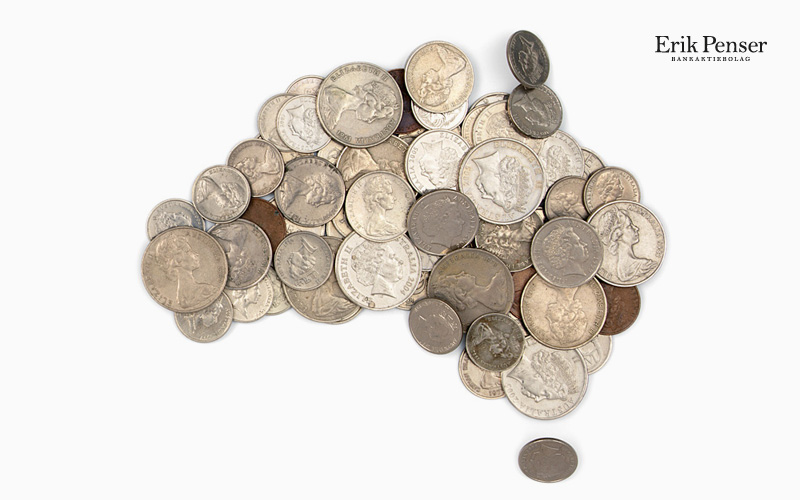
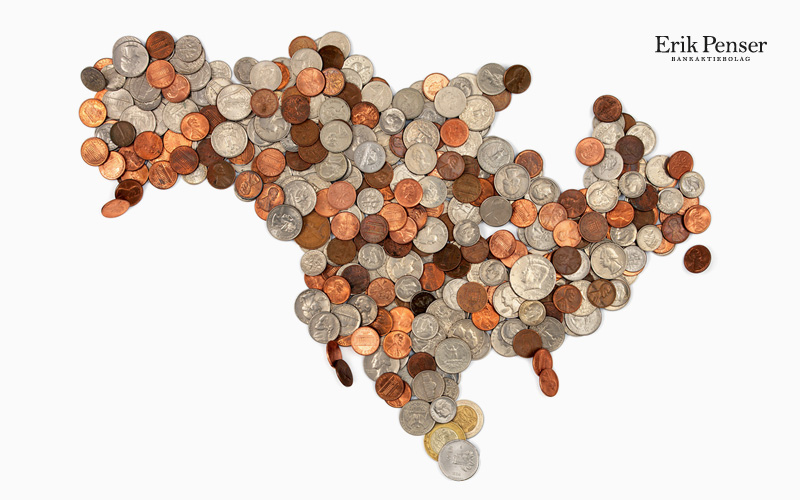
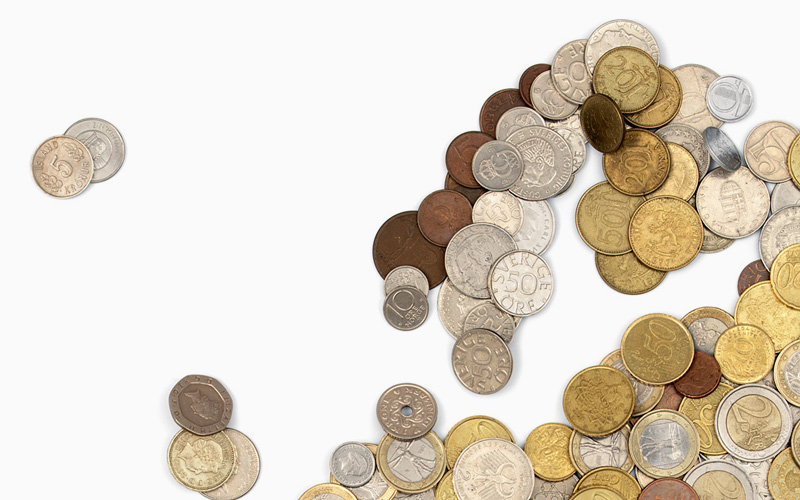
| Posted: 03 Jun 2012 04:00 AM PDT A world map used by Erik Penser Bankaktiebolag to visualize economic markets. The map contains approximately 3,000 coins and every continent is built out of its countries' currencies. Used in various medias during 2009. Click to enlarge: ˜˜˜
˜˜˜
˜˜˜
Source: Erik Penser Bankaktiebolag |
| Posted: 03 Jun 2012 03:00 AM PDT Some longer form weekend reads for your Sunday Morning:
What are you reading?
Five Reasons Why the Jobs Engine Is Seizing Up |





| You are subscribed to email updates from The Big Picture To stop receiving these emails, you may unsubscribe now. | Email delivery powered by Google |
| Google Inc., 20 West Kinzie, Chicago IL USA 60610 | |



0 comments:
Post a Comment