


The Big Picture |

- Open Thread: Microsoft Tablet vs Apple iPad
- 10 Tuesday PM Reads
- RMBS Case to Watch This Summer: No. 4
- ECB SMP didn’t work, so now the ESM wants to try?
- Another Stock Melt-Up?
- Housing Starts Fall (but look beneath the headlines)
- 10 Tuesday AM Reads
- Will The Federal Reserve Extend Operation Twist? We Say No
- Investors pay Denmark to lend money
- The False Deities of Economists
| Open Thread: Microsoft Tablet vs Apple iPad Posted: 19 Jun 2012 05:15 PM PDT I am curious as to what people’s views are regarding the new entry into the tablet wars: Does this thing have a chance? Can Microsoft compete in this arena? By popular demand, we have arranged for there to be NO REGISTRATION REQUIRED — just click the image, vote how you want, add a comment there if you wish. Thanks!
click to participate
|
| Posted: 19 Jun 2012 01:30 PM PDT My afternoon Long Island Railroad quiet car homework:
What are you reading?
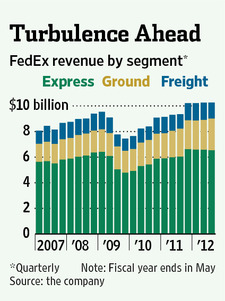
FedEx Signals Freightload of Economic Woe |
| RMBS Case to Watch This Summer: No. 4 Posted: 19 Jun 2012 12:30 PM PDT All this week, we will be looking at Isaac Gradman's Top 5 RMBS Cases to watch this Summer (author bio at bottom). Today, we go to No. 4 – Retirement Board of the Policemen's Annuity and Benefit Fund v. Bank of New York Mellon ~~~ Yesterday, I kicked off a countdown of the top 5 RMBS cases to watch this summer with a post about Syncora v. EMC and the impending summary judgment decision on loss causation. Today, I'd like to talk about another case to watch this summer: Retirement Board of the Policemen's Annuity and Benefit Fund v. Bank of New York Mellon, Case No. 11-CV-5459 in the Southern District of New York. This case seeks to blaze an entirely new pathway to recovery – suing mortgage backed securities Trustees for failing to live up to their contractual and statutory duties to investors. A win here for investors in this case could mean significant trustee liability and/or negotiating leverage to force trustees to act as fiduciaries for bondholders going forward. As I discussed a few months back, Judge William Pauley issued a groundbreaking decision in Retirement Board v. Bank of New York Mellon that sent ripples through the RMBS litigation world. Specifically, Pauley found that the Trust Indenture Act (TIA) applied to the RMBS Trusts at issue because they were in actuality more like debt than equity. This meant that investors could sue and impose liability on RMBS Trustees directly for failing to comply with their obligations to protect investors in the trusts they oversee. At the time, I predicted that the decision would go up to the Second Circuit on appeal, and it now seems like that is the route Bank of New York Mellon (BNYM) is hoping to go. On April 17, BNYM filed a Motion to Reconsider, in which it asks Judge Pauley to reconsider and reverse his prior decision or, in the alternative, to certify his Order for interlocutory review. In layman's terms, this means that BNYM wants to appeal a non-final Order prior to the end of the case, for which it needs the Court's permission. Not surprisingly, a number of bank advocacy groups, including SIFMA, the American Bankers Association and the Clearing House Association, have lined up behind BNYM in support of the Trustee's Motion to Reconsider. Their basic argument is that Pauley's decision threatens to upset the market's settled understanding regarding the obligations of RMBS Trustees (minimal) and delay the return of the moribund private label mortgage market (which isn't coming back anytime soon, regardless). In their Opposition, the investors' counsel does a good job of pointing out that the TIA was intended to protect investors from just these sorts of passive Trustees and that investors will be none too eager to flock back to private label RMBS if they're not adequately protected. But all policy arguments aside, the outcome of this decision turns in large part on case precedent (or lack thereof) surrounding the TIA's application to RMBS, and the SEC's historical interpretation of the same. The investors argue, consistent with Pauley's Opinion, that the SEC's interpretation of the applicability of the TIA is only persuasive if the reasoning behind that interpretation is persuasive. In its Reply, BNYM blows right past this point, saying, "but plaintiffs do not deny that the SEC consistently, over many years, has adhered to the view that the TIA is not applicable to PSA-governed certificates."
Well, plaintiffs may not have denied that the SEC has interpreted this issue consistently, but that doesn't make it so. In fact, I've uncovered evidence that the SEC itself has waffled on its characterization of RMBS. Specifically, readers may recall that, earlier this year, Option One agreed to pay $28.2 million to the SEC to settle charges that the H&R Block subsidiary misled investors about its deteriorating financial condition. In connection with this settlement, the SEC filed a Complaint on April 24, 2012 in which it discussed the RMBS issued by Option One as follows:
BNYM has argued vigorously that RMBS are equity securities and that investors have an ownership stake in the mortgage loans themselves, rather than the cash flows from those mortgages, to support the position that the TIA does not apply (by its terms, it only applies to debt securities). Without much legal precedent, BNYM has had to rely extensively on the fact that the SEC has consistently interpreted RMBS as equity securities. And yet, this passage from the Option One Complaint shows that even the SEC has interpreted RMBS governed by similar pooling and servicing agreements as debt securities representing claims on mortgage cash flows. This undermines whatever persuasive impact the SEC's interpretation may have had whatever court ultimately rules on this issue. With BNYM's Motion to Reconsider now fully briefed, counsel for the Retirement Board of the Policemen's Annuity may wish to seek leave to file a supplemental brief to bring this juicy revelation to Hizzoner's attention. In any event, we should know by the end of the summer whether Pauley intends to reverse his original decision (unlikely) or certify the issue for interlocutory review (somewhat more likely). Should the issue go up to the Second Circuit on appeal, BNYM runs the risk of creating unfavorable binding precedent for all lower courts in the Second Circuit, which is where most of these cases have been and would be brought. But given the vehemence with which it and the bank advocacy groups have fought the application of the TIA, this is apparently a risk they feel is worth taking. Since the onset of the mortgage crisis, RMBS trustees have done all they could to limit their own liability first and foremost, and minimize the costs they would incur to satisfy their obligations under the governing trust documents to boot. This makes sense, as trustees are paid very little for their troubles. Indeed, why should they incur liabilities or costs that they can avoid? But investors and bond insurers have complained early and often about the fact that trustees have not lived up to their contractual obligations and should have been doing more to protect the certificateholders that have limited rights to take action on their own behalf. Since standard trust agreements (known and pooling and servicing agreements) impose very few concrete obligations on trustees while providing them with broad indemnification rights at every step, getting trustee assistance has been quite difficult… up to now. If RMBS trustees are actually subject to extra-contractual duties under the TIA, that changes everything. This is especially true now that certain Attorneys General (see here and more recently here) and certain bondholders (see here and more recently here) are delving into whether mortgage were properly transferred into trusts in the first place – one area for which trustees are thought to be contractually responsible, and certainly a failure that could lead to liability under the TIA. Aside from constituting a breach of reps and warranties, a finding that loans were not properly transferred into the trusts has been held to preclude the trusts from foreclosing on delinquent borrowers, meaning massive losses (and claims) for bondholders. In short, the success of this novel pathway to recovery under the TIA could have a major impact on whether bondholders can look to trustees to should some of their losses or, in the alternative, use the threat of direct liability to wrangle trustee cooperation in enforcing their substantial mortgage put-back claims against originators and issuers. Click here to continue to Case No. 3 in our Top 5 Countdown, and learn why a non-RMBS lawsuit has been garnering so much attention in mortgage litigation circles. [Update: since this post was first published, Judge Pauley has granted plaintiffs' counsels' request to file in the public record the SEC documents referring to RMBS as "debt obligations" - IMG] |
| ECB SMP didn’t work, so now the ESM wants to try? Posted: 19 Jun 2012 11:21 AM PDT Eurozone crisis: Germany set to allow eurozone bailout fund to buy troubled countries’ debt — this story getting around. My thoughts: the ECB’s SMP program failed miserably and their purchases are now senior to the dismay to other bondholders so now Europe wants to do the same thing with the ESM? The ECB at least was a less political animal where the ESM would be full of it. Imagine everyday some politician from a specific country saying to the ESM, ‘buy my country’s bonds’ and another one from another nation saying ‘no, buy my country’s bonds.’ The shell game continues.
|
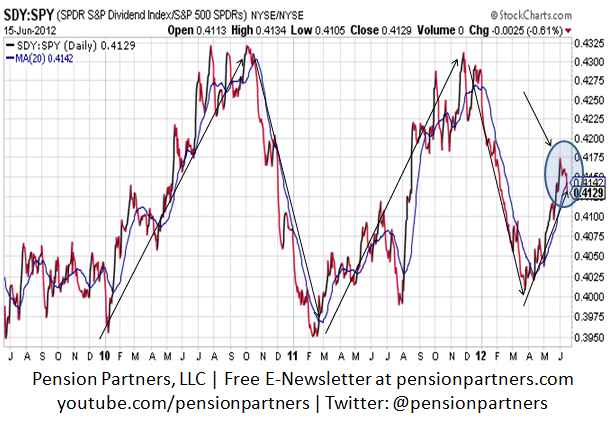
| Posted: 19 Jun 2012 09:00 AM PDT In my May 22nd post here on the Big Picture titled "Are Markets in a Crash?", I argued at the time that credit spreads, which dramatically widened in a matter of days, behaved as if we were in the midst of a Crash. This was occurring during the "mini-correction" of May which I began stating in my writings was likely as early as April 6th “Bad jobs numbers, a correction and risk-off”. As time moved forward, things got more interesting. Various intermarket trends by the very end of May behaved as if a Lehman-like event had already occurred “Making the Bullish Case for Stocks”, with various price ratios hitting levels not seen since late 2008. Because I focus my attention on market behavior based on intermarket analysis rather than absolute price movements, it seems entirely possible that a "melt-up" could occur again given that behaviorally markets did act like a massive decline in absolute terms already took place. Scared money in bonds is likely to get scared that it is wrong about the end of the world trade, with yields in the U.S. far below the Fed's stated inflation target of 2%, and in the face of stocks which are in better shape than most governments, have growth, and have better income potential than bonds. I addressed this in a recent BNN interview last week, and maintain that reflation is the environment we are re-entering as the negative narrative reverses and global growth expectations return. What confirms this is a price ratio chart I have shown quite a few times here. Take a look below at the price ratio of the S&P 500 Dividends Index (SDY) relative to the S&P 500 itself (SPY). As a reminder, a rising price ratio means the numerator/SDY is outperforming (up more/down less) the denominator/SPY.
Now, think this through. When dividend stocks outperform, it is indicative of bearish sentiment since dividend-heavy stocks tend to be 1) less cyclical, and 2) more defensive when entering into a highly volatile period. A rising ratio also coincides with sentiment that favors income over capital appreciation, which occurs when in a period of deflation expectations or reflation respectively. Notice how the two peaks coincided with post-Crash periods (Flash Crash of 2010 and Summer Crash of 2011), after which the ratio declined and a meaningful rally in risk assets began. Notice in 2012 that the ratio began rallying in mid-March, foreshadowing the May drop as money began getting afraid of the future again. Notice on the far right that the ratio appears to be at a turning point, which would favor capital appreciation, and such, a rising stock market environment. If a downtrend now emerges because of Greece's elections now being over, combined with optimism that Eurozone leaders won't let Spain go because of escalation of commitment, another melt-up in equities could arise similar to the Fall Melt-Up of last year. The catalyst for this is no catalyst – it is the removal of the Lehman event fear, as the Spring Switch out of bonds and into stocks gets flipped just in time. We could be in for a "Great Re-Allocation" as stocks become the new bonds in terms of investor preference as animal spirits return to a resilient stock market as I discussed on Bloomberg Radio: Click to listen: Should be an interesting Summer… ~~~` Michael A. Gayed, CFA is Chief Investment Strategist at Pension Partners, where he structures portfolios. Prior to this role, Michael served as a Portfolio Manager for a large international investment group, trading long/short investment ideas in an effort to capture excess returns. In 2007, he launched his own long/short hedge fund, using various trading strategies focused on taking advantage of stock market anomalies. Michael earned his B.S. from New York University, and is a CFA Charterholder.
This posting includes an audio/video/photo media file: Download Now |
| Housing Starts Fall (but look beneath the headlines) Posted: 19 Jun 2012 08:00 AM PDT Housing starts fell 4.8% to 708,000 in May (consensus was 722,000). Starts for single family properties increased 3.2% m/o/m to 516,000 in May. Note this returns us back to Spring 2010 levels of construction. Despite some happy talk, you should not mistake this modest stabilization for a turnaround in the housing market. Prior to the credit bubble, single family starts were trending at about 1.2 million units. During the mania, we saw single family starts near 1.8 million per year. I am compelled to point out that Starts compete with distressed sales and foreclosures. While we are seeing improvement, much of this comes formt ghe Foreclosure abatement of the past year. That has ended, and Foreclosures (as measured by RealtyTrak) are once again rising.
Previously: |
| Posted: 19 Jun 2012 07:00 AM PDT My morning reads:
What are you reading?
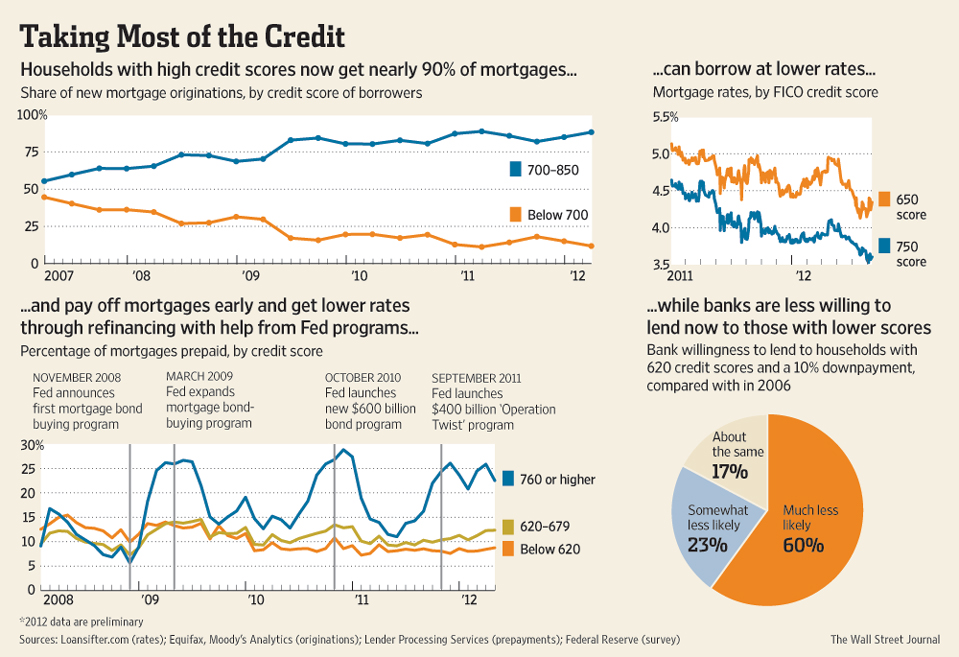
Fed Wrestles With Bridging Credit Divide
Source: WSJ
|
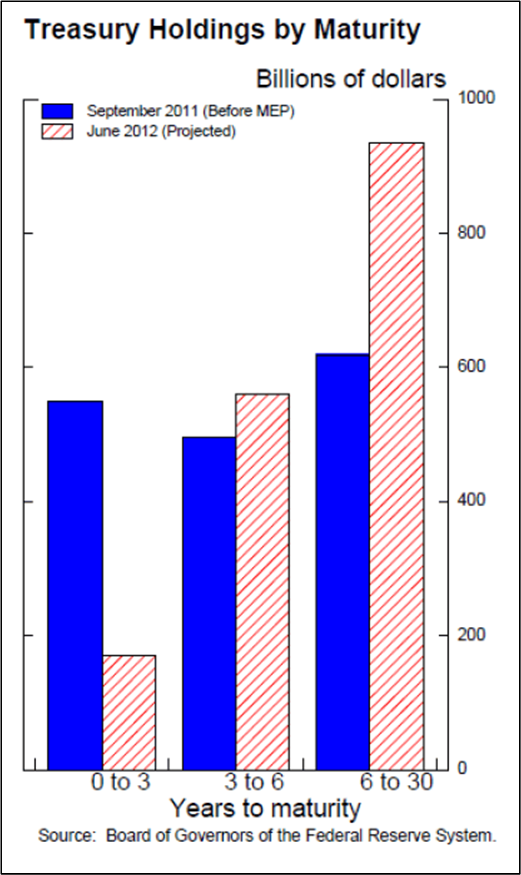
| Will The Federal Reserve Extend Operation Twist? We Say No Posted: 19 Jun 2012 05:30 AM PDT Bloomberg.com – Fed Seen Twisting to Risk Management to Spur U.S. Growth MarketWatch – Fed expected to twist again The Financial Times- Fed's hand could see it Twist again Comment As we noted earlier this month: Extending Twist is a limited option, as the Fed will have only about $175 bn of short-dated Treasuries (3 months to 3 years) in its SOMA portfolio on June 30. That would allow two to perhaps three months of further twisting at the current pace — i.e., into September. That does buy some time, but the Bernanke Fed has not been one to go for half-measures or small steps since the crisis began. If the outlook warrants more easing, we still see QE3 as the most likely tool chosen. We still believe this is the case. Click to enlarge:
Source: Bianco Research |
| Investors pay Denmark to lend money Posted: 19 Jun 2012 04:48 AM PDT While we’ve seen the German 2 yr note yield fall below zero in previous intraday trading, Denmark today was actually able to sell newly issued debt at a negative yield. A note maturing on Nov 15th, 2014 was sold with a coupon of -.08%. In sharp contrast, Spain sold 12 and 18 month bills at yields above 5%, about 200 bps above those sold in May. The newly elected New Democracy party in Greece seems close to forming a new gov’t and what will immediately come next will be their attempt to alter the terms of their bailout. Rather than a big change in the conditions, the Germans will likely only give them more time to implement the current promises. Either way, the reality distortion game continues as Greece needs more debt extinguishment and not more time. Investor confidence in the German economy in the next 6 months saw the biggest m/o/m drop since the Russian debt crisis in Oct 1998, falling from +10.8 to -16.9. French business confidence fell 1 pt to the weakest since Mar ’10. UK CPI in May fell to 2.8% y/o/y, below expectations of 3.0% and it’s the 1st time under 3.0% since Dec ’09. The BoE will likely take this as a license to do more QE. The Fed begins their two day meeting and whether something new is announced tomorrow or not, be sure that this collection of doves stand ready to further manipulate the US bond markets. |
| The False Deities of Economists Posted: 19 Jun 2012 04:23 AM PDT
Fascinating discussion at the FT about the failures of economics by Philip Stephens. Wondering how “a compassionate God” could “allow such terrible misery to be inflicted on life's innocents,” Stephens attempts to “square the circle” of ongoing economic errors, suggesting a leap of imagination is whats required. Monetarist fundamentalism proved a false prophet; efforts to regulate broader measures of credit failed; focus on exchange rates went nowhere; fixing the value of the pound with a cap on inflation did not work; Full independence for the Bank of England failed. Borrow-till-you-are-broke approach failed, as did Austerity. The latest economic catechism is fiscal flagellation. It too crashed and burned. In the US, we tried sanctifying Markets as all-knowing and all-powerful. They were neither, and collapsed in a heap. The fallout form, the damage they inflicted required a taxpayer funded bailout. Stephens invokes the idea of the Hedgehog and the Fox by noting “the fervour with which economists propagate this or that theory is usually in inverse proportion to the evidence. Fanaticism is thrown as a cloak over the absence of empiricism.” The concept of the single big idea as the solution to our woes, and the misplaced confidence economists have in those single big bold and typically wrong ideas cannot be denied. Consider that view in context of the politician’s embrace of economists and financiers, from Milton Friedman to Arthur Laffer to Robert Rubin to Larry Summers. Then consider the lasting damage each has inflicted upon the nation, as their flawed philosophies wreak ruin. Skepticism, and reality based policy is what is required. Not blind devotion to disproven fantasies. The sooner the world’s nations recognize this, the better off we will all be. What most countries on this planet need is a benevolent technocratic philosopher king — and not yet another partisan meglomaniac . . . > Source: |

| You are subscribed to email updates from The Big Picture To stop receiving these emails, you may unsubscribe now. | Email delivery powered by Google |
| Google Inc., 20 West Kinzie, Chicago IL USA 60610 | |



0 comments:
Post a Comment