


The Big Picture |

- Conan: Jack McBrayer (30 Rock) & Triumph the Insult Comic Dig Visit Chicago’s Weiner’s Circle
- America’s presidential race
- Succinct Summation of Week’s Events (6.22.12)
- Top 5 RMBS Cases to Watch: No. 1
- Inflation Ex-Deflation (this time, INCLUDING energy)
- Subordinated bondholders in Spain may get clipped
- Lacker tells why
- 10 Friday AM Reads
- Spain needs a maximum of E62bn to recap its banks – allegedly
- Choose Your Rationalization . . .
| Conan: Jack McBrayer (30 Rock) & Triumph the Insult Comic Dig Visit Chicago’s Weiner’s Circle Posted: 22 Jun 2012 03:09 PM PDT CONAN highlight: Jack McBrayer & Triumph the Insult Comic Dog cross swords with Chicago’s infamously hostile hot dog stand. |
| Posted: 22 Jun 2012 01:45 PM PDT With Mitt Romney formally assured of the Republican nomination, the presidential battlefield is expanding into states where Barack Obama thought he was safe. This videographic is best viewed in full-screen mode.
|
| Succinct Summation of Week’s Events (6.22.12) Posted: 22 Jun 2012 12:41 PM PDT Succinct summation of week’s events: Positives:
Negatives:
|
| Top 5 RMBS Cases to Watch: No. 1 Posted: 22 Jun 2012 11:00 AM PDT All this week, we will be looking at Isaac Gradman's Top 5 RMBS Cases to watch this Summer (author bio at bottom). ~~~ After a week-long build-up (I'm sure the suspense is killing you), we've reached the No. 1 case in our countdown of RMBS Cases to Watch this Summer. You may wish to catch up with parts I, II, III, and IV, if you haven't already. Though Case No. 2, Bank of New York's Article 77 settlement, may have garnered more media attention thus far, another case gets my vote for No. 1 because it represents a true adversarial process, the best and only way, as far as I know, to establish any semblance of "proof" as to who is to blame for the massive losses associated with mortgage derivatives. Read on to find out why the nation's former No. 1 bank may want to stop the freight train that is our No. 1 case, before it's too late. No. 1 – MBIA v. Countrywide, Bank of America Even relative newcomers to this blog should be well aware of the importance that I place on our No. 1 case, MBIA v. Countrywide, et al., No. As recently as April 24, I wrote about the progress MBIA was making in its case against Countrywide and BofA, in which it seeks compensation for the insurance payments it has made based on losses in 15 separate mortgage backed securities trusts. Therein, I noted that MBIA was on a roll, having won several recent discovery and case management motions, providing the bond insurer with an ever-growing stockpile of ammunition to use in its forthcoming summary judgment motion. But even since that time, there have been several developments that have only confirmed and continued this trend, as MBIA marches steadily toward a potentially crushing victory at trial. I will run through those developments below, followed by a head's up on what to watch for in this case going forward. Motion to Compel Fraud-Related Documents One of MBIA's primary claims is that it was fraudulently induced to provide insurance for Countrywide's securitizations based on misrepresentations by the lender regarding loan quality and the quality control procedures that it had in place. Though common law fraud is typically difficult to prove, as it requires showings of knowledge, intent and reliance, a successful fraud claim could return to the aggrieved party the full amount of its loss plus punitive damages. Usually, this requires some kind of smoking gun – emails or internal documents in which high-ranking corporate officers acknowledge a problem but cover it up and/or fail to disclose it to their business partners. MBIA has been looking for just this type of smoking gun since the beginning of their case, and it appears they believe they've found it, in the form of internal Countrywide documents relating to its fraud hotline and internal fraud investigations. If Countrywide knew there was widespread fraud in its loan origination processes, and covered up that information, it could certainly form the foundation for a finding that it intentionally misled MBIA into providing insurance coverage. And Countrywide has certainly acted like MBIA is knocking on the door of a treasure trove of damaging evidence, as it has fought like crazy to avoid producing these documents. But Judge Bransten is having none of it. On May 25, Bransten issued her ruling (actually dated May 11 or May 15, depending on which version you pull up on the docket), in which she granted the bulk of MBIA's discovery requests, and generally only limited the insurer's requests when they extended to documents unrelated to the securitizations at issue in the case. In particular, Bransten granted MBIA's requests for:
Whew! That document dump should keep Quinn's associates busy for awhile, and should reveal some very juicy details about what Countrywide knew about fraud and when, and what it did or didn't do about it. What might be even more significant about this ruling, however, is that Judge Bransten seems to have found her voice, emerging as a strident champion of the legal process while confronting head-on Countrywide/BofA's complaints about the mounting burden of this litigation. In the final paragraph of her Order, she writes:
This trend only continues in the Judge's next ruling, discussed below.
Motion to Compel Clawed Back Documents and Sanctions for Delay On May 4, the parties appeared before Judge Bransten to argue about whether Countrywide had the right to "claw back" documents it had previously produced in the middle of depositions, and right when plaintiff's counsel was about to use those documents to question opposing witnesses. At the time, MBIA counsel Peter Calamari asked the Court to sanction Countrywide, stating
Yet, Calamari also made clear that he did not want the case schedule slowed down as a result of these issues. In general, plaintiffs are already incentivized to try to propel their cases forward, both to put pressure on the opposition and to keep costs from spiraling out of control. But in this case, there's an additional factor: MBIA wants this case to reach trial before BofA's separate plenary action against MBIA (alleging violations of debtor-creditor law in connection with MBIA's restructuring) gets there first. Though an unlikely scenario given the current state of the two cases, should BofA's plenary action (pending before Judge Barbara Kapnick in New York Supreme Court) reach trial first, it would put MBIA in a precarious position. On one hand, the monoline could go to trial and risk losing, meaning the restructuring could be invalidated and/or MBIA could be hit with massive damages and no longer have the financial wherewithal to prosecute its case; on the other hand, MBIA could settle with BofA out of a position of weakness and on unfavorable terms. By far, MBIA would prefer to put BofA in that position by accelerating its MBS lawsuit to the point that it's ready to go to trial first, thereby forcing BofA to make the tough decision from a weakened position. Another reason that MBIA would like to accelerate its case is that it has an opportunity to score major victories against Countrywide/BofA on summary judgment. Pursuant to the court's Amended Pretrial Scheduling Order, opening summary judgment briefs are due by August 31 of this year, and the motions should be fully briefed by the end of October. At any point thereafter, depending on what's raised in MBIA's motion, Bransten could rule on issues such as successor liability, loss causation and even on the merits of MBIA's contractual arguments, should she find no genuine issue of fact exists. Adverse rulings in this regard could be devastating for BofA's proposed $8.5 billion settlement of Countrywide putback claims currently pending before Judge Kapnick, undermining the very assumptions on which the settlement figure is based (for detailed analysis of the loss causation issue and its impact, see my prior article here). Thus, we have seen MBIA's counsel emphasize at each turn that they want to keep the case on track, and decrying Countrywide and BofA's apparent efforts to drag their heels. At the May 4 hearing, in response to MBIA's arguments, Judge Bransten also expressed frustration both with the parties' conduct during discovery and with the overall pace of the litigation. Though Bransten didn't limit her comments solely to Countrywide, it's hard to read the following comments, given the context of MBIA's discovery motion, without concluding that she has the nation's former No. 1 lender in her sights:
Just over a month after that hearing, on June 7, Judge Bransten issued her ruling, which yielded few surprises based on those comments. Her Honor granted almost every request in MBIA's Motion to Compel, with the exception of its request for sanctions. In that regard, she noted in her Order:
The long and short of this is that MBIA will get documents regarding BofA's alleged de facto merger with, and assumption of liabilities of, Countrywide. These include loss reserve accounting estimates and Countrywide acquisition-related documents, which should provide further ammunition for MBIA's claims that BofA bears responsibility for Countrywide's liabilities as its successor-in-interest. MBIA also gets to hold the threat of sanctions over defendants' heads should they play games with discovery going forward. All-in-all, a big win for the monoline that allows it to continue to obtain damaging evidence while keeping its case on track. The Track Ahead: What to Watch For Having had little success before Judge Bransten, BofA has apparently decided that it stands a better chance before the New York Supreme Court's Appellate Division for the First Department. Though Bransten has a relatively successful track record on appeal, including in this case, BofA has continued to appeal nearly every meaningful ruling Bransten has made to the higher court. Most recently, BofA appealed Bransten's loss causation ruling as it applies to MBIA's fraud and breach of insurance contract claims (background here), after which MBIA cross-appealed as to her ruling on the issue of loss causation for put-back claims. The appeal and cross-appeal of the Partial Summary Judgment Order in MBIA v. Countrywide (and the virtually identical Order in the related case of Syncora v. Countrywide) is calendared for hearing before the Appellate Division during the October 2012 term, if the appeal is perfected. Also up on appeal is Bransten's Order denying Countrywide's Motion to Compel discovery regarding MBIA's practice of insuring similar risks. Though Countrywide had argued that it was entitled to test whether MBIA followed its stated guidelines in practice, and therefore whether the insurer actually relied on Countrywide's representations in deciding to insure the deals, Judge Bransten denied the motion. She found that Countrywide could test that fact based on the documents already produced in this case relating to the securitizations at issue, MBIA's guidelines or lack thereof, and relevant witness testimony. While these appeals are being heard in the higher court, there will be no shortage of activity in Bransten's trial court this summer. MBIA will continue to plow through discovery, including trying to obtain and digest all of the new documents Countrywide has been compelled to produce, as well as squeeze in all of its fact depositions, prior to the August 31 deadline for submission of summary judgment motions. This may include forcing BofA CEO Brian Moynihan to sit for deposition a second time, after Judge Bransten suggested that this would be the logical result of Moynihan's statement that he couldn't remember facts about certain meetings without having the meeting minutes in front of him (the same minutes Countrywide was trying to withhold and is now being forced to produce). Does anyone doubt that Moynihan is sick of talking about, let alone participating in, legacy mortgage litigation? Expert discovery will also continue throughout the summer, with August 1, 2012 being set as the deadline for expert depositions relating to primary liability against Countrywide. In short, while this should be a long, hot summer for all parties to this litigation, I have a feeling that BofA is starting to feel the heat a bit more acutely, as the victories continue to pile up for MBIA. Let's be clear: BofA is relying heavily on the success of BNYM's $8.5 billion settlement as part of its plan to put its legacy mortgage issues behind it. For the bank to allow this much smaller (by dollar amount at s I hope you enjoyed this week-long rundown of the Top 5 RMBS Cases to Watch this Summer. Keep an eye out for the epilogue to this series in the coming weeks, as I begin to evaluate end game scenarios and endeavor to tackle the big question on everyone's mind – how will all this subprime madness ultimately shake out? |
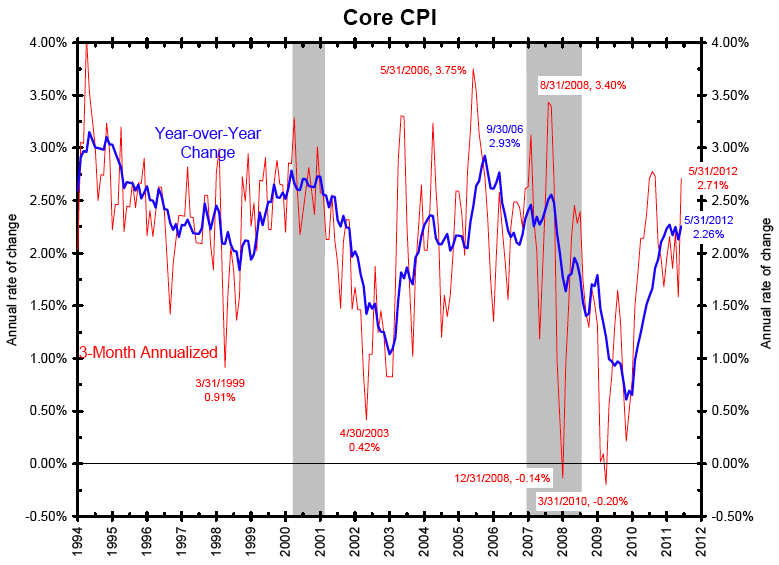
| Inflation Ex-Deflation (this time, INCLUDING energy) Posted: 22 Jun 2012 08:43 AM PDT Here is a twist: We used to discuss how the Fed loved their core (ex food & energy) inflation measures. I termed that Inflation Ex-Inflation, and if you look around TBP, you will see lots of mentions of that measure. Take a closer look at Energy, one of the biggest non-housing components. As noted this morning, Commodities have entered a Bear Market. Gas & Oil are not contributing much inflationary pressures. If anything, Energy costs now are acting as a drag on Inflation. Call it Inflation Ex-Deflation (Do you want to guess what that means for the Fed’s love of the Core Inflation (ex food & energy)? Consider the Federal Reserve inflation target of 2.0%. Jim Bianco notes that inflation is moderate at 1.73%. However, if you take a closer look at the chart below of core CPI — you will see a 2.3% on a year-over-year basis (blue line) and a heady 2.71% on a three-month annualized basis (red line). Sum it up and it means inflation less energy is largely running above the Federal Reserve's target. > Click to enlarge: Source: Bianco Research
More charts after the jump
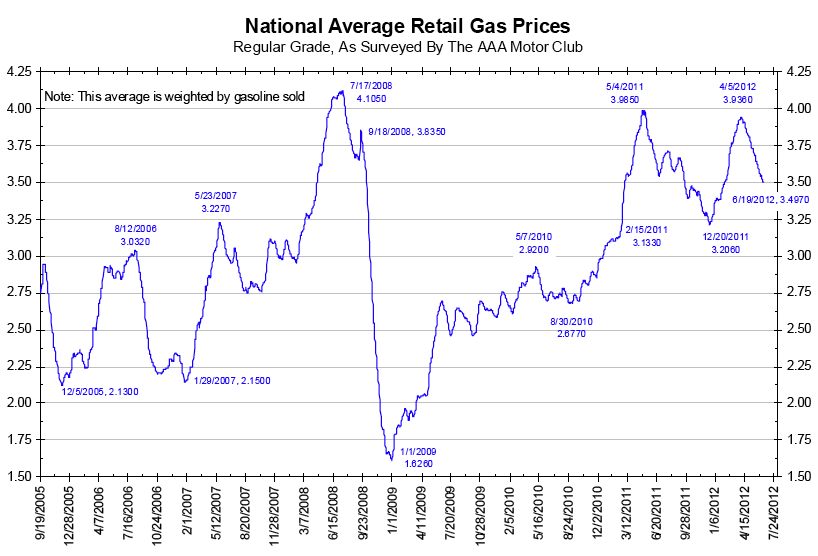
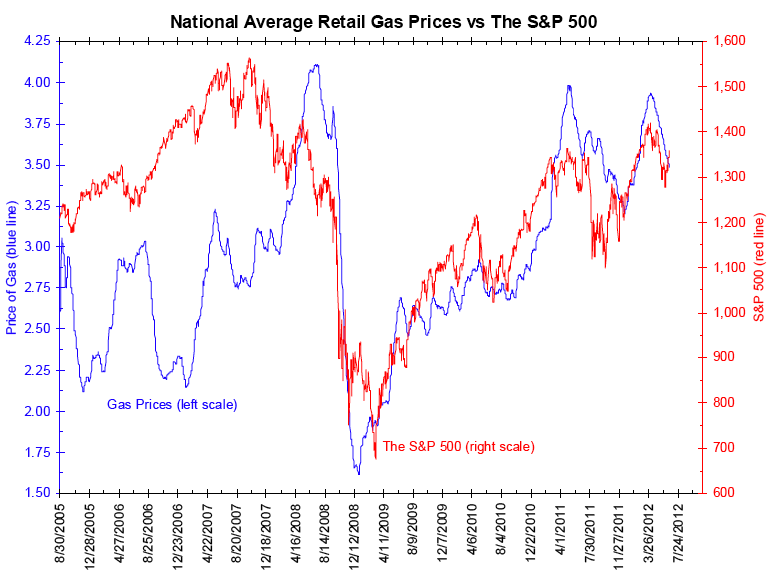
A Look At Gas Prices
|
| Subordinated bondholders in Spain may get clipped Posted: 22 Jun 2012 08:03 AM PDT Taking a cue from what Ireland did in its bank bailout, BN is reporting that Spain is looking into clipping subordinated bank bondholders and equity holders too in order to lower the amount of new equity that needs to be injected. From a rip the band aid off/debt restructuring perspective this is some progress but senior bank bondholders will get bailed out again. |
| Posted: 22 Jun 2012 06:56 AM PDT In an unusual gesture, Richmond Fed Pres Lacker is giving an official statement laying out why he dissented to the FOMC decision to extend OT. “I dissented on this decision because I do not believe that further monetary stimulus would make a substantial difference for economic growth and employment without increasing inflation by more than would be desirable.” In other words, in terms of helping the economy, the only bullets the Fed has left are blanks and the risks of current policy far outweigh their perceived and econometrically modeled benefits. He did though say monetary stimulus may be appropriate to fight the Fed’s boogeyman of deflation if it were to emerge. While the Fed looks at deflation as a black or white issue, good or bad, it’s not. Deflation is bad for debtors but good for creditors and savers. |
| Posted: 22 Jun 2012 06:51 AM PDT Some fascinating stuff to end your workweek:
What are you reading?
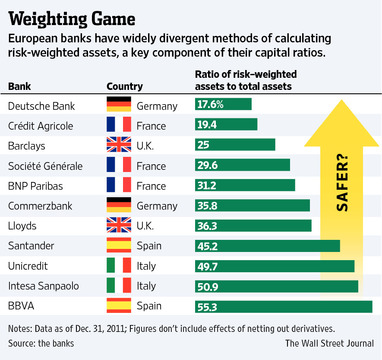
EU Banks’ Risk in Eyes of Beholder |
| Spain needs a maximum of E62bn to recap its banks – allegedly Posted: 22 Jun 2012 06:30 AM PDT Taiwan’s unemployment rate rose to 4.25% in May (forecast 4.20%), from 4.19% in April, yet more evidence of a slowing economy, particularly in Asia. Taiwan is important as it provides a good assessment of the Asian economy, in particular, as exports make up 2/3rds of Taiwan’s economy and have fallen in 5 out of the last 6 months; The Indian Rupee declined to a Rs 57.256 against the US$ this morning, a 9 month low, given the economic problems which are worsening. Foreign investors continue to reduce their holdings in Indian securities. Cant see any respite in the short term; Spain announced that its banks may need between E16bn, rising to E62bn (in an “extreme” case) to recap its banks through 2014. The EZ is set to provide up to E100bn, channeled through the FROB, (Spain’s bank recapitalisation fund), rather than directly to the banks, which will increase Spain’s debt to GDP to around 90% by the end of this year. The Spanish forecasts are viewed with extreme scepticism, given the Irish experience – quite rightly in my view. The IMF has criticized the EZ plans to channel the funds through the State, suggesting that a recap of Spanish banks directly would be much better – clearly right. However, Germany continues to resist such a change, though I suspect they may be persuaded, in return for EZ countries agreeing to strict budget targets and other measures to ensure fiscal discipline; Italian consumer confidence fell to 85.3 in June, the lowest reading since 1996, from 86.5 in May and forecast of 86. A recession, combined with rising taxes and unemployment (rose to a 12 year high of 10.1% in April) is taking its toll. Mr Monti is losing support and there is a growing threat of elections being called in Autumn. However, the political parties will wish for Mr Monti takes the tough decisions so as to avoid any voter backlash, before they call elections; The German President has agreed not to sign off on the ESM, as requested by the German Constitutional Court, following a complaint by a far left German party, which the Court states that they need to review. The Court may also be asked to consider the Fiscal Compact. Whilst, the Constitutional Court is not expected to rule against either the ESM and/or the fiscal compact, it is expected to take time to consider these issues, which could delay the ratification of these measures to mid to late July, creating yet more uncertainty. It is believed that German politicians have ignored the Constitutional Court, which based on this ruling, would appear “careless”; The important German IFO business climate index came in at 105.3 in June, as opposed to the forecast of 105.6 and 106.9 in May, the lowest reading since March 2010. The current conditions component was stronger than the forecast 112.0, coming in at 113.9, above May’s 113.2, though the more important expectations component was weaker. It came in at 97.3 (forecast 99.8), down from the 100.8 in May. There were also signs that manufacturing is coming under pressure and recent employment gains are reversing. The weaker IFO data confirms the downbeat German ZEW and PMI surveys and suggests that German economic forecasts may have to be reduced in the 2nd half of the year, in particular. Counter intuitively, this is good news, as it will add pressure on Germany to deal with her EZ partners; The meeting of the major EZ countries (Germany, France, Italy, and Spain) is not expected to result in any major announcements. Monti, supported by the French and Spanish, is pressing Mrs Merkel to relent on her tough stance – highly unlikely at this meeting, though some “concessions” by Germany are likely at the EU Heads of State meeting on 28/29th June; The ECB is likely to loosen collateral rules for Spanish banks materially, by reducing the impact of ratings of credit ratings agencies on its refinancing operations. The major concession could allow greater use of (lower quality) asset backed securities by Spanish banks, thereby reversing a major liquidity squeeze, which has increased as depositors continue to withdraw funds from Spanish banks. Spanish banking stocks have, inter alia, responded positively to the expected announcement today. However, the move will increase the risk of the ECB; Whilst generally, I cant see much opposition to Germany’s desire to enforce centrally controlled fiscal disciple in the EZ, the real problem country is France. They will fight such moves tooth and nail. However, I really don’t understand what alternative France has. Its not strong enough to tough it out by itself anbd its economy looks suspect. However, beware the inevitable political maneuvering; Brazil and China announced a R$60bn (US$29bn) currency swap. China has entered into over 20 such agreements with various countries, though to date, only Hong Kong has has to activate its lines. To date, cheap Chinese goods have flooded into Brazil, impacting domestic producers, whilst Brazil has exported just unprocessed commodities; US existing home sales declined by -1.5% in May, to an annualised rate of 4.62mn, though a 9.6% increase YoY. However, with cheaper mortgage rates,in particular, US housing is expected to continue to recover. Moody’s reduced the credit ratings of 15 of the worlds largest global banks, with Credit Suisse suffering a 3 notch downgrade, though Morgan Stanley was downgraded by just 3 notches. The news was expected, though will increase the borrowing costs of the relevant banks and, in addition, increase collateral requirements demanded by counter parties. Investors have shrugged off the widely anticipated Moody’s statement; Outlook Weaker US economic data added to the downbeat move in US markets yesterday, which has followed through into Asia and Europe, though Europe is recovering and US futures suggest a higher open. Oil (worryingly) sold off, with WTI and Brent trading below US$80 and US$90 respectively – some recovery this morning. I certainly would be worried if Oil trades below these levels for some period of time. The German Constitutional Court issues are concerning, not that they are expected to stop ratification of the ESM and the fiscal compact, but because it will take more time (greater uncertainty), something which the EZ has run out of. Having said that, I continue to believe that the EZ will deliver something at the next heads of State meeting on the 28/29th June, most likely agreement that the EFSF/ESM will be able to buy bonds in the secondary markets. With expectations extremely low, some good news is likely to be received positively by markets. Furthermore, I believe, increasingly, that the ECB will cut rates on 5th July. I continue to believe that it is dangerous to be short at present – indeed, I suspect it will be a buying opportunity next week, though investors may sell off into this weekend. The financials have not been beaten up, for example – indeed, European financials are performing well today, though the energy and mining sectors are weak. Gold does not look like the place to be, given declining inflation. In addition, historically, Gold has not acted as the insurance policy it is alleged to be. The Yen has not strengthened in spite of the weaker US and European economic data. Shorting the Yen has been the quickest way to the graveyard in the past, but……..The Euro is looking weak, with the US$ and Sterling holding up. Kiron Sarkar 22nd June 2012 . |
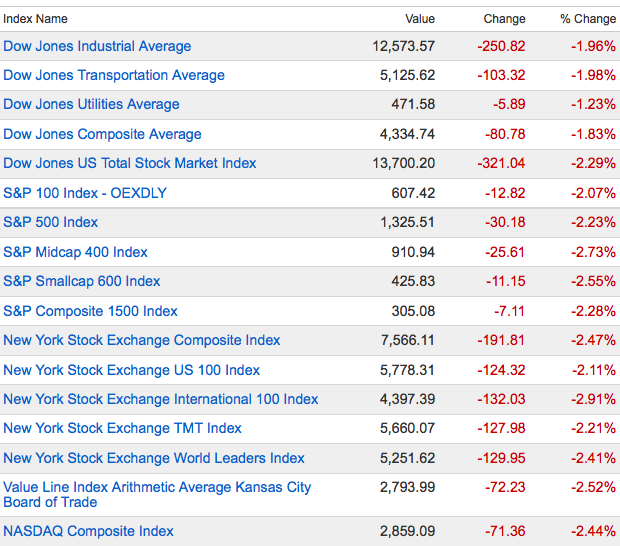
| Choose Your Rationalization . . . Posted: 22 Jun 2012 04:53 AM PDT Yesterday’s ugliness has the pundits looking at numerous explanations, correlations and motivations for what was the causation of the 2+% market sublimation. All those “-ations” leave out the most important one: Rationalization. For that is what all of these tales actually were. Consider the following “causes” trotted out for the move:
I have a different view: The day-to-day action is nearly all noise. It contains a surprising degree of randomness, but its not as totally random as some academics would have you believe. Why? Sometimes we see price continuation, leading to distinct trends. This is often acted on, reflected in the trading behavior of both Momentum traders and Trend followers. Occasionally, a move in either direction gets over-extended. Hence, Contrarians and Sentiment watchers try to anticipate the counter-trend reaction move. Third, the market internals can shift, become aberrational. Technicians try to discern what this is telegraphing behind the scenes in the activities of the biggest institutions as they impact the stock supply demand battle. Or not. All of these cross currents described above are hardly reliable guide posts. They occasionally provide a modicum of insight, but just as often lead to confusion. Typically, they make day-to-day trading exceedingly challenging. The shorter your timeline, and the greater your assumptions, the far less reliable your investment strategies become. The exception, ironically, are those folks who measure their holding periods in fractions of a second. High Frequency Traders (HFT) — a/k/a “cheaters” — mostly know the outcome of their trades in advance, courtesy of the information provided to them by the exchanges. Their high probability front-running is not available to ordinary investors, from whom their profits are derived. ~~~ What investment decision have you rationalized today?
click for updated market data |


| You are subscribed to email updates from The Big Picture To stop receiving these emails, you may unsubscribe now. | Email delivery powered by Google |
| Google Inc., 20 West Kinzie, Chicago IL USA 60610 | |



0 comments:
Post a Comment