


The Big Picture |

- 10 Monday PM Reads
- 2012 Election: The Race For House Control
- Bernanke defends Fed action
- Sell Side Indicator Still Shows Extreme Bearishness
- Moody’s to soon downgrade Spain? Priced in if so
- Weaker Chinese PMI data
- 10 Monday AM Reads
- Global mfr’g/Spain/Q3 earnings
- The Triffin Dilemma & Gold
- Fidelity’s Bond Funds Now Larger Than Equity Offerings
| Posted: 01 Oct 2012 02:00 PM PDT My afternoon train reading:
What are you reading?
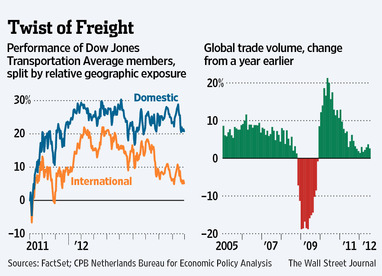
Transport Stocks: No Third Rail for Economy |
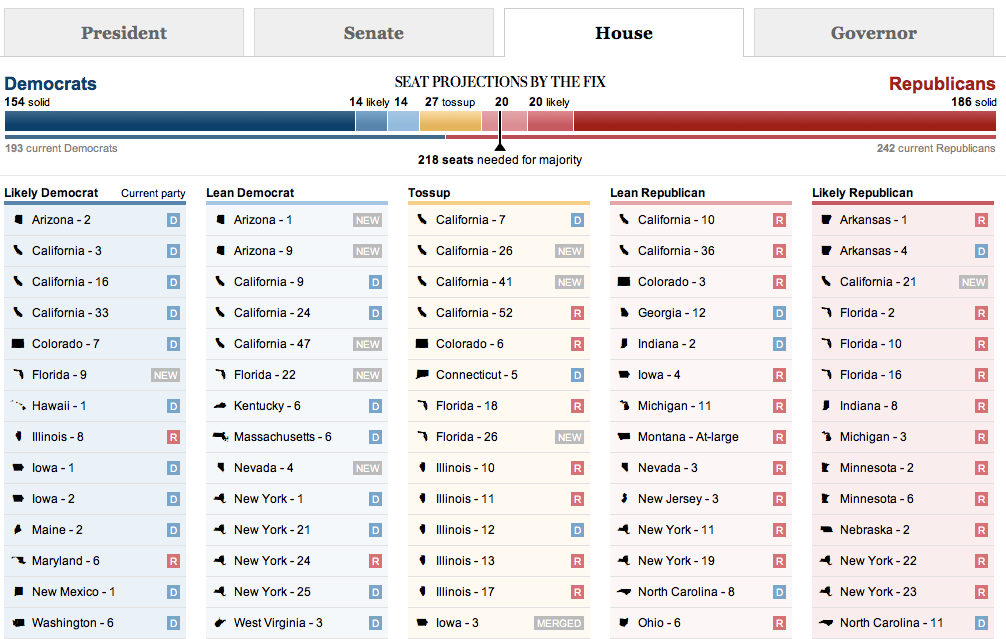
| 2012 Election: The Race For House Control Posted: 01 Oct 2012 11:30 AM PDT Click for interactive chart: |
| Posted: 01 Oct 2012 11:20 AM PDT Bernanke today has joined other voting and non voting Fed members in giving their opinions of what the FOMC announced on Sept 13th. The topic of his speech is “Five Questions about the Federal Reserve and Monetary Policy” and its his venue of trying to defend Fed action. Nothing is new and is more just a reiteration of what we already know. “We expect that a highly accommodative stance of monetary policy will remain appropriate for a considerable time after the economy strengthens.” While the criticism of Fed policy in the middle part of last decade was that they kept rates too low for too long (and we know the results), Ben wants to do it again by saying they “will take care not to raise rates prematurely.” The definition of premature evacuation of Fed policy at some point will of course be very subjective and the driver will be where inflation goes from here. On inflation, he starts by saying that the Fed’s “price stability record is excellent.” He defines “excellent” as only a 2% annual reduction in the purchasing power of the US$. In response to hearing “are you monetizing the debt-printing money for the gov’t to use-and will that inevitably lead to higher inflation? No, that’s not what is happening, and that will not happen.” He differentiates money printing and what he claims they are doing by saying money printing is a permanent source of financing for gov’t spending where he said what the Fed is doing is temporary.” Semantics I say. His benign inflation outlook was repeated and he remains confident that they have the tools to exit when necessary with necessary being the huge unknown. I conclude and repeat that whether they get the timing right or not, unwinding their balance sheet and normalizing the fed funds rate will be highly disruptive. |
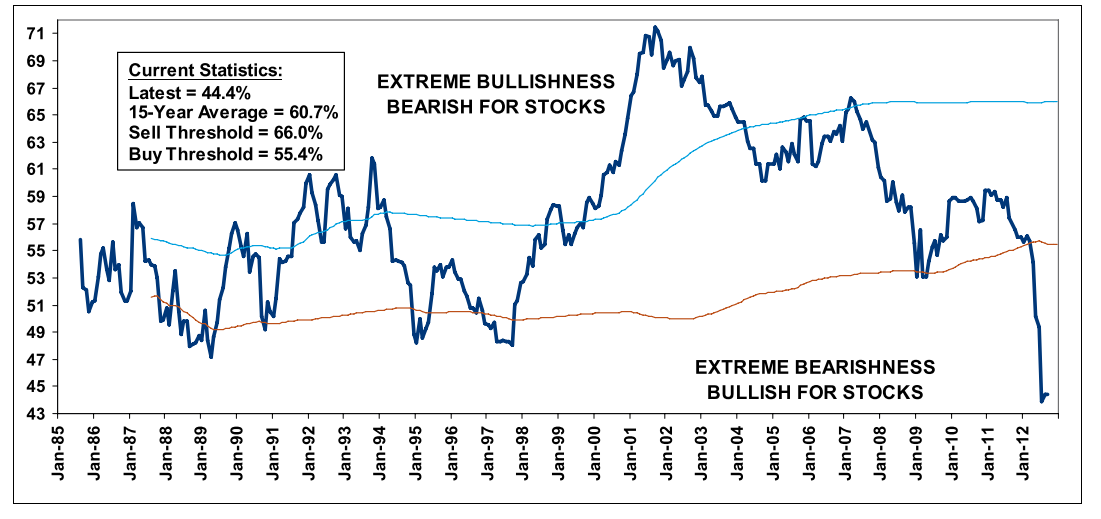
| Sell Side Indicator Still Shows Extreme Bearishness Posted: 01 Oct 2012 09:00 AM PDT Wall Street pays QE3 no mind
Merrill Lynch’s Equity & Quant Strategist, Savita Subramanian, notes that Wall Street is still excessively bearish, and that this remains a reliable contrarian indicator:
Source: |
| Moody’s to soon downgrade Spain? Priced in if so Posted: 01 Oct 2012 08:56 AM PDT Following the news from Spain last week on their budget and banking system, we are nearing a decision from Moody’s on whether to further downgrade Spain’s credit rating into junk territory from Baa3 currently. As usual, the marketplace has already anticipated this, if it were to occur, with the 5 yr Spanish CDS trading at 380 bps. It’s well below the record high of about 650 bps 2 days before Draghi came to the rescue but its higher than Ireland’s at 317 bps who has a credit rating of Ba1 from Moody’s, the 1st junk level below Spain. Also, Moody’s has the same Ba1 rating for Hungary that has the same CDS level as Spain. |
| Posted: 01 Oct 2012 07:30 AM PDT The BoJ’s Tankan index of sentiment in respect of large manufacturers fell in the 3rd Q to -3, from -1, the 4th consecutive negative reading. Sentiment worsened and the outlook remained cautious. The Nikkei declined by -0.8% to a 3 week low, having declined by over 4.0% in the 3rd Q. The continuing spat with China over ownership of certain islands in the S China seas, combined with the global economic slowdown is adding to the country’s woes; Taiwanese September manufacturing PMI (a good indicator of global demand) came in at 45.6, below the 50 dividing line for the 4th consecutive month; South Korean exports (one of the world’s largest exporters) declined by -1.8% in September Y/Y, the 7th decline this year. Exports to the EU dropped by -5.1%. The central bank is expected to cut interest rates this month as it reduces its 2012 growth forecast; Chinese manufacturing PMI declined to 47.9 in September, from 47.6 in August and the 11th consecutive monthly decline, according to HSBC/Markit. Export orders declined at the fastest rate in 42 months, whilst purchasing activity fell for the 5th consecutive month. Input and output prices continued to decline and businesses shed labour for the 7th consecutive month. The official Chinese PMI index rose to 49.8 in September, higher than August’s 49.2, though the 2nd month below 50 and below the forecast of 50.1. The new orders component rose to 49.8, from 48.7 in August, whilst exports rose to 48.8 from 46.6. Inventories declined to 47.9, from 48.2. The data suggest that Chinese GDP will have declined to between +7.2% to +7.3% Y/Y in the 3rd Q, down from +7.6% in Q2. The data is not effectively seasonally adjusted and whilst the headline number shows improvement, the reality may well be different; India’s manufacturing PMI came in at 52.8 in September, similar to August’s reading, according to HSBC. New orders rose marginally. Exports declined by -9.7% in August (better than the -14.8% in July), with imports lower by -5.1% (better than the -7.6% in July), resulting in a trade deficit of US$16bn. However, exports account for a smaller percentage of GDP than is the case of other countries in Asia; In the EZ, September manufacturing PMI data was as follows: Ireland 51.8, up from 50.9 and the 7th successive monthly rise. Spain 44.6, up from 44.1, the highest reading since February. Italy 45.7, up from 43.6 in August, much better than forecasts of around 44.1 and the highest since March. Holland, up to 50.7, from 49.7 in August. Germany final PMI, 47.4, up from 44.7. France final PMI came in at 42.7, slightly higher than the flash reading of 42.6 and a 41 month low. EZ final PMI came in at 46.1, slightly higher than the flash reading of 46.0 and up from 45.1 in August; The Troika are back in Athens. The Greek budget reports that GDP will decline by -6.1% this year, -4.0% next, though is forecast to have a primary surplus of +1.1% this year; Germany wants the Greece to receive the next (E31.5bn) tranche of aid. There are reports that Germany wants Greece to remain in the EZ for fear of contagion and are pushing the Troika to ensure that their report allows the EZ to continue to fund Greece. A report is expected on the 22nd October. The recently appointed leader of Germany’s opposition party, the SPD, Mr Steinbruck (he was the only credible candidate, in reality) favours a continued rescue of Greece, though repeats that they have to meet their commitments – Greece meet its commitments – come now Mr Steinbruck. However, Mr Steinbruck may well be an important player in due course. At the next election, Mrs Merkel may well be forced into a “grand coalition” with the SPD, which will result in her remaining as Chancellor and Mr Steinbruck taking over as Finance Minister from Mr Schaeuble. The IMF want Greece to restructure its debts. There is no doubt that another restructuring will prove necessary. This charade has long past its sell by date; The Spanish authorities have finally admitted that the 2013 budget deficit will come in higher than forecast at 7.3%, above the target of 6.3%. They allege that if it were not for aid to their banks, the deficit would have met the 6.3% target. In addition they raised (for the 2nd time) the 2011 budget deficit target to 9.44% of GDP, from 8.96% previously reported. Last Friday, the Spanish authorities claimed that their banks would need just E40bn, as opposed to the E54bn reported by an US consultancy. These are all mickey mouse numbers – most of the Spanish banks are insolvent and have not provided anywhere near enough, particularly in respect of their property exposure. Finally, debt to GDP is set to rise to 85.3% this year and 90.5% next – the government has forecast that its budget deficit will contract to 4.5% next year and 2.8% in 2014, as it reduces its deficit by E37bn – complete pie in the sky forecasts. Spain is currently in negotiations with Moody’s to avoid a further downgrade. Finally, the Spanish region of Catalonia is threatening to break away – far fetched in my view, as it will not be accepted in the EZ. However, they could demand more financial benefits from the central authorities – a serious possibility; France’s budget last week was similar to that of Spain’s in that its forecasts for economic growth are wildly optimistic. France proposes to cut discretionary spending by 2.0% of GDP next year, to reduce its budget deficit to 3.0% of GDP. At present, state spending is around 55% of GDP. The problems in France increase. At present, exports declined to 17% of total EZ exports resulting in a trade balance which was a surplus of +2.5% in 1999, to a deficit of -2.4%. With debt to GDP in excess of 90%. The most recent manufacturing PMI data came in at a shocking 42.6, the lowest since April 2009. A key leading indicator of money supply (6 month real M1 money) is contracting even faster than in Spain. The recent budget increased taxes on the “wealthy”, with the ratio of taxes to gross wages rising to 46.3% and have been front loaded, whilst expenditure cuts have been back loaded. Just 39.7% of those aged between 55 and 64 work (57.7% in Germany and 56.6% in the UK, for comparison purposes), due to early retirement provisions introduced by French governments. I can go on and on, but you get the picture. Essentially, France remains the biggest threat to the EZ,as I keep banging on\ (Source Telegraph); Just to underscore the problems in the EZ, the August unemployment rate came in at 11.4%, though in line with estimates and the same as July’s; UK September manufacturing PMI came in at 48.4, lower than August’s 49.6, slightly worse than expectations of 49.0. Output fell and employment declined, though, alarmingly, input prices surged to 57.5 in September to 48.8 in August, though output prices were subdued; Fitch confirmed the UK’s AAA credit rating, citing a flexible economy, political stability and strong institutions. Great, but the chances of the UK retaining its AAA rating look numbered, though should not have a material impact when it happens; US September manufacturing PMI came in at 51.5, in line with expectations and August’s number; The WTO has forecast that global volume of trade in goods would rise by just +2.5% this year, down from +5.0% last year and +14.0% in 2010. Still seems too high to me. Global trade expanded by +6.0% over the last 2 decades; The Xstrata/Glencore saga has finally ended. Xstrata recommended the revised and increased offer by Glencore. However, some investors (Threadneedle for example) remain opposed. The Xstrata board has decided to allow shareholders to vote on 2 packages in respect of the offer, one which includes a provision to pay Sterling 140mn to senior executives as a retention bonus and one that does not. Whilst some shareholders remain opposed, the merger looks as if it will go ahead; Outlook Asian markets (ex Japan) closed mainly higher, though a number are on holiday. European markets are much firmer, reflecting better PMI data from the peripheral EZ countries – the Italian MIB is up over 2.0%. US futures suggest a higher open, following on from better Asian and European markets. In addition, the beginning of each Q are generally better for markets. The Euro is firmer at US$1.2925. Gold is up at US$1788, with Brent (November) at US$113. In spite of the bad news, I remain of the view that you cant fight central banks and, as a result, remain net long. Still remain short the Euro. The Australian central bank, the RBA meets this week – expectations are that they will cut rates. I remain short the A$. The BoJ, ECB, and the BoE also meet, but no change is expected. The US earnings season will be upon us imminently – expect weaker to cautious outlook statements. The 1st of the US Presidential debates starts this week – should be interesting. In New York for the next 2 weeks. Looks great as usual. Kiron Sarkar 1st October 2012 |
| Posted: 01 Oct 2012 07:00 AM PDT A few reads to start off my week:
What are you reading?
Post-Rally Risks in U.S. Stocks |
| Global mfr’g/Spain/Q3 earnings Posted: 01 Oct 2012 05:35 AM PDT It’s a heavy economic data day today with the focus on global manufacturing and the results seen so far point to continued weakness. China’s state heavy mfr’g PMI remained below 50 for a 2nd month but barely at 49.8 vs 49.2 in Aug. The HSBC smaller enterprise mfr’g index at 47.9 was about in line with the preliminary read. India’s PMI remained at a 9 month low of 52.8. Taiwan saw further weakness as their PMI fell to 45.6 from 46.1, the lowest since Nov. Japan’s Q3 mfr’g Tankan mfr’g report fell to -3 from -1 and was below estimates of -4. Dating back to last yr’s earthquake, it’s below zero for 5 of the last 6 q’s. Services though remained positive. In Europe, UK PMI fell to 48.4 from 49.6, its 5th month in a row below 50 and the final EC PMI was in line with the preliminary at 46.1. Industrial commodities and oil are trading lower off the above news but European markets are well bid as they digest the Spanish banking news from Friday. The Spanish budget and bank capital needs were no different (however separated from reality) than expected but at least for now provides a base line for further discussions between Rajoy and the EU. From an equity market perspective, earnings will start to dominate making the investing landscape a minefield with more earnings disappointments and guidance sure to come. |
| Posted: 01 Oct 2012 05:30 AM PDT The Triffin Dilemma & Gold
"This tension – the Triffin dilemma – was linked to the specific modalities of the gold-exchange standard in 1960, when his Gold and the dollar crisis was first published. Today we are in a much more flexible system, where the demand for global liquidity can be more easily accommodated. But even if the mechanics have changed, the dilemma is still valid if we capture its essence and formulate it in broader terms, as I will do in the first part of my comments today. In second place, I will briefly recall how the dilemma came into being and was addressed in Triffin's times. This will allow me to better identify the main differences and similarities compared with our times, which will lead me to conclude that it is indeed correct to talk about a 'Triffin dilemma revisited'. Finally, I will look ahead and ask whether and how it is possible to escape the dilemma today." Source: Speech by Lorenzo Bini Smaghi, Member of the Executive Board of the ECB, at the Conference on the International Monetary System: sustainability and reform proposals, marking the 100th anniversary of Robert Triffin (1911-1993), at the Triffin International Foundation, Brussels, 3 October 2011. See: http://www.ecb.int/press/key/date/2011/html/sp111003.en.html . The link does not always open; so, you may have to go to the ECB website and separately pull up the Bini Smaghi speech. Robert Triffin saw the inherently destabilizing effects that originate from global reserve currency status. He perceived the tensions between short-term and long-term effects, in terms of trade deficits. He never imagined that the tension would be exacerbated by extraordinary monetary policy of the type we see implemented by central banks today. Triffin's observations were made in the 1960s. He saw how gold rose to trade at $40 per ounce after the official $35 price gave way to the incipient anti-dollar pressure of the '60s. By the 1970s, the Bretton Woods fixed currency exchange regime had collapsed. The gold exchange standard ceased when President Nixon revalued the dollar to $42 per ounce of gold and then closed the "gold window" by stopping the exchange of gold for dollars. In its official accounting, the US Treasury still values its gold hoard in Fort Knox at $42 per ounce. The Federal Reserve's gold certificates are similarly valued. Until his death in 1993, Triffin watched the trade deficit grow and the reserve currency status of the US dollar slowly erode. His warnings about the Triffin dilemma were unheeded by policy makers. The speculation around Triffin's work was about how the US dollar's world reserve currency status would evolve (unwind) and what the catalyst would be for its demise. Second-derivative questions were about whether the unwinding would be orderly or violent. Lastly, there was speculation about what would replace the dollar. Many proposals about a global central bank and a global reserve were offered. None have materialized in any serious way. Fast forward to today. The dollar maintains its reserve currency status because it is the least worst of the major four currencies – the US dollar, the British pound, the Japanese yen, and the euro. All four of these currencies are now suffering the effects of a stimulative, expansive, and QE-oriented monetary policy. We must now add the Swiss franc as a major currency, since Switzerland and its central bank are embarked on a policy course of fixing the exchange rate between the franc and the euro at 1.2 to 1. Hence the Swiss National Bank becomes an extension of the European Central Bank, and therefore its monetary policy is necessarily linked to that of the eurozone. For the balance sheets of the five central banks associated with these currencies, see www.cumber.com. When you add up these currencies and the others that are linked to them, you conclude that about 80% of the world's capital markets are tied to one of them. All of the major four are in QE of one sort or another. All four are maintaining a shorter-term interest rate near zero, which explains the reduction of volatility in the shorter-term rate structure. If all currencies yield about the same and are likely to continue doing so for a while, it becomes hard to distinguish a relative value among them; hence, volatility falls. The other currencies of the world may have value-adding characteristics. We see that in places like Canada, Sweden, and New Zealand. But the capital-market size of those currencies, or even of a basket of them, is not sufficient to replace the dollar as the major reserve currency. Thus the dollar wins as the least worst of the big guys. Fear of dollar debasement is, however, well-founded. The United States continues to run federal budget deficits at high percentages of GDP. The US central bank has a policy of QE and has committed itself to an extension of the period during which it will preserve this expansive policy. That timeframe is now estimated to be at least three years. The central bank has specifically said it wants more inflation. The real interest rates in US-dollar-denominated Treasury debt are negative. This is a recipe for a weaker dollar. The only reason that the dollar is not much weaker is that the other major central banks are engaged in similar policies. Enter gold. Gold is not money when it comes to functioning as a medium of exchange. We live in a fiat currency world where money is printed (electronically) by central banks. We pay each other in currency, not gold. The US dollar and euro are the two giants when it comes to payments. We do not use gold as a unit of account. We measure prices in dollars, not ounces of gold. True, other countries measure their prices and settle their payments in currency like yuan, krona, or rand. But the world's transactions are still largely executed in dollars, priced in dollars, and paid in dollars. Modern currency hedging allows this practice to continue without much risk to the specific agent making or receiving the payment. Gold comes into play when we focus on the store of value characteristic of money. The world's distrust of fiat currencies is rising. Given the policies in place, one would expect that to be the case. One investor, or one agent, at a time decides to reallocate a portion of wealth to gold. That agent also looks at the central banks of the world and sees them buying gold to add to their reserves. He doesn't see much institutional selling of gold. Individual investors now have vehicles like the exchange-traded products (ETFs and ETNs), which allow them to participate in this reallocation process. When an investor buys a gold ETF, like GLD or IAU, he may be thinking only of a speculative trade. But given the size of the total gold holdings in ETFs and their turnover, it appears that a growing number of investors are adding to a personal hoard of gold ETFs as a way to store value in other than a domestic currency. Physically backed gold ETPs now exceed 2500 tonnes (source: Barclays) and are steadily growing. That makes the ETF universe one of the largest gold hoards in the world. Very few countries hold more than 2500 tonnes of gold. Cumberland recognizes this trend and believes it may persist as long as the central banks continue their present policies. Our internal modeling of changes in velocity (GDP divided by M2) suggests that the gold price will move much higher, when measured in the various currencies engaged in QE. Remember, gold is a long-duration asset, and the central banks are buying long duration from the market. A "deep-pockets," persistent buyer is likely to drive the price higher. Cumberland's Global Multi-Asset Class portfolios hold gold and are routinely rebalanced to maintain the internally determined weight. Relative to the size of gold in a global allocation, we consider these gold positions to be overweight. Triffin's paradox did not focus on QE and its effects on reserve reallocation. Triffin did not have to consider a central bank policy of buying long duration from the market. Triffin's writings disparaged gold as a reserve and also opposed floating exchange rates. Professor Triffin did not foresee the present-day construction. Today, we have floating exchange rates, gold as reserves, and central banks using QE to buy long duration. One can only speculate what Triffin would write today. Meanwhile, gold prices seem to be headed higher. ~~~ David R. Kotok, Chairman and Chief Investment Officer |
| Fidelity’s Bond Funds Now Larger Than Equity Offerings Posted: 01 Oct 2012 04:30 AM PDT Way back in the Summer of 2003, I wrote a report that analyzed the Contrary Indicators 2000 – 2003 Bear market. It consisted of both internal and external signals that strongly suggested that the 2000 crash was over, and it was safe to get back into equities. The second of the external signals was that PIMCO’s Total Return Bond fund had surpassed the Vanguard S&P500 fund to become the largest mutual fund (as of October 2002) in the world. I bring that up this morning, with futures solidly to the upside, as a similar (if more modest) contrary signal has appeared: Last week, “bond and money market assets at Boston-based Fidelity now total $848.9 billion, more than half of the company’s $1.6 trillion in managed assets.” What makes this so noteworthy was that for most of its history, Stocks were king at Fidelity Investments. Recall the days of Peter Lynch‘s Magellan fund. The thought of investing in a bond fund was almost laughable back then. It was an era of stock picking, the residue of which remains a misplaced and nearly obsessive focus in the media even today. The PIMCO vs Vanguard observation was noteworthy in October 2002, when Bonds surpassed Equities as the bottom of a brutal crash was occurring. The technical types will point out markets were tracing a double bottom, with March 2003 holding near the October lows setting up the start of the next leg higher. Now that Stocks have been eclipsed by bonds at Fidelity, are we approaching a very similar moment? The key difference is that markets are up 100% over the past 3 years, not down 81%, like the Nasdaq was in October 2002. Regardless, this is an interesting contrarian sign; it suggests to me we are closer to the end of the secular bear that began in March 2000 than we are to the beginning. My best guess? This is the seventh inning stretch. If we get a recession in 2013-14, you will have one terrific chance at a low cost, lower risk entry point into equities. If only the markets were so accommodating . . . Source: |

| You are subscribed to email updates from The Big Picture To stop receiving these emails, you may unsubscribe now. | Email delivery powered by Google |
| Google Inc., 20 West Kinzie, Chicago IL USA 60610 | |



0 comments:
Post a Comment