


The Big Picture |

- Are You Better Off Than You Were (1 or 4) Years Ago?
- FT: What Black Monday says about a Flash Crash
- Too Much Natural Gas?
- 10 Lessons from 1987 Market Crash
- SEC Must Put a Stop to Casino Markets
- Remembering Black Monday Crash of 1987
- 10 Sunday Reads
| Are You Better Off Than You Were (1 or 4) Years Ago? Posted: 21 Oct 2012 04:15 PM PDT @TBPInvictus: Ever since the Reagan-Carter debate, the question asked of all voters continues to be: “Are you better off now than you were four years ago?” Recall the circumstances of what was going on 4 years ago: A freefall caused by frozen credit markets, and a stock market mid-crash. Perhaps the better question — and what polling indicates Americans care about — refers to the more recent trend of the economy. We can explore that in many ways, via employment, income, inflation, etc. For our purposes — and with all due respect to Jack Welch — let’s have a look at state-by-state Unemployment Rates. We saw the final Regional & State Unemployment Report from BLS last week that we’ll get to see before November 6 elections. As noted in the report:
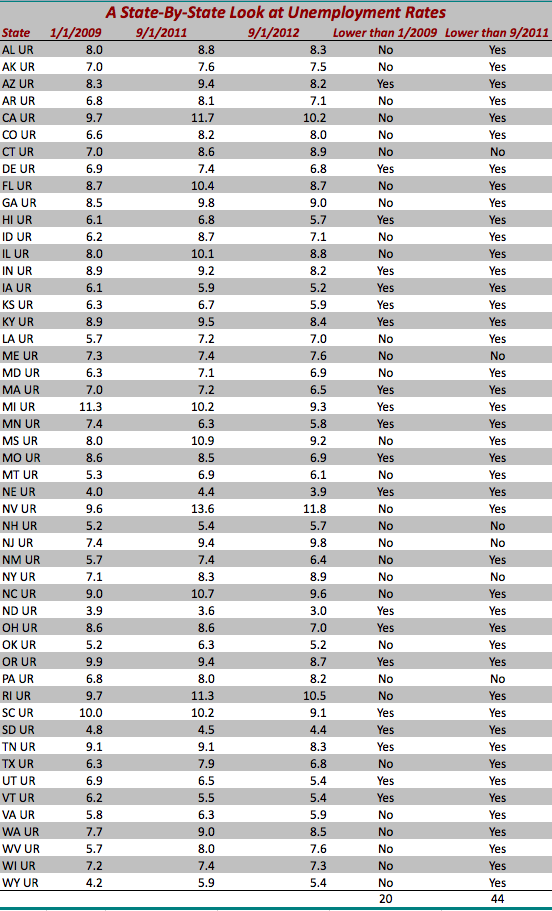
Let’s take a look at how state-by-state unemployment has fared on both fronts: click for larger table (Notes on table: Source: FRED (via the fabulous Excel Add-in). First two letters are state abbreviations, “UR” is FRED-speak for Unemployment Rate. Also please note that state rates are not translatable into the national rate.)
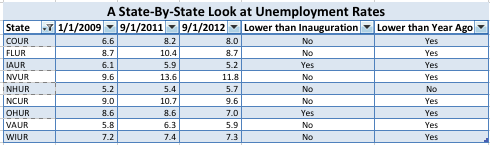
Where is the unemployment rate higher than where it stood one year ago? Six states, all in the northeast or mid-atlantic region: Connecticut, Maine, New Hampshire, New Jersey, New York, Pennsylvania. The rates in these six states are also higher – in some cases significantly so – than they were four years ago. (Adding: In NY, CT, NJ, for sure, this has much to do with the ongoing and savage slimming down of the finance industry.) The Swing StatesAs to the swing states (does anything else really matter?), let’s filter out the noise (i.e. the solidly blue and red states) and look at them on a stand-alone basis (see also here for a swing-state map):
In this view, only one of nine – New Hampshire (4 electoral votes) – is higher now than it was one year ago, while eight have seen an improving year-over-year trend. Critically, Ohio (18 electoral votes) has seen a significant improvement from 8.6 down to 7.0 on both a year-over-year and inauguration-to-date basis. The only other state with a rate lower than January 2009 is Iowa (6 electoral votes), which has dropped from 6.1 to 5.2; the other seven are still higher than they were four years ago. The extent to which this data will influence voters will clearly hinge on whether they’re employed or unemployed. I also believe that real income, a direct consequence of gaping labor market slack, is problematic for the incumbent office holder. But, for whatever it’s worth, the trend in statewide unemployment rates does seem to be a tailwind, with one more national number due the Friday before election day. The challenger asks “Are you better off now than you were four years ago?” The incumbent has been rephrasing the question to ask “Are you better off now than you were last year?” If you can discern which answer voters think is more important, then you can likely figure out what the outcome of the Presidential election will be. |
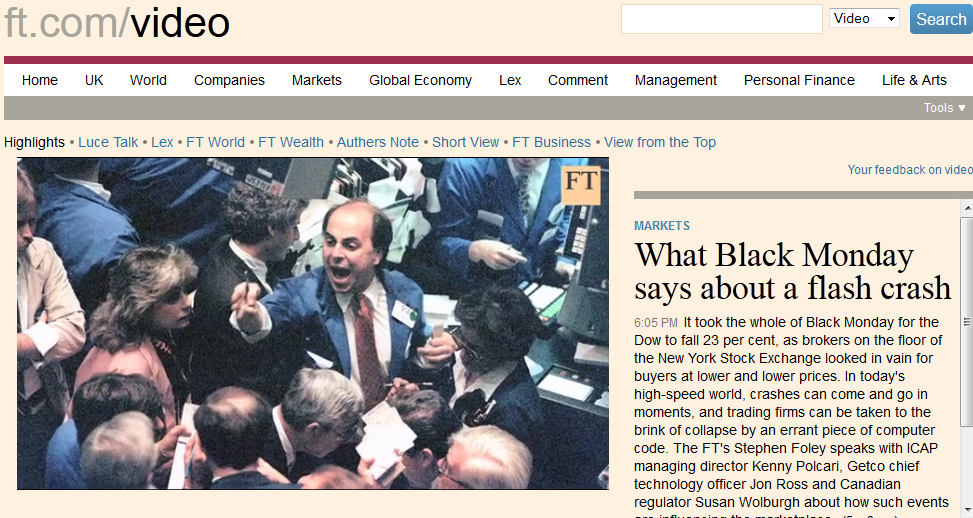
| FT: What Black Monday says about a Flash Crash Posted: 21 Oct 2012 01:00 PM PDT |
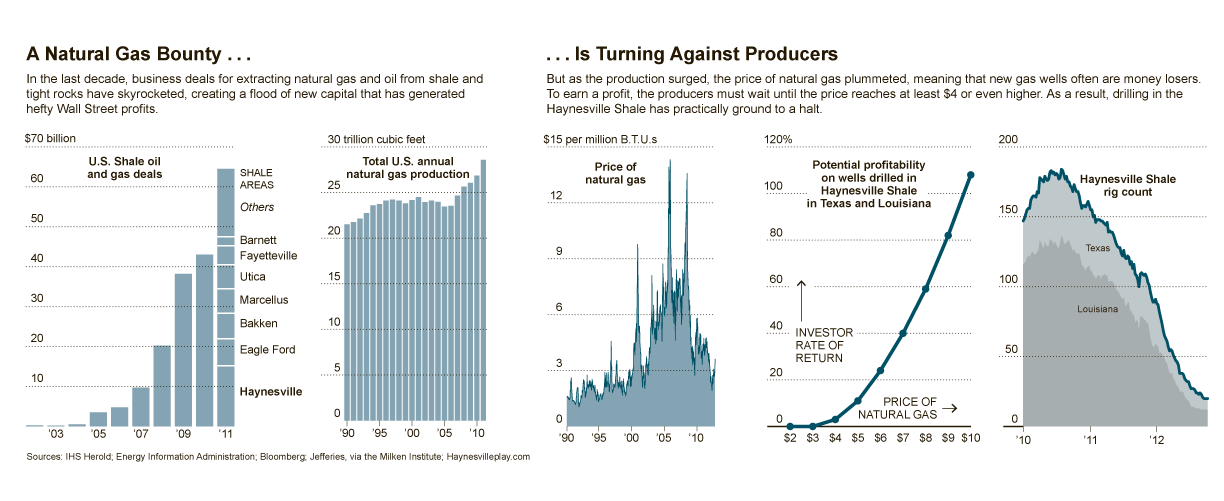
| Posted: 21 Oct 2012 12:00 PM PDT A Natural Gas Bounty Is Turning Against Producers |
| 10 Lessons from 1987 Market Crash Posted: 21 Oct 2012 08:00 AM PDT Nice set of rules from Wallace Witkowski of MarketWatch:
Source: |
| SEC Must Put a Stop to Casino Markets Posted: 21 Oct 2012 07:00 AM PDT SEC Must Put a Stop to Casino Markets
In 1994, an academic paper titled "Why do Nasdaq market makers avoid odd-eight quotes?" found substantial evidence, albeit only circumstantial, that market makers were colluding to keep spreads artificially wide. The paper caused an immediate response from Washington. Wall Street firms were fined millions of dollars and the Securities and Exchange Commission embarked on a decade of new regulations. This culminated in July 2007 when the uptick rule for short sales was eliminated and Reg NMS, an attempt to modernise the structure of the national markets, was implemented. The SEC hoped these new regulations would increase competition. Indeed, spreads have narrowed in the most active stocks and commission rates have dropped, but there's no free lunch. Due to a lack of economic incentives, traditional market makers, who used to act as shock absorbers in times of volatility, have exited the business, only to be replaced by "automated market makers". Their operating model is based on paying brokers to direct trades to them – called "payment for order flow" – and then using powerful computer systems to make a small profit per share on turnover of these trades. Rather than helping customers achieve best execution, automated market makers use these orders to trade for their own account. They have little or no obligation to facilitate trades when times get tough. Moreover, the lack of spreads has caused many broker dealers to exit the business of underwriting IPOs, leaving a void in our economy. The result is the fragmented equity market that we have today. Instead of a few non-profit, centralised exchanges with deep liquidity, our market structure is based on 13 for-profit exchanges, approximately 40 dark markets and a few dozen of these automated market makers. With all of their computer trading systems interacting at lightning speed, if anything gets out of whack, it's like a room full of mousetraps loaded with ping pong balls going off. Clearly, the SEC's market structure experiment has failed. Unless something changes, confidence-shaking events will only increase in frequency. The SEC has proposed some fixes, but most are still on the shelf. More recently, as part of the JOBS Act – legislation designed to help start-ups and small businesses to raise money – the SEC was mandated to study how increasing spreads would affect liquidity. Last month, it recommended continued discussion. There's no more time for talk. Retail and institutional investors have already withdrawn more than $300bn from domestic equity mutual funds since the flash crash. The market needs to move from its current short-term casino environment and return to its true purpose – capital raising and allocation. Here are three things the SEC can do that will have an immediate, beneficial effect:
There is no need for the heavy hand of regulation to start all over again. These simple changes will go a long way to getting rid of the microsecond arbitrage games that have turned our market into a casino. The sooner the SEC acts, the faster we can start rebuilding trust and confidence in our market. ~~~ Leon Cooperman is chairman and CEO of Omega Advisors and a former chairman and CEO of Goldman Sachs Asset Management. Sal Arnuk and Joseph Saluzzi are co-founders of Themis Trading |
| Remembering Black Monday Crash of 1987 Posted: 21 Oct 2012 06:29 AM PDT Francesco Guerrera and former SEC chairman David Ruder discuss his memories of the stock-market crash of 1987, and Chuck Jaffe says that while the stories of the crash are fresh, the actual losses have been forgotten
|
| Posted: 21 Oct 2012 04:00 AM PDT Pull up a chair, pour yourself a cup of coffee and enjoy these Sunday reads:
What are you reading ?
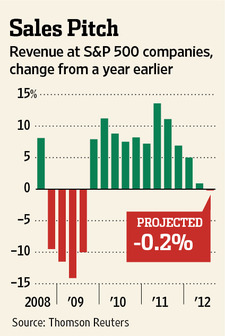
Falling Revenue Dings Stocks |

| You are subscribed to email updates from The Big Picture To stop receiving these emails, you may unsubscribe now. | Email delivery powered by Google |
| Google Inc., 20 West Kinzie, Chicago IL USA 60610 | |



5 comments:
It is perfect time to make some plans for the future and it's time to be happy. I have read this post and if I could I want to suggest you some interesting things or tips. Maybe you could write next articles referring to this article. I desire to read more things about it!
Feel free to surf to my blog post; Gesetzliche krankenkasse deutschland
my site - Http://deboraoh.datingish.Com/Weblog/
If you are going for most excellent contents like I do, simply
visit this site everyday as it presents quality contents, thanks
Feel free to visit my web page ... seo expert
Hi everyone, it's my first visit at this site, and post is actually fruitful in favor of me, keep up posting these types of content.
Feel free to visit my website; best online business ideas
Also see my site > click through the following web site
I like the valuable info you provide to your articles.
I will bookmark your blog and check once more right here regularly.
I'm relatively certain I will learn plenty of new stuff proper here! Best of luck for the following!
Feel free to visit my page :: http://www.xfire.com/blog/tomokober/4580001
Thanks very nice blog!
Feel free to visit my web page ... http://wiki.mvtom.ru/index.php/Участник:KennyXUR
Post a Comment