


The Big Picture |

- Open Thread: Look Out Below!
- Why Doesn’t MTV Play Music Videos Anymore?
- FOMC minutes, QE4 soon to come
- 10 Midweek PM Reads
- Manhattan’s Cloudy Rental Discounts
- What, Exactly, Is the Fiscal Cliff, You Ask?
- Japanese General Election in December
- MBA/Japan/Europe
- 10 Midweek AM Reads
- Retail sales and PPI
| Posted: 14 Nov 2012 04:32 PM PST Over the past few weeks, I have become increasingly cautious on the markets. I mentioned on Bloomberg I suspected this cyclical rally might be ending, and that we were moving from over-weight to equal-weight to eventually underweight equities. My concerns were about an Earnings slow down as well. On October 26, I got even more explicit: Time to Reduce Equity Exposure. (see this and this and this and this). As is so often the case, there was some pushback: Some folks said you can’t fight the Fed, others said any dip was a buying opportunity. Lots of traders and investors and fund managers read this blog — do tell us what your perspectives are. What Say ye ? |
| Why Doesn’t MTV Play Music Videos Anymore? Posted: 14 Nov 2012 03:00 PM PST In this installment of “Ask A Network Head,” Natalie asks the head of programming at MTV why they stopped playing music videos. And gets a fun answer! Yay! |
| FOMC minutes, QE4 soon to come Posted: 14 Nov 2012 01:27 PM PST Noteworthy in the Oct FOMC minutes was the discussion on the effects of the Sept announcement of QE3. They said “the initial effects were generally viewed as consistent with a marked easing in financial conditions. For example, yields on MBS dropped noticeably, leading to a decline in mortgage interest rates, and corporate bond yields generally moved lower.” The Fed now defines a 16 bps move lower in interest rates as “noticeable” as that has been the decline in MBS yields to 2.2% for the 30 yr FNMA coupon. The 16 bps drop is in the context of a drop already from 6% seen since 2008. Investment grade corporate bond yields have fallen but junk yields have gone up. On the markets inflation response which went up, “a couple of participants saw this increase as a sign that the open ended asset purchases posed a risk to the stability of longer term inflation expectations. However, others saw the effect on expected inflation as relatively muted or likely the result of reduced risks of undesirably low inflation.” On the actual economy, many members believed that lower rates “were providing support to aggregate spending, most notably” in housing, autos and other consumer durables. Lastly, QE4 is soon to come when OT expires as “a number of participants indicated that additional asset purchases would likely be appropriate next yr after the conclusion of” OT “in order to achieve a substantial improvement in the labor market.” This should not be a surprise. Peter Boockvar |
| Posted: 14 Nov 2012 01:20 PM PST My afternoon train reads:
What are you reading?
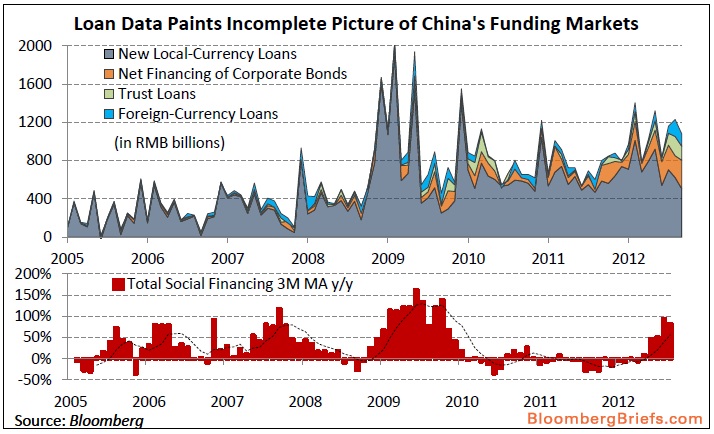
Decline in China's Traditional Loans More Than Offset by Surge in Social Financing
|
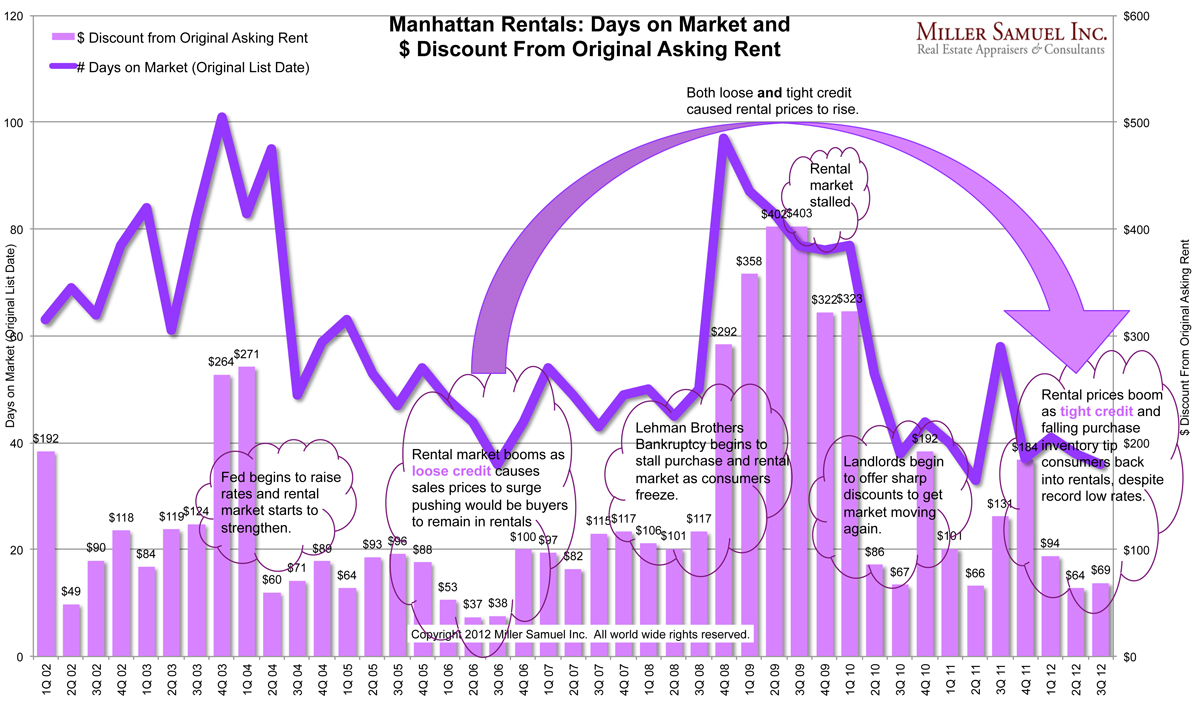
| Manhattan’s Cloudy Rental Discounts Posted: 14 Nov 2012 11:30 AM PST |
| What, Exactly, Is the Fiscal Cliff, You Ask? Posted: 14 Nov 2012 08:58 AM PST Think Markets has an excellent piece on the Fiscal Cliff. The highlights?
Full chart after the jump . . .
|
| Japanese General Election in December Posted: 14 Nov 2012 07:30 AM PST Australian wages rose by +0.7% in Q3, lower than the +1.0% increase in Q2. The Westpack consumer confidence index rose to 104.3, the highest level since April last year. However, Australian company directors are more pessimistic than at any time in the past 2 years due to budget cuts, increasing regulatory burdens and a slowing China, according to reports in the Australian press The A$ rose to over to US$1.0450, though is weakening – currently US$1.0420. Notwithstanding the better data, I will look to increase my short – the views of Australian business leaders are far more important; Japanese PM Mr Noda is planning dissolve the lower house this Friday and call a general elections if the opposition agrees to electoral reforms. Elections are likely be held on 16th December. Voting on the deficit-financing bill is expected tomorrow, which will pass. The Yen should weaken, as the head of the current opposition (the center-right LDP, which is likely to win the elections), Mr Abe, has called for aggressive monetary easing policies – indeed, he suggests that the BoJ should target an inflation level of 3.0% !!!!. Furthermore, Mr Abe stressed (a) the need to beat deflation, (b) for the BoJ to take “bold steps” toward this goal by taking unlimited action (he has suggested changing legislation which, in effect, would make the BoJ less independent), (c) for more public works (which Japan certainly does not need) and (d) to agree on a large supplementary budget – all measures which should weaken the Yen; Given the spat between Japan and China, Bloomberg citing Nikkei, reports that the Japanese are looking to invest Yen1.2tr into India. Great news for India, but historically investment into India has always faced numerous problems, including bureaucracy, corruption, delay ….. the list is endless. Hopefully the Indian authorities will get their act together, though bad habits are hard to get rid of; The 18th Chinese Party Congress ended today, following the appointment of members of its Central Committee and Central Commission for Discipline. Tomorrow, the Central Committee meets to endorse the new Politburo Standing Committee (expected to comprise 7 members, from 9 at present) The governor of the BoC, Mr Zhou, has been dropped from the Communist Party’s central committee, which suggests that he will be replaced, once his term ends next year; The Indian October wholesale-price index declined to +7.45% Y/Y, from +7.81% in September and well below the +7.9% expected. However, a reduction in the subsidy for diesel is expected to increase inflation in coming months;
Negotiations between Cyprus and the EZ have stalled, as Cypriot banks have allegedly been involved in money laundering on behalf of Russians. German authorities allege that Cypriot banks hold some US$26bn on behalf of Russians, as compared with the country’s GDP of just US$17bn. In addition, a number of Russian controlled companies are registered in Cyprus. Recently Cyprus have, in effect been selling EU passports in return for purchases of properties in the country. There certainly is a lot to clean up in the EZ; The German finance minister, Mr Schaeuble, confirmed that providing Greece with E44bn in one lump sum was being considered. However, he added that control mechanisms need to be put in place and that the final report from the Troika was necessary before any decision could be made. The Dutch have stated that they would not support any plan which provides additional funds for Greece, other than that agreed, adding that there was a “big risk” that Greece would need more funds. Greece managed to sell E4.1bn of 1 and 3 month treasury bills, to help raise the E5bn necessary to repay maturing bills this coming Friday. However, far more interestingly, the German opposition leaders insisted yesterday that the IMF testify in front of the Bundestag to confirm whether Mrs Merkel’s promises that there would be no need for more aid to Greece were realistic and as to whether existing aid would be repaid. Will not happen, but……However, Mrs Merkel’s promise that bail outs wont cost Germany is her Achilles heel. Furthermore, to align herself with the Greeks, given the country’s history, seems particularly dangerous; Greek Q3 GDP, on a non seasonal basis, contracted by -7.2% Y/Y, worse than the -6.2% Y/Y in Q2. Greece is in the 5th year of recession; The Bank of Portugal reports that the economy will contract by -1.6% in 2013, as opposed to a previous estimate of a flat reading – the government has forecast that GDP will decline by just -1.0%. Furthermore, its budget deficit target of -5.0% this year looks as if it is going to be tough to achieve – it has moved higher from the -4.5% in September. Unemployment data released today reveals that the Q3 unemployment rate has risen to +15.8% Q/Q (up from +12.4% in the corresponding period last year), as opposed to +15.0% in Q2, the 8th quarterly rise. Furthermore, the government has forecast that unemployment will rise to +16.4% next year. Why should any of this be a surprise – the more the Portuguese cut spending and raise taxes, the larger the decline in GDP and, as a result, revenues will contract. It is almost certain that the fiscal multiplier in Portugal is above 1, as the IMF has suggested. Portuguese Q3 GDP declined by -0.8% Q/Q (more than the forecast of a decline of -0.6%) or -3.4% Y/Y (the largest decline since Q2 2009), as compared with -1.2% Q/Q and -3.2% Y/Y in Q2. The Portuguese economy has been in recession for 2 years, with the recession expected continue into 2013; It looks as if the EU will confront Spain over its forecast budget deficit later today – Spain has stuck to its forecast of -6.3% this year, whilst indications are that it will come in around 8.0%; The recent Euro group meeting of finance ministers failed to reach agreement on the proposal to set up a banking supervisor. The EU had set a deadline to reach agreement by the year end which, as usual with the EU, looks optimistic. The establishment of a banking supervisor is a precondition for allowing EZ countries to access the bailout fund. Remember that Spanish banks need to be recapped Agreement on the EU budget later this month looks unlikely; EZ September seasonally adjusted industrial production declined by -2.5% M/M (-2.3% Y/Y), worse than the -2.0% M/M expected and the upwardly revised +0.9% M/M in August. Interestingly, a recent YouGov poll suggests that 57% of Germans want to stay in the Euro, with only 25% opposed; The YouGov poll results for the UK suggests that 49% of Brits want to high tail it out of the EU, with 28% wanting to stay in. I’m amazed that 28% want to remain in; UK October jobless claims rose by 10.1k, worse than the flat reading expected. The September unemployment rate declined to 7.8%, from 7.9% forecast and 7.9% in August. UK unemployment has not risen materially for some inexplicable reason – it may well start to rise from now on, especially as Olympics related temporary jobs fall away; The BoE quarterly inflation report revised down UK growth forecasts, though increased its inflation expectations and, indeed, was decidedly downbeat:
All in all a much more pessimistic forecast than expected. Sterling declined on the news; The FED’s Vice Chair, Janet Yellen stated that short term rates should remain around zero until 2016. In addition, she proposed adopting inflation and employment targets to set FED rate policy. Essentially, she seems prepared to accept higher inflation to reduce unemployment. Ms Yellen is expected to take over from Mr Bernanke, when he retires at the end of next year; US NFIB October small business sentiment rose marginally to 93.1, as opposed to 93.0 expected and 92.8 in September; The US October budget deficit soared to US$120bn, well above forecasts of US$114bn. Action is long overdue; US October PPI declined by -0.2% M/M ( +2.3% Y/Y) , much lower than the +0.2% expected. US October retail sales came in at -0.3%, slightly worse than the -0.2% expected and +1.3% in September. Ex autos and gas, October retail sales declined by -0.3%, as opposed to +0.4% expected and +1.0% in September; President Obama has called for US$1.6tr in additional taxes over the next decade, double the US$800bn previously discussed with Republicans in mid 2011. Meetings will start this Friday. The President did not suggest that current spending, including on entitlements, was sacrosanct. Clearly the extent of the proposed tax rises will be resisted strongly by the Republicans; Outlook Asian markets closed flat to higher today. European markets are lower. US markets have opened slightly higher. The Euro has risen – currently US$1.2745. Gold is trading around US$1727, with December Brent at US$107.58. Given the forthcoming elections in Japan and the likely win of the LDP, the Yen should weaken. Increased my short (against the US$) materially – currently trading at Yen80.28 against the US$. A wave of co-ordinated anti-austerity protests has swept across Europe today, in particular in Spain, Portugal, Italy and Greece, though French workers were also involved. In spring next year, as the weather improves, watch out. I continue to fear that public opposition to the austerity measures will increase materially next year, which will pose a major problem for the EZ’s austerity policy. Whilst the Euro should rise on some kind of deal on Greece and subsequently Spain, I continue to look to short the currency thereafter.
Ms Largarde repeated that the EZ needs “a real fix, rather than a quick fix”, including on debt sustainability in respect of Greece. With the IMF and the EZ at loggerheads, where do we go from here. The EZ is likely to proceed with its politically inspired (though financially absurd) bail out of Greece even though everyone knows that the EZ will have to agree to haircuts on bail out funds already provided. The IMF is expected to be unwilling to participate – not good politically and will embolden the euro-sceptics. Cisco shares rose by over +7.0% in after-market trading yesterday, following comments by the CEO of a pick up in demand in the US. Revenues rose by 6.0%, above the 4.0% forecast and despite a 10% decline in Europe. He added that Europe remained weak and that EM’s were not “strong enough”. Cisco sales in China had collapsed following press reports that the company was the source of a critical US report on the Chinese tech company Huawei. However, the announcement confirms that the US is economically much better positioned than other regions across the globe. Unless there is some bad news from the EZ, in particular, markets look somewhat oversold, in particular US markets, though I don’t see much upside – currency markets remain far more interesting. Kiron Sarkar 14th November 2012 |
| Posted: 14 Nov 2012 07:00 AM PST After 5 weeks in a row of declines totaling 28%, notwithstanding historically low mortgage rates, the MBA said refi apps for the week rose 13.1% to a 4 week high. Purchase apps rose 11% also to a 4 week high. With the stabilization in housing a bright spot, albeit off dramatically low levels, lets hope this continues. Of note in Asia is the biggest one day decline in the yen in 2 mo’s after the Japanese PM threatened to throw out Parliament and hold new elections where the opposition party LDP would likely win which could lead to an even bigger role of the BoJ in printing yen to try to boost inflation. This news occurred after the Nikkei closed. As today closes the Chinese govt transition, the yuan is rising to a new 19 yr high vs the US$. India’s wholesale inflation in Oct fell to 7.45% y/o/y, an 8 month low and maybe gives the RBI room to cut rates. In Europe, UK Jobless Claims unexpectedly rose by 10.1k, the biggest increase since Sept ’11 and Sept was revised up. BoE Gov King today acknowledged UK stagflation by saying “we face the rather unappealing combination of a subdued recovery with inflation remaining above target for a while.” Euro zone IP in Sept fell a touch more than expected and Italy sold 5b euros of debt consisting of 3s, 10s and 16s, in line with their target. Portugal’s economy contracted for an 8th straight quarter in Q3 and their gov’t followed that with an “enormous increase in taxes” at the same time trying to “identify cuts in public spending” said their Fin Min back in Oct. The echo has reached US shores post election. II: Bulls 38.3 v 43.6 Bears 28.7 v 27.7 |
| Posted: 14 Nov 2012 06:39 AM PST My morning reads:
What are you reading?
S&P 500 and All Ten Sectors Remain Oversold |
| Posted: 14 Nov 2012 06:09 AM PST Retail Sales in Oct were soft as the core rate, taking out autos, gasoline and building materials, fell .1% m/o/m vs expectations of a gain of .4%. Building materials fell by 1.9%, autos/parts were down by 1.5%, electronics were lower by 1%, furniture sales fell for a 3rd month, clothing sales fell by .1%, department store sales dropped .3%, online retail sales fell by 1.8% (still up 12.6% y/o/y) and restaurant/bar sales were lower by .4%. Sales gains were seen only in food/beverages, health/personal care, gasoline stations and sporting goods. Bottom line, the Northeast storm had an obvious impact to sales in October so its tough to gauge what the natural state of business would have been otherwise. Sales in necessities in the Northeast picked up prior to the storm and sales of everything collapsed after. It’s this reason why the S&P’s didn’t respond much to the broad sales weakness. Separately, Oct PPI unexpectedly fell .2% m/o/m both headline and core vs the estimate of up .2% and .1% respectively. The y/o/y gains remain above 2% at 2.3% and 2.1% for headline and core. A .5% drop in energy prices offset the .4% gain in food prices. The other key drag was a sharp drop in the price of autos as passenger car prices fell 1.6% m/o/m and truck prices fell by 1.5%. Inflation at the intermediate stage of production was flattish and were mixed at the crude stage. For the market, tomorrow’s CPI will be more of a focus. |


| You are subscribed to email updates from The Big Picture To stop receiving these emails, you may unsubscribe now. | Email delivery powered by Google |
| Google Inc., 20 West Kinzie, Chicago IL USA 60610 | |



0 comments:
Post a Comment