


The Big Picture |

- 10 Thursday PM Reads
- 73% of Voters Think Medical Marijuana Should be Legal
- First Ever U.S. Ferrari F12 Berlinetta to be Auctioned to Benefit Hurricane Sandy Victims
- October Foreclosure Activity Rises +3%
- CPI benign? Not for many.
- 10 Thursday AM Reads
- Blu-Ray: LOTR Trilogy $43.49
- Europe/Japan,China/bears
- Yen weakening materially
- Lies of the Deficit Hysteria
| Posted: 15 Nov 2012 01:30 PM PST My afternoon train reads:
What are you reading?
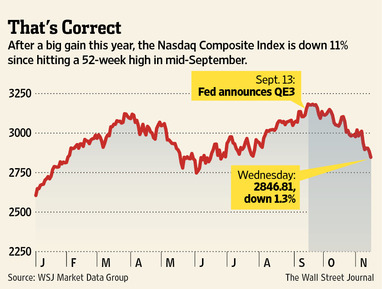
Stocks Can’t Shake Their Funk |
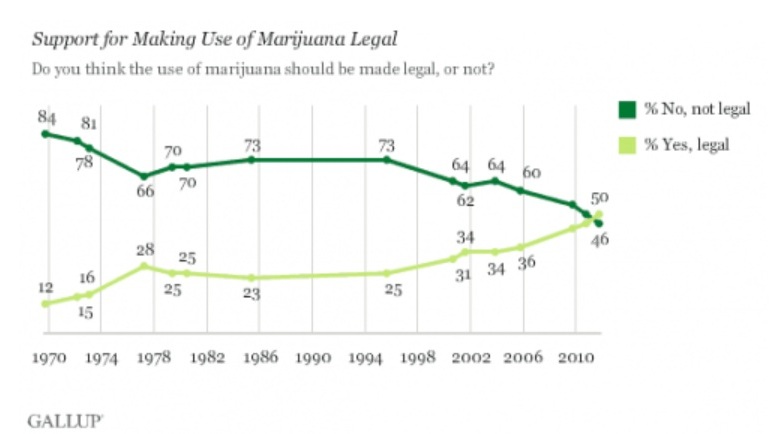
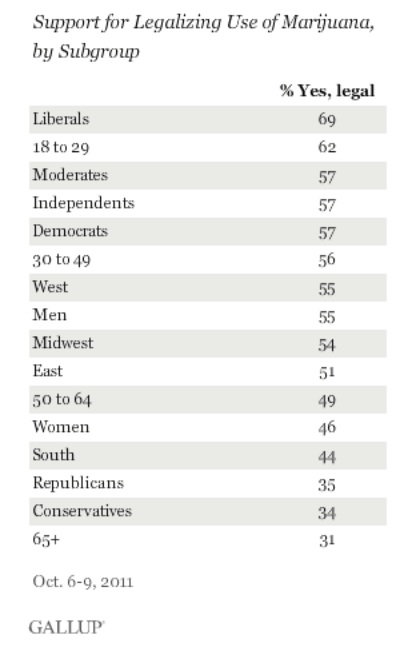
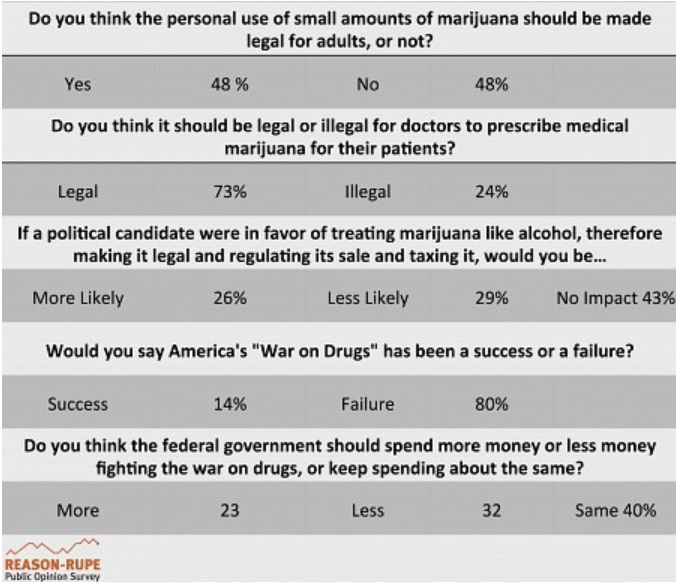
| 73% of Voters Think Medical Marijuana Should be Legal Posted: 15 Nov 2012 11:30 AM PST I don’t know about you, but I found this data surprising:
Record-High 50% of Americans Favor Legalizing Marijuana Use
Source: Gallup
73 Percent of Voters Think Medical Marijuana Should be Legal, Half think Recreational Pot Should Be Too
Source: Reason.com |
| First Ever U.S. Ferrari F12 Berlinetta to be Auctioned to Benefit Hurricane Sandy Victims Posted: 15 Nov 2012 09:30 AM PST
The base price of Ferrari’s halo model is about $315,000, and given what history has shown us about 001 cars, this version should sell at caught a premium. I’m guessing between 1 and 2 million dollars. The auction will be this Saturday night 9 p.m. EST. at the Circuit of the Americas in Austin, Texas. Place your bids directly at the auction, or through your local Ferrari dealership. If you are unfamiliar with the F12, its has a 731-hp V12, seven-speed dual-clutch transmission and weighs 150 pounds less than the car it replaced, the Ferrari 599. It is both pretty and a badass on the road or track. Do your part to help victims of Hurricane Sandy. I’ll start the bidding at $750k . . .
|
| October Foreclosure Activity Rises +3% Posted: 15 Nov 2012 08:45 AM PST The other day, someone asked me when foreclosure activity would begin to reflect what I wrote earlier this year (Foreclosure machinery creaks back to life). After peaking in Q2 2009 & Q3 2010 respectively, Foreclosure Starts and Bank Repossessions have trended downwards ever since. The voluntary mortgage abatements of 2011 during the robosigning negotiations kept the momentum going. Now, we are starting to see early signs that the foreclosures are beginning to tick back up. September’s numbers was plus 1%, and now October is up 3%. I suspect we are going to see these numbers continue to creep up, even without any sort of economic slow down. If we do see a recession, than that slow crawl higher becomes faster.
BTW, you can access everything I've written on Foreclosures here and on Real Estate here.
Source: |
| Posted: 15 Nov 2012 07:40 AM PST Consumer inflation in Oct rose .1% headline m/o/m and .2% core. The headline figure was in line with estimates but the core rate was .1 of a % higher. The y/o/y gain headline is 2.2%, the highest since April and is above the 1.6% avg hourly earnings gain seen in Oct and is a clear squeeze on many. The core rate was up 2% y/o/y. The .2% decline in energy prices was offset by a .2% gain in food. Owners Equivalent Rent, 24% of CPI, was higher by .2% m/o/m and 2.1% y/o/y and Rent of Primary Residence was up by .4%, the biggest m/o/m gain since Nov ’07. Apparel prices were higher by .7%. New and used vehicle prices were lower. Medical care costs were flat as were commodity prices. Bottom line, on a seasonally adjusted basis, the CPI index went to another all time high and is up 2.2% y/o/y, a 6 month high. I continue to state the absolute index level in addition to the rate of change because many Americans are not seeing their highest income ever just as we’re seeing the highest cost of living ever. With consumer spending about 70% of growth, it obviously is important. |
| Posted: 15 Nov 2012 06:59 AM PST My morning reads:
What are you reading?
Sentiment Survey Results |
| Posted: 15 Nov 2012 06:37 AM PST
Its 15 Discs and 682 minutes of Tolkien inspired epic fantasy directed by Peter Jackson on BluRay. You don’t have to be a Tolkien fanboy to appreciate the scope and grandeur of the films. A wonderful story told brilliantly. Last time we discussed this, it was $49 |
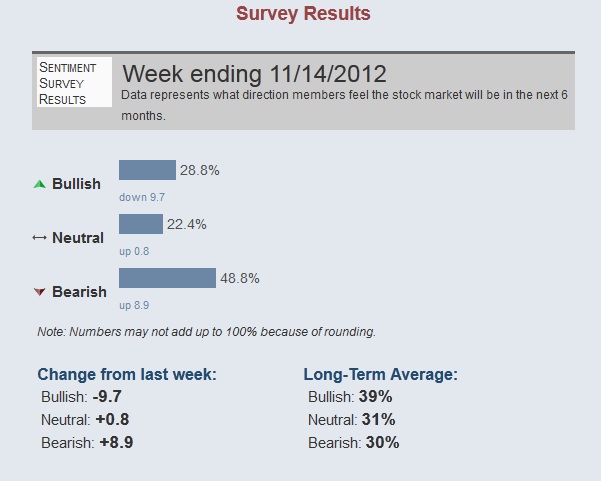
| Posted: 15 Nov 2012 06:29 AM PST Notwithstanding a slightly better than expected Q3 GDP print for Germany and France, the euro zone economy contracted in Q3 as forecasted. Q3 GDP for the region fell .1% q/o/q, the 3rd q in the past 4 of declines. At the same time, CPI rose 2.5% y/o/y in Oct, remaining above the 2% ECB target rate for a 23rd straight month. In the UK, retail sales in Oct fell more than expected. On Greece, the German Finance Minister said they’ll figure out by Tuesday on how to fill the 30b euro gap. In Asia, the yen is down sharply for a 2nd day to near a 7 month low vs the US$ following the new gov’t turmoil with new elections coming and comments yesterday from opposition leader Shinzo Abe who said “we should set an inflation target and print unlimited yen until we reach that target.” The Nikkei was up 1.9% in response. The Shanghai index fell to a 7 week low after Q3 non performing loans rose in Q3 across the Chinese banking system. In the US, post election and the subsequent market selloff has the individual investor at the most bearish since Aug ’11 at 48.8 v 39.9 last week. Bulls fell to 28.8 vs 38.5, near the lowest since July according to AAII. Combine this with a very oversold market and we’re close to a short term bounce. |
| Posted: 15 Nov 2012 06:22 AM PST The Australian Central Bank, the RBA stated that it had increased sales of the A$ last month to a number of buyers, including foreign central banks. The sales amounted to US$500mn, the most since June 2009. The A$ declined on the news – currently US$1.0337. For full disclosure purposes, I remain short the A$, against the US$;
The Japanese lower house has passed the (US$477bn) budget deficit financing bill, which was necessary to finance 40% of government spending for the fiscal year ending 31st March 2013. The head of the LDP party states that, if elected (likely), they would “work with” (dictate more likely !!!) the BoJ to ease, on an unlimited basis, until deflation is overcome. In addition, Mr Abe added that the BoJ should set interest rates at zero or below zero to enhance lending. The Japanese PM will dissolve Parliament tomorrow and has called a general election for the 16th December. Increased my short Yen, against the US$ to just below my maximum limit, which is currently trading at Yen 80.88 against the US$, a 6 month low – Yen81 next target? – very likely;
The Standing Committee of the Communist Party has indeed been limited to 7 individuals. As expected, Mr Xi Jinping was appointed the head of the Communist Party and, most importantly, Chairman of the Central Military Commission. He will take over as President in March, when the current President, Mr Hu retires. Mr Li Keqiang will become the Premier. The other 5 members of the Standing Committee are deemed conservatives. Don’t expect a significant change in policy and/or economic direction. No surprise, the vested interests in China don’t want to destroy their overfull rice bowl. The big issue is whether the Chinese authorities can continue to keep control, given the massive level of corruption, lack of freedom etc, etc. Too early to tell, but……….The Shanghai index declined by -1.2%, whilst Hong Kong was -1.4% lower – probably the best indication of the views on the new leaders. Having said that, I have no doubt that the new leadership will have to stimulate the economy, which in spite of recent positive “official” data (if you believe Chinese data, which I most certainly do not), suggested an improvement in the economy; The Indian government raised just US$1.7bn, less than 25% of its target from the auction of wireless spectrum. The extremely poor auction results will prove a major problem for the finance minister, who was hoping for far greater proceeds to reduce the budget deficit to -5.3% of GDP this fiscal year (year to 31st March 2013) – looks highly unlikely. The failure could well result in the Indian credit rating being reduced to junk – quite likely. However, the failure could well force the Indian government to sell state assets, which is a necessity and will prove positive in due course. The EU economic commissioner Mr Rehn stated that Spain would not be required to implement further austerity measures until the end of 2013, even though he accepted that the country will miss its 2012/13 budget targets materially. The announcement recognises that the current policy of austerity has, in effect, been played out/failed. Mr Rehn reported that the EC will not set budget deficit targets for Spain, on the basis that structural reforms proposed by the Spanish authorities in September, will be implemented. The EC is moving closer to the position of the IMF, though this change in policy must be approved by member states, including Germany !!!!. The move, if approved by member states, will make it easier for the Spanish PM to request a bail out, as he has opposed a bail out to date as it would have required further austerity measures. Austerity measures by themselves are impossible (indeed ludicrous) at this stage. If Mr Rehn’s change of policy is confirmed by member states, this announcement could well be positive for European markets – will watch very, very carefully. Spanish Press reports that Spain will seek a credit line form the IMF, rather than seeking a bail out from the EZ. Such a move will be better for Mrs Merkel, as she will not have to seek approval from an increasingly sceptical Bundestag, though will the IMF provide as much as is necessary? and/or want to go it alone? – unlikely; Mr Rehn reported that the IMF participation was necessary to provide further funding for Greece. Now how does that work, may I ask. Mrs Lagarde has publicly disagreed with the EZ over the current (ludicrous) proposals by the EZ. Analysts continue to believe that the EZ will push through further aid for Greece – well maybe, but there are questions being raised and it remains no shoe in; German Q3 GDP rose by +0.2% Q/Q (+0.9% Y/Y), as opposed to +0.1% expected and +0.3% in Q2; French Q3 GDP rose by +0.2% Q/Q (+0.2% Y/Y), higher than the flat reading expected and -0.1% in Q2; Spanish Q3 GDP declined by -0.3% (-1.6% Y/Y), in line with expectations and a similar reading in Q2; Dutch Q3 GDP declined materially to -1.1% (-1.6% Y/Y), much lower than the decline of -0.2% expected and as compared with +0.2% in Q2; Italian Q3 GDP declined by -0.2% (-2.4% Y/Y), much better than the decline of -0.5% expected and the -0.8% in Q2; The data was a little more positive for both France and Germany and in particular, France, which seems a little to good to be true. However, GDP is expected to be negative for both countries in the current Q, as will be the case in Spain, which has had 5 Q’s of negative growth and, most likely, will face further declines throughout 2013. The much worse reading for Holland confirms that contagion from the debt crisis is impacting the core EZ countries. Unemployment in Holland rose to +6.8% in September, from +6.6%. Italian GDP was much better, which confirms the better recent economic data; EZ Q3 GDP (seasonally adjusted) came in at -0.1% Q/Q (-0.6% Y/Y), in line with expectations and -0.2% in Q2; EZ October CPI came in at +0.2% (+2.5% Y/Y), in line with expectations and +0.7% in September; The EZ is technically in recession (for the 2nd time in 4 years), which is expected to continue this Q. The only good news is that the EZ inflation numbers are improving; The head of Spain’s largest bank, Mr Botin, Santander calls for a banking union in the EZ as a matter of urgency. The impassioned plea suggests that Spanish banks are (much?) weaker than generally believed, or as reported by Spanish authorities. No great surprise. However, the German’s in particular, do not want to agree to any deal which could involve themselves being liable for serious potential liabilities (unsurprisingly) and continue to be opposed to a EZ wide deposit guarantee scheme. Furthermore, they are moving cautiously towards banking union; UK October retail sales (including fuel) collapsed by -0.8% M/M ((+0.6% Y/Y), much lower than the -0.1% expected and the +0.5% in September. A definite Ooops and the largest decline since April. Sterling declined on the news There are reports (Moody’s) about the UK potentially losing its AAA rating – likely sometime next year; The Irish finance ministry increased its 2012 GDP forecast to +0.9% from +0.7% previously, though cut their 2013 GDP forecast to +1.5%, from +2.0%. The 2014 estimate was cut to +2.5% from +3.0%. Debt to GDP is expected to peak at 121% next year. The finance ministry affirmed their 2012 budget deficit forecast at -8.3% and 2013 at -7.5%. The forecast unemployment rate was increased. Interestingly, the government will not increase austerity measures and whilst the country has been the poster child of the EZ, it certainly looks like the country is facing austerity fatigue. As I have reported, the current focus on austerity only looks as if its way past its sell by date. Fitch confirmed Ireland’s BBB+ rating with a stable, rather than negative, outlook – at least some good news; US business inventories (ex auto’s) rose by +0.7% M/M, higher than the +0.6%. Business sales rose by +1.4%, the largest rise since March 2011 and as compared with +0.6% in August. The US economy, I continue to believe, is and will perform better than expectations, on the assumption that the majority of the contraction, as a result of a deal on the fiscal cliff, is sorted out; The FED minutes reveal that a “number” of members favoured further QE, following the end of Operation Twist, given the level of unemployment, though several members questioned the effectiveness of QE, or if a moderate growth environment warranted more purchases. Members believed that inflation would remain below 2.0%, with the economy growing at a “moderate pace”. The participants reported that several businesses said that they were delaying hiring and spending due to concerns relating to the fiscal cliff – too true – sorting it out, will result in a material improvement. Finally, the FOMC “generally favoured” the zero-rate outlook tied to quantitative thresholds (suggested by Ms Yellen, amongst others), such as a predetermined level of unemployment, rather than the present policy of setting interest rate policy linked to a calendar date . The US$ declined initially, though recovered shortly thereafter; President Obama made clear last night that he would not compromise on his policy to let the Bush-era tax cuts expire. He added that he was willing to compromise on other issues, including the need to cut spending. Formal talks are set to start on Friday. The market, on balance, believes that some deal will be done to mitigate most of the impact of the mandatory sequestration programme and the material tax rises, though some analysts suggest that it may take until after 1st January. I continue to believe that a deal will be reached, which will mitigate a majority of the impact of the fiscal cliff; BP reports that it is in “advanced discussions” with the US Department of Justice and faces a record criminal penalty. An announcement is expected today. The company also faces civil penalties and damages from federal, state and local authorities. However a deal with the DoJ should clear some of the uncertainty – positive, unless the fine is enormous; Outlook US markets closed near their lows yesterday – down -1.4% and at a 3 month low. Traders reported that the reason for the sharp decline was due to (a) concern over the US fiscal cliff issues, together with weaker US retail sales (Hurricane Sandy impacted, I would suggest) (b) rising tensions in the Middle East, following the Israeli attack on a Hamas leader (c) worse economic data from the EZ and (d) concerns about China. However, I believe that the extremely silly (German inspired) policy of pushing austerity measures as the only policy is beginning to be rethought by the EZ. As you know, I have argued that the austerity by itself is making the situation much worse, in particular, in countries such as Greece, Portugal and Spain, quite possibly others, due to the negative impact of the fiscal multipliers. We have had no comments from Germany, as yet, which suggests that caution is appropriate, especially as member states (in particular Germany) have to approve a change in policy. Furthermore, comments by Mr Rehn that Spain need only continue with its programme of structural reforms, rather than to stick to budget deficit targets (which we all know they will not adhere to) and, today, that the EZ need the participation of the IMF in a Greek bail out is difficult to reconcile, given the very differing views of the Euro group and the IMF, publicly aired earlier this week and the current German inspired policy. The EZ has a history to disappoint, but at the very least a discussion is taking place – about time !!!!! Asian markets (ex the Nikkei – up nearly 2.0%) closed much lower today, following the much weaker US markets yesterday. European markets are lower, but by less than initially expected. US futures suggest a modestly higher opening. The Euro, well it continues to rise (currently US$1.2770) , which in my view is equity positive. However, the far more important currency move is that of the Yen – the Yen is weakening materially, currently Yen 81.13 against the US$. The Euro rose by well over 1.0% against the Yen yesterday – less so against the US$, though still higher and has continued to strengthen against the Yen and the US$ today. That suggests to me that the traditional flight to safety Yen trade may well be ending and, furthermore, a rising Euro is generally positive for markets. However, markets do look fragile I must admit, though I would be reluctant to short at these levels (may actually start buying some equities shortly – financials, energy?, in addition to my long US/UK building material stocks and UK – London based – property/building companies) – however, I still far prefer playing the currencies – I’m short Yen/A$/Rand against the US$, for full disclosure purposes. Gold is trading at US$1723, with December Brent at US$108.50. Kiron Sarkar 15th November 2012 |
| Posted: 15 Nov 2012 05:30 AM PST Applebee's Obamacare Rant Reveals the Lies of the Deficit Hysteria
Zane Tankel, a wealthy owner of over 40 Applebee franchises has attracted media attention by denouncing Obamacare and claiming that it will impose such burdensome expenses on him that he will need to fire workers, limit the hours of existing workers so that they are part-time and do not qualify for health insurance coverage, and cancel plans to open new restaurants. The media reaction has understandably focused on the public rage at such a wealthy man throwing his workers under the bus. I write to make a different point. Tankel illustrates some of the reasons why the Congressional Budget Office's (CBO) projections of a purported U.S. financial crisis arising from the safety net are baseless. Tankel's complaint is Obamacare's "employer mandate." Small businesses are exempt, but businesses like those Tankel owns are required to provide health insurance for their full-time workers.
Businesses criticizing Obamacare have made two contradictory arguments about the impact of the employer mandate. The CEO of Papa John's has become infamous by arguing that the price of the pizzas he sells will go up by 14 cents.
Other CEOs claim that they cannot pass on the costs and will therefore suffer crippling drops in profits.
"Somebody has to pay" is precisely the point. Under the current U.S. system health care expenses for most Americans are paid for through private health insurance, typically from the employer. Employers are able to deduct the costs of health insurance as a business expense and employees are not taxed on the implicit income they receive in the form of the health care (nominally) paid for by the employer. There is, therefore, a substantial federal subsidy for employer health insurance programs.
Despite that subsidy, the cost of private health insurance is enormous and rising rapidly. The media has focused overwhelmingly on the projected increases in health care costs of health components of the safety net (Medicare and Medicaid), but those programs are not unique. The problem we face is health care costs – not Medicare and Medicaid.
The Financial Outlook for Medicare, Medicaid, and Total National Health Expenditures Out-of-pocket expenses have fallen substantially, so the increase in the "all other" category is due to a very rapid increase in private insurance costs. The "all other" category rose from slightly above 5% of GDP in 1960 to over 13% of GDP in 2010 (representing twice the federal expense of Medicare and Medicaid combined). The "all other" cost category is rising at roughly the same rate as the safety net and the direct out-of-pocket subcategory has fallen sharply, which means that the private health insurance cost subcategory is larger than the combined Medicare and Medicaid costs and has been rising considerably faster than the Medicare and Medicaid. As Tankel emphasized, "somebody has to pay" for health care. Pete Peterson and Representative Paul Ryan are trying to generate a "moral panic" about future budget deficits causing a crisis. The factor that drives this moral panic is, overwhelmingly, the rapid increase in Medicare and Medicaid expenses which the CBO projections assume will continue for decades. Projecting that U.S. health care costs will continue to increase at roughly twice the average growth rate of GDP guarantees that federal budget expenditures will be driven by health care costs. Chart 7 of Foster's testimony explains that what he terms the "alternative" projection is what he favors as most accurate. Under this scenario, Medicare would rise to approximately 10.5% of GDP by 2080. Chart 8 projects Medicaid expenses only out to 2020 – increasing to nearly 4% of GDP. By 2080, this implies that combined federal Medicare and Medicaid expenditures would exceed 20% of GDP – roughly 100% of the federal budget. That is absurd, a point made forcefully by Federal Reserve economists in an article entitled: AN EXAMINATION OF HEALTH-SPENDING GROWTH IN THE UNITED STATES: PAST TRENDS AND FUTURE PROSPECTS (by Glenn Follette and Louise Sheiner). "All other" health care expenses would, under similar approaches to projections, rise to over 40% of GDP by 2080. The overwhelming bulk of these expenses would be private health insurance and state contributions to Medicaid. The first question that should arise, therefore, is which constraint would actually bite first and doom the projections. The imminent constraint is not the federal budget. The U.S. is neither a household nor a business firm. We have a sovereign currency that we allow to freely float and we borrow in our own currency. The U.S. federal government, therefore, is nothing like a nation that has joined the euro and given up its sovereign currency. Like Japan, the U.S. can create money, or if it chooses to issue debt it can do so at minimal interest rates even with a debt to GDP ratio over twice as large as the current U.S. ratio. Businesses have to compete. Many must already compete globally and the future will increase the number of firms that must maintain global competitiveness. Foreign firms often provide no health care benefits to their workers. U.S. businesses also have to compete against small U.S. businesses that are not subject to the employer mandate of Obamacare. Decades before the U.S. federal government experiences ran into any real budgetary "crisis" the increase in health care costs that the CBO is projecting would bankrupt businesses that offered health insurance. "Somebody has to pay" – and if health care costs increase indefinitely at twice the growth of GDP no business can long survive paying such costs. The only question is how soon they will become uncompetitive and fail – and the Tankels (Applebee) and Schnatters (Papa John) of the world are claiming that we have already rendered them uncompetitive by requiring them to provide health insurance to a pool of very young workers in good health (i.e., a far cheaper pool to insure than would be the case for most professions and industries). Note that neither of their businesses faces global competition. Many U.S. industries and professions will face much more severe competitive disadvantages than restaurants do if health care expenses increase as the CBO projects. The mass loss of U.S. competitiveness that would occur if the CBO health care expense projections proved true would mean that the CBO budget projections would be wildly over-optimistic. One of the grave but more subtle flaws in the CBO projections is that they are not "stock flow consistent." For example, under the CBO's projected increase in health care expenses U.S. firms would soon fail by the tens of thousands as they were rendered uncompetitive. The U.S. would fall into a Great Depression, the budget deficit would explode, and Medicare expenses would skyrocket as tens of millions of Americans lost their jobs and became impoverished. Health care expenses measured as a percentage of GDP would surge as expenses increased and GDP fell sharply. The CBO projections, however, are internally inconsistent on multiple dimensions as James K. Galbraith, L. Randall Wray, and Warren Mosler explained in their Congressional testimony and paper entitled: THE CASE AGAINST INTERGENERATIONAL ACCOUNTING: The Accounting Campaign Against Social Security and Medicare. Another example of internal inconsistency would become obvious if we increased the length of the CBO projection. Eventually, health care costs would exceed 100% of GDP under the CBO's methodology. That is, of course, impossible because health care costs are part of GDP. The assumptions about the growth of health care expenses and GDP are not consistent. My hope is that this article makes clear that the problem is not the federal budget and it certainly isn't Medicare and Medicaid (or Social Security). The critical constraint is the private sector. American businesses cannot compete globally if our health care costs are placed on employers and we allow those expenses to increase indefinitely at twice our GDP. America's reliance on a private insurance model of providing health care produces inferior health outcomes at roughly twice the expense (relative to GDP) of some developed European nations. The paradox is that the bad news is the good news. Because the real crisis will be felt in the private sector and will force that sector to recognize that health care costs can and must be contained if they wish to survive there are better prospects that businesses will decide not to continue down a suicidal path. The private sector has the political power and marketing skills to implement a strategy that recognizes that "somebody has to pay" and proceeds to adopt proven policies that provide universal health care paid for by the government at a far lower cost than the wasteful U.S. model based on private health insurance. |



| You are subscribed to email updates from The Big Picture To stop receiving these emails, you may unsubscribe now. | Email delivery powered by Google |
| Google Inc., 20 West Kinzie, Chicago IL USA 60610 | |



0 comments:
Post a Comment