


The Big Picture |

- World Production Stagnates
- 100 Years of Presidential Election Maps
- The Heat Official Trailer
- Is the EZ’s “cunning plan” for Greece credible?
- Lessons from the 2012 election
- Conjecture
- Ferrari California 30
- 10 Weekend Reads
- Solving the Too Big to Fail Problem
| Posted: 17 Nov 2012 12:00 PM PST vlivk for ginormpous graphic
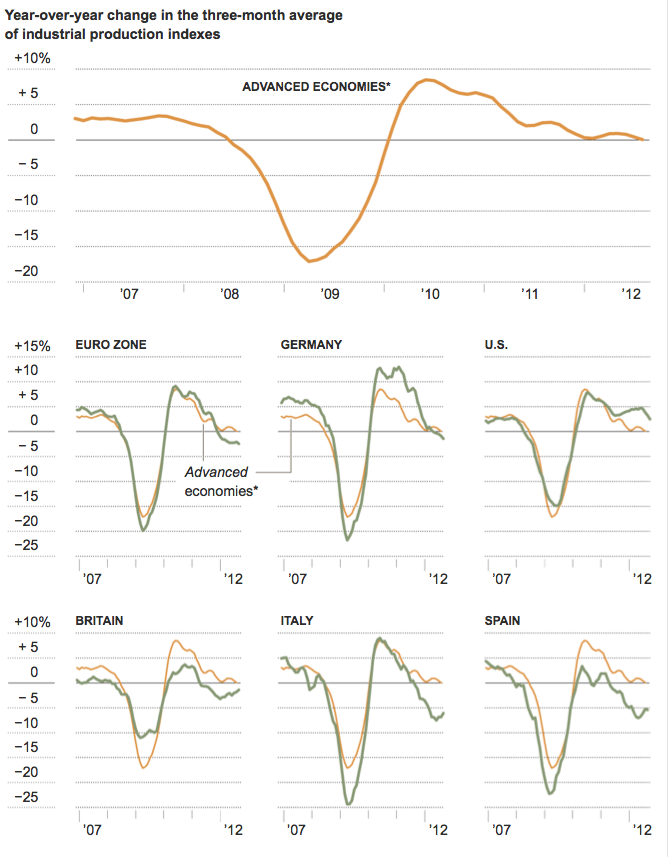
Floyd Norris points out that “industrial production has been stagnating in many advanced economies around the world and is beginning to damage the German economy, which has been the strongest in the troubled euro zone.” The US remains the healthiest of the bunch, but even Germany is tipping into contraction . . . |
| 100 Years of Presidential Election Maps Posted: 17 Nov 2012 10:12 AM PST 112 years of American elections take place in two minutes below, County by County:
|
| Posted: 17 Nov 2012 08:33 AM PST OMG, this looks hilarious: Sandra Bullock. Melissa McCarthy & Paul Feig, the director of Bridesmaids. The first buddy-cop comedy where the cops are chicks |
| Is the EZ’s “cunning plan” for Greece credible? Posted: 17 Nov 2012 08:00 AM PST The meeting of the EZ finance ministers next Tuesday (20th November) to “settle” on a deal for Greece is certainly a “must be watched “event. The market consensus suggests that some kind of deal will be done. Well, that may be the case, but let me just raise the following.
OK, so how does the EZ sort out this awful mess. I have to say that whilst virtually every commentator/analyst tells me that this will be sorted out next Tuesday and, furthermore, ratified by the Parliaments of those EZ countries that need to obtain such approval subsequently (by the end of November), I am far from sure that this is the “shoe in” that people think. I do not underestimate Mrs Merkel and her ability to force through measures which she deems important and providing further funds for Greece, at least until her next general elections in September next year, is certainly her goal – indeed an increasing priority for her. However, the more the “fiddling” and “extend and pretend” type games, the greater the complexity. History is littered with examples where, in these situations, a normally totally unexpected event, just blows these kinds of “deals” to pieces. Interestingly, on Friday, the Dutch Prime Minister, Mr Rutte, stated that if agreement could not be reached on Tuesday, a further meeting would be called in January !!!!. I have found that, above all, Holland is the most rational and practical of all the EZ countries. Well lets wait for next weeks episode. This stuff makes reality TV seem totally boring and unexciting. You could not make this stuff up – if you had, everyone would tell you that the script lacked credibility and would never happen in the real world. Welcome to the EZ. Kiron Sarkar 17th November 2012 |
| Lessons from the 2012 election Posted: 17 Nov 2012 07:00 AM PST Lessons from the 2012 election
Wisdom can be found in many places. Whenever I encounter some momentous event with winners and losers, I try to discern broader lessons to apply elsewhere. The 2012 presidential election was no different, with lessons that can be applied to investing and business. 1 Process, not outcome, is what matters. When it came to forecasting the election, the winner was mathematics. Sharp data analysis beat squishy feelings every time. The accuracy of the new class of data junkies and statisticians was the single most important story line of the election for investors. Nate Silver showed data, logical reasoning and mathematics outperform "gut feel" and instinct. The bloviating punditry got it wrong, the stat geeks got it right. To quote the delightful nerd comic XKCD, "To the surprise of pundits, numbers continue to be the best system for determining which of two things is larger." 2 Do your homework and practice. Yes, I refer to the first debate. "No Drama Obama" created a lot of drama by making an awful showing. He looked unprepared and surprised that his opponent wasn't simply going to lie down. Perhaps he was cocky after enjoying a comfortable lead for most of 2012. Regardless, the lessons were obvious: You can never be too prepared. And practice is crucial, even if you are the president of the United States. 3 Think deeply before you speak. Grand pronouncements have a big appeal to our egos. They can make us look smart, and play to the policy wonks of the world. But they have limited upside and immense downside. In Mitt Romney's case, his Nov. 18, 2008, New York Times opinion piece, "Let Detroit Go Bankrupt," probably came back to haunt him in Ohio, where one in eight workers was employed by the auto industry. 4 Avoid clichés. The media completely misread this election. There were a series of narratives about razor-thin margins, another late night waiting for results, even the House of Representatives having to break a tie. In the end, the incumbent received 3 million more votes than the challenger. But that margin understates the electoral college blowout, with the incumbent winning 332 electoral votes to the challenger's 206. The one cliché the mainstream overlooked: There are strong advantages to incumbency. 5 Don't live in a bubble. Large swaths of the conservative movement seem to live in a world of their own creation. The balkanization of media outlets allow people to read only that which they agree with. This selective perception and confirmation bias creates a self-reinforcing alternative universe. Facts don't matter; data and science are irrelevant. You only hear exactly what it is you want to hear. Outlets like Fox News and pundits like George Will and Dick Morris were forecasting a Mitt Romney landslide. Don't like the polling data? Create a site called "UnskewedPolls.com" to provide numbers you do like. As it turned out, UnskewedPolls was the least accurate polling aggregator this election cycle. If you spend most of your time rationalizing why the polls are inaccurate and the media are biased, you will probably be surprised at what happens next. As smart investors know, this sort of bias can be very expensive. 6 Have influential allies. At times, the GOP primary seemed to be a Federal Reserve bashing contest. There was a constant critique about Federal Open Marketing Committee interventions, quantitative easing and the zero interest rate policy. Rick Perry accused Fed chief Ben Bernanke of treason, and seemingly threatened to lynch the man ("I don't know what y'all would do to him in Iowa, but we — we would treat him pretty ugly down in Texas.") Ron Paul's book "End the Fed" made his intentions clear. It was a far cry from George H.W. Bush's complaint that then-Fed Chairman Alan Greenspan didn't do enough to help the economy during his 1992 election campaign. Have a look at Gallup's Daily U.S. Economic Confidence Index. This survey combines responses to polls on current economic conditions and future economic outlook. The survey reported big spurts in August 2011, following the Fed's Operation Twist. There was another spurt after September 2012's announcement of QE3, the third round of quantitative easing. The Fed seemed to be driving economic confidence higher. The lesson I learned? It is smart not to alienate powerful, well-placed people of influence and authority, especially those who might assist you. 7 Be true to yourself. Romney was a moderate, pro-choice governor who worked as bipartisan chief executive in Massachusetts to deal with a health-care budget crisis. He created a statewide health-care program that was the basis of Obamacare. But Romney ran from that record, tacking hard to the right to win over the base during the GOP primaries before shifting to the middle during the general election campaign. He would have been much better off running on his credentials instead of morphing into a series of personas trying to please everyone. That is an important lesson to anyone running a business: Understand who you are and what you do best. Focus on providing that. 8 Choose your business partners well. The vice-presidential choice is a major decision any presidential candidate makes. Romney's selection of Rep. Paul Ryan added nothing to his electoral chances. Ryan failed to deliver his home state, Wisconsin. He fumbled his debate to a grinning and goofy Joe Biden. And Ryan's plan to "voucherize" Medicaid probably hurt Romney with Florida seniors. 9 It takes more than money. No one is happy about all of the money in politics, but the impact may be more muted than we believe. Consider the outsize money interests in this election cycle. Sheldon Adelson poured $100 million into six races, and lost them all. Karl Rove's super PAC put more than $300 million into myriad races; he found success in Indiana – but was shut out everywhere else. And the $91 million dollars Connecticut candidate Linda McMahon spent in two Senate campaigns yielded her exactly zero electoral success. A threshold amount of money is necessary to be competitive in any business endeavor, but only to a point. Beyond the marginal utility of a minimum dollar amount, pouring more money onto a project is no substitute for substance, a clear value proposition and a product consumers want. 10 It helps to make your own luck. In the waning months of the election, two tragedies presented each campaign an opportunity to respond. The first was the tragedy in Benghazi, Libya, where four Americans, including the U.S. ambassador, were killed by terrorists. The second was Hurricane Sandy, which became a superstorm and devastated parts of New York and New Jersey. The responses to these to circumstances were markedly different: Obama put partisanship aside, worked closely with New Jersey Gov. Chris Christie and focused on managing the response to the storm. Christie, the keynote speaker at the GOP convention and vocal Obama critic, was effusive in his praise of the president. Romney's response to Benghazi was not nearly as bipartisan. He came across as opportunistic, even craven in response to the tragedy. He was, in the light of American deaths, not especially presidential. Emergencies are opportunities to demonstrate an understanding of priorities, a sense of what matters most. How you respond to circumstances is important. There are times to focus on your business, and times to put that aside and focus on your people. ~~~ Ritholtz is chief executive of FusionIQ, a quantitative research firm. He is the author of "Bailout Nation" and runs a finance blog, the Big Picture. On Twitter: @Ritholtz. |
| Posted: 17 Nov 2012 05:30 AM PST This short piece connects: the US election; subsequent political language; subsequent negative reactions of "risk markets"; and a recent piece distributed by Ken Landon of J.P. Morgan entitled "The Global Agenda to Drain Capital" (we cannot re-print it here due to copyright guidelines). By way of explanation, Landon's piece describes well the current state of global monetary affairs, namely: global politicians and their surrogates are in the process of codifying base money printing into official policy, in effect choosing to destroy the purchasing power of their currencies together in a manner not obvious to their populations. Further, Landon implies that President Obama's post-election rhetoric with regard to domestic US tax policy threatens economic growth because productive people in the private sector will lose incentive to expand. Landon notes the obvious irony: aggregate tax receipts will ultimately be reduced, which in turn would exacerbate fiscal debt and deficit problems while starving the factors of production of necessary liquidity for debt service and economic expansion (our specific words, not his). Now his words:
The greatest irony we see is that it seems this administration is actively staking out a position that would harm its base constituency most. Blue color, union and government workers would ultimately be starved of funding should after-tax private sector investment and pre-tax income be shifted in a manner that strikes most casual observers as fairer. (We are not judging the wisdom of the politics or the peoples' preference for wealth re-distribution; only the likely outcome of that temporal wealth re-distribution, which would be to ultimately widen, not narrow, income and wealth gaps. We see this as an apolitical observation. Private sectors in capitalist economies are always relied upon for commercial production that funds their public sectors, as well as for subsidies that benefit lower wage workers, both of which are domestic commercial liabilities of the private sector.) Economic advisors in the Obama administration are not stupid or ill-informed (though their success may be due to having been branded "liberal economists," making it politically difficult now to recommend classically "conservative economic" positions). They might not have to. Raising dividend tax rates but leaving capital gains rates unchanged would theoretically be stock market bullish, as it would spur buyback programs. It would seem this would be a compromise in which the Administration could save face. While this might help stock market indexes, it is difficult to see how it would help the real economy. (Sadly, cynical policy and superficial optics could prevail over real economic solutions…again.)
Lee Quaintance & Paul Brodsky
1 J.P. Morgan; November 15, 2012; Kenneth Landon; "Landon Lowdown: The Global Agenda to Drain Capital"
Source: http://www.qbamco.com/ |
| Posted: 17 Nov 2012 04:30 AM PST
• An additional 30bhp, a reduction in weight of 30kg Source: Classic Driver |
| Posted: 17 Nov 2012 03:51 AM PST Its Saturday morning, and that means its time for some longer form reads to keep you busy over the weekend:
What are you doing this weekend? |
| Solving the Too Big to Fail Problem Posted: 17 Nov 2012 03:00 AM PST Solving the Too Big to Fail Problem Remarks at the Clearing House’s Second Annual Business Meeting and Conference, New York City
It is a pleasure to have the opportunity to speak here today. I am glad to see the progress our city and region have made recovering from Sandy, but obviously significant challenges remain. I am going to focus my remarks today on what is popularly known as the "too big to fail" (TBTF) problem. In particular, should society tolerate a financial system in which certain financial institutions are deemed to be too big to fail? And, if not, then what should we do about it? The answer to the first question is clearly "no." We cannot tolerate a financial system in which some firms are too big to fail—at least not ones that operate in any form other than that of a very tightly regulated utility. The second question is the more interesting one. Is the current approach of the official sector to ending TBTF the right one? I'd characterize this approach as reducing the incentives for firms to operate with a large systemic footprint, reducing the likelihood of them failing, and lowering the cost to society when they do fail. Or would it be better to take the more direct, but less nuanced approach advocated by some and simply break up the most systemically important firms into smaller or simpler pieces in the hope that what emerges is no longer systemic and too big to fail?1 As I will explain tonight, I believe we should continue to press forward on the first path. But, if we fail to reach our destination by this route, then a blunter approach may yet prove necessary. As always, my views may not necessarily reflect those of the Federal Reserve System. What Is the Too-Big-to-Fail Problem? There are negative externalities associated with the failure of any financial firm, but these are disproportionately high in the case of large, complex and interconnected firms. Although the moniker is "too big to fail," the magnitude of these externalities does not depend simply on size. The size of the externalities also depends on the particular mix of business activities and the degree of interconnectedness with the rest of the financial industry. One important element is the importance of the services the firm provides to the broader financial system and the economy and the ease with which customers can move their business to other providers. Another is the extent to which the firm's structure and activities create the potential for contagion—that is, direct losses for counterparties, fire sales of assets held by other leveraged financial institutions, or loss of confidence that might precipitate runs on other firms with similar business models. The presence of large negative externalities creates a dilemma for policymakers when such firms are in danger of failing, particularly if the wider financial system is also under stress at the same moment. At that point in time, the expected costs to society of failure are very large compared to the short-run costs from providing the extraordinary liquidity support, capital or other emergency assistance necessary to prevent catastrophic failure. The market’s belief that a TBTF firm is more likely to be rescued in the event of distress than other firms weakens the degree of market discipline exerted by capital providers and counterparties. This reduces the firm’s cost of funds and incents the firm to take more risk than would be the case if there were no prospect of rescue and funding costs were higher. The fact that firms deemed by the market to be TBTF enjoy an artificial subsidy in the form of lower funding costs distorts competition to the detriment of smaller, less complex firms. This advantage, in turn, creates an unfortunate incentive for firms to get even larger and more complex. The funding benefit of being seen to be TBTF causes the financial system to become artificially skewed toward larger and more complex firms—in ways that are unrelated to true economies of scale and scope. Now to be clear, I don’t believe that firms necessarily deliberately set out to become TBTF. Nor do I think that TBTF was the main cause of the breakdown in market discipline that preceded the financial crisis. Many factors were at work, including the failure to grasp the riskiness of new types of credit products and business models, and principal-agent problems such as the "trader's put." But I do think TBTF contributed to the underpricing of risk in the system and did create a bad set of incentives, and if not addressed comprehensively, would likely be an even larger problem in the future. So How Did the Problem Become So Serious? The comptroller went on to declare that the largest 11 national, commercial banks were too big to fail.But the problem has become more significant since that time for several reasons. First, the biggest financial institutions have become much larger, both in absolute terms and relative to the overall size of the banking system. This reflects many factors including the end of prohibitions on interstate banking, the repeal of the Glass-Steagall Act restrictions separating investment from commercial banking, the rapid growth of the capital markets, and the globalization of the economy—all of which created intense competitive pressures to expand in order to gain economies of scale and scope. In commercial banking, consolidation occurred at a rapid pace. For example, Bank of America was the outgrowth of over 160 different mergers, which pushed up the size of the original acquirer from $23 billion of assets in 1980 to $2.2 trillion today. In the securities industry, some partnerships became public companies, in part, so that they could more easily obtain the capital needed to expand rapidly. For example, when Goldman Sachs went public in 1999, it had about 15,000 employees and $250 billion of assets. Just eight years later, the firm had expanded to 35,000 employees and $1.1 trillion of assets. In the mid-1990s, the top five banks in the United States had total assets of $1 trillion or about 14 percent of gross domestic product (GDP). The top securities firms had total assets of $718 billion, or about 9 percent of GDP. By the end of 2007, the top five banks had assets of $6.8 trillion or 49 percent of GDP. Similarly, the top securities firms accounted for $3.8 trillion, or about 27 percent of GDP. In addition, the firms' off-balance-sheet exposures rose sharply. Second, the complexity and interconnectedness of the largest financial firms increased markedly. Factors behind this include the adoption of a universal banking model by some commercial bank holding companies and the rapid growth of trading businesses, especially the over the counter (OTC) derivatives market. In the early 1980s, there were no true U.S. "universal banks" that combined traditional commercial banking with capital markets and underwriting activities. By 2007, there were several operating in the United States, including Citigroup, J.P. Morgan, UBS, Credit Suisse and Deutsche Bank. Also, the OTC derivatives business in foreign exchange, interest rate swaps and credit default swaps had exploded from its start in the early 1980s. The total notional value of the OTC derivatives outstanding for the five largest banks and securities firms currently totals about $200 trillion. During this period, there was inadequate attention to the risks that were building up in the system. The regulatory and supervisory framework did not keep up with the changes in size, complexity, interconnectedness and globalization that created growing systemic risk externalities and widened the wedge between private and social costs in the event of failure. Let me mention just a few of the issues:
The TBTF problem was further aggravated by the financial crisis and the policy response. Faced with systemwide stress, the Federal Reserve, with the support of the U.S. Treasury, intervened to prevent the disorderly failure of Bear Stearns, a firm that would not have been high on the list of TBTF firms a few years earlier. Meanwhile, the failure of Lehman Brothers demonstrated that the cost to society of the uncontrolled failure of a TBTF firm in a period of generalized stress was considerably greater than anticipated. Following the bankruptcy of Lehman, contagion spread by many channels, including prime brokerage, OTC derivatives positions, money market mutual funds, tri-party repo and wholesale funding markets. The loss in confidence disrupted the flow of credit throughout the global financial system, generating a global economic downturn and the worst contraction in the United States since the Great Depression. Recognition of the costs generated by the Lehman failure led to extraordinary interventions to prevent further catastrophic failures. These included the rescue of AIG, the FDIC's TLGP program, the ring-fence of Citigroup's poorer quality assets, and the TARP injection of capital into the largest U.S. financial institutions. Because this solidified in investors' minds that TBTF firms—after the Lehman debacle—would be protected, this worsened the TBTF problem. The problem was exacerbated during the crisis by the acquisition of weakened firms by stronger firms, a development that was actively promoted by policymakers in a bid to avoid or temper the consequences of their failure. J.P. Morgan absorbed Bear Stearns and Washington Mutual and its assets grew from $1.5 trillion in 2007 to $2.3 trillion today; Wells Fargo purchased Wachovia and its assets increased from $575 billion in 2007 to $1.3 trillion today; and Bank of America purchased Countrywide and Merrill Lynch, increasing its assets from $1.7 trillion in 2007 to $2.2 trillion today. This, of course, made the surviving firms even bigger and more complex. When the smoke had cleared, the situation was clearly untenable. The experience of the crisis increased the advantage from being perceived as TBTF, and, thus, strengthened the incentives to become bigger, more complex, and interconnected. The Dodd Frank Act (DFA) set out to end TBTF. One means was by eliminating the Federal Reserve's discretion to provide emergency financial support through a program open only to a single financial institution, and, in general, raising the bar for broader-based emergency interventions under section 13.3 of the Federal Reserve Act. But, as the DFA recognized, simply tying the Fed's hands on intervention is insufficient. It does not reduce the cost to society from the failure of a large and complex firm. In order for the non-intervention strategy to be both fully credible and consistent with the public interest, we need to tackle the underlying externalities and incentive problems that give rise to TBTF in the first place. Tackling Too Big to Fail One set of measures works to reduce the incentives for excessive risk-taking and to lower the probability that large financial firms fail or come close to failure. Another set lessens the disruption to the financial system and hence the cost their failure imposes on the broader economy and society as a whole. Along with measures that penalize characteristics associated with the negative externalities from failure, these changes work against the incentive to be too big to fail. Policy measures that alter incentives and reduce the probability of distress A number of steps have already been taken that reduce the probability of failure. For example, there has already been considerable progress in forcing firms to bolster their capital and liquidity resources. On the capital side, consistent with the Dodd-Frank Act, Basel III significantly raises the quantity and quality of capital required of internationally active bank holding companies. This ensures that the firm's shareholders will bear all the firm's losses across a much wider range of scenarios than before. This should strengthen market discipline. Meanwhile, to the extent that some of the specific activities that generate significant externalities are now subject to higher capital charges, this should cause banks to alter their business activities in ways that reduce both the likelihood and social cost of their failure. Moreover, the new Basel regime explicitly adjusts capital requirements upward based on size, complexity, interconnectedness, global exposure and substitutability—attributes that are proxies for the negative externalities generated by failure. If a bank is deemed a global systemic financial institution or G-SIFI, then it will have to hold a greater amount of capital relative to its risk-weighted assets compared to a less systemic institution.4 The notion behind the SIFI surcharge is a simple one. The cost to society from the failure of a large, complex firm is proportionally considerably higher than the cost to society of the failure of a non-systemic firm. As a result the capital buffer for the more systemic firm should be higher so that its expected probability of failure will be lower than for the less systemic firm. The SIFI surcharge acts as a penalty for size and complexity, leaning against the funding cost advantage a firm may have because it is perceived to be TBTF. This helps level the playing field for smaller firms and reduces the incentive to seek to become TBTF in the first place. Domestically, we have adopted a more forward-looking approach to capital through the use of stress tests, in particular the annual Comprehensive Capital Assessment Review (CCAR) program. By promoting transparency, CCAR also strengthens market discipline. On the liquidity front, the largest, most systemically important bank holding companies will be required to hold a 30-day liquidity buffer—the so-called liquidity coverage ratio or LCR. The purpose of the LCR is to ensure that such a bank will have sufficient liquid resources so if it were to encounter business difficulties and temporarily lose access to market funding, it would still have some time to address its underlying problems. With a liquidity buffer, banks will not immediately be forced to sell illiquid assets during times of stress. This should enhance their stability, and provide some protection against the fire sale externalities we saw during the crisis: forced asset sales, falling asset prices, leading to rising capital losses at other firms that led, in turn, to further funding difficulties, asset sales and so on. On the supervisory side, firms are now increasingly being evaluated on a cross-industry basis in order to identify best practices and to identify laggards that need to upgrade areas such as MIS, governance, model validation, and risk management practices. Activity restrictions are another potential means to reduce the risk of failure. The biggest initiative in this area is the Volcker Rule. By limiting proprietary trading activities, the Volcker Rules seeks to reduce trading risk and the likelihood of failure. In addition, the Financial Stability Oversight Council (FSOC) is in the process of identifying those non-bank financial firms that are systemically important. These firms will be subject to tougher prudential standards and supervisory oversight by the Federal Reserve. Some argue that this designation process merely creates more TBTF firms. I see it differently. The system risk externalities do not depend on whether we label them systemic or not. If these risks are present, then we should face up to the issue with tougher standards and enhanced supervisory oversight rather than leave the issue unaddressed. This has to be a superior approach relative to pretending these firms could not be TBTF and the problem doesn't exist. Policy measures to reduce the adverse systemic consequences from failure Because no plausible level of capital and liquidity standards will be sufficient to reduce the probability of failure to zero, it also makes sense to work on the other major margin—to reduce the cost of the failure of a large, complex financial firm. We can do this by making changes so that such failures are less likely to impair the functioning of the broader financial system. In this area, although many initiatives are in train, I would conclude that we are still very far from where we need to be. One simple but meaningful step that already has been enacted is to put a brake on the ability of the largest and most complex firms to become even larger and more complex. To this end, the Dodd-Frank Act adds "the risk to stability of the U.S. banking or financial system" as an additional factor to be considered in evaluating a proposed merger or acquisition under the Bank Merger Act and the Bank Holding Company Act. As Governor Daniel Tarullo discussed in a recent speech, there is not a hard and fast rule to be applied here. But his view, which I share, is that there would be a "a strong, though not irrebuttable, presumption of denial [of a merger or acquisition] by any firm that falls in the higher end of the list of global systemically important banks…"5,6 Another step for dealing with the firms that might be viewed by some as already TBTF is to understand better the interconnections and pathways through which the distress or failure of one firm impairs the larger system and causes harm to society. We have made progress through the supervisory process in mapping out critical activities performed by firms. Also, we have identified a number of areas, such as collateral management, where better practices could both improve the safety and soundness of the individual firm and reduce the negative externalities generated by a firm's failure. Work is also underway to evaluate what changes would be required to make the future bankruptcy of large complex firms less disruptive, while also developing an alternative means for the orderly resolution of such firms outside the normal bankruptcy process. The costs to society of large complex financial firms failing can be reduced at least to some degree by having firms, working in conjunction with their regulators, "pre-plan" their own failure through the so-called "living will" process. The largest and most systemically important banks submitted their "living wills" to the Federal Reserve and the FDIC this summer. We have reviewed the first iterations of their plans and are currently drafting feedback for the firms to incorporate in their next submissions. Through such "living wills," regulators are gaining a better understanding of the impediments to an orderly bankruptcy. This is the necessary first phase in the process of determining how to ameliorate these impediments over time and then doing so. In my view, this initial exercise has confirmed that we are a long way from the desired situation in which large complex firms could be allowed to go bankrupt without major disruptions to the financial system and large costs to society. Significant changes in structure and organization will ultimately be required for this to be achieved. However, the "living will" exercise is an iterative process, and we have only taken the first step in a long journey. The second way to potentially minimize the negative externalities from a firm's failure would be to avoid a bankruptcy proceeding altogether and instead resolve the firm under the Dodd-Frank Act's Title II orderly liquidation 7 authority.8 The "single point of entry" model has much promise, but much remains to be done before it could be implemented with confidence for a globally active firm. Title II authority is U.S. law. Subsidiaries and affiliates chartered in other countries could be wound down under the bankruptcy laws of those countries, if authorities there did not have full confidence that local interests would be protected. Certain Title II measures including the one-day stay provision with respect to OTC derivatives and other qualified financial contracts may not apply through the force of law outside the United States, making orderly resolution difficult. The other essential dimension of solving TBTF is to make the financial system more robust—addressing structural vulnerabilities that tend to amplify shocks rather than absorb them. If the financial system can be made more resilient, it will be better positioned to withstand the failure of a large and complex firm and continue to provide essential financial services to the real economy. I would highlight three areas of work that are critical to solving the TBTF problem. First, regulators and supervisors are pushing for changes in wholesale funding markets, a source of particular vulnerability during the crisis. This includes reforms to tri-party repo, which are underway, and necessary reforms to the money market mutual fund industry, which are being evaluated by the Securities and Exchange Commission (SEC) and the Financial Stability Oversight Council. Second, the financial market infrastructures are being strengthened to make them more robust to the failure of individual firms. The Committee on Payments and Settlement Systems and the International Organization of Securities Commissions (IOSCO) have published a set of standards for financial market infrastructures called "Principles for Financial Market Infrastructures" that will serve as minimum standards globally. Finally, the OTC derivatives market is being reformed with the aim of reducing bilateral exposures between firms and, thus, the systemic impact from any one firm failing. All standardized OTC derivatives in the interest rate, credit default, and equities markets will soon have to be centrally cleared through central counterparties (CCPs). The clearing of standardized derivatives trades through CCPs should reduce risk in the overall financial system by facilitating the netting down of OTC derivative exposures. Such trades will also have to be reported to trade repositories and information about the trades will be made available on a post-trade basis. This should make the OTC derivatives market more transparent and, thus, reduce the risk of contagion. The Way Forward Further international coordination is almost certainly going to be necessary to ensure that bankruptcy regimes interact in ways that minimize negative externalities. At home we also need to ensure that different authorities and resolution regimes operate in a mutually consistent manner. In particular, we may need to revisit the SIPC regime that governs securities firms in bankruptcy. At present, the bankruptcy of a securities firm is very disruptive because the claims of all counterparties are typically frozen for a considerable period and the value of these claims is not easy to ascertain or monetize quickly. As I have argued above, we shouldn't focus on solving TBTF exclusively at the level of the individual firm. We need significant changes in market structures and practices as well in order to have a financial system in which the key players can fail without big social costs. We also must continue to ask ourselves the question of whether the steps in train go far enough. For example, one could make a good case that the capital surcharge for systemically important firms should be higher than that contemplated by the Basel Committee. Of course, such a judgment depends on how much other policies succeed in reducing the negative externalities their failure would generate. Critics of our approach believe it would be better to just break up firms deemed TBTF now—perhaps through legislation requiring the separation of retail banking and capital markets activities or by imposing size restrictions that require firms to shrink dramatically from their current scale. My own view is that while this could yet prove necessary, it is premature to give up on the current approach: changing the incentives facing large and complex firms, forcing them to become more resilient, and making the financial system more robust to their failure. In my opinion, there are shortcomings to reimposing Glass-Steagall-type activity restrictions or strict size limits. With respect to Glass-Steagall, it is not obvious to me that the pairing of securities and banking businesses was an important causal element behind the crisis. In fact, independent investment banks were much more vulnerable during 2008 than the universal banking firms which conducted both banking and securities activities. More important is to address the well-known sources of instability in wholesale funding markets and give careful consideration to whether there should be a more robust lender of last resort regime for securities activities. With respect to size limitations, it is important to recognize that a new and much reduced size threshold could sacrifice socially useful economies of scale and scope benefits. And it could do this without actually solving the problem of system risk externalities that aren't related to balance sheet size. Evaluating the socially optimal size, scope and organizational structure of financial firms is a complicated business, and so is establishing a viable transition path to a system of much smaller firms. It would be helpful in this regard if advocates of break-up solutions would put a bit more flesh on the bones and develop detailed proposals that address essential questions of how such downsizing or functional separation would be accomplished, and what benefits and costs could be expected. Such an analysis should answer several questions: How would you force divestiture (in good times and bad)? Should firms be split up by activity or reduced pro-rata in size? How much would they have to be shrunk in order for the externalities of failure to no longer create TBTF problems? How would global trading and investment banking services and network-type activities be supported? Should some activities be retained in natural monopoly form, but subject to utility type regulation? How costly would it be to replicate support services or to manage liquidity and capital locally? Are there ways of designing size limits that cannot be arbitraged by banks via off-balance-sheet structures and other forms of financial innovation? So far, advocacy for the break-up path has been strong, but without the detail to assess whether this is indeed superior to the course we are currently following. But, I'm open-minded. It is important to recognize that any credible approach to addressing the TBTF problem, including the one we are pursuing today, necessarily implies changes to the structure and business mix of financial firms and financial markets. Moreover, it is important to stress that not all of these adjustments will be in the private interests of these firms, and some will result in changes to the price and volume of certain financial services. These are intended consequences, not unintended consequences. Too big to fail is an unacceptable regime. The good news is there are many efforts underway to address this problem. The bad news is that some of these efforts are just in their nascent stages. It is important that as the crisis recedes in memory, that these efforts not flag—this is a project that needs to be seen to a successful conclusion and then sustained on a permanent basis. Thank you for your attention, I would be happy to take a few questions. 1 This would presumably require legislation. 2 Conover, C.T. 1984. "Testimony: Inquiry Into the Continental Illinois Corp. and Continental Illinois National Bank." Hearings Before the Subcommittee on Financial Institutions Supervision, Regulation, and Insurance of the Committee on Banking, Finance and Urban Affairs, U.S. House of Representatives, 98th Cong., 2nd Session, September 18, 19 and October 4: 172-391. P. 288 3 Under Section 13(3) of the Federal Reserve Act, the Federal Reserve is authorized to lend to individuals, corporations and partnerships. But this may occur only if a super majority of the Board of Governors of the Federal Reserve System has determined that circumstances are "unusual and exigent." Subsequently, the Dodd-Frank Act further constrained this authority by prohibiting its use to rescue an individual company from bankruptcy. 4 Earlier this month, the Financial Stability Board published a list of 28 global systemically important banks or G-SIBs that will be subject to capital surcharges. The firms were arrayed in four buckets, with an increasing capital surcharge as a percent of risk-weighted assets imposed as one ascended upward to the higher buckets. 5 See Governor Daniel K. Tarullo, "Financial Stability Regulation," October 10, 2012. Mr Tarullo added that "I would not apply the presumption in the case of certain de minimis acquisitions or in cases where asset dispositions were judged to offset any increase in systemic risk from the proposed new acquisiton.” 6 Earlier this year, the Board of Governors issued an order approving Capital One Financial Corporation’s acquisition of a federal savings bank, ING Bank. In that order, the Board set forth two principles that are relevant to this particular issue. First, the Board stated that it would generally find a significant adverse effect if the failure of the firm resulting from a merger or acquisition “would likely impair financial intermediation or financial market functioning so as to inflict material damage on the broader economy.” Second, the Board observed that there are some small acquisitions or mergers that would not raise a financial stability concern, such as "a proposal that involves an acquisition of less than $2 billion in assets, [or] results in a firm with less than $25 billion in total assets . . . . " 7 The FDIC’s “single point of entry” framework for implementing this authority envisages establishing a bridge company into which all the operating subsidiaries of the parent company would be transferred. The bridge company would be recapitalized by converting all or some of the parent company's subordinated and senior unsecured debt into fresh equity in the bridge company. The parent company would be allowed to fail. The transfer of the operating subsidiaries to the bridge company would allow critical operations to continue and provide time for the FDIC to move the systemically important operations back into private hands. 8 The DFA orderly liquidation authority is viewed as to be used only as a last resort under a very well-defined set of circumstances. To resolve a firm under the FDIC's orderly liquidation authority, a number of determinations must be satisfied. First, the troubled firm must be designated a covered financial company (CFC) and that it is in default or danger of default and a resolution under bankruptcy would result in adverse consequences. The determination to use OLA authority requires the assent of the Treasury Secretary after consultation with the President. |


| You are subscribed to email updates from The Big Picture To stop receiving these emails, you may unsubscribe now. | Email delivery powered by Google |
| Google Inc., 20 West Kinzie, Chicago IL USA 60610 | |



0 comments:
Post a Comment