.

{2} GoogleTranslate (H)

English French German Spanish Italian Dutch Russian Portuguese Japanese Korean Arabic Chinese Simplified

Our New Stuff

{3} up AdBrite + eToro

Your Ad Here

Tuesday, November 20, 2012

The Big Picture

The Big Picture


Shadow Banking System Larger than at the Start of the Financial Crisis

Posted: 19 Nov 2012 10:30 PM PST

One of the Main Indicators of Financial Danger Has Increased

The failure to regulate the shadow banking system was one of the causes of the financial crisis.

As we noted in 2009, the Bank for International Settlements – often described as a central bank for central banks (BIS)  – slammed the Federal Reserve for failing to rein in the shadow banking system:

How could such a huge shadow banking system emerge without provoking clear statements of official concern?

Years later, the Fed and other regulators have allowed the shadow banking system to grow even bigger.

As Reuters notes today:

The system of so-called "shadow banking," blamed by some for aggravating the global financial crisis, grew to a new high of $67 trillion globally last year, a top regulatory group said, calling for tighter control of the sector.

A report by the Financial Stability Board (FSB) on Sunday appeared to confirm fears among policymakers that shadow banking is set to thrive, beyond the reach of a regulatory net tightening around traditional banks and banking activities.

***

The study by the FSB said shadow banking around the world more than doubled to $62 trillion in the five years to 2007 before the crisis struck.

But the size of the total system had grown to $67 trillion in 2011 — more than the total economic output of all the countries in the study.

***

The United States had the largest shadow banking system, said the FSB, with assets of $23 trillion in 2011, followed by the euro area — with $22 trillion — and the United Kingdom — at $9 trillion.

The U.S. share of the global shadow banking system has declined in recent years, the FSB said, while the shares of the United Kingdom and the euro area have increased.

At the same time, authorities have relaxed rules against fraud, excessive leverage and moral hazard … three of the other main causes of the financial crisis.

Where Will the Jobs Come From?

Posted: 19 Nov 2012 07:00 PM PST

Where Will the Jobs Come From?
By John Mauldin
Nov 19, 2012


The Next Bubble
A Hollow Powerhouse?
We've Seen This (Manufacturing) Movie Before
A Manufacturing Renaissance
Bismarck, Scandinavia, Greece, Geneva, and Writing Schedule


For the last year, as I travel around, it seems a main topic of conversation is "Where will my kids find jobs?" It is a topic I am all too familiar with. Where indeed? Youth unemployment in the US is 17.1%. If you are in Europe the problem is even more pronounced. The basket case that is Greece has youth unemployment of 58%, and Spain is close at 55%. Portugal is at 36% and in Italy it's 35%. France is over 25%. Is this just a cyclical symptom of the credit crisis? Much of it clearly is, but I think there is something deeper at work here, an underlying tectonic shift in the foundation of employment. And that means that before we see a true recovery in the unemployment rate, there must be a shift in how we think about work and training for the future of employment. This week is the first of what will be occasional letters over the coming months with an emphasis on employment. (This letter will print a little longer, as there are a lot of charts.)

But first, the staff at Mauldin Economics is furiously putting the finishing touches on your free Post-Election Economic Summit webinar, which will air tomorrow at 2 pm Eastern. They are distilling multiple hours of discussion into a fast-paced, thoughtful (and often lively) conversation about what is in store in our economic future. Panelists and guests include Mohamed El-Erian, James Bianco, Barry Ritholtz, Gary Shilling, Barry Habib, and Rich Yamarone. We also have a truly unique interview with the chiefs of staff of Majority Leader Harry Reid and Senator Rob Portman. While we excerpted part of that interview for the webinar, the entire interview will be made available. If you want to get a true feel for what is going on in Washington, I suggest you listen in. You can sign up to listen here. Now, let's think about employment.


The Next Bubble

Let's look at a few facts put forth by the Young Entrepreneur Council from their list of 43 (available here):

·  1 out of 2 college grads  – about 1.5 million, or about 53.6 percent, of bachelor's degree holders age 25 or younger  – were unemployed or underemployed in 2011.
·  For high school grads (age 17-20), the unemployment rate was 31.1 percent from April 2011-March 2012; underemployment was 54 percent.
·  For young college grads (age 21-24), unemployment was 9.4 percent last year, while underemployment was 19.1 percent.
·  According to some researchers, up to 95 percent of job positions lost occurred in low-tech, middle-income jobs like bank tellers. Gains in jobs are going to workers at the top or the bottom, not in the middle.
·  More college graduates are getting low-level jobs, period. U.S. bachelor's degree holders are more likely to wait tables, tend bar or become food-service helpers than to be employed as engineers, physicists, chemists or mathematicians combined  – 100,000 versus 90,000.
·  According to new U.S. government projections, only three of the 30 occupations with the largest projected number of job openings in the next eight years will require a bachelor's degree or higher. Most job openings by 2020 will be in low-wage professions like retail sales, fast food and truck driving.

While there may not be a bubble in education, there is definitely a growing debt bubble in student loans. More than 1/3 of young Americans of college age went back to school because of the economy, and in doing so have contributed to the $1 trillion in student loans. People are clearly going back to school and taking out loans as a way to make ends meet. The average college graduate has $25,000 in debt. Default rates are up 31% in the last two years. Student loans are relatively easy to get. They are like the old NINJA subprime mortgage loans available toward the end of the housing bubble: "No income, no job, no assets." And they are just as likely to end up in default. But Congress recently passed new bankruptcy laws, and unlike housing loans, student loans cannot be discharged in a bankruptcy. The law of compound interest means that borrowers, mostly young, will be paying back this debt for many, many years.

We have told our children that education is their ticket to a better life. And the data still shows that there is a clear advantage to having a college degree. But our recent experience suggests that not all college degrees are created equal.

Tom Friedman, writing in this weekend's New York Times, highlights the problem of education and jobs. He quotes Traci Tapani, who with her sister runs a sheet metal company in Wyoming with 55 employees.

"About 2009," she explained, "when the economy was collapsing and there was a lot of unemployment, we were working with a company that got a contract to armor Humvees," so her 55-person company "had to hire a lot of people. I was in the market looking for 10 welders. I had lots and lots of applicants, but they did not have enough skill to meet the standard for armoring Humvees. Many years ago, people learned to weld in a high school shop class or in a family business or farm, and they came up through the ranks and capped out at a certain skill level. They did not know the science behind welding," so could not meet the new standards of the U.S. military and aerospace industry.

"They could make beautiful welds," she said, "but they did not understand metallurgy, modern cleaning and brushing techniques" and how different metals and gases, pressures and temperatures had to be combined. Moreover, in small manufacturing businesses like hers, explained Tapani, "unlike a Chinese firm that does high-volume, low-tech jobs, we do a lot of low-volume, high-tech jobs, and each one has its own design drawings. So a welder has to be able to read and understand five different design drawings in a single day."

[She ended up training her new potential employees and eventually was able to train someone to train welders.] But even getting the right raw recruits is not easy. Welding "is a $20-an-hour job with health care, paid vacations and full benefits," said Tapani, "but you have to have science and math. I can't think of any job in my sheet metal fabrication company where math is not important. If you work in a manufacturing facility, you use math every day; you need to compute angles and understand what happens to a piece of metal when it's bent to a certain angle."

Who knew? Welding is now a STEM job  – that is, a job that requires knowledge of science, technology, engineering and math.

Employers across America will tell you similar stories. It's one reason we have three million open jobs around the country but 8 percent unemployment. We're in the midst of a perfect storm: a Great Recession that has caused a sharp increase in unemployment and a Great Inflection  – a merger of the information technology revolution and globalization that is simultaneously wiping out many decent-wage, middle-skilled jobs, which were the foundation of our middle class, and replacing them with decent-wage, high-skilled jobs. Every decent-paying job today takes more skill and more education, but too many Americans aren't ready. This problem awaits us after the "fiscal cliff.'"

A Hollow Powerhouse

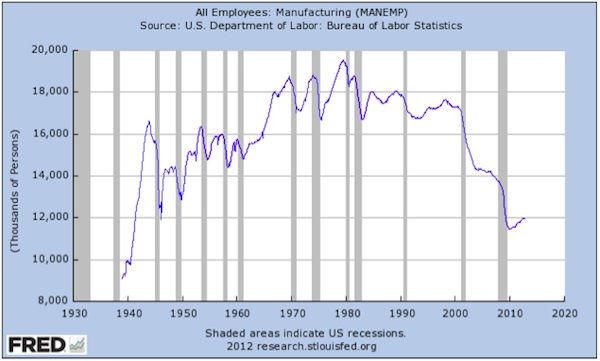
There is a continual complaint that US manufacturing has been "hollowed out." Where manufacturing jobs once were tickets to the middle-class lifestyle, there are now fewer and fewer such jobs available. Indeed, the next chart shows that manufacturing jobs are down almost 40% from the peak in 1978 and back to roughly where they were during World War II.

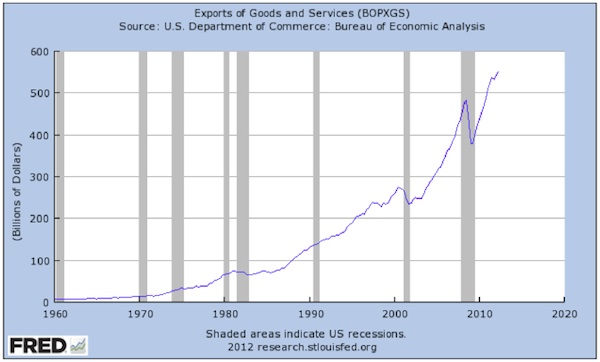
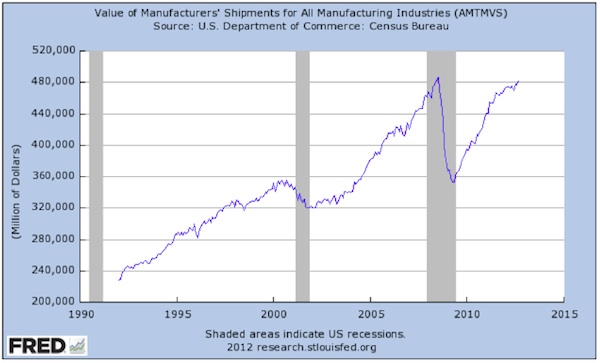
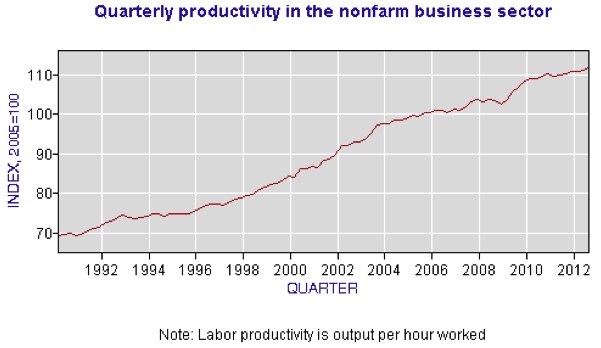
Yet the number of manufacturing employees doesn't tell the whole story. The US is still the number one manufacturing country in the world. We are an export powerhouse. Indeed, the growth of exports in the last 20 years has been nothing short of phenomenal. Exports have doubled and then doubled again. Total manufacturing in the US has almost come back to where it was prior to the Great Recession. Productivity in the last 20 years is up over 50%. We are producing as much as or more than we did in the past but with far fewer people. Taken alone, US manufacturing would be the ninth largest economy in the world. See the next three charts:

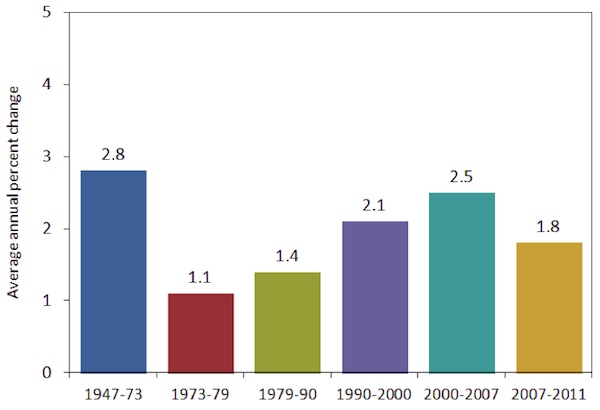
The chart below shows the average growth in productivity over various periods during the last 65 years. Note that after the postwar boom productivity growth fell and then began to increase again, up until the Great Recession. Greenspan was right to call it the Productivity Miracle.

We've Seen This (Manufacturing) Movie Before

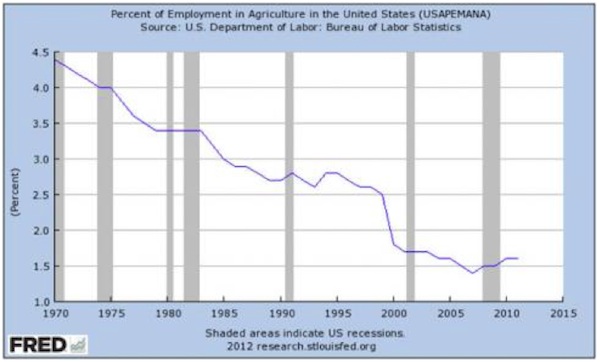
At the dawn of the 19th century, farmworkers were somewhere between 75% and 80% of the entire labor force (http://www.nber.org/chapters/c8007.pdf). That number was still over 50% in 1860. It was not just the Industrial Revolution that increased the number of manufacturing workers in the US, it was an agricultural productivity revolution that allowed more food to be produced by fewer people. Even so, productivity growth was not all that exceptional in the first 60 years of the 19th century.

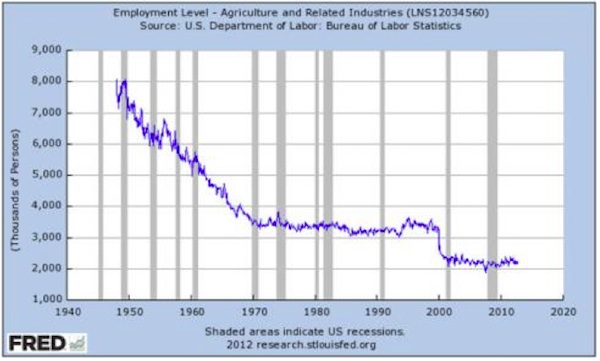
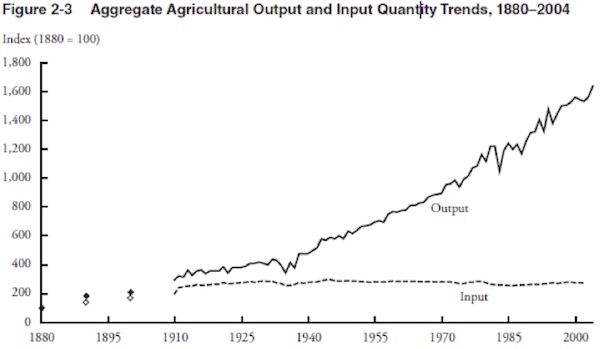
But that was then and this is now. Today the percentage of the labor force employed in agriculture is less than 2%. Agricultural productivity is up some 16 times since 1880, but we barely have more than two million people working on the farm, about the number working in agriculture in 1820. Take a look at the charts below:

This latter chart is from http://www.springer.com/economics/agricultural+economics/book/978-1-4419-0657-1

The Industrial Revolution and the shift to a manufacturing economy was clearly disruptive to employment. Yet who would advocate going back even 40 years to when the farm labor force was three times the relative size it is today? Especially if you had to be the farm labor? Been there, done that. Not interested in hoeing spuds.

A Manufacturing Renaissance

Just as agricultural output per worker has increased dramatically over time, I think that in the next 40 to 50 years we will see massive gains in manufacturing output without an accompanying large increase in manufacturing jobs. Companies are beginning to bring manufacturing back to the US because automation, robotics, and other new technology make it cheaper to manufacture products locally than to use inexpensive labor in other countries. I am told that Foxconn (in China) is beginning to use robotic manufacturing lines. When Foxconn is turning to robots rather than cheap labor, you know there is a revolution in the offing.

Yet even the manufacturing jobs that are left will not demand a "college degree." They will require serious skills and technical know-how, but that is different from the typical college degree. That is not to say college education will not be useful, but it is increasingly going to have to be an education that has a focus and goal of a marketable skill.

What is going to be needed is the creation of brand-new industries, as well as the unleashing of the entrepreneurial skills of the younger generation. Small business is the engine of growth for jobs. It seems that all politicians can do is talk about the need to create jobs, yet the reality is that government doesn't create jobs. It can create the conditions in which jobs are created, but it is up to the individual businessman (or, increasingly, businesswoman) to make a decision to hire additional workers.

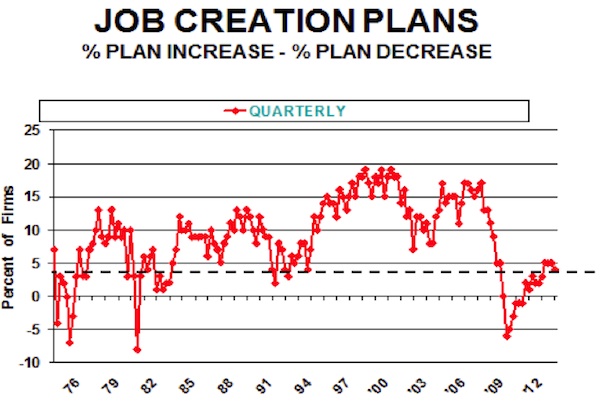
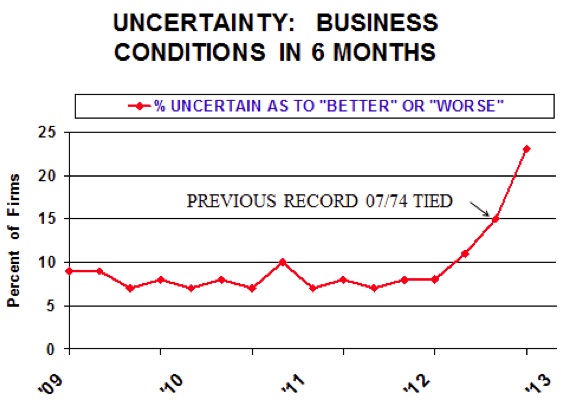
My friend Bill Dunkelberg is the chief economist for the National Federation of Independent Businesses. He's been doing regular surveys since at least 1974. His latest monthly survey shows that businesses are not terribly optimistic in terms of their plans to increase employment, which should be no surprise. The number one problem? Uncertainty.

Let's hope that our political leaders can give us a little more certainty and that it will not be the certainty of a recession.  David Krone (Senate Majority Leader Reid's chief of staff) felt, in our interview for the Summit tomorrow, that it was only 50-50 that a deal would be done to avert the fiscal cliff. He was rather adamant that they would rather go over the cliff than kick the can down the road on the deficit. Not that it couldn't be fixed later – but I suggest you listen to at least that part of the interview we'll post tomorrow. I should note that both congressional chiefs of staff acknowledged they have been working for weeks prior to the election to come up with solutions to the cliff. These are the guys (along with their counterparts) responsible for much of the detail that will come out of the negotiations. They don't get interviewed often, and that is a shame. It makes you feel better about the country to know t here are people who care enough about our future to work with each other responsibly, even if they don't agree on the path we must take.

A final scheduling note: On December 4 I will be doing a special live conversation with Dr. Lacy Hunt and my partner Jon Sundt of Altegris. Lacy is expecting a recession next year. The question now is how deep a recession – and what can investors do about it?  Lacy and I both anticipate a bumpy few years ahead as we stare into the teeth of a rolling global deleveraging recession – the Endgame, as I've called it.  The decisions that we make in the next couple of years about how to handle our budget deficits – here in the US, in Europe, in China, in Japan, and elsewhere – are going to be absolutely crucial.   If you are an accredited investor or a financial professional and have already registered with the Mauldin Circle (and are in the US), you will shortly be receiving an invitation to attend. If you have not, I invite you to go to www.mauldincircle.com and register today, so you can hear Lacy, Jon, and me discuss the direction of the economy, the Endgame, and ways for investors to navigate the landscape in 2013. (In this regard, I am president and a registered representative of Millennium Wave Securities, LLC, member FINRA.) Thanks.

Bismarck, Scandinavia, Greece, Geneva, and Writing Schedule

It is time to hit the send button. It is going to be a busy week, as I have so much stacked up in my "inbox." And of course Thanksgiving will be here in a few days, and that means an afternoon of going to the local fresh food market to purchase all the needed victuals and spending the next day cooking and getting ready. Thankfully, none of my culinary creations call for Twinkies, so I don't have to worry about the shelves being empty. It is rather sad to note that 18,000 people will be losing their jobs this season as Hostess shuts down. That means we need to create at least 4,000 new small businesses to make up for those lost jobs.

I have read numerous reports about the bankruptcy of Hostess and was planning to comment on that debacle, but there is not enough space and time. Both sides of that argument can share the blame. One of the ironies is that the unions are vilifying the private-equity company that owned Hostess, and yet the owner of the PE firm is a certified big-time Democrat and sought out opportunities to find unionized companies to buy. And while the unions seemed to have a death wish, management simply had no clue. They were in a shrinking business (even if they made you personally fatter) and did not adapt. Side bet: Someone will buy them, move them to a non-union state, and produce the same amount of goods with fewer workers. Not that the people at Hostess didn't work hard; they just had crazy rules and hundreds of conflicting contracts no sane business could compete with. Management so loaded the company up with debt that there was no money to advertise or create new (and healthier) product lines. It was truly bizarre.

Note: This was one of those times when a private-equity firm simply lost money. They bought the company out of bankruptcy, and it was already laden with debt. Then commodity prices soared, and unfunded pensions that exceeded the total assets of the company were a drag. Pensions like that cannot possibly make their targets when the Fed is keeping rates so low, and that means companies go deeper in the hole. Now, the pensions of the union members of Hostess will have to be taken over by the Pension Benefit Guaranty Corporation, which is itself massively underfunded. Union members will only get a fraction of what they think they should get. And we taxpayers get to fund the PBGC losses. Sigh.

I do have a few personal flights to make in the next month, but other than a speaking engagement in Bismarck, North Dakota, I will mostly be home until I leave for Copenhagen, Oslo, and Stockholm in early January, to speak for Skagen Funds. I have to be in Geneva a week later, so I will stay in Europe. I plan to visit Greece and perhaps one other country, to try to get a feel for the mood on the ground and what is likely to happen. It was not so long ago when we were "All Greece, All the Time."

I will be working with Bill Dunkelberg on a book on the future of employment over the next few months, hoping to finish it shortly after the first of the year.

As luck would have it, the Mavericks are playing three games this week while I am home. I really do enjoy watching NBA basketball and have had season tickets for almost 30 years. My first tickets were $2 a game on the very top row in the corner at the old Reunion Arena. It was all we could afford back then. Times have changed, and my seats are now much better, as over the years I have been able to move over and down. Given that the Mavericks are not likely to overawe me this season (though I have this dream that Dirk will come back better than ever), I just enjoy watching B-ball. I will admit to not having the same patience for the Cowboys. If they aren't winning, I'm not watching.

Have a great week. I will do my own part for the employment numbers this week and make a job offer to a new potential associate.

Your trying hard to imagine the future analyst,

John Mauldin
subscribers@MauldinEconomics.com

Fiscal Cliff? Try Mis-Positioned Investments

Posted: 19 Nov 2012 05:44 PM PST

My quote about this idiotic obsession with the fiscal cliff in the Daily Beast:

"I wouldn't pay much attention to Wall Street's assessment of politics," said Barry Ritholtz, a money manager and proprietor of the Big Picture blog. "Let me remind you that the Street bet heavily on Romney, in both donations to campaigns and how they positioned their portfolios. They misread what turned out to be an Electoral College blowout of 332 to 206, and the sell-off since the election is as much about the mispositioned Street reversing themselves as anything else."

I think that’s about right . . .


Source:
Day 13: Wall St. Happy With Fiscal Cliff Negotiations, But Skeptics See Photo-Op
Daniel Gross
Daily Beast Nov 19, 2012  
http://www.thedailybeast.com/articles/2012/11/19/day-13-wall-st-happy-with-fiscal-cliff-negotiations-but-skeptics-see-photo-op.html

Apple’s Big Day

Posted: 19 Nov 2012 05:00 PM PST

Apple confirmed its Friday hammer panic bottom with a $38 plus move higher, closing up 7.21 percent on the day.  Nice!

How big was the move?  BIG!

Apple's $35.8 billion market cap increase on the day is larger than the total market cap of all but 146 listed public companies.   At the high of day,  Apple's market value change was larger than the entire market cap of Starbucks and almost as large as Dupont and Deustche Bank's.  If ranked as a country GDP, the move is larger than 97 of the 186 economies monitored by the IMF.  Stunning!

Where to now?  We don't know with certainty, but, after consolidating this big move, it looks like the 200-day at $596 is doable,   Always with a stop!

(click here if chart and tables are not observable)

10 Monday PM Reads

Posted: 19 Nov 2012 01:30 PM PST

My afternoon train reads:

• GDP Accelerating to 2.9% Helping U.S. Overcome Sandy Woes (Bloomberg) see also Sales of Existing Homes Increase Unexpectedly in U.S. (Bloomberg)
Dark Trading: Is It Hurting Market Quality? (CFA Institute)
• Regulators Take Look at Patent Firms’ Impact (WSJ)
• America's Mid-20th-Century Infrastructure (Economix)
• Hard Times Could Create a Tech Boom (Bits)
• The Next Chapters in the Republican War on Math: Tax Cuts and Austerity (The Atlantic) see also Republicans Can't Claim Mandate as Democrats Top House Vote (Bloomberg)
• The lost empire: Can Best Buy come back? (StarTribune)
• Using Just 10% of Your Brain? Think Again (WSJ)
• This Survey Is Devastating For Microsoft: 42% Of Windows Users Plan To Switch To Apple (Business Insidersee also U.S. consumers hesitant to make switch to Windows 8 (USA Today)
• Experts: If You Don’t Get A Flu Shot, You’re Stupid. And A Dick (NSFWCORP)

What are you reading?


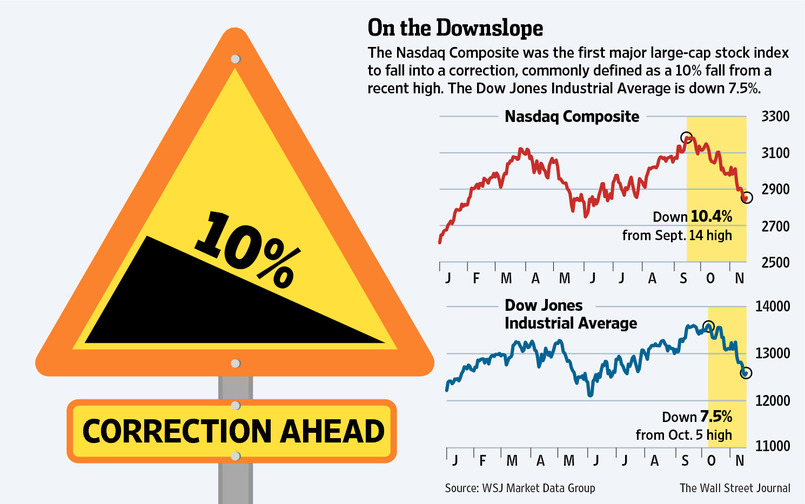
Tech Sets Correction Course

Source: WSJ

Another Fudge Re Greece Proposed

Posted: 19 Nov 2012 12:45 PM PST

According to the latest leaks ahead of the EZ finance ministers meeting tomorrow, the EZ is considering the following.

• To decide on financing requirements for Greece through 2014 (ie after Mrs Merkel’s elections in September 2013), and not 2016;
• E44bn will be provided to Greece in one lump sum (on December 5th), a part of which will be used to buy back bonds from the private sector. The German’s have suggested at a 75% discount is applied on half of the outstanding private sector debt;
• There will be no additional money for Greece to finance the funding gap;
• Interest rates on existing bail out funds will be reduced (materially). Those reduced rates will apply to Ireland and Portugal, as well;
• A moratorium (until 2032) on loans provided to Greece is being considered strongly;
• The EFSF/ESM will have significant control over the spending of bail out funds;
• The IMF and the EZ continue to disagree over debt sustainability.

Talk about being in denial, the Spanish authorities have stepped even further into cloud cuckoo land. Apparently, Spanish authorities suggest that they need just E40bn to recap their banks, as opposed to the E100bn, which the EZ has provisionally allocated and the E60bn approx which they had previously estimated. You will recall, that bad loans at Spanish banks have risen to a 15 month high of 10.7% in September, from 10.52% in August, according to data released by the Bank of Spain yesterday. The real reason for the lower alleged capital required is that Spain is worried that the greater the funds required, the higher their debt to GDP. However, the lack of funding for Spanish banks will mean that the economy will, in effect, continue to decline.

By way of comparison, Southern Ireland, with a population of 4.6mn people, has had to inject E64bn into its banks, about 40% of its GDP. Spain’s population is 10 times larger at 47.2mn people. In addition, Spain is in recession (and will be next year), whereas Ireland has positive growth this year and is expected to do so next year, as well. Spanish investment into housing was much, much greater and the country has an unemployment rate of over 25%, nearly double that of Ireland. Irish property prices are over 50% lower than the peak – Spain claims that property prices are just around 30% lower. I can go on and on and Come on Mr Rajoy, do yourself a favour and get real

The only good news for Spain is that it looks as if the secessionists in government in Catalonia are rethinking, though I would have thought that the public will still vote for independence;

The US home builders index, the NAHB Market Index, rose to 46 in November, the highest since May 2006 and much higher than the 41 expected and 41 in October.

US October existing home sales came in at an annual pace of 4.79mn, as opposed to 4.74mn expected and a revised 4.69mn in September. Home sales rose by +2.1% (+10.9% Y/Y) as opposed to a decline of -0.2% expected and a downwardly revised -2.9% in September. The median price of an existing home rose by +11.1%. Inventories declined to 2.14mn homes, down from 2.17mn homes in September and are 21.9% lower Y/Y. The numbers could well have been better, as they were affected by hurricane Sandy and next months numbers will also reflect the impact of the hurricane;

European markets closed over 2.5%+ higher today. The Euro has crept up above US$1.28. US markets are about +1.5% higher.  I’ll remain on the sidelines.

Thought I’d send this out given the EZ proposed fudge (sorry “deal”) re Greece.


Source:
Kiron Sarkar
November 19, 2012

Foreign Holders of US Treasuries

Posted: 19 Nov 2012 11:30 AM PST

Treasuries' Foreign Buying Doubles China's $123 Billion Cut

Source: Treasury data, Bloomberg


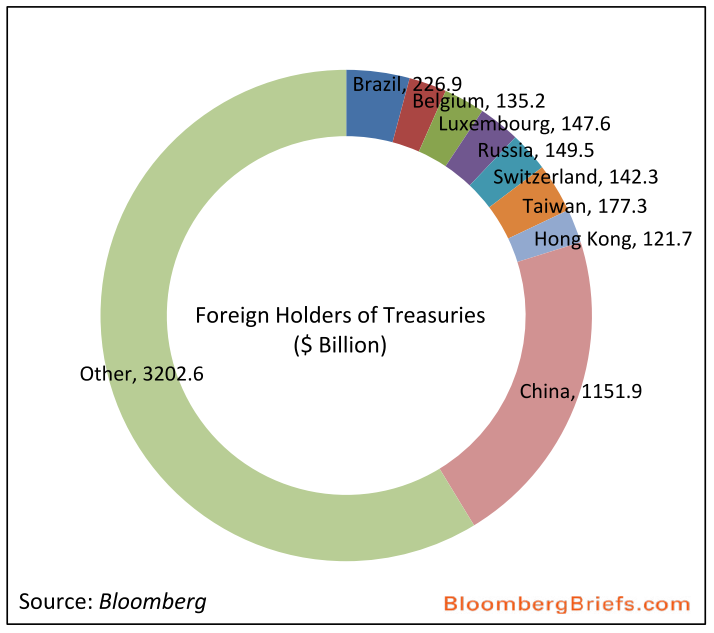
Bloomberg Briefs notes that “Belgium, Luxembourg, Russia, Switzerland, Brazil, Taiwan and Hong Kong boosted their holdings of U.S. government securities by a collective $264.8 billion since the last debt ceiling debate ended in August 2011.”

These purchases “more than made up for the decline in Treasuries owned by China,” down $123 billion to $1.156 trillion.

One note about the chart above — I don’t see Japan, who is a huge holder as well of US treasuries.


Source:
Treasuries' Foreign Buying Doubles China's $123 Billion Cut
Daniel Kruger & Niraj Shah
Bloomberg Briefs, November 19, 2012

Home Sales Remain Bright Spot in Economy

Posted: 19 Nov 2012 09:30 AM PST

click for giant graphic

Source: Calculated Risk


The NAR reported that Existing Home Sales rose 2.1% in October, better than 2011 and 2010, but still below the tax credit driven activity in 2009.

The key difference between 2012 and the prior two years has been how far the Fed has driven rates — about 3.375% for a 30 year fixed mortgage.

We continue to see Distressed homes (foreclosures and short sales) below where they were prior to the voluntary foreclosure abatements — they are about 24% of October sales versus high 30% in years gone by. The NAR estimates these foreclosures sold for an average of 20% less than “market value,” but I have no idea what their basis of claiming that is. How does the NAR “know” a distressed house goes for 20% off market value — what actually is market value, and how do they assess that measure? I will see if I can dig up their methodology.

The other details of the housing data were fairly decent:  They were 10.9% above October 2011. The national median existing-home price was $178,600 in October, up 11.1% year-over-year, the eighth consecutive monthly year-over-year increases. Inventory also fell to 2.14 million existing homes available for sale, a 5.4-month supply.

The initial monthly data continues to be a bit optimistic — September EHS were revised downwards.

All-cash sales were 29% of all transactions — the combination of private equity investors, overseas buyers and high end homes being the drivers of this stat.

 
Update 12:59 pm 11/19/12: I see that Bill at Calculated Risk notes that NAR Distressed Sale data are “questionable,” and are the results unscientific survey of Realtors. This is a better methodology)


Sources:
Existing-Home Sales Rise in October with Ongoing Price and Equity Gains
NAR November 19, 2012
http://bit.ly/UP4G64

Existing home sales and builder sentiment

Posted: 19 Nov 2012 08:30 AM PST

Existing Home Sales in Oct totaled 4.79mm, 50k more than expected but Sept was revised down by 60k to 4.69mm. The Oct annualized run rate is the 2nd highest (Aug at 4.83 was highest) since the tax credit influenced months in Apr and May ’10. Sales were seen for both single family and condos/co-ops and months supply fell to 5.4 from 5.6 as the absolute amount of homes for sale fell by 30k. This inventory to sales ratio is the lowest since Feb ’06 and is the main driver for the 11.1% y/o/y price increase to $178,600 but that is still below the high of ’12 of $188,800. Distressed sales made up 24% of the total, unchanged with Sept but down from 28% in Oct ’11. We are seeing a continued increase in the amount of investor buying which is helping to boost sales. Investors, who mostly in turn rent them out, made up 20% of sales vs 18% in Sept and 18% in Oct ’11. Bottom line, housing sales continue to improve, albeit it off a very depressed level. Single family home sales are just back to where they were in Dec 1997 and remain below the 20 yr average of 4.41mm annualized. The runway is thus long for improvement but the recovery will be in fits and starts. The housing data in the next few months will certainly reflect the negative impact of the hurricane

Separately, home builder sentiment gained 5 pts to 46, just shy of the breakeven between growth and contraction. It’s the best level since May ’06 and was mostly led by the Present situation component which was up 8 pts to 49. The Future outlook rose 2 pts to 53 but Prospective Buyers Traffic was flat at 35. The NAHB is citing the shrinkage of inventories of foreclosed and distressed properties in markets across the country as the catalyst for the new home optimism. The caveat to the recovery remains the same, “difficult appraisals and tight lending conditions for builders and buyers remain limiting factors.”

Much better markets on hope of a solution of the US fiscal cliff

Posted: 19 Nov 2012 07:30 AM PST

Reuters reports that the recent (Yomuri) poll reveals that the LDP party has the support of 25% of the Japanese population, whilst 13% would vote for the DPJ, the current administration. However, 43% of the Japanese public remain undecided !!!!. The head of the LDP party has stated that he would force the BoJ to buy construction bonds to reverse the impact of deflation – yet more building projects which Japan does not need. The current PM, Mr Noda, warns of the risks inherent in interfering with BoJ policy. In addition, he wants to deal more constructively with China, whereas Mr Abe is likely to push for a more aggressive stance in dealings with China. The BoJ meeting concludes tomorrow;

Chinese new home prices rose in 35 out of 70 major cities in October, up from 31 in September. The Chinese real estate market seems to have stabilised;

Spanish bank bad loans have risen to E182.2bn in September, some 10.7% of assets, as compared with 10.52% in August, according the the Bank of Spain;

Italian September industrial orders (seasonally adjusted) declined by -4.0% M/M (-12.8% Y/Y), much worse than the -1.0% expected and +0.7% M/M in August. Recently, Italian economic data has stabilised/improved, but this number is a wake up call. It also suggests that data from other EZ countries will be awful;

The most recent polling data suggests that 56% of UK voters want to exit the EU. About 68% of Conservatives want to leave, as opposed to 24% who want to remain in. Interestingly, 44% of Labour supporters want out, against 39% who wish to remain in. Even the Liberal Democrats (the most pro EU party and in coalition with the Conservatives) are increasingly opposed to membership of the EU – some 39% would probably or definitely wish to leave, whilst 47% want to remain in. The only party whose single policy is to leave the EU, the UKIP party, has the support of 10% of the UK population, higher than the Liberal Democrats, whose rating has collapsed to just 8%. Interestingly, Ed Milliband, the leader of the Labour party promised that his party would adopt a “hard headed” approach to the EU, calling for a cut of the next 7 year EU budget, which is to be discussed by EU heads of State this coming Thursday. The UK PM cannot agree to any deal, other than a cut in its budget, given the recent (OK, non binding) Parliamentary vote. Its going to get interesting. The EU is said to be working on plans to agree a budget without the UK – unlikely to work.

As most of you know, I have always been opposed to a politicised EU and the Euro – the EU was supposed to be a free trade zone. I have not changed my mind – indeed, recent events have just reinforced my views. The EU remains a basket case and is becoming (has become?) the pariah of the world, with very little, at present, to suggest that it will get its act together. Even though I expect a change in EZ policy – the current policy of pushing austerity at the expense of all else, is way past its sell by date and will likely/certainly? change in 2013 – the EU remains, functionally, a disaster zone, as all can see. I recently wrote an article for MarketWatch on precisely this point – I can send you a copy if you wish;

The Economist’s front cover is a picture of baguettes held together with a French Tricolor with a lighted fuse. Pretty graphic stuff. However, unfortunately, a pretty accurate description of where France is at present. How does France gets out of its self inflicted mess, particularly under President Hollande – the French remain in denial and opposed to fiscal, leading to a political union, within the EZ – the key German plan. Germany, increasingly, is becoming more assertive whilst ignoring France and relations between the two leaders are frosty, to say the least. In the past, France and Germany have been the leaders of the EU/EZ, with the French, effectively in political control – how times change. President Hollande’s approval rating has declined to just 41%, a new low, with the French PM down 6 points to 43%;

Ireland has been the poster child of the EZ, whereas all the other countries have singularly failed to achieve their targets. However, Ireland has not benefited at all. Portugal has had its budget deficit targets raised. Greece, well we all know about Greece. Spain will not meet its targets and remains in denial. However, the EU Commissioner Mr Rehn acknowledged that Spain will not meet its budget targets, which he has accepted, though on the basis that Spain sticks to their “alleged” structural reform programme – I emphasize “alleged”. Italy, well recent economic data suggests some kind of stabilisation of their economy, though the Italians will not make their numbers either and, in addition, they face a general election in the 1st Q next year and today’s industrial orders number (see above) was truly awful. However, the Irish have been granted very little, in spite of meeting all that has been required of them. I spoke at the recent annual conference in Ireland (Kilkenonomics) arranged by David McWilliams, one of the best economists in Ireland and, quite frankly, elsewhere. The main theme of my presentations covered exactly this point – indeed, I suggested that the Irish policy of playing nice was the wrong strategy and Ireland needed to press much harder to extract a better deal from the EZ. I wonder whether they will – the Irish population are getting fed up of continued austerity. Better for the EZ to help the poster child than to see it turn tail – where will the EZ be then. The EZ needs to set up a carrot and stick approach, if they have any hope of succeeding – the current (German inspired) policy of wielding the cane only, is well past being credible;

The FT reports that US corporate tax breaks worth more than US$150bn over the next 10 years could be closed. Many chief executives say that they would be willing to give up certain tax breaks in return for a lower tax rate – currently 35%, which is one of the highest rate in DM’s. Last Friday, both sides reported that a deal in respect of the fiscal cliff will be done, resulting in US markets rallying. Whilst I expect some compromise deal to be agreed at or maybe (more likely?) after the 1st January deadline, I’m not at all sure its going to be that easy. Sentiment, having been overly bearish has now turned – overly bullish?;

There are reports that BP is planning a share buy back – to provide some protection against the threat of a take over?. BP has settled potential criminal charges with the US DoJ , but a number of civil suits remain – a share buy back in those circumstances?. The company has been pretty much a disaster in recent years (the shares are some 35% lower since the oil spill in the gulf of Mexico), but some of the uncertainty has been cleared. For full disclosure purposes, I’m long BP;

Outlook

Asian markets rose, though China and India are barely higher. European markets are much stronger, some 1.5%+ higher (the DAX is nearly +2.0% higher), following anticipation that the fiscal cliff will be settled. US futures suggest a higher open – over +0.75%. The Euro, well its higher,currently US$1.2770. Gold is trading around US$1728, with January Brent at 110.50.

I had thought that markets were oversold and expected a pick up. The better news from the US on Friday (relating to a possible agreement on the fiscal cliff) has resulted in markets rising materially. The energy and financial stocks I picked up on Friday are certainly performing well – between 3.0% to 5.5%% higher at present. However, the gloom over the fiscal cliff, in particular, has turned around too quickly. I was thinking of adding to those positions, but will back off. Volumes are dreadful.

The EZ finance ministers meet tomorrow re Greece. Analysts expect a deal. Personally, whilst I acknowledge that the German’s are pressing for a deal and will never underestimate Mrs Merkel, I will wait and see.

A number of analysts keep plugging EM’s and the BRIC’s in particular – personally, I’m not at all convinced. Yes, a deal on the US fiscal cliff and the EZ on Greece (possibly Spain) will help, but EM’s have a tough road ahead of them.

The US/Yen has come off its highs. However, I see no reason to close my short Yen (against the US$) position.

Kiron Sarkar

19th November 2012

10 Monday AM Reads

Posted: 19 Nov 2012 06:50 AM PST

My morning reads:

• Investors Rush to Beat Threat of Higher Taxes (NYT)
• The new boom: Shale gas fueling an American industrial revival (Washington Post)
• Proof that austerity measures are making European economies worse, not better (Quartz) see also Bond investor takes big punt on Ireland (FT Alphaville)
• David Merkel: Think longer term with your investments  (Aleph)
• Apple Investors Are Still Wusses (All Things D)
• DeMark Fibonacci Charts Embraced by Cohen Lure Investors (BusinessWeek)
• The Tablet Market Grows Cluttered (NYT) see also Dell, HP Earnings Expected to Herald the End of PC Era (Bloomberg)
• If you're 27 or younger, you've never experienced a colder-than-average month (Grist) see also Grantham To Climate Scientists: 'Be Persuasive. Be Brave. Be Arrested (If Necessary)' (Think Progress)
• Why We Like Crisp, New Dollar Bills (Businessweek)
• How ‘black swans’ and ‘perfect storms’ become lame excuses for bad risk management (Eurek Alert) see also Frankenstorm, the Not So Black Swan: Climate as the New Risk Variable (All About Alpha)

What are you reading?


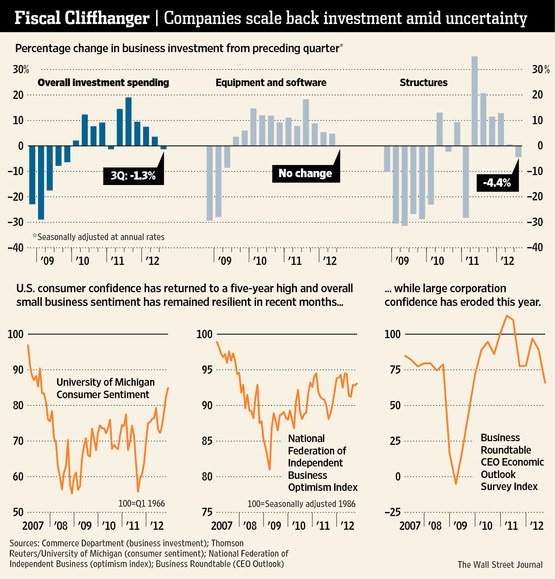
CapEx Investment Falls Off a Cliff

Source: WSJ


“You can’t always get what you want…”

Posted: 19 Nov 2012 06:01 AM PST

“You can’t always get what you want, but if you try sometimes, you just might find you get what you need.” I couldn’t help envisioning Nancy Pelosi, Harry Reid, John Boehner and Mitch McConnell on a park bench singing this song together over the weekend as they negotiate a tax and spending deal and ahead of the Rolling Stones 50th anniversary tour. I repeat my belief that a deal that doesn’t face healthcare spending head on and also raises taxes of substance with economic growth mediocre is not a good deal. This said, the markets will celebrate any deal in the short term but will likely deal with the economic consequences in 2013 (outside of capital gains induced selling in 2012). In Asia, the Nikkei rallied another 1.4% and is up 5.6% in the past three trading days as a new government may take hold on Dec 16th with a mandate to print a lot of yen. China said 35 cities of 70 saw home price gains in Oct vs 31 in Sept. In Europe, Spain’s Rajoy remains defiant against calls for a bailout as he said ‘the worst is over’ and the Spanish economy will be ‘better in 2013 than 2012.’ The Spanish 2 yr yield is near a two month high. European Finance Ministers meet tomorrow to try to hammer out a deal to come up with another 30b euros to bridge Greece over for the next few weeks, on top of what’s already been pledged to them. Expectations of a deal have the Greek stock market up 2.5% and the Greek 10 yr note is up 7 days in a row. On the markets response to the Israeli/Hamas confrontation, the Tel Aviv stock market is up .8% today after a 1.4% rally yesterday and has gotten back everything it lost last week.

.

0 comments:

Post a Comment

previous home Next

{8} chatroll


{9} AdBrite FOOTER

{8} Nice Blogs (Adgetize)