


The Big Picture |

- Grantham: Biggest Housing Bubble Since 807 A.D. Has Burst
- Discuss: To Hell With the Fiscal Cliff . . .
- A Bit More iPhone 5
- 10 Tuesday PM Reads
- BNN Appearance: Bernanke, HP & Accounting Shenanigans
- Sex Sells JGBs
- Tocqueville-an error
- Bernanke speaks
- One year in the life of the Euro
- Mauboussin on ‘The Success Equation’
- Housing continues to improve
- S&P500 vs 3 Month Lows; 90% Up Days
| Grantham: Biggest Housing Bubble Since 807 A.D. Has Burst Posted: 20 Nov 2012 10:30 PM PST
Or Maybe Of All Time …Preface: Housing is currently experiencing a rebound. But the housing crash which started in 2007 was so massive that it is historic in its significance. We've previously noted that the housing bubble which burst in 2007 was bigger than the Great Depression … and perhaps bigger than any housing bubble in 700 years:
Jeremy Grantham just said that our recent bubble was the largest in 1,200 years:
2007 – when the housing bubble popped – minus 1,200 years brings us to 807 A.D. To give a sense of how long ago that was, Charlemagne had just defeated the Saxons – one of the tribes forming the famed Anglo-Saxons – and forcibly converted them to Christianity. England didn't become a country until hundreds of years later, during the Norman Conquest of 1066 . But the housing bubble which burst in 2007 was arguably the largest in history … ever. As we've noted:
We also noted something that is now obvious to all:
|
| Discuss: To Hell With the Fiscal Cliff . . . Posted: 20 Nov 2012 05:24 PM PST Feel free to comment |
| Posted: 20 Nov 2012 05:00 PM PST 1. AppleCare does not cover water damage, I stand corrected. Then again, the “genius” at the Apple Store said it did. What we’ve got today is a plethora of misinformation parading as truth. I do not want to fall into that category, therefore I print this correction. It’s just too hard to keep up on everything today. The amount of factually wrong information that comes into my inbox is frightening. If you’re going to buy something, and care what it is, best to do research. But I have compassion for you, keeping up is a full time job, and it’s a futile effort. P.S. Buy with an AmEx card and you could be protected against theft and accidental damage, the devil is in the details: http://amex.co/TWs3vC P.P.S. AppleCare may be worth it because of the lack of hassle. They never argue, they just repair, frequently replace. Unless you’re ten, time is more valuable than money. 2. Loyalty Sit on the lift and ask someone how they like their new skis and they always say GREAT! Because they paid for them. You won’t find anybody with a new phone who says it sucks…unless they’re planning to get rid of it. 3. Argument I wish people were as passionate about bands. My inbox is coming apart at the seams with opinions, people argue Apple/Android the same way we used to argue Beatles/Stones back in the sixties…yes, they used to have competitions on radio between the two back then. Unfortunately, mobile manufacturers are more cutting edge than bands. They know if they go to sleep for even six months, they fall behind. I.e. HTC. Whereas a band puts out an album and expects to tour on it for two to three years. Stay in the marketplace. Keep coming up with new stuff. Surprise people, like Apple did with the iPad 4. Give people more than they were looking for. And go for the wow factor. And I don’t mean dancing. 4. Apple’s Hidden Advantage Read this: http://bit.ly/Q8IuH8 The money quote: “What I will add in this article, however, is my belief that an architecture decision by Apple has also given it an intrinsic and durable advantage over Google’s Android OS.” “This intrinsic advantage allows Apple to run Apps in its devices faster than those same Apps would run on Android devices with comparable hardware specs; or alternatively, to consume less power when running at the same speed,” Santos writes. “This is non-trivial for Apple, for both performance and power consumption come at a premium in battery-reliant mobile devices. It’s also non-trivial because an architecture decision is something which stays rather immutable over long periods of time, so any advantage gained is hard to overcome.” http://bit.ly/UTrffH 5. Functionality We’ve now entered the sixties/seventies of phone development. Where the exterior is more important than what’s under the hood. Toyota and Datsun crushed Detroit by making cars that ran well, that did not break down. They might have been boxy, but they were headache free and cheaper. Your Android phone may look flashy, but how much of its functionality do you use? How much do you know how to use? Where do you go for help? For every self-starter hacking his phone, there are hundreds of thousands of people who are completely clueless. Who own what is essentially a thick brick which can dial calls, text, maybe get e-mail and possibly display maps. Apple won by making it easy. 6. Luddites If you’re bragging about having an old phone, you’re saying you don’t listen to new music, your opinion doesn’t count. They’re no longer phones, they’re mobile computers. The desktop is dying, get with the program. 7. Service Providers They’re different. In reach and speed. T-Mobile might offer you a great deal, but if you need LTE…good luck! Verizon might be expensive, but take a look at its LTE map. It blows AT&T’s away. Sprint might give you unlimited data, but check its speed. And maybe you don’t care about all of this, but if that’s so, please stop bloviating, you’re just demonstrating your ignorance. 8. Profitability. Samsung and the low cost providers own television. Panasonic may get out and Sony is a shell of itself. But at what cost? Flat panel margins are so thin as to frequently be nonexistent. I.e. the TV’s are selling at a loss. Market share doesn’t mean much if you can’t make money. There’s a business in being BMW or Mercedes. Making top drawer stuff for people who can pay. But what is fascinating is Apple employed this strategy to create and own the iPod market, and the tablet market and a lot of the smart phone market. Can they pull off this strategy in the future? That was why I was writing, not to ding the iPhone 5. I can’t tell you how many e-mails I got from people who “read” my article and then said they had changed their mind and were no longer going to buy the iPhone 5. Mine was a business analysis. Can you own the sphere when you’ve got no low cost option, and others do? Let’s go the other way, with Clayton Christensen, the business guru who wrote “The Innovator’s Dilemma.” He’s all about the mantra “good enough.” That “good enough” triumphs in the end. He won’t pay for the best. He says “good enough” keeps getting better and then squeezes best. Are we seeing this now in smart phones? Have Android handsets gotten good enough that the Apple superiority is no longer worth the extra price? That’s the question. 9. Tomorrow Apple is no different than a band. To rule in the future, it needs hit new products. It can make money/tour on the old stuff for a long while, but playing to a smaller audience/smaller buildings. We revere those who can do it once again. Who can reinvent the wheel. Show us something we’ve never seen before. That’s one of the keys to the Beatles’ success. They kept taking us to new places we couldn’t even contemplate. That’s why music’s in a funk. You know what you’re gonna hear before you turn on Top Forty radio. Then again, many kids don’t even listen to the radio. They don’t even watch TV. If you’re a fat cat businessman you’ve got two choices… You can plan your exit strategy to coincide with the cliff, i.e. exit the car just before it plunges. Or you can tackle these challenges. The music business is littered with those employing the former strategy. Caring only about themselves, they’re paying themselves high salaries and planning to exit before tomorrow comes. And then there are those who think they have the power to prevent tomorrow. As if Microsoft could stop the tablet and keep the desktop computer dominant. You can’t stop tomorrow. You’ve got to play for the day after tomorrow. One thing we know for sure is no one’s going to be using the same mobile device ten years from now that they are today. Many will not even be using the same device two years from now. What will they be using? And early adopters sculpt the landscape for those who follow. 10. Trade-In iPhones are worth more. So you can trade up each and every year for a minimum of cash. Usually less than a hundred bucks. There are websites that buy used phones, you can sell them on eBay. Therefore, there are many surfers of the new who get a new phone every year and don’t pay that much. But you’ve got to trade early. Skip a cycle and your old phone becomes a worthless brick. As someone e-mailed me, maybe cutting edge phones should be leased! – |
| Posted: 20 Nov 2012 01:20 PM PST My afternoon train reading:
What are you reading? > |
| BNN Appearance: Bernanke, HP & Accounting Shenanigans Posted: 20 Nov 2012 12:29 PM PST click for video
Where I say some not nice things about the accounting industry serving Wall Street investors. |
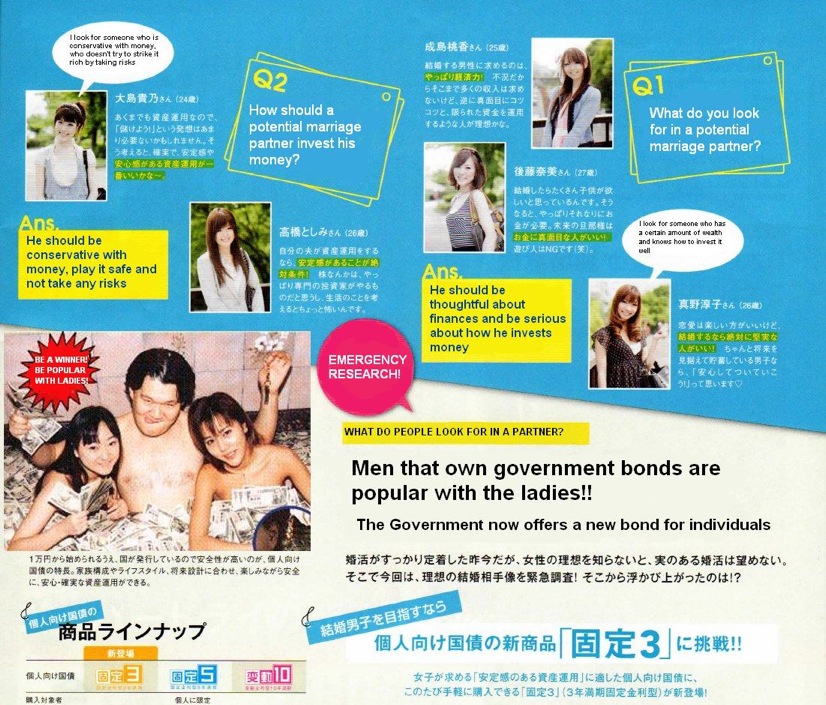
| Posted: 20 Nov 2012 11:30 AM PST This is one of those so bizarre you wonder if its real things: Apparently, according to this Bloomberg article – Women Prefer Men Holding State Bonds, Japan Ad Says — yes, it is:
"Men that own government bonds are popular with the ladies!"
Yes, its a slow holiday week . . . ~~~ UPDATE: November 20, 2012 3:20pm Readers tell me it is pure photoshop
|
| Posted: 20 Nov 2012 10:30 AM PST Tocqueville-an error
In our recent piece on the fiscal cliff and slippery slope we opened with two quotes. One was wrongly attributed to Alexis de Tocqueville. Several readers called the error to our attention. The original piece is posted on Cumberland's website, www.cumber.com . The erroneous section reads "We shall see if Alexis de Tocqueville may be right in his quote, 'A democracy cannot exist as a permanent form of government. It can only exist until the majority discovers it can vote itself largess out of the public treasury.' ” I guess we could have written this more accurately by saying, Often wrongly attributed to Alexis de Tocqueville, but more likely sourced to an obscure reference in 1951, this quotation applies to the current debate. "A democracy cannot exist as a permanent form of, it can only exist until the majority discovers it can vote itself largess out of the public treasury." One writer for whom we have great respect is Barron's editorial writer Tom Donlan. He wrote: "Dear David, Your 2d paragraph quote from Tocqueville is true, but not accurately attributed. It's from a 1951 letter to the editor of the Daily Oklahoman. The letter-writer (falsely) attributed the quote to Alexander Tytler. For more than you'd ever want to know about it, see http://www.lorencollins.net/tytler.html . Regards, Tom Donlan" We thank Tom, and others, for calling the error to our attention. The fiscal cliff piece was dictated while waiting for a plane. Voice recognition software captured my words and converted them into electronic impulses. The text quickly traveled cyberspace, was restored to a voice message and transcribed by an assistant in Cumberland. She had instructions to research the quotes and fact check the text. She used Google and found several citations that this was a Tocqueville utterance. A second research associate independently confirmed Tocqueville. He noted that others, including presidents and congressional leaders had cited Tocqueville as the source. We included the quote in the final draft and sent it to Charley Sweet, a professional copy editor, and asked him for his review. Charley and his partner are supposed to review text for facts and for syntax and for grammar. They left the Tocqueville quote intact. Charley has subsequently emailed me with an apologetic note. Besides Charley, the others who tried to help me were all well intentioned. They sought sources, believed them and used them as verification. But the ultimate responsibility for a writer falls singly on the author. So the citation error is mine and mine alone. Tocqueville wrote about America during its fledgling period. His native tongue was French. Many attributions to him are translations of French into English so there is some inaccuracy involved since linguistic transition is never perfectly accomplished. His two volumes entitled "Democracy in America" contain warnings about socialism and how it can dilute and destroy the freedoms of democracy. Here are some Tocqueville citations from Wikiquote. "Socialism is a new form of slavery." Source: Notes for a Speech on Socialism (1848) "As for me, I am deeply a democrat; this is why I am in no way a socialist. Democracy and socialism cannot go together. You can’t have it both ways." Source: Notes for a Speech on Socialism (1848) "La démocratie étend la sphère de l’indépendence individuelle, le socialisme la reserre. La démocratie donne toute sa valeur possible à chacque homme, le socialisme fait de chaque homme un agent, un instrument, un chiffre. La démocratie et le socialisme ne se tiennent qu par un mot, l’égalité; mais remarquez la différence: la démocratie veut l’égalité dans la liberté et le socialisme veut l’égalité dans la gene et dan la servitude." Translation (from Hayek, The Road to Serfdom): Democracy extends the sphere of individual freedom, socialism restricts it. Democracy attaches all possible value to each man; socialism makes each man a mere agent, a mere number. Democracy and socialism have nothing in common but one word: equality. But notice the difference: while democracy seeks equality in liberty, socialism seeks equality in restraint and servitude. Source: 12 September 1848, “Discours prononcé à l’assemblée constituante le 12 Septembre 1848 sur la question du droit au travail”, Oeuvres complètes, vol. IX, p. 546 Our conclusion about Tocqueville is that he would have said something like the words wrongly attributed to him had he phrased his writings in English and not in French. The Tocqueville message about risk to the American democracy is sound, even if it was uttered by someone else in a 1951 letter in an obscure newspaper. Our view of fiscal cliffs or slippery slopes remains intact. That is what the current Washington political debate is all about. Happy Thanksgiving. ~~~ |
| Posted: 20 Nov 2012 10:23 AM PST Ben Bernanke’s speech today is nothing that is market moving. He talks about the sluggish recovery and gives his opinions of the reasons why. He is happy with 2% inflation per year over the past 3 years even though average hourly earnings are up about 1.7% on average during this time (which is the part he doesn’t acknowledge). He goes on to mention the fiscal issues of the US and its potential drag on economic activity. He also cites Europe and its issues. He gave no hint of how he plans to handle the expiration of OT as he’ll likely wait until the FOMC meeting in Dec. Be sure we’ll see QE4. Bottom line, I find his speech of little importance as the factors he cites as headwinds to economic growth are just symptoms of the deeper problem which Fed policy has only helped to perpetuate, that being TOO MUCH DEBT. Fed policy remains predicated solely on the belief that the only way out of the current lackluster recovery is to just borrow more money at the government, corporate and consumer levels so we can somehow grow out of the ashes of the previous debt induced bubble driven by the Fed. |
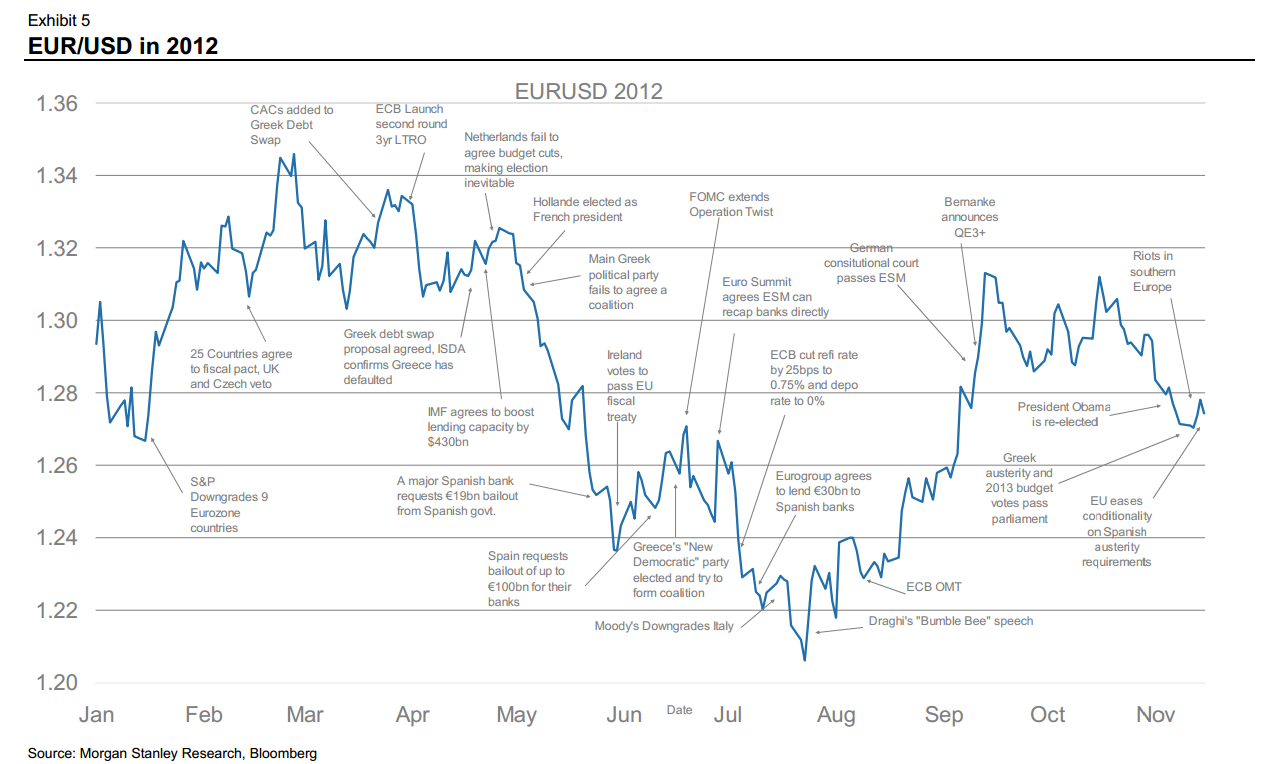
| One year in the life of the Euro Posted: 20 Nov 2012 09:30 AM PST click for ginormous chart
Fantastic annotated chart from Morgan Stanley by way of FT Alphaville
|
| Mauboussin on ‘The Success Equation’ Posted: 20 Nov 2012 08:37 AM PST Michael Mauboussin, chief investment strategist at Legg Mason Capital Management Inc., talks about his new book “The Success Equation: Untangling Skill and Luck in Business, Sports, and Investing.” Mauboussin talks with Tom Keene and Sara Eisen on Bloomberg Television’s “Surveillance.” Viewers should pay close attention to his definition of certainty vs uncertainty and experience vs expertise: Source: Bloomberg, Nov. 20 2012 |
| Posted: 20 Nov 2012 08:24 AM PST Housing continues to improve as Oct Starts totaled 894k, 54k more than expected, the most since July ’08 and up from a revised 863k in Sept (from 872k). The improvement m/o/m though was all in multi family as starts there rose to 300k from 268k. Single family starts fell 1k but after jumping by 57k in Sept. While Permits fell by 24k from Sept to 866k, the level is still around the best also since July ’08. With respect to construction jobs, housing completions totaled 772k, more than 100k below starts, thus providing opportunities for workers to find new work after finishing a home. As seen, the housing industry is getting better to the benefit of the balance sheets of the American consumer and banking system and we all hope this continues. The shrinking supply of existing homes is leading more to new construction. Housing has bottomed but I still think it’s important to keep the recent improvement into perspective so as not to get carried away as the recovery I believe will still be in fits and starts. Housing starts at 894k is near where they were at the depths of the 1981 and 1991 recessions and 60% below the peak in Jan ’06. |
| S&P500 vs 3 Month Lows; 90% Up Days Posted: 20 Nov 2012 08:16 AM PST Interesting data point from Jason Goephert, Sentiment Trader:
Then there is this from Merrill’s Market Analysis research team:
I am not sure what this means going forward, but they are the other side of my view.
|
| You are subscribed to email updates from The Big Picture To stop receiving these emails, you may unsubscribe now. | Email delivery powered by Google |
| Google Inc., 20 West Kinzie, Chicago IL USA 60610 | |



0 comments:
Post a Comment