


The Big Picture |

- Safe Travels for Thanksgiving
- 10 Mid-Week PM Reads
- HP is “Epitome of a Value Trap”
- Alicia Keyes: TheGirl Who Player with Fire
- Happy Anniversary Helicopter Ben!
- About That Ballooning Deficit . . .
- Israel’s Social War: Strategy & Tactics
- EZ fails to agree on Greece
- 10 Mid-Week AM Reads
- MBA/Greece/Yen
- Shocking News … Bond Bearishness!
- CJR Says Fiscal Cliff is a CNBC Scam
| Posted: 21 Nov 2012 03:38 PM PST |
| Posted: 21 Nov 2012 01:00 PM PST Traveling for Thanksgiving? Fire up the tablet and enjoy some pre-holiday reads!
What are you eating tomorrow?
Will Retailers’ Black Friday Strategies Work?
Source: WSJ
|
| HP is “Epitome of a Value Trap” Posted: 21 Nov 2012 12:49 PM PST |
| Alicia Keyes: TheGirl Who Player with Fire Posted: 21 Nov 2012 12:17 PM PST
I didn’t realize how smitten I was with Alicia Keys until I saw this month’s spectacular Billboard magazine cover photo. The song referenced in the cover shot above can be seen here.
|
| Happy Anniversary Helicopter Ben! Posted: 21 Nov 2012 11:13 AM PST
http://www.federalreserve.gov/boarddocs/speeches/2002/20021121/default.htm |
| About That Ballooning Deficit . . . Posted: 21 Nov 2012 09:10 AM PST
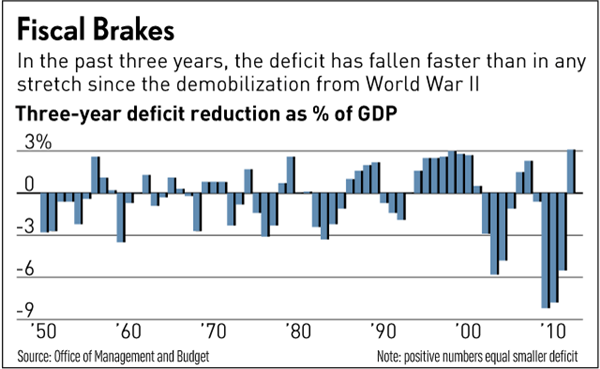
Wow, this is a rather surprising data point: “From fiscal 2009 to fiscal 2012, the deficit shrank 3.1 percentage points, from 10.1% to 7.0% of GDP.” It is even more surprising when you consider its source is the usually conservative Investors’ Business Daily. Here is a longer excerpt:
Yet more proof that the fiscal cliff is a manufactured crisis of minimal importance.
Source: |
| Israel’s Social War: Strategy & Tactics Posted: 21 Nov 2012 08:30 AM PST A short presentation exploring how Israel’s Defense Forces are fighting their war in Gaza using social media strategy. From hot Israeli soldiers on Instagram to war infographics on Facebook, we quickly survey the IDF’s social excellence.
by Oliver Woods on Nov 18, 2012 |
| Posted: 21 Nov 2012 08:20 AM PST The Japanese October merchandise trade deficit increased to -Yen 549.0bn, well above the -Yen 360.0bn expected and the 4th consecutive monthly deficit. Japanese exports slumped by -6.5% in October (much worse than the -4.9% expected), the 5th consecutive monthly decline and the lowest for 3 years. Exports to China, Japan’s largest export market, declined by -11.6% Y/Y (-14.6% in September) and even lower to the EU (down -20.1%), though were +3.1% higher to the US. The export slump is expected to continue this Q. Exports of cars to China declined by -82% Y/Y. The Japanese MoF stated it was the worst trade deficit for October since 1979. Imports declined by -1.6% Y/Y; The Japanese LDP party set out details of its proposals in respect of the economy/Yen. Details as follows: To consider setting up a fund to buy foreign bonds; State that they will introduce economic stimulus, immediately after taking power; Will announce a major stimulus focused budget; Will beat deflation and increase nominal growth to 3.0%. They proposes that the inflation target is raised to between 2.0% to 3.0%, from 1.0% presently; Seeks cooperation with the BoJ; Will consider a change to the constitution to enshrine right to self defence; Pledges to increase military spending and the size of the military; Will consider placing personnel on disputed islands; Wants to create a primary surplus by 2020; Will cut welfare payments by 10%; Will cut corporation tax; Will consider changes to sales tax for the less well off. The bottom line is that Mr Abe, head of the LDP Party, stated that “We should set an inflation target and print unlimited Yen until we reach that target”. No real surprise, but the increase in the military budget and placing personnel on the disputed islands, combined with proposing changes to the Japanese constitution, enabling foreign military intervention, will increase tensions with China; Japanese October FDI into China amounted to US$460mn, down 32.4% Y/Y. Only one way Japanese FDI into China is going and that’s down; Interestingly, Japanese press reports suggest that their largest banks were net sellers of Yen 2.34tr of JGB’s in October, the largest in 6 months – a very definite Oops. However, it looks as if Japanese regional banks picked up all the JGB’s sold; The Shanghai Composite having declined below the psychologically important 2000 level, rallied to close +1.1% higher at 2030.32 (the all time high was near 6100 in October 2007, by the way) on speculation of a cut in RRR’s; EZ finance ministers, together with the IMF, failed to agree on a bail out package for Greece and are to reconvene next Monday (26th November) to try and settle their differences. There is an aversion by EZ countries to accept any write downs on existing loans, something the IMF has called for, and a number of EZ countries (including Germany) deem such a policy it “illegal”. Yeah right, the main reason is that they do not want to explain the resulting losses to their electorate, having told them that there would be none. The IMF would not agree to a 2 year extension (to 2022), which they deem necessary to reduce Greek debt to GDP to 120%. Without a debt write-down, Greece’s debt to GDP would amount to 144% in 2020 and 133% in 2022, an EU paper suggested. The focus of yesterday’s meeting was on an extension of maturities of the existing loans (basically the extend and pretend option, though likely), a reduction in interest rates (once again likely, though the German’s do not want too drastic a reduction), combined with an interest payment holiday (likely), the ECB giving up on its “profits” on its holdings of Greek bonds (likely) and debt buy backs of bonds held by private sector investors (also likely). Interestingly, Germany has indicated that they would provide new funds for Greece (most likely through the EFSF, as it does not involve Germany having to provide funds – the EFSF raises funds from the market, based on guarantees of EZ member states) to plug a funding gap of around E14bn through 2014, though other EZ countries, such as Holland remain sceptical. The IMF’s debt sustainability demand (reducing Greek debt to GDP to 120% by 2020) has yet to be resolved, though there are some reports that the IMF is wavering – the US, in particular, do not want a problem in Europe and may well put pressure on the IMF to relent – likely. Mrs Merkel advised the Bundestag that the Greek funding gap can be plugged by reducing interest rates and by the EFSF providing guarantees on bonds to be issued by Greece, in order that Greece can raise the funds it needs. Essentially providing a guarantee on bonds that you know are going to default – great plan !!!!! Furthermore, she added that the EZ debt crisis will take years to resolve !!!!!. Basically the same old EZ. Having said that some kind of fudge next week is possible (looks like the IMF will be lent on), though this issue will come back again and again and……. The Greeks are furious and are demanding that the EZ deliver. However, its only a matter of time before the Greeks do not deliver on their commitments. Mr Tsipras, the head of the Syriza party (who wants Greece to default) waits in the wings – basically he’s happy for Greece to get as much money from the EZ as possible, before defaulting; Fitch announces that it will review France’s AAA rating in 2013 – another downgrade is coming boys and girls. French authorities advised that they would not be revising their 2013 forecasts, even though everyone knows its unadulterated nonsense;
Will the EU countries sort out their differences and agree on an EU 2014/20 budget tomorrow. Whilst the UK is pressing for at least a freeze of the budget, the Italians report that a deal will be done, but Mrs Merkel warns that agreement may not be reached until 2013. I’ll go with Mrs Merkel; UK October budget deficit came in at £8.6bn, much worse than the £6.0bn expected and as compared with the £5.9bn a year earlier. Expenditure rose by +7.4%, though tax revenues rose by just +1.8% – corporation tax receipts were -9.5% lower. The forecast deficit of £120bn for the current fiscal year (to March 2013) will not be met – likely to come in around £125bn. Not good news, especially as there is pressure for the UK to loosen its austerity programme. UK public sector net borrowings for October were £6.503bn, worse than the £4.0bn forecast. The BoE voted by 8 to 1 to keep QE on hold at £375bn; US housing starts rose by +3.6% in October, up to a 894k annual pace, the highest rate since July 2008. However, permits dropped by -2.7%. A rise of +11.9% in multifamily units was the reason for the rise. Permits for multifamily homes have risen by 54.5% Y/Y; Mr Bernanke warned that the uncertainty over the “fiscal cliff” was already negatively impacting the US economy and urged Congress to deal with the matter. However, he added that there are signs that the US economy (aided, inter alia, by a pick up of the housing market) would improve next year – subject to dealing with the fiscal cliff; US flash November manufacturing PMI rose to 52.4,above the 51.0 expected and 51.0 in October. The output component rose to 52.8, from 51.1 previously. New orders increased to 52.8, from 51.1, with employment also better, coming in at 52.6, as opposed to 51.8; US initial jobless claims came in at 410k, in line with expectations and a revised 451k. Continuing claims came in at 3.337 W/W, slightly better than the 3.345mn expected and a revised 3.367mn in the previous week. The BLS state that the numbers remain affected by Hurricane Sandy;
Outlook Asian stocks closed higher, with European markets flat to marginally higher. US futures suggest a flat open. The Euro (currently US$1.2820), having weakened following the failure to consummate a deal on Greece, has recovered its losses – counter intuitive. The Yen, which is currently trading at 82.41, having briefly risen above Yen 82.50, is trading at the lowest level since April this year . Spot gold is trading around US$1726, with January Brent at US$110.84. The problems in Israel/Gaza is impacting the oil market, but not equity markets at present. The Yen is weakening materially, following the extremely poor trade data, even though the LDP’s election manifesto was not as radical as initially suggested. Nevertheless, with sentiment poor and declining, the Yen looks like weakening further. I get the feeling that some sort of cobbled up deal on Greece will emerge next week and will wait (impatiently) for that, before I resume shorting the Euro. Kiron Sarkar 21st November 2012
|
| Posted: 21 Nov 2012 06:35 AM PST Getting ready to travel for Thanksgiving? Here are some reads to keep you busy
What are you reading?
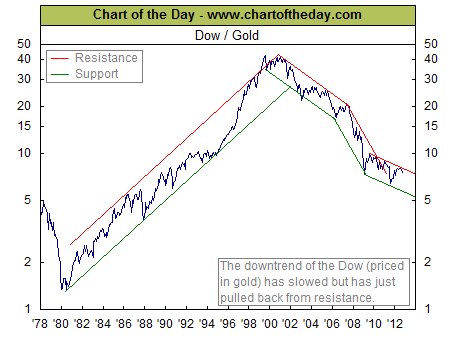
Dow priced in gold
> Source: Chart of the Day |
| Posted: 21 Nov 2012 06:21 AM PST With mortgage rates still historically low but that have stopped going lower, the weekly MBA data was mixed. Refi apps fell 3.2% after rising 13.1% in the week prior but remains 6.5% below the average level since the Fed started QE3. Purchase apps though rose by 2.7% after an 11% jump last week and the index level matches the highest since June. In Europe, the troika still hasn’t been able to seal the deal on Greece but it seems close as the IMF head said “We made some good work and we’re closing the gap.” Markets aren’t worried as the Greek 10 yr bond is up for an 8th straight day and Greek stocks are little changed as is the euro. In Asia, yen weakness continues as it falls for a 6th straight day to near an 8 month low vs the US$ and the relief is evident in the Nikkei which rallied again to within 10 pts of the highest level since May. Japanese exports fell 6.5% in Oct y/o/y, the 5th straight month of declines as exports to the EU fell 20.1% y/o/y and to China by 11.6% y/o/y. Japanese exports ytd are the weakest since ’09 and would get needed relief if the yen weakness continues. The Shanghai index bounced about 1% off near its lowest level since Mar ’09 on speculation of an imminent RRR cut. |
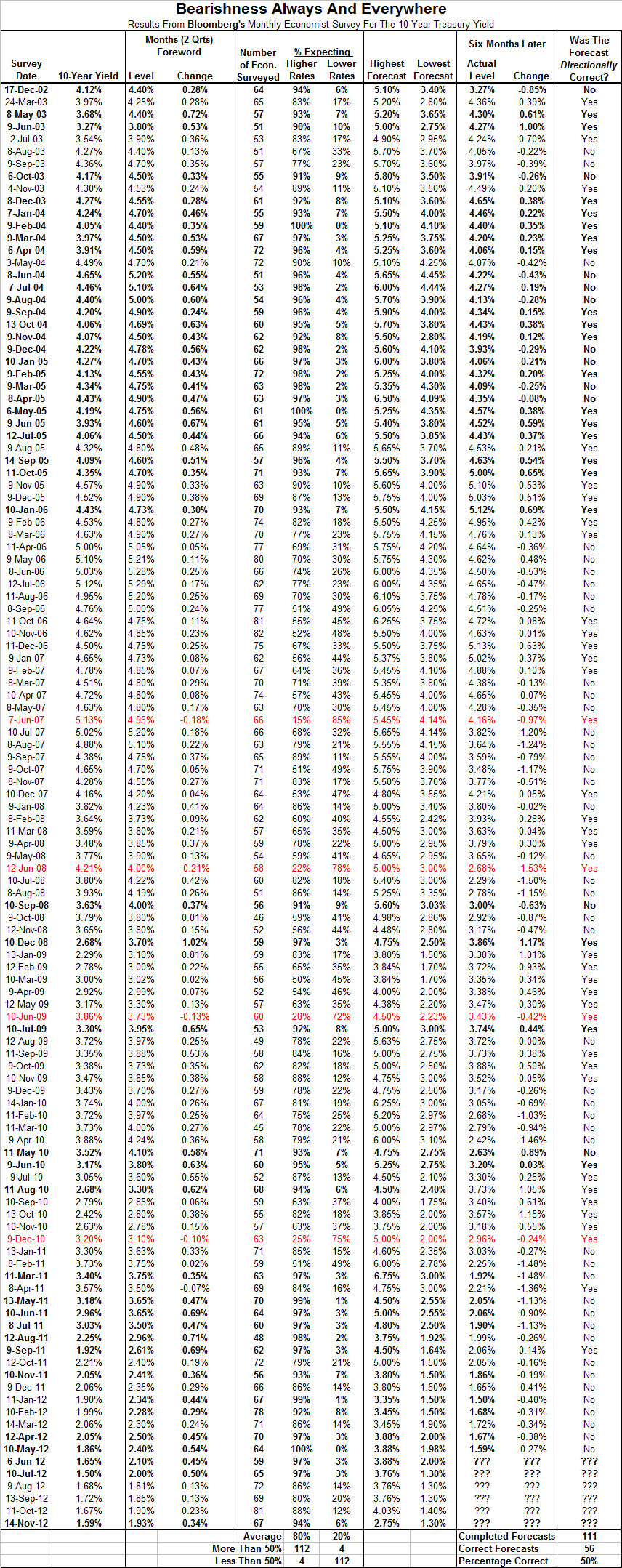
| Shocking News … Bond Bearishness! Posted: 21 Nov 2012 05:30 AM PST The Financial Times – Bond markets: A false sense of security Comment Whenever we see stories warning of the risks in bonds, as if the subject has never been discussed, we want to remind everyone that this is the only thing that has been said about the bond market for many years. And, it has been wrong for many years. Here is what we wrote last month:
These predictions all range from several months to several years old. 10-year yields have not cooperated with these sages as rates continue to stay low. Why? Maybe because these predictions are solidly a consensus opinion and consensus opinions rarely play out exactly as expected. The table below shows the monthly survey of economists as conducted by Bloomberg. In the history of finance we cannot find a more one-sided opinion about a freely traded double-auction market. Witness: • 116 months of surveys have been completed since December 2002. The world has been very bearish on bonds for years and has been very wrong. It is hard to make a case for value in the bond market when the Federal Reserve is pushing rates lower via QE. That said, this bearishness is so well understood that it has been priced into the bond market for a while now (years). We would argue this is why the constant drum-beat of bond bearishness has not been working as the bears have already placed their bets. At some point the bond bears are going to be right. But after a decade of crying wolf, it is hard to listen to these calls.
Source: Bianco Research |
| CJR Says Fiscal Cliff is a CNBC Scam Posted: 21 Nov 2012 04:32 AM PST
Just a quick note before I run out this morning: Today’s must read is a brutal takedown of the CNBC driven narrative of the fiscal cliff. Its written by Ryan Chittum of The Audit, which is the Columbia Journalism Review’s site that focuses on the financial press. Here is a quick excerpt:
You really must read the entire thing. When you do, think about the things that have gotten the press in general worked up into a tizzy. In particular, consider what CNBC has and has not gotten worked up about in the past, and what they completely missed. They are a fairly reliable fade . . .
Source: |






| You are subscribed to email updates from The Big Picture To stop receiving these emails, you may unsubscribe now. | Email delivery powered by Google |
| Google Inc., 20 West Kinzie, Chicago IL USA 60610 | |



0 comments:
Post a Comment