


The Big Picture |

- 10 Thursday PM Reads
- 2008 versus 2012 Election
- Global Credit Cycle Lurches Down
- Flows Into Domestic Equity Mutual Funds And ETFs
- Announcing: The Post-Election Economy – Free Online Video Event
- Chevrolet Corvette Sting Ray ‘Split Window’ Coupé
- Power Down
| Posted: 08 Nov 2012 01:30 PM PST My no electricity post blizzard afternoon reads:
What are you reading?
Spending versus Taxing Gap |
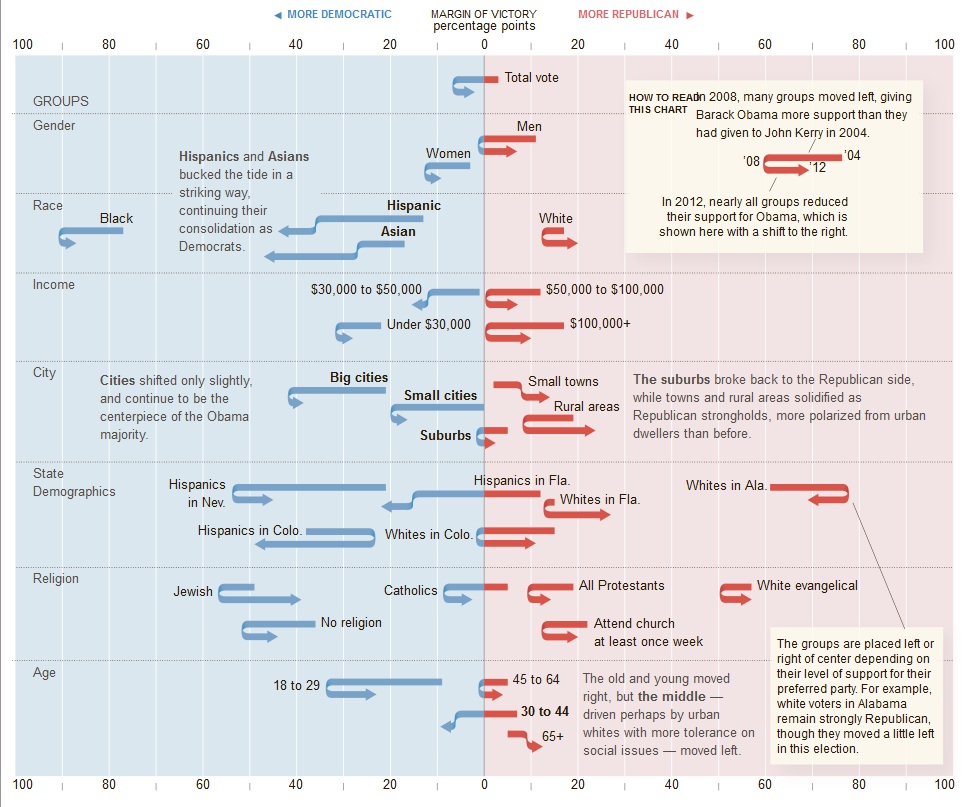
| Posted: 08 Nov 2012 09:21 AM PST Neat infographic from the NYT: Obama Was Not as Strong as in 2008, but Strong Enough |
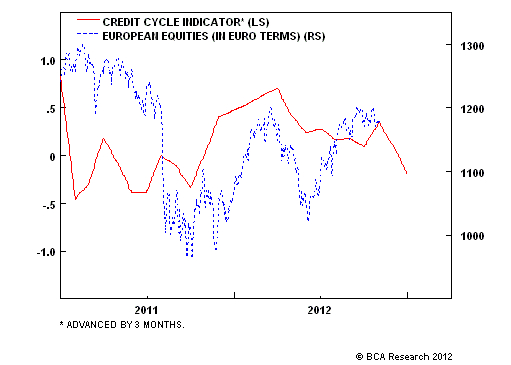
| Global Credit Cycle Lurches Down Posted: 08 Nov 2012 09:00 AM PST After a brief period of stabilization, our measure of global credit impulse has plummeted. This does not bode well for European equities.
The credit impulses in all three major economies – the euro area, the U.S. and China – are now negative, albeit very slightly in the case of China. This is the first time in three years that all three components have been simultaneously negative. And after hovering at a point of inflection the combined credit cycle indicator has lurched down again. For any open exporting economy, such as the euro area, the global credit cycle is much more important than the domestic credit cycle. This is because the sales and profits of large European companies are sourced globally, not just from Europe. According to our European Investment Strategy service, a weakening credit cycle normally precedes a poorer return/risk trade-off for risk assets such as equities – through lower returns and/or higher volatility. After their recent strong rallies, European equities seem vulnerable to any new downgrades to growth. Hence, for short-term investors we advise against an absolute overweight position in European equities. Source: BCAResearch |
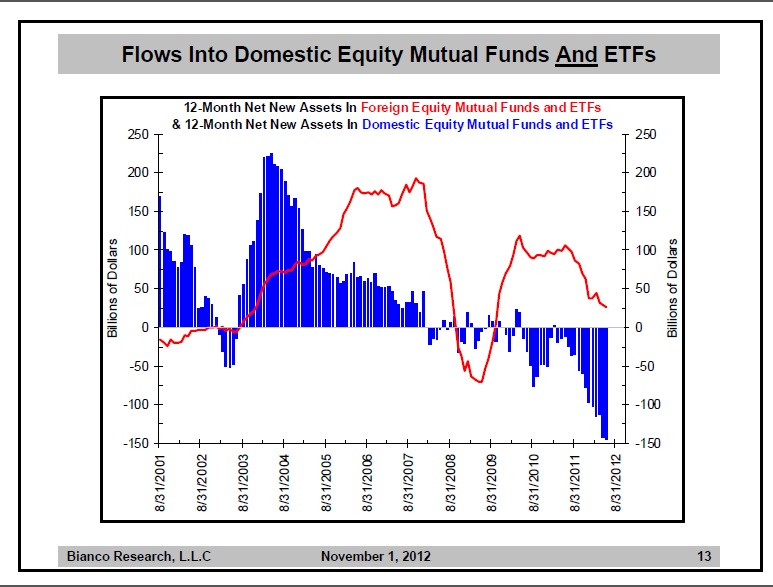
| Flows Into Domestic Equity Mutual Funds And ETFs Posted: 08 Nov 2012 08:30 AM PST Click to enlarge |
| Announcing: The Post-Election Economy – Free Online Video Event Posted: 08 Nov 2012 07:30 AM PST By John Mauldin | November 1, 2012 Earlier this week my publisher, Ed D’Agostino, sent you an email with the subject of “A video invitation from John Mauldin.” In it, he linked you to a video I created for you about what to expect and how to invest in the post-election economy. If you haven’t yet watched the video, you can do so here. That video was our first announcement of a free online event we’re putting together, called The Post-Election Economy: A Clear-Eyed Analysis of the Risks and Opportunities for Investors. I’m pleased to add that the event is being cosponsored by our associates at Real Clear Politics, one of the fastest-growing political news websites on the Internet. The Post-Election Economy will be a no-holds-barred discussion featuring a faculty of top economic and investing experts, including Mohamed El-Erian of PIMCO, Barry Ritholtz of The Big Picture and FusionIQ, your humble analyst, and a slew of other guests, listed on the event registration page here. We’re also bringing in Lauren Lyster of the Capital Account program on RT America to moderate the discussion. With the election less than one week away, I continue to get urgent questions from readers about what to do with their money after the election. The level of uncertainty is unprecedented. And with good reason, too. The future of our economy hangs in the balance, with any of a number of factors ready to deal a serious blow: the Fiscal Cliff; perpetually low real employment figures; extravagant deficit spending and unprecedented debt; never-ending increases in entitlement spending; and the Fed’s willingness to print ad infinitum – if that’s what it takes. Any of these could bring on disaster. And that’s just our “at-home” issues – there’s still a huge risk to our economy from growing problems in Europe and Asia. Add to all that the big unknown of the election, and investors are worried. Can the US economy handle another four years of Obama? What happens if Romney fulfills his promises of big change in Washington? And what about Congress – can they ever get their act together? Will our problems morph into a true crisis if Washington tries to kick the can down the road for another election cycle? These are the questions I get daily. And all of this leads back to the big question: What should we, as investors, be doing with our money after the election? There will be new risks and new opportunities, no matter who takes the reins in Washington. How can we navigate the new, post-election economy? These are exactly the questions we’ll be answering during the free online event, The Post-Election Economy. You can hear our thinking and our answers by tuning in to the broadcast on your computer. It costs nothing to reserve your spot today. No matter what happens at the polls, we can expect big changes in the post-election economy. As I said, there will be new risks – and new opportunities. During our 90-minute, free web broadcast we’ll do our best to help you navigate this uncharted territory. Simply visit the event page to register and reserve your spot now. Your preparing for turbulent markets analyst,
John Mauldin
|
| Chevrolet Corvette Sting Ray ‘Split Window’ Coupé Posted: 08 Nov 2012 05:00 AM PST Click to enlarge images
• A variety of Chevrolet V8s were available which culminated in the famous L88 engine option, a 427ci homologation special, which found its way into the last Sting Rays in 1967. • Fuel injection was an option, with regular 'big-blocks' coming into the range from the 1965 model year onwards; Source: Classic Driver |
| Posted: 08 Nov 2012 04:02 AM PST Staying at my brothers while our power is out — he had power restored a few days ago. Just now, the power went out. These are the last vestiges of iPad until the cell towers batteries die. Hopefully, be back soon. |



| You are subscribed to email updates from The Big Picture To stop receiving these emails, you may unsubscribe now. | Email delivery powered by Google |
| Google Inc., 20 West Kinzie, Chicago IL USA 60610 | |



0 comments:
Post a Comment