.

{2} GoogleTranslate (H)

English French German Spanish Italian Dutch Russian Portuguese Japanese Korean Arabic Chinese Simplified

Our New Stuff

{3} up AdBrite + eToro

Your Ad Here

Wednesday, December 12, 2012

The Big Picture

The Big Picture


Investing in China — Pitfalls and Promise

Posted: 11 Dec 2012 10:00 PM PST

Great People – Terrible Economic Model

As I have repeated in a number of past issues, China is following its own version what author Eamonn Fingelton has called the East Asian Economic Model. According to Fingelton, this model was first followed by Japan in its WW II puppet state in Manchuria, then in post-War Japan itself, then Taiwan and Korea and now China. The Chinese version of the model relies on protectionism, heavy promotion of exports by subsidies and an undervalued exchange rate and a State/Communist Party directed over- allocation of resources to investment including real estate and infrastructure projects. The model has been enormously successful in its early stages in raising living standards but as the movement from the countryside subsides and exports in the current global near recession can't be dramatically increased, the Chinese model has reached a dead end of diminishing marginal returns on capital.

This is where China is heading. All those airports, railroads, empty cities etc etc are going to turn in an ever lower return on capital. Chinese proudly point to their spanking new infrastructure. Americans in the post Civil War era could have proudly pointed to their new, partly subsidized coast to coast railroad system as well. But British investors in American railroad securities often lost their shirts.

So it is today with investors in Chinese stocks. Yes the Chinese people are hardworking, literate, relatively obedient and totally obsessed with getting rich. Good qualities for investors and ones that go a long way to offset what is really a terrible economic system. But investors have to be careful.

Observers have noted with some wonderment that the Shanghai A Share Index has gone down for three straight years. No surprise as far as I'm concerned. The companies in the A Share Index are largely majority state owned enterprises (SOEs). These companies on balance destroy capital. Their investment decisions are often made with State/Party directives in mind and they are recipients of subsidized below market bank loans. And the SOE's have preferential treatment as far as access to the Shanghai stock exchange goes.

The contrast couldn't be greater with true private sector Chinese companies which in many ways are starved for capital. I have looked at a number of private Chinese companies and with company after company I can find no or low debt. Growth is funded out of internal cash flows. Most of the true private sector companies have had to raise equity capital abroad in New York or Hong Kong.

Forcing their own companies to raise capital in the US doesn't make a whole lot of sense for China, which has such a high savings rate and a huge cache of foreign reserves. What seems to have happened is that the bulk of China's savings are misdirected into the state sectors while the true private sector companies have to scrounge for capital abroad. This has led to a number of problems and value discrepancies.

It is curious that the Hong Kong stock exchange wasn't more aggressive in getting these Chinese companies to list in Hong Kong. As discussed in a previous essay, after an initial infatuation phase the Chinese companies listed in the US have become "orphans", misunderstood, suspected of being frauds and grossly undervalued in many cases. Of course it hasn't helped that some of them were indeed frauds.

One Way to Buy China—Invest in Southeast Asia

Investing in companies is ultimately about investing in people. One ideal combination (not the only one to be sure) is the Chinese work ethic (the Puritan ethic as it used to be called in the US) without the Chinese economic and legal system. And in a number of Southeast Asian countries, especially Singapore, Malaysia, Thailand and the Philippines, that is what you get. You get a business community which is signifcantly Chinese in origin. Chinese entrepreneurs are legends in this part of the world. But you also get market friendly legal/economic systems that are either British (Singapore, Malaysia) or American (the Philippines) in origin or at least heavily influenced by Western legal traditions (Thailand).

It goes beyond that. Southeast Asia is the destination of an ever increasing number of Chinese tourists as well as foreign investments. China is the number one destination for ASEAN (Association of South East Asian Nations) exports. So to a large extent Southeast Asia is part of the China growth story but without some of the drawbacks. Of course, if China were to have a really hard landing that would be a negative for Southeast Asia as it would be for the rest of the world.

But Southeast Asia is more than a China story. Consider:

  1. Southeast Asia is also the destination of an increasing number of Indian tourists and foreign investment.
  2. The banking systems and external debt situations—partly as a result of the Asian crisis of 1998—are in sound shape as opposed to those in the West, the more opaque and unbalanced Chinese system and the corrupt and bureaucracy laden Indian economy.
  3. The market driven nature of Southeast Asian economies means the overinvestment imbalances of the Chinese economy are absent in Southeast Asia. State intervention in Southeast Asian economies compared with China or the West is relatively minimal.
  4. The major Southeast Asian economies are growing at healthy but not unsustainable five percentish rates.
  5. As an added bonus the English language is the working language of ASEAN and is also widely used in Singapore, the Philippines, Malaysia, Brunei, Myanmar and even Thailand.
  6. The majority of ASEAN countries are democracies. ASEAN has the longer term potential to become a meaningful economic entity. (Hopefully not exactly like the European Economic Union.)

The major exception to this otherwise favorable picture is Vietnam. Vietnam has a Chinese style State/Communist Party controlled political and economic system. It's no wonder Vietnam has been such a big disappointment in recent years. Vietnam spent a thousand years or so fighting off Chinese attempts to make the country into another Chinese province. But as any visitor will attest Vietnam seems in so many ways – culturally, politically – like China.

The one disadvantage for foreign investors in Southeast Asia is that most of the companies are small and do not have ADRs in New York. But herein lies the opportunity for those willing to take the time. These markets are underfollowed and growth opportunities do exist. These companies have websites usually in English. Information thanks to the internet is not the problem it used to be.

Some Statistics on Southeast Asia

                    2012 GDP Growth%    Gov Exp/GDP%    Population(Millions)     Chinese Orig % incl mixd

Singapore               2.4                                     17.7                                5.4                           74

Malaysia                 5.1                                     28.2                               29.0                          25

Thailand                 6.0                                      24.1                              64.5                        30-40

Philippines              5.5                                     19.2                               97.7                          25

Indonesia                6.3                                     19.8                              244.5                         3.7

Sources: IMF, Economist, Wikipedia


Regulators from Hell (1)—Will All Chinese Stocks in the US Be Delisted?

The SEC said Dec. 3 that Deloitte Touche Tohmatsu CPA Ltd., Ernst & Young Hua Ming LLP, KPMG Huazhen and PricewaterhouseCoopers Zhong Tian CPAs Ltd. have refused to cooperate with accounting investigations into nine companies traded in the U.S. The SEC hasn't named the nine stocks it's focused on. The issue is the US accounting affiliates will not provide documents required by the SEC for its investigation of fraud because they claim this would be in violation of Chinese law. The SEC is threatening the US firms with penalties if the documents are not provided.

If the SEC order is carried out to its logical conclusion all Chinese stocks will eventually have to be delisted from US stock exchanges since no accounting firm acceptable to the SEC will put itself in the position of having to not comply with an SEC order . This would mean the delisting of hundreds of companies including some major ones like Baidu or Sina. It also may bring problems for American multinationals that operate in China and require local auditors for these operations. This SEC order would bring about a major destruction of value for US investors as the rug of liquidity would be pulled out from under these Chinese stocks. Leveraged buyouts would be transacted at a fraction of these firms' true value. I cannot judge who is being unreasonable in this case—the Chinese or the Americans – and there certainly is a need for vigilance against fraud with Chinese stocks. But from the viewpoint of the American investor in Chinese stocks this SEC action has a "burn the village in order to save it" feel. One would hope adult behavior could prevail and this issue gets sorted out. One would have thought this issue could have been sorted out before the Chinese firms listed in the US.

The delisting of all Chinese companies would be another nail in the coffin of New York's hopes to become the global center for equity financing. As if Sarbanes Oxley wasn't enough. If the Hong Kong exchange were smart, it would open a special pathway for these companies to migrate from New York to Hong Kong.

Regulators from Hell (2) – Go for the Money

"The American extortion of Standard Chartered is nearly over. The British bank is ready to pay off, sorry I mean settle with, the rest of the US mafia crew otherwise known as federal regulators, with a fine of US$330 million for breaching US sanctions against Iran…The US is tough on foreigners, but it is anything but with its own companies. In the past decade, the US Treasury Department granted exemptions to almost 4,000 US companies to do business worth billions of dollars with countries under sanctions, such as Iran, Sudan and Cuba."

-Alex Ho, MY TAKE, South China Morning Post, Dec 7, 2012

The above is one unhappy Hong Kong journalist's opinion. But it is pretty much my opinion as well. HSBC and Standard Chartered have been made to pay enormous fines for ostensibly violating American foreign policy. HSBC and Standard Chartered have a long and honorable history going way back in Hong Kong. They are still respected institutions there and comprise, along with Bank of China, the note issuing banks in the territory. The American regulators on the other hand represent bankrupt Federal and State governments. Because of the size of the US economy and the role the dollar plays in the world economy, dollar transactions must be cleared through the US. Like the medieval barons of old who exacted extortionate tolls on commerce transiting through their territory, the US regulators are doing likewise.

-Peter T. Treadway

______________________________________________________

Dr. Peter T Treadway  is principal of Historical Analytics LLC. Historical Analytics is a consulting/investment management firm dedicated to global portfolio management. Its investment approach is based on Dr. Treadway's combined top-down and bottom-up Wall Street experience as economist, strategist and securities analyst.

Dr. Treadway also serves as Chief Economist, CTRISKS Rating, LTD, Hong Kong.

Why Don’t Bad Ideas Die ?

Posted: 11 Dec 2012 04:30 PM PST

I was having a conversation the other day about some of the dumber ideas in finance that don’t see to want to die — which led to a laundry list of really bad economic memes, investment concepts, and other assorted silliness.

But all of this begs the question:Why don’t bad ideas die? Why are there all of these zombie concepts that are clearly wrong, money-losing foolishness that seem to hang on forever?

Where is Darwin in all this?


Any suggestions? I am really curious as to why this is . . .

Hospitals: The cost of admission

Posted: 11 Dec 2012 03:00 PM PST

Want to know why medical care is so expensive int he US, check out this video:

Steve Kroft investigates allegations from doctors that the hospital chain they worked for pressured them to admit patients regardless of their medical needs.

December 2, 2012 4:42 PM

10 Tuesday PM Reads

Posted: 11 Dec 2012 01:30 PM PST

My afternoon train reads:

• Should You Secular Market Time? (Yes, based on Valuations) (Rick Ferri)
• If Investors Are Dumping Stocks, Why Are ETFs So Hot? (The Fiscal Times) see also US stock market rally deserves respect (FT Alphaville)
• The VIX – Is It Telling Us Anything? At All? (Pragmatic Capitalism)
• Scaring Retail Investors? Mission Accomplished (The Reformed Broker) see also For Many Financial Advisers, Stocks Become a Hard Sell (WSJ)
• Republicans have surrendered on fiscal cliff (MarketWatch)
• TODAY IN APPLE NEWS: Apple's Big Manufacturing Boom to the U.S.—200 Jobs (The Fiscal Times) see also Apple Not Seen Paying
• A Warning About That Guy Who Is Beating the Market (Bucks)
• Hostess took workers’ pension money to fund itself (Daily Kos) see also Hostess Maneuver Deprived Pension (Yahoo Finance)
• How to Control an Army of Zombies (NYT)
• The Case for Drinking as Much Coffee as You Like (The Atlantic)

What are you reading?


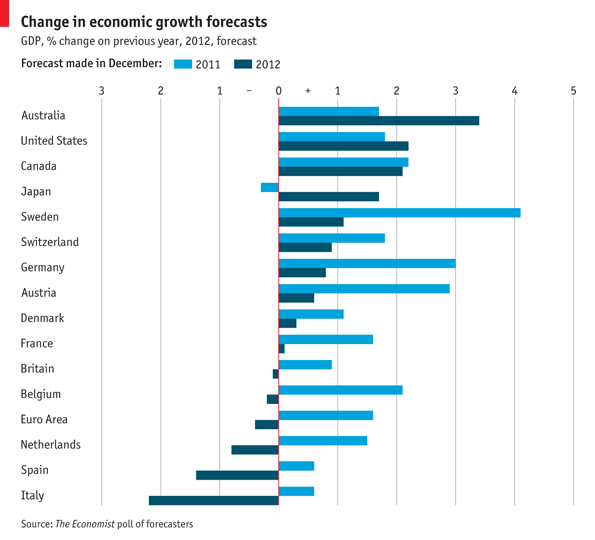
Precarious predictions

Source: The Economist

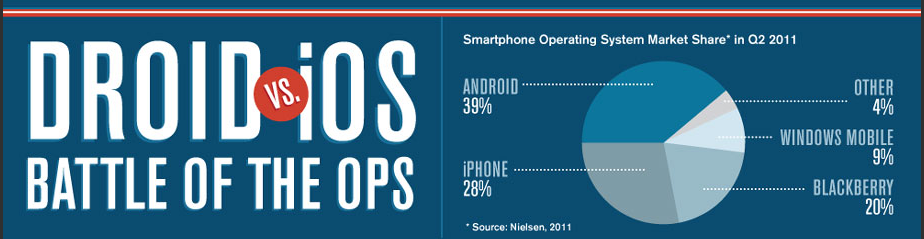
Droid vs iOS

Posted: 11 Dec 2012 11:30 AM PST

click for complete infographic


click for ginormous graphic

Social Security: Best-Funded Government Program

Posted: 11 Dec 2012 10:00 AM PST

Social Security Is the Best-Funded Government Program

Source: Yahoo

Materially better German investor confidence (ZEW) data

Posted: 11 Dec 2012 09:30 AM PST

Australian NAB November business confidence declined to -9, from -1 in October, the lowest since May 2009. The business conditions index came in at -5, in line with October, the weakest since March 2009. The confidence index is currently 15 points below the long-run average of +6. The report reveals that retail, manufacturing and wholesale was weak, with the mining component slumping to -4, from +25 previously. Construction was flat, with manufacturing the weakest. The A$ declined on the news, but has rebounded back sharply – currently US$1.0514 – amazing !!!;

Recent polls suggest that Mr Abe’s party, the LDP, together with their coalition partner, the New Komeito party, are heading for a victory in the lower house of Parliament – Reuters suggest that they may gain 300 seats out of the 480 seat assembly. The Japan Restoration Party, a conservative and nationalist leaning party, could gain a further 50 seats. Mr Abe has proposed that the BoJ act more aggressively in terms of monetary easing and has suggested a programme of fixed asset fiscal stimulus. Mr Abe has also been more vocal on China’s territorial claims in the South China Seas. A change in Japan’s pacifist constitution would require a 2/3rd majority in both the upper and lower houses, as well as a public referendum, though the interpretation of that policy is easier to accomplish, reports Reuters

Chinese November bank loans amounted to Yuan 522.9bn (US$84bn) of local-currency loans, reports the PBoC, lower than the Yuan 550bn forecast and Yuan 562.2 in the corresponding period last year. M2 rose by +13.9bn Y/Y, lower than the forecast of +14.1%. Total financing came in at Yuan 1.14tr in November, the lowest since August and as compared with Yuan 1.29tr in October. Somewhat disappointing data;

Greece has just announce that they received some  E32bn nominal of bonds as part of their tender. The average price was E0.335 on the Euro. Given the price, the Greeks slightly missed (by E450mmn) their target – another fudge will occur;

Having announced that he would resign as PM over the weekend, Mr Monti has hinted that he may now stand as a candidate for PM. Mr Monti is expected to announce his decision this week;

Italian business lobby, Confidustria, has revised lower 2013 Italian GDP to -1.1%, from -0.6% previously. GDP is expected to contract by -2.1% this year, slightly better than their previous forecast of -2.4%. Debt to GDP is expected to come in just below 125.9% this year and 126.7% next;

German ZEW December (investors) confidence came in at +6.9, significantly better than the -11.5 expected and the -15.7 reading in November. The economic sentiment index is positive for the 1st time since May 2012. The current situation component came in at 5.7, slightly lower than the 6.0 expected and 5.4 in November. The survey, albeit less important than the IFO survey, suggests that Germany will not face a recession next year. Exports to the US and the ROW (ex the EZ) are rising materially. Having said that Germany is expected to announce negative GDP this Q, with the economy stagnating in Q1 2013;

The US trade deficit widened by +4.9% in October to US$42.2bn, from a downwardly revised US$40.3bn in September, though below expectations of a deficit of US$42.7bn. Exports declined by -3.6%, the most since January 2012. Reduced agricultural exports, due to the drought, hurt exports. Exports declined to US$180.5bn, the lowest since February and US$187.3bn in September. However, imports declined by -2.1%, the lowest since April 2011;

US wholesale inventories rose by +0.6% in October, lower than the +1.1% increase in September, though higher than the +0.4% expected.

US NFIB small business optimism index came in at 87.5 in November, lower than the 92.5 expected and 93.1 in October;

Outlook

Asian markets closed mixed. European markets are higher on the better German ZEW news. US markets are higher as well, as there is more optimism over the possibility of a deal between the Democrats and the Republicans on the fiscal cliff. In addition, the markets expect that the FED will increase its QE programme tomorrow.

The ZEW data has also helped the Euro, which is currently trading around US$1.30.

Spot gold is trading around US$1707, with January Brent at US$106.60 – oil has been weakening recently and my chartist friends suggest suggest that oil could weaken even further.

All awaiting the FED’s decision re potentially an increased QE programme tomorrow.


Kiron Sarkar


12th December 2012


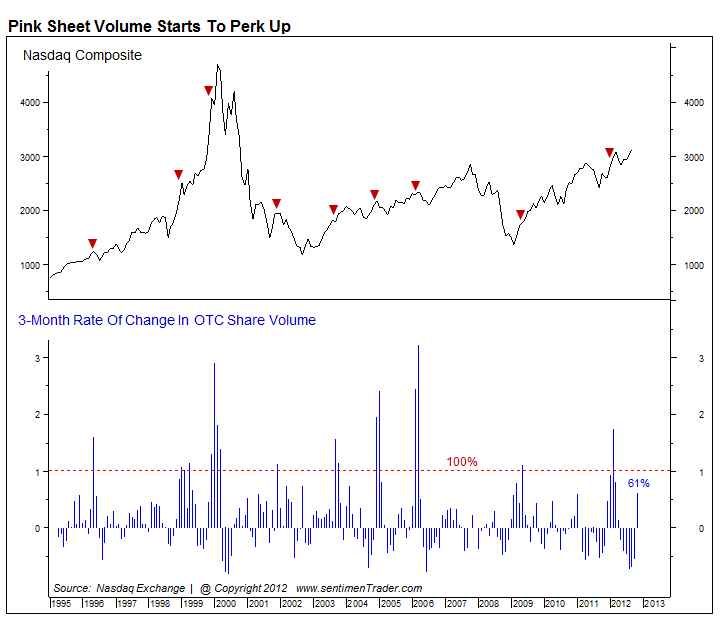
Penny Stock Trading Jumped >50% in November

Posted: 11 Dec 2012 08:30 AM PST

click for larger chart

Source: SentimenTrader


There is not much to say about this, other than its not where you want to see the flows of capital rolling to over the long haul . . .

10 Tuesday AM Reads

Posted: 11 Dec 2012 06:45 AM PST

My morning reads:

• Investing forecasts omit key factor: Luck (FT Alphaville) see also Silly Season Begins! (The Reformed Broker)
• Analysts Get Gloomy, Right on Schedule (WSJ)
• A Cooperative Approach on 'Too Big to Fail' Banks (DealBook)
see also The UK is well ahead of the US and the EU in its use of fiscal rules (London School of Economics and Political Science)
• MBS industry takes a hit in second NY ruling on trustee liability (Thomson Reuters)
• High-Frequency Trading: A Grave Threat to the Markets and the Economy (24/7 Wall St)
• Homebuilders Boom as Lending Masks Uneven U.S. Recovery (Bloomberg)
• China's banking Weapons of Mass Ponzi problem pops up again (FT Alphaville)
• Google Revenues Sheltered in No-Tax Bermuda Soar to $10 Billion (Bloomberg) see also Windows 8's Clarity Problem (Bits)
• Opportunity, a Mars Rover Past Its Best-By Date, Keeps Going (NYT)
• The history of AOL as told through New York Times crossword clues (Quartz)

What Are You Reading?


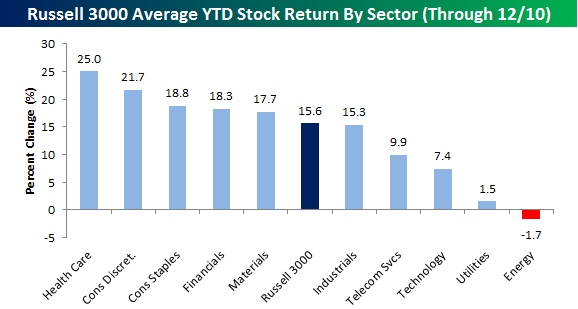
Russell 3000 Top Performing Sectors YTD

Source: Bespoke

Trade Deficit/imports, exports weak

Posted: 11 Dec 2012 05:51 AM PST

While out online late yesterday, today’s paper version of the WSJ is reporting that the “Obama-GOP Cliff Talks Take Positive Step…Neither Side Gives Details, but Strict Moratorium on Public Comments is Considered Sign of Progress at Bargaining Table.” We’ll see but while we wait, small businesses are getting more and more fed up. The NFIB small business optimism index was not optimistic as the index fell sharply to 87.5 in Nov from 93.1, to the lowest since March ’10. Most glaring, those that Expect a Better Economy plummeted to -35% from +2%. The NFIB claims that 1mm small businesses will be hit by the hike in taxes on the top 2%. In Asia, China said bank loans in Nov totaled 523b yuan, bouncing a touch off the lowest since Sept ’11 but was a bit below expectations of 550b. Money supply growth was 13.9% y/o/y vs the est of 14.1%. In response to both data points, the Shanghai index fell .4% off its 4 week high. Business confidence in Australia fell to the lowest since Apr ’09 as they deal with a strong Aussie$ and China moderation. Indonesia left rates unchanged as expected. In Europe, investors are optimistic for the German economy over the next 6 mo’s but less so currently. The ZEW expectations component rose to +6.9 from -15.7, positive for the 1st time since May but the Current situation was +5.7 vs +5.4 (lowest since June ’10), slightly below the est of +6.0. Spain sold 12 and 18 mo bills that went well as 3.89b euros were sold vs their max target of 3.5b. Yields in Spain and Italy are lower after yesterday’s move up. Greek stocks are up 1.6% and the 10 yr bond is at a new high of .44 as more signs point to Greece meeting the 30b euro buyback target level.

Peak Oil or Peak Energy? – A Happy Solution

Posted: 11 Dec 2012 05:30 AM PST

Peak Oil or Peak Energy? – A Happy Solution
By John Mauldin
December 10, 2012


Looking Over My Shoulder
It Takes an Entrepreneur
The Line of Death
Get a Job
Not Everyone Can Run a Surplus
Peak Oil or Peak Energy? – A Happy Solution
New York, Cleveland, and Europe


A consistent theme in this letter has been the connections between items that may seem to be far removed from each other but are actually linked at the very core. If you push on one end you get a reaction in what would seem to be the most unlikely spots. Today we explore the connection between the fiscal deficit and energy policy. Everyone in Washington is starting to "get religion" about wanting to fix the deficit, with serious thinkers on all sides acknowledging that there must be reform and a path to a balanced budget. Burgeoning healthcare and Social Security costs are rightly pointed to as the problem, and entitlement reform will soon be front and center.

But the fiscal (government) deficit in the US cannot go away unless we also deal with the trade deficit. As we will see, it is a simple accounting issue, and one based on 400 years of accepted accounting principles. And dealing with the trade deficit in the US means working with our energy policy.

The trade imbalances among the partners in the eurozone are at the heart of the problems there as well. And while we will get back to Europe in a few weeks (remember when we seemed to be focused on Europe and Greece for months on end?), today we will explore the trade problem from a US perspective. Happily, this problem, while serious, does have a workable solution. And it might even happen in spite of government policy, though if a proactive energy policy were developed, it could ignite a true economic renaissance.

I have been wanting to explore the implications of the shale oil revolution. Old oil fields are wearing out, as peak oil advocates point out. Where can we find the huge and cheap-to-exploit oil fields to replace them? Hasn't all the easy oil already been found? We will start in the Texas of my youth, journey to North Dakota where I was last week, and then think about the implications of that journey. There are many connections and interesting paths to explore. The letter will print a little long, as there are a lot of charts.

Looking Over My Shoulder

But first, this is the month when economists and investment analysts trot out their annual forecasts. I traditionally make mine the first week in January, after I read scores of other forecast the last three weeks of the year. It's just something I have done for many years. I make a point of reading those I suspect I might disagree with to help me with my own thinking. It helps keep me in the middle of the road.

This year you can share in that experience with me, if you like. I publish a service called Over My Shoulder, in which I highlight 5-10 items a week (out of the hundred or more that I read) that I think are worthy of your attention. My reading is quite eclectic and broad, which is reflected in my choices for posting. The subscribers to Over My Shoulder have given me very positive feedback, for which I am grateful.

In essence, I act as your personal filter for news that is important to your investments and money management, generally from sources you won't encounter in your own regular reading. This year in OMS I will highlight what I think are some of the better and more well-reasoned annual forecasts. I think you will find it quite useful. You can subscribe by going here. I am often told I should charge more for the service, but I think it is a reasonable price. I certainly charge less than I would if I were paying someone else to round up these pieces, and you get access to all my sources, some of which are quite pricey. You can subscribe risk-free and read and think along with me about the coming year. And now, come along with me to the Bakken.

It Takes an Entrepreneur

First though, I have to take you back to Wise County, Texas, about 60 miles west of Fort Worth. A Greek goat herder named Savas Paraskivoupolis (who changed his name to Mitchell) came to Galveston in 1905. His son George Mitchell worked his way through Texas A&M and got a degree in petroleum engineering. After the war, George teamed up with his brother Johnnie and Merlyn Christie. They drilled their first well in 1952, in what became known as the Boonesville Field in Wise County, near Bridgeport where I grew up. They went on to drill hundreds of gas wells but had to shut them down because they had no way to deliver the natural gas they found in abundance. The work was done at serious financial risk, but they just kept drilling and plugging those wells. Finally a contract for a pipeline was financed by an Illinois utility, and those wells went into production.

What started as Christie, Mitchell and Mitchell soon became a major employer in my little hometown and a powerful spur to the local economy. The future father-in-law of my childhood best friend was first permanent North Texas employee, back in the early 1950s, and he was eventually joined by the fathers of many of my friends.

Over the coming years Mitchell would drill over 10,000 wells, with over 1000 of them being wildcat or exploratory wells. He is a legend. His story is reminiscent of that of Walt Disney, who also lived constantly on the edge of crisis in the early days of his business. In the late '80s and early '90s Mitchell pioneered a new drilling method called horizontal drilling. It is still hard for me to imagine, that there is a small amount of flexibility in what seems like rigid steel pipe. Over hundreds of feet of drilling, they can turn a pipe inch by inch until it describes a 90° arc.

Everyone knew there was more gas deeper in the ground, but it was trapped in very tight shale formations. Mitchell and his engineers figured out how to put water under pressure back into the earth to create very minute fractures that allowed the gas and oil to be freed. This is the process known as hydraulic fracturing, or fracking. In the '90s and especially the last decade, there has once again been an oil and gas boom in Wise county, in what is called the Barnett Shale. Except, the Barnett Shale is a far more massive formation than the original Boonesville field. Once again Texas was at the center of US energy production. The new technology opened up vast new reserves that were impossible to get to just a few years ago.

And then it turned out there were potentially even larger shale oil fields scattered throughout the United States – and, as we are learning, seemingly everywhere in the world. The first modern oil wells were drilled in Poland in 1854 at around 100 feet in depth, and now exploratory wells show that 11,000 to 13,000 feet below the surface there is considerably more oil and gas in Poland and the surrounding region.

In contrast to today's deep wells, the legendary Drake Well was drilled in Titusville, Pennsylvania, in 1859 at a depth of 69 feet. And there is evidence of ancient oil drilling using bamboo pipes in China. Marco Polo remarked on bubbling springs of oil in what is now Azerbaijan.

And that brings us to the Bakken shale oil and gas fields. I was invited to speak to the customers of BNC Bank in North Dakota by its president and CEO, Greg Cleveland, last week. He graciously offered to take me on a helicopter tour of the Bakken Field if I would come a day early, which I of course agreed to do. As a special bonus, he arranged for Loren Kopseng to be our tour guide. Loren didn't drill the first well in the Bakken, but he was there by the time the third well went in, and he now owns a piece of about 20% of all the wells drilled in the region. (There are over 7,000 wells in the region and counting.)

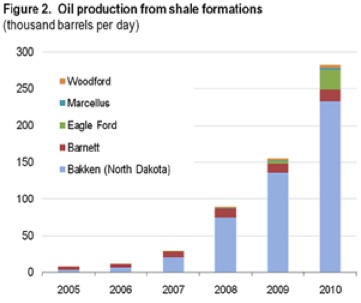
Today the Bakken overshadows the Barnett. Notice in the graph below how rapid the growth has been. More recently, permits were granted for 904 wells in August, September, and October 2012, with October being the record with 370 wells.

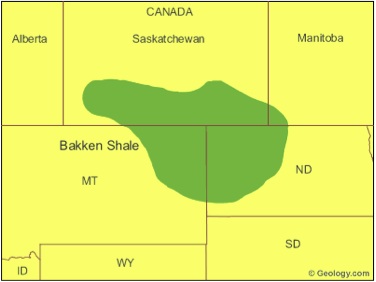
We flew the 50-odd miles from Bismarck to the edge of the Bakken, over the famous Badlands (which I found quietly beautiful) to what Loren called the line of death. On one side of the line, if you drilled you would get a dry hole. On the other side there is an amazing reported 99% success rate. The field stretches from western North Dakota and eastern Montana up into Saskatchewan, Canada.

The Line of Death

Easy money, right? Just punch a hole in the ground and count your money. Today, perhaps, but not in the beginning. As we were flying, Loren asked me what I knew about oil drilling. I had to admit I didn't know much, except that my best friend Randy Scroggins from elementary school wouldn't let me invest in his oil company in 1981.

Loren laughed and said Randy was a very good friend indeed – and added that "1981 was the first time I went bankrupt." While Loren grew up in Bismarck, he would have been at home in Texas. He is the quintessential wildcatter, straight out of central casting. There is a certain infectious enthusiasm that seems to emanate from that special breed of entrepreneur called an oil man. Not only do you have to put up with the potential for drilling a dry hole, whereupon you lose all your money, you have to contend with the ups and downs in oil prices. While the major oil companies have become more conservative players, the real cutting edge is among smaller independents. And Loren is at the knife point of the cutting edge.

Flying into the heart of the field reminded me of my roots in Bridgeport. Drilling for oil is not pretty. It is actually fairly messy, although I must say there is seemingly much greater care taken to keep things neater than what I remember as a kid. Flying over completed wells, when it was just the pump and storage containers, showed a relatively small footprint, with the land being farmed right to the edge of the pad.

In my experience, oil wells were drilled pretty densely across the land, as you could only drill straight down. You basically got only the oil that was right underneath your well. In fracking shale oil, there is less need to put wells so close together. There is typically only one drilling pad for one section of land, that is, 640 acres or one square mile. Current technology is improving even on that, as a well can go down two miles and then turn horizontally another two miles.

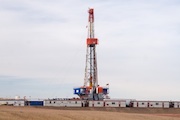
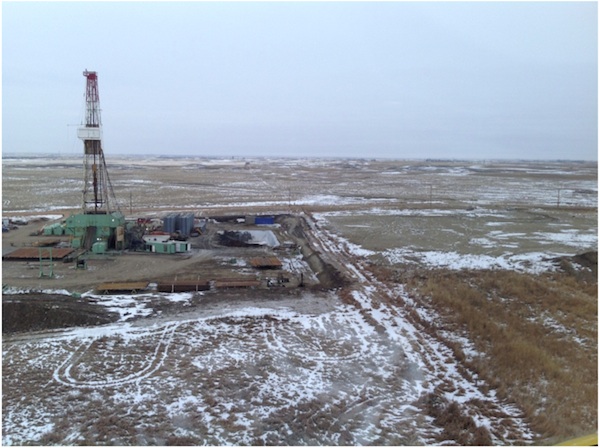
I took the picture below my with my iPad as we were flying into this well for a tour. That drilling pad will be cleaned up and once again become part of the farmland that surrounds it today. That is a pretty massive rig, but it can be torn down, moved, and set back up in seven days.

A quick tutorial on shale oil: Global shale oil reserves are currently estimated at over three trillion barrels recoverable under current technology. The US has well over two trillion of those barrels. (Average estimates from numerous sources.)

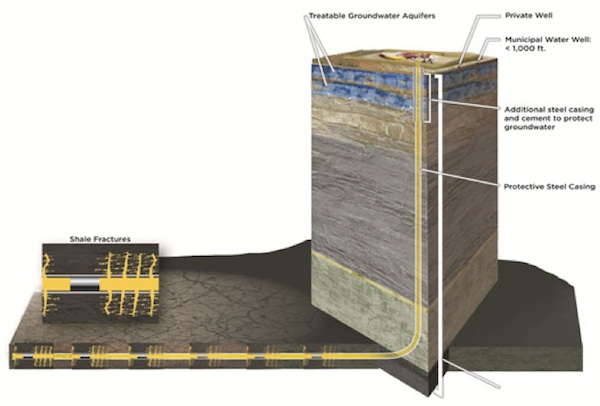
The illustration below shows the typical construction of a shale oil or gas well. Note that the drill holes are "cemented" in around the pipes so that nothing can leak into the surrounding earth. Shale oil and gas lie very deep under very nonporous layers of rock. There are very serious environmental rules about drilling and fracking (as there should be). A large portion of the drilling rig is containment for the water and other fluids that come from the drilling. The waste fluids are not dumped onto the local ground.

No serious person would allow fracking near the water table. That does not mean there is not oil and gas in the water table already. Stockton, California lighted its county courthouse in 1854 with natural gas from a local water well. California has thousands of naturally occurring seeps. In the Gulf of Mexico, there are more than 600 natural oil seeps that leak between five hundred thousand and one million barrels of oil per year. When a petroleum seep develops underwater it may form a peculiar type of volcano known as an asphalt volcano. The ecological system has evolved certain bacteria that thrive on the oil seeps. One of the interesting things about the British Petroleum oil-spill disaster in the Gulf of Mexico was the disappearance of the oil over a few years. While it was a true disaster, it is theorized that the bacteria multiplied to deal with the crisis. But it took a long time. There is no excuse for what BP did.

As far as I can research from true experts, properly done, horizontal drilling and fracking pose no danger to the environment. (That is different from saying that burning gas in our cars has no impact. Different topic. I'm all for my electric car powered by nuclear energy.)

Notice in the illustration above the small gray areas in the horizontal pipe. Loren took me to a pile of what he called "jewelry." These are about four-foot-long marvels of technology encased in beautiful stainless steel, looking like shiny gems along the dark string of iron pipe. The first wells drilled in the Bakken had just one "jewel." While there is some debate about how many jewels to use to maximize fracking effectiveness in a two-mile pipe, I think I remember Loren saying that they are using up to 37. (It might have been 23, but oddly, I do remember it was definitely a prime number.)

Loren simply went into raptures describing the technology in each of those jewels. Since it was 9° out, with the wind chill taking it down to about -15° and I was not appropriately dressed, I might have missed a point or two.

The US Energy Information Administration (EIA) reports that over 750 trillion cubic feet of technically recoverable shale gas and 24 billion barrels of technically recoverable shale oil have been discovered in shale plays. Except that they are reportedly having to update their update. Just five days ago they announced new projections that suggest US energy imports (as a share of production) will fall in half in the next 30 years. (This does not include any new sources of non-carbon-based energy – new technology can make estimates turn out quite wrong.)

Harold Hamm and Continental Resources drilled the first horizontal well to use fracking in the Bakken in 2004. He knows something about the region. He is now telling us that there may be four more layers (which are called benches) of shale oil and gas below the Upper Bakken formation, including the promising Three Forks stratum. Just a week ago (onDecember 3), Continental announced they had completed a well in the "third bench." The Three Forks could be a bigger story than the Upper Bakken formation, as it is much thicker. Hamm is projecting almost a trillion barrels of reserves in the area.

What Loren thinks will happen is that the new drilling rigs that can move themselves will soon drill as many as 16 holes from one pad, into all the various levels and in different directions. Punch a hole in the ground, complete the well, move the rig over a bit and start the process again. That really helps keep down the cost of drilling, as does each bit of new technology.

Get a Job

North Dakota is the third most productive energy state, on its way to being number two, behind Texas. And that is creating jobs. Lots of jobs. Unemployment in the Bakken region is 1%. $10-15 an hour for working in a fast food restaurant, if you can even find someone to work for so little.

Let me give you a rundown on what I found. When we went into the "office" of the rig there was a young man who looked to be in his early 30s. He was a "tool-pusher," which means he ran the rig. Clearly very smart and trustworthy, but he didn't have a college degree, just lots of oil-field experience. He works 28 days, 12 hours a day straight and then takes two weeks off to go see his wife and kids. When working he lives in a small room at the rig. He makes $350,000 a year. The kid is one of those millionaires and billionaires that Obama wants to tax.

A starting salary on the rig is $120,000 a year, with no experience. But you work your tail off for very long hours. The consultant who oversaw the rig operation for the investors made around $250,000. (By the way, he could tell me to the dollar what his costs were for the well during the hour we were there. There were very sophisticated cost controls.)

An oil-truck driver makes $150-175,000 a year. All that oil has to be taken by truck to a railroad terminal and loaded onto railcars, to form 100-car trains that take the oil to refineries around the country. Loren took us to his new train terminal, where the trucks were lined up to empty their tanks and go back to another well for a load. All up and down the line, there are jobs that are begging to be filled.

But working in the oil field is hard work and a difficult life. That starter oil-rig job? It looked quite dangerous to me. Campgrounds packed with small trailers are everywhere. There are "man camps," which are glorified dormitories that can cost as much as $3,000 a month for room and board. Construction? If you can swing a hammer in the cold, you can have a job. Most people seemed to work for 14 or 28 days (12 hours) and then take a week or two off.

Within a few hours of being in Bismarck, my son Chad was offered a job at about 50% more than he could make here in Dallas. (The local bank president took him and another man on a tour of Bismarck while I was in the air, so Chad did have some job-hunting help.)

I went to a Christmas party that night for the customers of the bank – as nice a group of people as you could want to meet, many of them local farmers who drove in for the conference. If you own a farm with mineral rights, your life has changed in recent years.

As a side note, Loren pointedly told me that Greg Cleveland (founder and chairman of BNC Bank) had loaned him $1 million to get his current business started back in 1985 when no one else would. The level of trust between these two was obvious. That night, bank customers came up and literally kissed Greg on the cheeks, while telling me how he had loaned them the money to start their businesses "back in the day." Not just in the oil business, either. That type of banking relationship is hard to find these days. Lloyd Blankfein (Goldman Sachs CEO and chairman), eat your heart out. This is small-town banking as it's supposed to be (we had that once in Texas).

As I noted a few weeks ago, shale gas will add about 0.5% to the growth of US GDP next year, in a year when we will be lucky to get 2%. This is a huge driver of jobs and growth. And it is not just in North Dakota; there are shale gas plays all over the US and Canada. Continental Resources announced a major new shale gas field in Oklahoma in October, comparing its geology to that of the Bakken.

The US will be exporting natural gas within 3-4 years from McAllen, Texas, and other LNG ports are in various stages of permitting. Natural gas in Japan is over $15, compared to $3.78 this morning in the US. Europe is in double digits ($11.83). There is an arbitrage available here. Even an economist can do the math.

But our real advantage may not come in exporting raw gas but rather in the chemical products you need gas to make. Not just fertilizers but feedstocks for plastics and other organic chemicals.

The Financial Times wrote last Saturday, “Europeans are already complaining that cheap US gas is encouraging a flight of energy intensive businesses [to the US]. How can, say Europe’s chemical producers – buying expensive Russian gas – compete with US rivals guaranteed access to cut-price feedstock?" (Hat tip Vincent Farrell.)

One way for them to compete is, perhaps, to develop their own (seemingly considerable) shale oil and gas fields. But there seems to be a great deal of resistance to that. And that reluctance will help the US close its trade deficit.

Not Everyone Can Run a Surplus

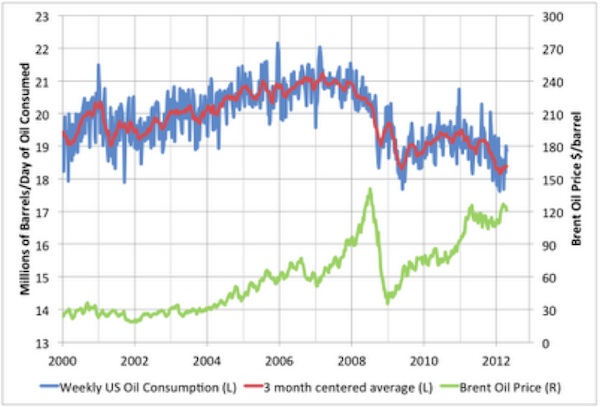
The chart below shows that we are spending more for energy even as we use less of it, and that drives up our trade deficit. Let's see why this matters. As long-time readers know, I have often written about how you cannot balance private and government deficits without a positive trade balance. Let me quickly review.

It is the desire of every country to somehow grow its way out of the current mess. And indeed that is the time-honored way for a country to heal itself. But let’s look at an equation that shows why that might not be possible this time. We have here another case of people wanting to believe six impossible things before breakfast.

Let’s divide a country’s economy into three sectors: private, government, and exports. If you play with the variables a little bit, you find that you get the following equation. Keep in mind that this is an accounting identity, not a theory. If it is wrong, then five centuries of double-entry bookkeeping must also be wrong.

Domestic Private Sector Financial Balance + Governmental Fiscal Balance – the Current Account Balance (or Trade Deficit/Surplus) = 0

By Domestic Private Sector Financial Balance we mean the net balance of businesses and consumers. Are they borrowing money, or paying down debt? Government Fiscal Balance is the same: is the government borrowing, or paying down debt? And the Current Account Balance is the trade deficit or surplus.

The implications are simple: the three items have to add up to zero. That means you cannot have surpluses in both the private and government sectors and run a trade deficit; you have to have a trade surplus.

Let’s make this simple. Let’s say that the private sector runs a $100 surplus (they pay down debt), as does the government. Now, we subtract the trade balance. To make the equation come to zero there must be a $200 trade surplus:

$100 (private debt reduction) + $100 (government debt reduction) – $200 (trade surplus) = 0.

But what if the country wanted to run a $100 trade deficit? Then either private or public debt would have to increase by $100. The numbers have to add up to zero. One way for that to happen would be:

$50 (private debt reduction) + (-$150) (government deficit) – (-$100) (trade deficit) = 0. (Note that we are adding a negative number and then subtracting a negative number.)

Bottom line: you can run a trade deficit, reduce government debt, or reduce private debt, but not all three at the same time. Choose two. Choose carefully.

Peak Oil or Peak Energy? – A Happy Solution

The US is lucky; there is plenty of oil and gas below our borders, with much of it in private hands. There are estimates the US could be energy independent within 7-10 years. But it will not be easy. Skeptic Arthur Berman recently presented Oil-Prone Shale Plays: The Illusion of Energy Independence. He estimates that it will take 1,488 new wells a year in the Bakken just to replace the oil currently produced there, as wells deplete over time. He argues (quite well) that the US will not become energy independent. You can read his report at http://www.sipeshouston.org/Presentations.sh.sem.10.2012/8%20Oil%20Shale.pdf

His analysis suggests that oil prices will have to remain high or go even higher for shale oil to be profitable. I think he is right on that. I have always maintained that we are not likely to run out of oil for a very long time; we will just run out of cheap oil. Thankfully, there are alternatives being developed over time. The cost of producing solar energy has dropped about 50% per decade for a long time. In another few decades solar will be quite competitive with carbon-based energy. Nuclear remains my favourite shorter-term source, but it confronts considerable political opposition in many countries.

But in the meantime, we should open up public lands for commercial drilling. And we should do it for a price. Texas finances a great deal of its higher education from oil and gas royalties for wells on state land. US government land should be used to produce revenue as well. New technologies allow for environmentally sensitive use of land. Not only will increased drilling produce needed revenue from royalties and taxes, it will create jobs and allow the possibility of eliminating the trade deficit. What a happy solution! And compared to healthcare, this should be easy!

And why do I think all this can happen? Because of the cast of characters who will keep raising money and drilling for oil and gas. Guys like Loren Kopseng and Harold Hamm, who are just a force of nature and will get it done. These are the true entrepreneurs, who are the main source of our new jobs. If we can keep them from being saddled with too-high taxes and too many rules, they will build that future for us.

There are scores if not hundreds of these larger-than-life characters, with a few good bankers like Greg Cleveland to back them. Let's turn them loose!

New York, Cleveland, and Europe

I will leave Tuesday for a trip to NYC to meet with my partners in Mauldin Economics to do our own annual planning and forecast work. The recent webinar was well-received and -reviewed (start here). The next week I jump to LA/San Diego for a planning session with Jon Sundt and my partners at Altegris. I can honestly say I have never been as excited about the prospects for a coming year. There are so many great new things we will be doing. But as with Christmas presents, I can't tell you – it would spoil the surprise.

I will be on Tom Keene at 6 AM Eastern on Wednesday, so no late night for me. Thursday I go to Cleveland to stay with Dr. Mike Roizen for a night and then have some doctors poke and prod me on Friday, before heading back home.

As a side note, I have run across an odd statistic. Long-time readers know that I have recommended a face cream with stem cells in it. It really does rejuvenate the skin. It turns out that over 50% of the customers are men. That was a surprise. I hear great reviews and receive thanks from all over from people who use it. It makes a great Christmas present. Go to https://www.lifelineskincare.com/content/ahead-curve-december-2012 to get yours at a very special price for the season. You will be glad you did!

Today we had a birthday party for my granddaughter Lively, who turned three this week. There were 16 people at the brunch table at Del Frisco's Grille (my new favourite Sunday brunch place – awesome food!). All seven kids once again, along with significant others, grandkids, et al.

It is very interesting to watch your kids grow up, have their own successes, and deal with their problems. I remember struggling as a young man and watching my dad struggle as well. Those days back in Bridgeport? He owned a very nice gravel trucking business but went bankrupt in the late '50s and had to start over. It was tough on him at 50 years of age to start again, and we struggled to make ends meet. I had to go to work very early. It was good for me, as I look back, but I have tried to help my kids not to have to deal with some of the same concerns. And I will admit I would not have minded a little help with college.

I think Chad is going to move to Bismarck after the holidays. Abbi is getting married in the spring and will stay in Tulsa. Amanda will bring another granddaughter into my life in the spring, too. She just took it upon herself to decorate my house for Christmas, and it looks the best it ever has. And the tree, for whatever reason, is especially fragrant this year. Changes are everywhere and yet some things stay the same. And that's the way I like it.

I was reminded of that last week, when I spent the day with Newt Gingrich in DC. Of course we talked about the current political scene and the fiscal problems. He always seems to have a particular story from history to illustrate his views. But what we talked about the most was not the past or the present but the future. And not the political future but our shared enthusiasm for the accelerating pace of technological change. There is just so much to be optimistic about, even as we worry over the current economic issues.

I am working with Bill Dunkelberg on our book on the future of employment,  and I will then turn to writing my book on where the world will be in 20 years. This one has been in the planning stages for far too long. No one in 20 years will want to go back to the good old days of 2012. I know people sometimes think (wrongly) that I am of a bearish disposition, but that is just not true. I am just bearish on governments.

Europe will be a whirlwind. Norway, Copenhagen, Sweden for the Skagen Funds, and then on to Dublin for the weekend. And then to London for an evening meeting, followed by meetings in Greece. I have my travel plans laid out except for Europe, January 16-20. If you have a suggestion or a media contact, let me know. And on the 20th I go to Geneva before heading back to Dallas on the 22nd. Quite the trip.

Have a great week, and hopefully you'll be home for the season. All the best.

Your strangely wishing he had more time in Bismarck,John Mauldin

subscribers@mauldineconomics.com

Nighttime Earth From Space

Posted: 11 Dec 2012 05:00 AM PST

click for more photos

Source: Wired

.

0 comments:

Post a Comment

previous home Next

{8} chatroll


{9} AdBrite FOOTER

{8} Nice Blogs (Adgetize)