There are two systems of justice in America … one for the big banks and other fatcats, and one for everyone else. See this, this, this and this.
The system is rigged to allow the big banks to commit continuous and massive fraud, and then to pay small fines as the "cost of doing business". As Nobel prize winning economist Joseph Stiglitz noted years ago:
"The system is set so that even if you're caught, the penalty is just a small number relative to what you walk home with.
The fine is just a cost of doing business. It's like a parking fine. Sometimes you make a decision to park knowing that you might get a fine because going around the corner to the parking lot takes you too much time."
Now – with the slap on the wrist of giant HSBC for laundering huge sums of drug money (the Guardian points out that "the sum represents about four weeks' earnings given the bank's pre-tax profits of $21.9bn last year") – even the mainstream press is starting to catch on.
Congressional hearings exposed weaknesses at the Office of the Comptroller of the Currency, the national bank regulator. In 2010, the regulator found that HSBC had severe deficiencies in its anti-money laundering controls, including $60 trillion in transactions and 17,000 accounts flagged as potentially suspicious, activities that were not reviewed. Despite the findings, the regulator did not fine the bank.
During the hearings this summer, lawmakers assailed the regulator. At one point, Senator Tom Coburn, Republican of Oklahoma, called the comptroller "a lap dog, not a watchdog."
It is a dark day for the rule of law. Federal and state authorities have chosen not to indict HSBC, the London-based bank, on charges of vast and prolonged money laundering, for fear that criminal prosecution would topple the bank and, in the process, endanger the financial system. They also have not charged any top HSBC banker in the case, though it boggles the mind that a bank could launder money as HSBC did without anyone in a position of authority making culpable decisions.
Clearly, the government has bought into the notion that too big to fail is too big to jail. When prosecutors choose not to prosecute to the full extent of the law in a case as egregious as this, the law itself is diminished. The deterrence that comes from the threat of criminal prosecution is weakened, if not lost.
***
Even large financial settlements are small compared with the size of international major banks. More important, once criminal sanctions are considered off limits, penalties and forfeitures become just another cost of doing business, a risk factor to consider on the road to profits.
***
According to several law enforcement officials with knowledge of the inquiry, prosecutors found that, for years, HSBC had also moved tainted money from Mexican drug cartels and Saudi banks with ties to terrorist groups. Those findings echo those of a Congressional report, issued in July, which said that between 2001 and 2010, HSBC exposed the American "financial system to money laundering and terrorist financing risks."
If banks operating at the center of the global economy cannot be held fully accountable, the solution is to reduce their size by breaking them up and restricting their activities — not shield them and their leaders from prosecution for illegal activities.
The Washington Post writes that its not just HSBC:
A string of august names in global banking — Credit Suisse, Lloyds Bank, ABN Amro, ING Bank and now HSBC — have reached settlements in the past couple of years with the U.S. government for billions of dollars in tainted transactions. These investigations have revealed that weaknesses in the financial system lay not with the so-called hawala brokers of Karachi, Pakistan, but the bespoke bankers of London, Amsterdam and Geneva, and their American affiliates.
***
The settlement drew criticism that HSBC had escaped lightly, given the gravity and scale of the crimes.
"If these people aren't prosecuted, who will be?" asked Jack Blum, a Washington attorney and a former special counsel for the Senate Foreign Relations Committee who specializes in money laundering and financial crimes. "What do you have to do to be prosecuted? They have crossed every bright line in bank compliance. When is there an offense that's bad enough for a big bank to be prosecuted?"
"Steal a little," wrote Bob Dylan, "they throw you in jail; steal a lot and they make you a king." These days, he might recraft the line to read: deal a little dope, they throw you in jail; launder the narco billions, they'll make you apologise ….
***
The dealings had been flagged up to HSBC bosses by an anti-money laundering officer, but to no avail – the dirty business continued.
***
[A couple of years ago, when Wachovia was busted for laundering drug money,] no one from Wachovia went to jail – and, said Woods at the time of the settlement: "These are the proceeds of murder and misery in Mexico, and of drugs sold around the world. But no one goes to jail. What does the settlement do to fight the cartels? Nothing. It encourages the cartels and anyone who wants to make money by laundering their blood dollars."
***
Wachovia was not the first, neither will HSBC be the last. Six years ago, a subsidiary of Barclays – Barclays Private Bank – was exposed as having been used to launder drug money from Colombia through five accounts linked to the infamous Medellín cartel.
***
And the issue is wider than drug-money. It is about where banks, law enforcement officers and the regulators – and politics and society generally – want to draw the line between the criminal and supposed "legal" economies, if there is one.
***
No one was sanctioned under criminal law last month when the ING bank was fined $619m for illegally moving billions of dollars into the US banking system….
***
A foremost trainer of anti-money laundering officers in the US is Robert Mazur, who infiltrated the Medellín cartel during the prosecution and collapse of the BCCI bank in 1991, and who tells the Observer that "the only thing that will make the banks properly vigilant to what is happening is when they hear the rattle of handcuffs in the boardroom".
***
"People don't like to ask how close the banker's finger is to the trigger of the killer's gun," says Woods.
But in this newspaper – when we revealed the original "cease and desist" order against HSBC – the former head of the UN Office on Drugs and Crime, Antonio Maria Costa, posited that four pillars of the international banking system are: drug-money laundering, sanctions busting, tax evasion and arms trafficking. [indeed, drug dealers kept the banking system afloat during the depths of the 2008 financial crisis.]
The response of politicians is to cower from any serious legal assault on this reality, for the simple reasons that the money is too big (plus consultancies to be had after leaving office). The British government recruits a former chairman of HSBC as trade secretary just as the drug-laundering scandal breaks.
***
The notion of any dichotomy between the global criminal economy and the "legal" one is fantasy. Worse, it is a lie. They are seamless, mutually interdependent – one and the same.
"Wachovia's blatant disregard for our banking laws gave international cocaine cartels a virtual carte blanche to finance their operations," said Jeffrey Sloman, the federal prosecutor. Yet the total fine was less than 2% of the bank's $12.3bn profit for 2009. On 24 March 2010, Wells Fargo stock traded at $30.86 – up 1% on the week of the court settlement.
The conclusion to the case was only the tip of an iceberg, demonstrating the role of the "legal" banking sector in swilling hundreds of billions of dollars – the blood money from the murderous drug trade in Mexico and other places in the world – around their global operations, now bailed out by the taxpayer.
"The message this is sending is if you want to engage in money laundering, make sure you're doing it within the context of your employment at a bank," [University of Notre Dame law professor Jimmy Gurulé, a former assistant U.S. Attorney General and former Undersecretary for Enforcement for the U.S. Treasury Department] said in a phone interview. "And don't go small. Do it on a very large scale, and you won't get prosecuted."
"It's essentially telling the executives in these institutions crime pays," Neil Barofsky, former Special Inspector General for the Troubled Asset Relief Program, the government's bailout program, told CNN. "Go ahead, do whatever you want to do, enjoy your profits, and the worst thing that happens, well, you have some fines that really make up a couple of weeks of profits that you lose."
DOJ's actions with regards to HSBC are … downright terrifying for weakening the general deterrence for megabanks, both foreign and domestic, which could rationally interpret yesterday's actions as a license to steal.
***
Yesterday's action now spikes the punch with a new toxin, confirmation that criminal penalties are off the table, leaving a worst-case scenario of a fine totaling far less than even a single quarter's earnings. Given the potential profits of criminal behavior and the unlikelihood of personal consequences for the executives directing it, the message is clear: Crime pays. This will inevitably lead to more reckless risk-taking that will further undermine systemic stability and lead to an even greater financial meltdown down the road.
When you decide not to prosecute bankers for billion-dollar crimes connected to drug-dealing and terrorism (some of HSBC's Saudi and Bangladeshi clients had terrorist ties, according to a Senate investigation), it doesn't protect the banking system, it does exactly the opposite. It terrifies investors and depositors everywhere, leaving them with the clear impression that even the most "reputable" banks may in fact be captured institutions whose senior executives are in the employ of (this can't be repeated often enough) murderersand terrorists. Even more shocking, the Justice Department's response to learning about all of this was to do exactly the same thing that the HSBC executives did in the first place to get themselves in trouble – they took money to look the other way.
(Taibbi also notes that the failure to prosecute HSBC shows that the war on drugs is a joke. He's right; and see this).
The top Wall Street fraud expert – William Black – confirms:
Public reports of the results of the government investigations of HSBC describe a bank that has been a criminal enterprise for at least 15 years. The current settlement addresses only three of the many scandals HSBC has committed over that time period. HSBC is a recidivist of epic proportions, but the Obama and Cameron governments have failed to prosecute HSBC or any of its officers. When powerful corporations and their controlling officers grow wealthy through massive frauds and do so with impunity from criminal sanction integrity and justice are eaten away. Effective financial regulation, supervision, and prosecutions are essential to "free" financial markets. When cheaters prosper honest firms are driven from the markets, a point that the Nobel Laureate George Akerlof explained in his famous 1970 article on markets for "lemons." He described a "Gresham's" dynamic in which bad ethics drove good ethics from the marketplace.
BBC points out that we will end up paying for the banks' sins:
The point, as the Governor of the Bank of England said recently, is that banks may not have adequate capital to absorb the full financial cost of all the punishment being meted out for banks' past sins.
And as you will be tired of hearing, capital is expensive. And when banks are obliged to raise more of it, the burden falls initially on investors and subsequently on customers – who are forced to pay more for banking services to reward the providers of the capital.
Or to put it another way, we are all punished when banks are found guilty.
But even so, Democratic Senator Merkley just wrote a letter slamming the Department of Justice:
Assistant Attorney General Lanny Breuer highlighted just how brazen the violations were, with traffickers depositing "hundreds of thousands of dollars in cash, in a single day, into a single account, using boxes designed to fit the precise dimensions of the teller window." Sanctions violations were equally deliberate, with the bank intentionally stripping information from transactions to avoid detection. Yet despite these clear and blatant violations, the Department of Justice refused to bring criminal charges against the bank, relevant employees, or senior management.
Indeed, Mr. Breuer stated yesterday that in deciding not to prosecute, the Department considered the "collateral consequences" of its decision on the financial system. Mr. Breuer stated "If you prosecute one of the largest banks in the world, do you risk that people will lose jobs, other financial institutions and other parties will leave the bank, and there will be some kind of event in the world economy?" The HSBC decision comes on the back of deferred prosecution agreements with Standard Charter Bank and ING Group related to similar charges.
***
I am deeply concerned that four years after the financial crisis, the Department appears to have firmly set the precedent that no bank, bank employee, or bank executive can be prosecuted even for serious criminal actions if that bank is a large, systemically important financial institution. This "too big to jail" approach to law enforcement, which deeply offends the public's sense of justice, effectively vitiates the law as written by Congress. Had Congress wished to declare that violations of money laundering, terrorist financing, fraud, and a number of other illicit financial actions would only constitute civil violations, it could have done so. It did not.
***
Drug cartels are also increasingly connected to terrorism. According to the Drug Enforcement Administration, 39 percent of State Department-designated foreign terrorist organizations (FTOs) have "confirmed links" to the drug trade, as of November 2011. The consequences to U.S. national security for violations involving terrorism financing … are obvious and severe. Congress deemed criminal law the appropriate tool for punishing and deterring actions that have such serious and damaging public consequences.
***
According to the U.S. Sentencing Commission, jail time is served by over 96 percent of persons that plead or are found guilty of drug trafficking, 80 percent of those that plead or are found guilty of money laundering, and 63 percent of those caught in possession of drugs. As the deferred prosecution agreement appears now to be the corporate equivalent of acknowledging guilt, the best way for a guilty party to avoid jail time may be to ensure that the party is or is employed by a globally significant bank. The Department's deferred prosecution agreements may offer something in the way of promises of future compliance, but they look sorely lacking in justice and accountability.
Merkley also notes that failing to criminally prosecute bank crimes makes the "too big to fail" problem even worse:
Refusing to prosecute on the grounds of financial stability is also troubling from the perspective of ending "too big to fail." The Dodd-Frank Wall Street Reform and Consumer Protection Act, which declared some institutions to be systemically important financial institutions subject to tougher regulation, did not declare that those institutions would be exempt from criminal prosecution. Indeed, the Dodd-Frank Act explicitly created new authority to permit a failed institution to be wound down safely, without impacting financial stability. If a financial institution, because of its criminal actions, ultimately fails, that may indeed be precisely the consequence that justice and accountability demand, and which is so necessary to deterring future illegal behavior. I am deeply concerned that the Department's continuing application of deferred prosecution agreements on the grounds of financial stability runs contrary to the intent of Congress and undermines the accountability to the rule of law that is so fundamental to a healthy, functioning free market economy.
In a separate letter, Republican Senator Chuck Grassley also slammed the justice department:
The Department has refused to prosecute any individual employees or the bank responsible for these crimes. This troubling lack of real enforcement will have consequences for the health of our economy and the safety and prosperity of the American people.
***
Despite the fact that this is a "record" settlement, for a bank as gigantic as HSBC this is hardly even a slap on the wrist. It only amounts to between 9 and 11% of HBSC's profits last year alone, and is a bare fraction of the sums left unmonitored. Additionally, the DPA states that "at least $881 million in drug proceeds" entered the U.S. financial system, but how much more remains undiscovered? Did HSBC profit from the DPA because it actually made more than $1.92 billion by providing services to drug kingpins and terrorists? The American people may never know, because you have declined to prosecute.
Even more concerning is the fact that the individuals responsible for these failures are not being held accountable. The Department has not prosecuted a single employee of HSBC—no executives, no directors, no AML compliance staff members, no one. By allowing these individuals to walk away without any real punishment, the Department is declaring that crime actually does pay. Functionally, HSBC has quite literally purchased a get-out-of-jail-free card for its employees for the price of $1.92 billion dollars.
There is no doubt that the Department has "missed a rare chance to send an unmistakable signal about the threat posed by financial institutions willing to assist drug lords and terror groups in moving their money." One international banking expert went as far as to argue that, despite the "astonishing amount of criminal behavior" from HSBC employees, the DPA is no more than a "parking ticket." A former banking regulator added that it is "mind-boggling" how the Department believes that "you can have a financial system and allow this kind of impunity."Future bank employees with a choice between following the law or profiting from illegal activities will have been taught the lesson that they will never face prison time for their actions. Consequently, this DPA does little to discourage future lawbreakers, and leaves the U.S. financial system highly vulnerable to exploitation by drug cartels and terrorists.
The Department's inexcusable reluctance to prosecute is the continuation of a failed policy allowing lawbreakers to escape justice. In a letter to the Department on March 9, 2012, I noted that the Department had "brought no criminal cases against any of the major Wall Street banks or executives who are responsible for the financial crisis" …. As others have repeatedly warned, failing to prosecute individuals or banks when they have committed crimes will result in perverse incentives and ultimately undermine the integrity of the U.S. financial system and economy.
The United States is already seeing the results of these failed policies. Past settlements with large banks prove that they do nothing to change what appears to be a culture of noncompliance for some businesses. In March 2010, the Department arranged a then-record $160 million deferred prosecution agreement with Wachovia based on its laundering of more than $110 million from Colombian and Mexican drug cartels. Officials at the time stated that "blatant disregard for our banking laws gave international cocaine cartels a virtual carte blanche to finance their operations." In this case, a bank escaped with a record monetary settlement and a conspicuous absence of individuals behind bars. If the story sounds eerily similar, that's because it is. It happened again with HSBC.
Make no mistake, the Department's refusal to prosecute individuals or the bank directly threatens the safety of Americans. After evidence revealed Wachovia's involvement with money-laundering, one whistleblower stated, "[i]t's simple: if you don't see the correlation between the money laundering by banks and the 30,000 people killed in Mexico, you're missing the point." HSBC's criminal actions have no doubt enabled similar violence in Mexico by supporting the very cartels now terrorizing Mexican civilians. This violence often spills over the border into American cities ….
As the Ranking Member of the Senate Judiciary Committee, I have an obligation to ensure that the executive branch is fully, fairly, and effectively enforcing the law. But what I have seen from the Department is an inexplicable unwillingness to prosecute and convict those responsible for aiding and abetting drug lords and terrorists. I cannot help but agree with an editorial in the New York Times that "the government has bought into the notion that too big to fail is too big to jail."
May I throw the DUH flag on all the whining about the $250k top bracket? I am going to go out on a limb and suggest that $500k is a number all sides will live with for the 39% bracket.
First, let’s talk history: That top bracket dates back to 1993, and if we inflation adjust $250k of back to 1993, its closer to $400k. Keep that in mind.
Next, if you have ever bought a used car, a Turkish rug, or engaged in any form of haggling, you know that you NEVER start with the actual number where you want to end up.
Instead, you use a number that is your opening gambit. It's a bid, a feint, a frame to the negotiations. Its where we start, not where we will end up. In terms of the top bracket, I doubt it will be either $250k or $1m.
With $500k, everyone gets a little something to take back to their supporters and declare victory.
The GOP gets to say the held the line on taxes for 95+% of the country, the Dems get to say they finally made the wealthy pay their share, and all the politicians are happy.
~~~
My guess is the top bracket settles out at about $500,000 – What say ye?
• Economics may be dismal, but it is not a science (John Kay) • Gold-hunting in a frugal age (The Economist) • The myth of shareholder value (Gordon Pearson) see also Down With Shareholder Value (NYT) • Why these business owners are hiring (CNN Money) • Apple, strategists and the proprietary software problem (FT Alphaville) • How President Obama's campaign used big data to rally individual voters, part 1. (Technology Review) • Can’t Think of a Good Holiday Gift? Give a Bad One (Psychology Today) • Have Scientists Found Two Different Higgs Bosons? (Scientific American) see also Double trouble (Babbage) • The First Time Tech Ruined the Music Business (Echoes) • Louis C.K.: The Proust Questionnaire (Vanity Fair)
What are you reading?
How the 'fiscal cliff' will affect your taxes Source: Washington Post
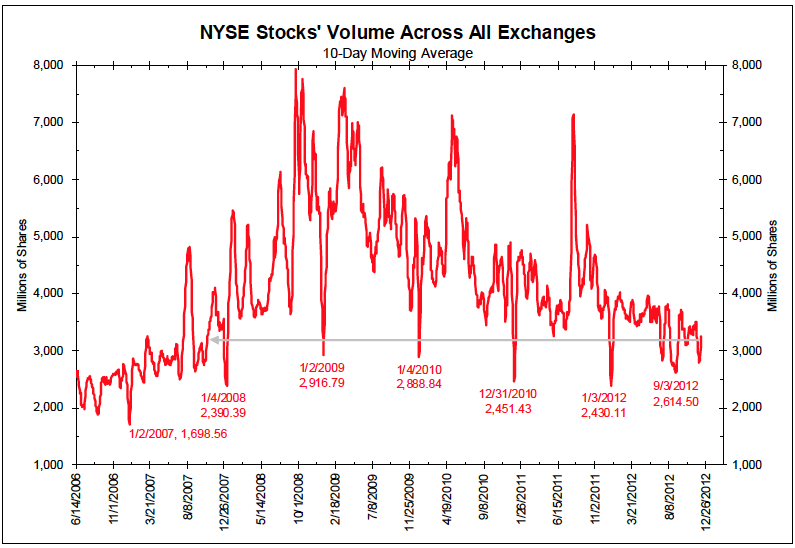
We have been playing a bit of a parlor game around the office, looking at what are the most important charts of the year. An Apple chart was way too obvious, as was a Fed balance sheet or Interest rates. Josh thinks consumer trends, JC prefers spread between Oil and Nat Gas, Bat like CINF.
I want to nominate what may be the most deceptive chart you will see: NYSE Volume. Its deceptive because its simplicity reveals so many things beyond what it is ostensibly covering of mere trading volume.
Consider what the overall falling volume trend means:
• The financial services industry is shrinking;
• Commissions are falling
• Stock picking is being replaced with ETFs;
• Psychology is negative, as Main St is not participating and Mom & Pop have left;
• Active trading is being replaced with passive indexing;
• HFT Algos may spoof millions of phony bids, but they are having a harder time getting executed.
That’s why I nominate NYSE Volume as my chart of the year . . .
The LDP (won 294 seats), lead by Mr Abe, together with their coalition partner, Komeito, won 325 seats (out of 480 seats) in the lower house, which would give the coalition the 2/3 rds needed to approve most legislation without the need for ratification by the Upper House, which they do not control. Voter turnout was 59.3%, the lowest since World War 11, emphasizing the collapse of support for the DJP, rather than enthusiasm for the LDP coalition. Elections for the Upper House will take place 8 months ahead.
Mr Abe, who will become PM once again, has promised a much looser fiscal policy and to raise inflation to 2.0% with nominal growth of 3.0%, whilst embarking on a capital expenditure programme to stimulate the economy. In addition, the LDP/Komeito coalition have threatened to take a more aggressive policy position with China, in respect of disputed territory in the South China seas and, furthermore, has threatened to change Japan’s current pacifist constitution. Defence spending will increase, in any event.The nationalist Japan Restoration Party, also in favour of taking a tougher position with China, is projected to win more than 50 seats which will make it the 3rd largest party after the DPJ, who may retain less than 60 seats, well below the 300 in the 2009 elections.
The Yen should continue to decline on this outcome. The BoJ meets on the 20th December and is expected to announce further monetary loosening of between Yen 5tr to Yen 10tr, though they may delay their plans until after the new governments policies are announced. Its going to be interesting to see what the ratings agencies do. Moody’s stated that Japan would face “negative credit implications” if it cannot raise its potential growth rate and/or delays the proposed sales tax hike, unless the government cuts other spending. Fitch warned that delaying fiscal consolidation would weigh on Japan’s A+ rating, including delaying or cancelling the agreed doubling of the sales tax.
I continue to be deeply concerned about the conflicting territorial claims in the South China seas, in particular as the market remains remarkably complacent on this issue. The risks of an accident leading to conflict will increase.
I remain short the Yen;
In his first speech since winning in the general election, Mr Abe has (a) reiterated his plans to stop deflation and weaken the Yen, (b) restated Japanese ownership of the disputed islands in the South China seas vowing to protect Japanese territory and (c) has called for a special session of the Diet, the Japanese Parliament, for 26th December. The Japanese economy is in recession at present, having contracted in Q2 and Q3. With debt to GDP around 220%, a budget deficit of 10%+ of GDP, policies to increase inflation and, as a result bond yields, could well prove dangerous. However, for the moment Japanese markets remain positive, with the Nikkei up over +0.9% today ;
Chinese authorities will seek better “quality and efficiency” and sustained and healthy development” in terms of economic growth next year. The phrases used suggests that the leadership will seek lower growth rates in return for a more sustainable growth model. There were also calls for further urbanisation;
China has scrapped investment limits by foreign wealth funds and central banks in its capital markets. The move is to promote more long term investment and to gradually open up China’s capital account. Its foreign-currency quota for qualified investors under its QF11 programme is also likely to be increased once the current limit of US$80bn is utilised. I continue to be positive on Chinese markets, which closed some +0.6% higher today and is just around 2.0% lower for the year;
The Indian government has cut its GDP forecast for the year to 31st March to +5.7% to +5.9%, from +7.85% previously, the slowest growth rate since 2003. Inflation in March 2013 is expected to decline to +6.8% to +7.0%, with the budget deficit coming in at -5.3% of GDP. The Indian Central bank, the RBI meets tomorrow;
Mr Monti is expected to resign as PM in a weeks time following the passage the 2013 budget. In addition, Italian press reports suggest that he will not stand for PM in the upcoming general elections, expected in February next year;
The EU heads of State summit failed to make any progress on budget integration/fiscal union last week. The matter is to be discussed yet again in June, though Germany clearly does not want to proceed on budget integration, especially ahead of their general elections next September.
Mrs Merkel has warned that excessive social welfare spending in Europe will need to be reduced to restore competitiveness. Yes and, in any event, its unaffordable;
EZ October seasonally adjusted trade balance came in at E7.9bn M/M, well below the E11.0bn expected and the revised E11.0bn in September; US manufacturers have announced some US$90bn of capex investments over the last 2 years, to take advantage of surging supplies of cheap natural gas. Natural gas is priced at US$3.30 per mBTU in the US, though LNG is being sold at US$16 per mBTU in Asia and Europe. The major increase in natural gas production will prove a significant benefit to the energy intensive industries, including petrochemical, fertiliser, steel and fuel sectors and place the US at a major advantage over other countries. (Source FT);
Mr Boehner, the Republican speaker of the House of Representatives, has suggested that tax rates for Americans earning over US$1mn per year could be raised, a major concession in ongoing discussions with President Obama over the US$600bn fiscal cliff issue. President Obama proposes to raise taxes on those earning over US$250k per year. In addition, the House speaker suggested that there would be no fight over raising the debt ceiling for at least 1 year and that the Republicans would consider new revenue sources if the Democrats/President committed to significant spending cuts, including on pension and healthcare. A compromise deal is likely, though possibly early in the New Year;
US December Empire manufacturing index came in at -8.1, much worse than the -1.0 expected and the previous -5.22 in November. New orders were particularly weak, coming in at -3.70, from +3.08 previously;
CFTC Commitments of Traders report (which discloses net speculative positions up to the previous Tuesday) reveals, in particular:
an increase in net Yen shorts;
an increase in net C$ longs;
an increase in net long A$;
flat Euro shorts;
flat GBP longs.
The Yen shorts are their highest level since 2007 and its the first time that A$ longs have exceeded 100k contracts (103k);
US TIC date shows that the net total of all foreign financial outflows came in at -US$56.7bn in October M/M, from +US$4.3bn in September. In addition, net purchases of foreign securities increased to US$27.1bn, the largest sequential increase in more than 1 year. The data shows that the massive inflows into US assets in 2010 and 2011 have declined, suggesting that investors are taking more market risk, even though foreign central bank purchases of US$ assets continues;
Outlook
Asian markets closed mixed, with Japan and China higher. European markets are flat to lower. US markets are higher.
The Euro is trading at US$1.3172, slightly higher on the day, with the Yen at 83.73 against the US$, weaker on the day.
Spot gold is trading around US$1696, relatively flat on the day, with oil (Feb Brent) weaker at US$105.39.
All eyes on Japan over the next few days and the US in respect of the fiscal cliff negotiations – I continue to believe that there will be a compromise between Republicans and Democrats.
Another bad idea from the University of Chicago: It is commonly believed that directors’ primary responsibility is to boost stock prices. But case law established that their top priority is to benefit the company – which doesn’t always mean a higher stock price, Lynn Stout of Cornell Law School tells David Cay Johnston. (July 17, 2012)
• The Cult of Uncertainty (Fool) see also So Much Uncertainty, So Little Volatility (Hedge World) • 2008 Investment Guides Are HILARIOUS (TBP) • Claudio Borio on the financial cycle (Free Exchange) • A major change in Bernanke's policy reaction function (Gavyn Davies) see also The Omnipotent Fed idea (Noahpinion) • Fracking's Future (Harvard Magazine) • iPhone 5 Sets China Record With 2 Million Sales in Three Days (Bloomberg) see also The iPad mini is the best tablet (The Wirecutter) • Dan Gross: GOP Leaders Finally Ready to Cave on Taxing the Rich (The Daily Beast) • How Accurate Are Your Pet Pundits? (Project-Syndicate) • Building a Better Truth Machine (Slate) • Insurance Industry Paying Increasing Attention to Climate Change (Science Daily)
Whats on you iPad?
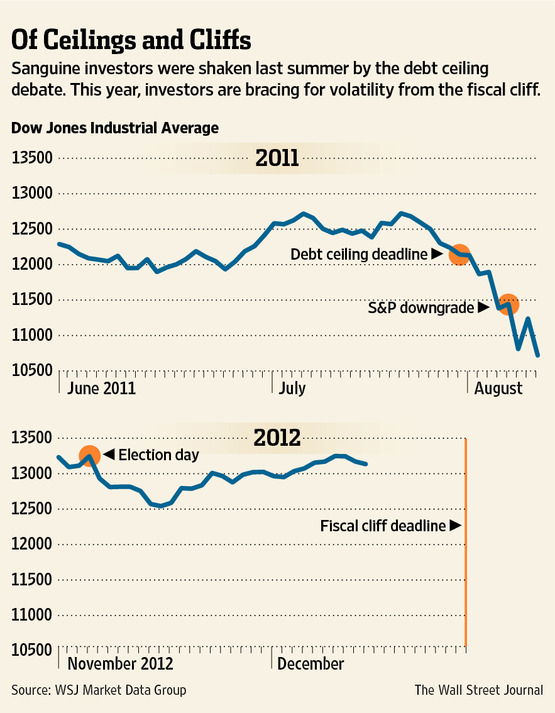
Cliff? What Cliff? Investors snap up stocks even as DC inches closer to sequestration Source: WSJ
"If ever there was proof positive that ratings were a lagging indicator, it's certainly been true with the way the rating agencies have responded to Europe's three-year debt crisis.”
-Bonnie Baha, the head of global developed credit at DoubleLine Capital.
One of the unrepentant and unprosecuted villains of the credit crisis were the major ratings agencies, especially Moody’s and S&P. They slapped triple AAA ratings on securitized products that were junk. They did so not due to an error or omission or miscalculation, but rather, because they were paid to do so by the underwriters of those products.
They were, in a word, corrupt.
The net results of that corruption is starting to show up in how credit buyers treat their ratings. For that, we go to a fascinating article in Bloomberg this morning:
The global bond market disagreed with Moody's Investors Service and Standard & Poor's more often than not this year when the companies told investors that governments were becoming safer or more risky.
Yields on sovereign securities moved in the opposite direction from what ratings suggested in 53 percent of the 32 upgrades, downgrades and changes in credit outlook, according to data compiled by Bloomberg. That's worse than the longer-term average of 47 percent, based on more than 300 changes since 1974. This year, investors ignored 56 percent of Moody's rating and outlook changes and 50 percent of those by S&P.”
There are lots of reasons to doubt the value, even the validity of Ratings Agencies view of credit. Off the top of my head, I can think of four:
1. Broken Business Model: Ratings used to be supported by bond buyers through a subscription model. In the 1990s, it morphed into an underwriter paid for model, also known as Pay for Play.
2. Lagging the markets: Credit Ratings are lagging, chasing changes that have been largely priced into the market already.
3. Error Prone Models: The Treasury said S&P made a colossal $2 trillion error in its calculations, leading to a shift in S&P budget projections. Whether this was due to inherent problems in the models or simply poor execution, the net results were the same.
4. NRSROs: The SEC recognition of NRSROs seem to have created a moral hazard of relying on ratings. We may even have an institutional error built into credit markets.
It is encouraging to see credit buyers doing their own research and ignoring the failed ratings agencies.


 Image by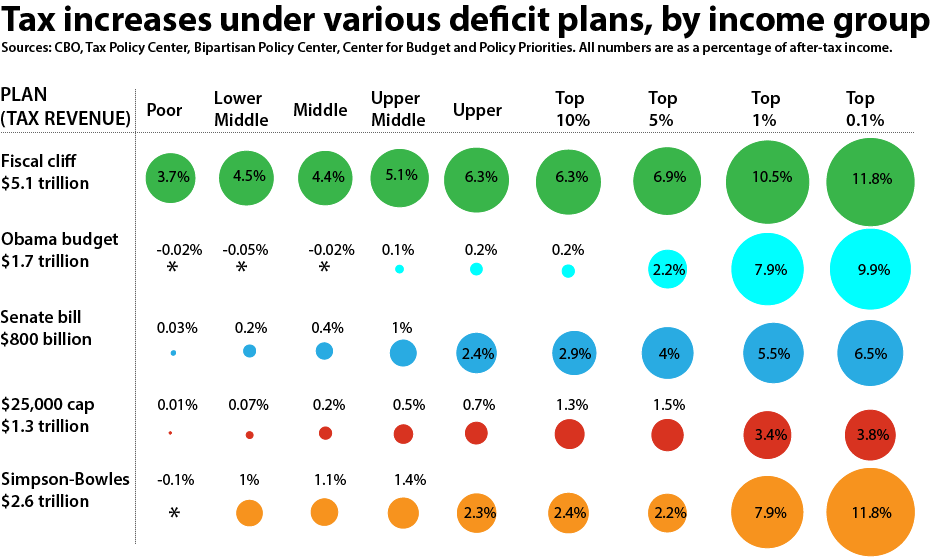



0 comments:
Post a Comment