


The Big Picture |

- The Lie that Prosecuting Bank Fraud Will Destabilize the Economy Is What Is REALLY Destroying the Economy
- Guns in America: 45 Years on the Treadmill
- Quentin Tarantino on Leaving the Film Business
- QOTD: On Bias, Correlation and Objectivity
- THINGS THAT MAKE YOU GO HMMMMM: White Bits
- The Future Of Music
- WaPo: Why don’t bad ideas ever die?
- Mayans, Lincoln, Markets
- Let’s Celebrate the Failure of the July 2011 Great Betrayal
- Audi’s 2017 R20 Supercar
- FT Alphaville Podcast: Dylan Grice
- 10 Weekend Reads
| Posted: 22 Dec 2012 10:30 PM PST Failing to Prosecute White Collar Crime Guarantees a Weak and Unstable Economy … and Future Financial CrashesThe Departments of Justice and Treasury are pretending that criminally prosecuting criminal banksters will destabilize the economy. The exact opposite is true. Failing to prosecute criminal fraud has been destabilizing the economy since at least 2007 … and will cause huge crashes in the future. After all, the main driver of economic growth is a strong rule of law. Nobel prize winning economist Joseph Stiglitz says that we have to prosecute fraud or else the economy won't recover:
Nobel prize winning economist George Akerlof has demonstrated that failure to punish white collar criminals – and instead bailing them out- creates incentives for more economic crimes and further destruction of the economy in the future. Indeed, professor of law and economics (and chief S&L prosecutor) William Black notes that we've known of this dynamic for "hundreds of years". And see this, this, this and this. (Review of the data on accounting fraud confirms that fraud goes up as criminal prosecutions go down.) The Director of the Securities and Exchange Commission's enforcement division told Congress:
Paul Zak (Professor of Economics and Department Chair, as well as the founding Director of the Center for Neuroeconomics Studies at Claremont Graduate wrote a paper called Trust and Growth, showing that enforcing the rule of law – i.e. prosecuting white collar fraud – is necessary for a healthy economy. One of the leading business schools in America – the Wharton School of Business – published an essay by a psychologist on the causes and solutions to the economic crisis. Wharton points out that restoring trust is the key to recovery, and that trust cannot be restored until wrongdoers are held accountable:
Note that Sachs urges "hold[ing] the perpetrators of the economic disaster responsible." In other words, just "looking forward" and promising to do things differently isn't enough. Robert Shiller – one of the top housing experts in the United States – says that the mortgage fraud is a lot like the fraud which occurred during the Great notes:
Economist James K. Galbraith wrote in the introduction to his father, John Kenneth Galbraith's, definitive study of the Great Depression, The Great Crash, 1929:
In 2004, the FBI warned publicly of "an epidemic of mortgage fraud." But the government did nothing, and less than nothing, delivering instead low interest rates, deregulation and clear signals that laws would not be enforced. The signals were not subtle: on one occasion the director of the Office of Thrift Supervision came to a conference with copies of the Federal <p>This was fraud, perpetrated in the first instance by the government on the population, and by the rich on the poor.</p><br />
James Galbraith recently said that "at the root of the crisis we find the largest financial swindle in world history", where "counterfeit" mortgages were "laundered" by the banks. As he has repeatedly noted, the economy will not recover until the perpetrators of the frauds which caused our current economic crisis are held accountable, so that trust can be restored. See this, this and this. No wonder James Galbraith has said economists should move into the background, and "criminologists to the forefront." The bottom line is that the Departments of Justice and Treasury have it exactly backwards: by failing to prosecute criminal fraud, they are destabilizing the economy … and ensuring future crashes. |
| Guns in America: 45 Years on the Treadmill Posted: 22 Dec 2012 05:00 PM PST
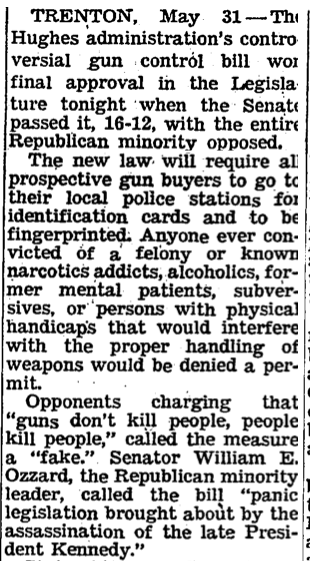
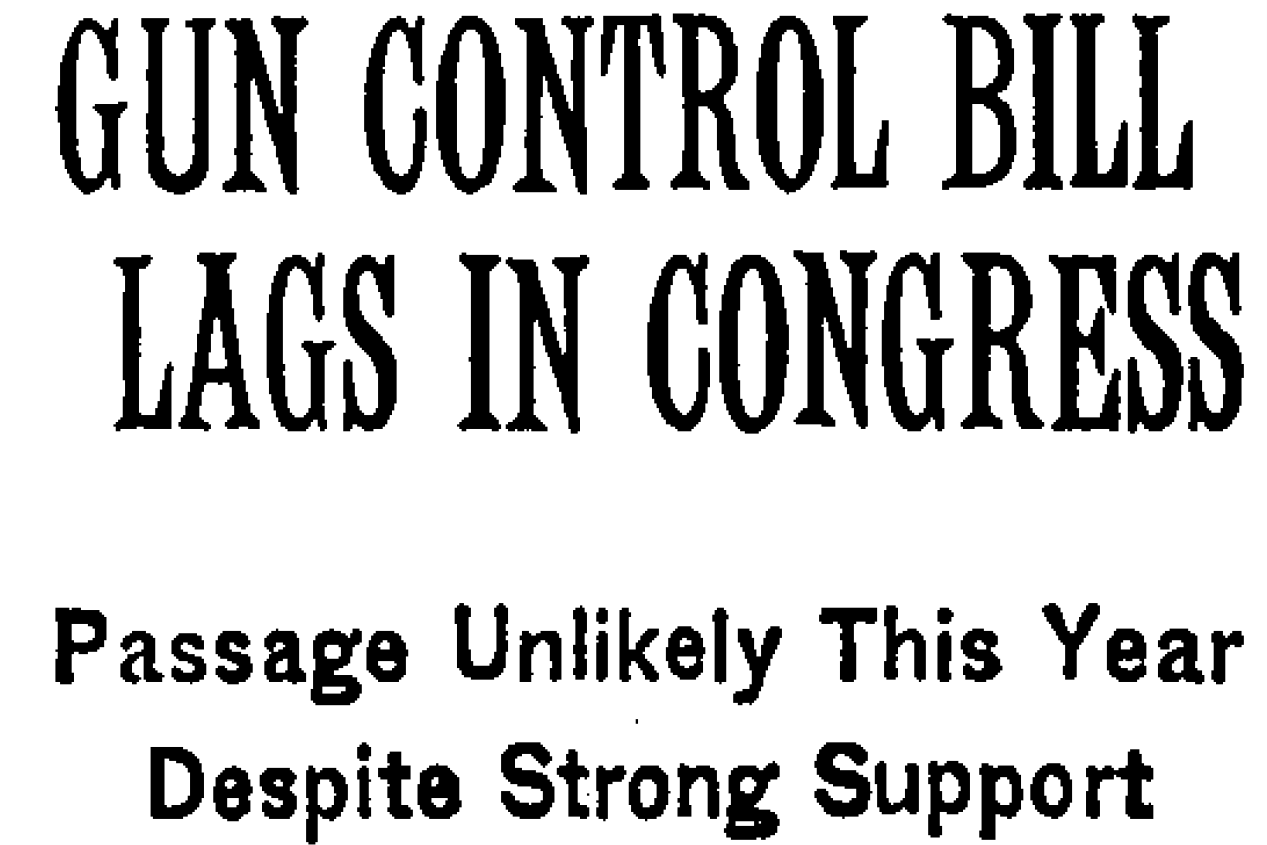
I’ve got no charts, graphs, tables or economic analysis to offer with this post, so please forgive me and move along if that’s what you were looking for. I’ve been simmering as I absorbed some of the commentary proffered by the right on the recent Newtown shooting. The self-exoneration speech by the NRA’s Wayne LaPierre has brought me to a boil. So, herewith a look at what passes for the right’s “leadership.” Note: None of this is from The Onion. First up, Mike Huckabee, who claimed that the shooting was the result of our having taken God out of our schools which, of course, begs the question as to how pedophiles have had free run of churches for the past few centuries. What’s up with that, Mike? Let’s move on to Megan McArdle, who proposed that “if we drilled it into young people that the correct thing to do is for everyone to instantly run at the guy with the gun, these sorts of mass shootings would be less deadly, because even a guy with a very powerful weapon can be brought down by 8-12 unarmed bodies piling on him at once.” Yes! Now there’s a strategy – 20 six-year-olds giving the bum’s rush to a guy who’s not in his right mind and armed to the teeth. Let me know how that works out for you, Megan. Oh, and if we’re ever (regrettably for me) in the same place together and a shooting erupts, I’ll be right behind you rushing the shooter, because I just know you’d go first. Right behind McArdle (not in rushing the shooter, but just in sheer idiocy) is Charlotte Allen, who would have 12-year-olds (like my son) rush the shooter: “Think of what Sandy Hook might have been like if a couple of male teachers who had played high-school football, or even some of the huskier 12-year-old boys, had converged on Lanza.” Yup, Charlotte, put a couple of “husky 12-year-olds” up against a semi-automatic weapon and it’s pretty much game over, eh? The guys over at Powerline came up with a variant of LaPierre’s strategy before Wayne did: Schools should be more like “biker bars”: “Within the realm of constitutional options, the most practical remedy I can think of would be to require that a certain number of teachers or administrators in each school be trained in the use of firearms and armed at all times. That would probably deter most school shooters. It is curious, but true, that even those killers who do not intend to survive their crimes never seem to open fire in the presence of another armed person. No one tries to shoot up a biker bar.” Maybe we could also give the kids jello shots to sedate them a bit before rest period. The arm-teachers-and-administrators argument has, I think, a couple of problems, not the least of which is this: Teachers are the exact same people that conservative folks (like those at Powerline) generally think are incompetent and overpaid (AEI: “Overall, public-school-teacher compensation exceeds private levels by approximately 52 percent, for a total of more than $120 billion annually in excessive labor costs.” Heritage: “Public-school teachers receive significantly higher salaries than private-school teachers, even more than private teachers at secular general-education schools.”) Yet now we should arm them and give charge them with putting their lives on the line. Good luck with that; it seems just a tad twisted, contradictory and conflicted to me. It’s been all but forgotten that there was at least one armed officer at Columbine at the time of the attack. It should also be noted that when police took down a shooter at NY’s Empire State Building, 9 people were wounded – all of them directly or indirectly (shrapnel) by police bullets. How is the “arm everyone” strategy going to play out in a crowded theater, mall, arena, or stadium, with potentially dozens of armed citizens pulling/firing weapons? Let’s discuss a couple of other issues: Bloomberg estimated that it would cost $7.9 billion to put an armed guard in every school. How is that going to fly with the Tea Party? Are they going to stand behind that? And that’s apparently one guard per school. My daughter’s high school is massive facility with at least a dozen entry points. It accommodates about 1,600 students. So we’ll have one guard at a huge (and I mean huge) physical plant protecting 1,600 students and dozens of teachers and administrators. Color me skeptical. And, of course, no tragedy is complete without someone implying that it was a government conspiracy, this time as a catalyst to allow Obama to shred the second amendment and confiscate every gun in the country. All that said – and that’s a whole lotta crazy – LaPierre trumps them all. His speech [PDF] was about as tone deaf as anything I’ve ever heard; it was nauseating for me to listen to it. He blamed Hollywood (arguably the folks from whom he lifted his plan, seeing as it leans heavily on the plot of the 1990 comedy Kindergarten Cop), the media, video games. The NRA waited a week to speak up – out of respect for the victims, they said – which should have given them time to collect their thoughts and come up with their best “meaningful contribution” to this discussion. Then LaPierre came out and shit the bed like I’ve never seen anyone do before. (NY Times editorial: “Still, we were stunned by Mr. LaPierre's mendacious, delusional, almost deranged rant. Mr. LaPierre looked wild-eyed at times as he said the killing was the fault of the media, songwriters and singers and the people who listen to them, movie and TV scriptwriters and the people who watch their work, advocates of gun control, video game makers and video game players.”) To my knowledge, no one has yet come out in support of Mr. LaPierre’s rant, or his “plan.” Finally, it should go without saying that LaPierre’s refusal to take any questions at his presser – which was announced right up front – was beyond cowardly. So, that’s what the past week has brought us – nothing even remotely in the ballpark of any meaningful change. Just useless rhetoric by folks who have been giving us nothing but for 45 years. When we experience meaningful events in our society – like Newtown – I often browse archival databases to see what’s happened in the past when similar events (assuming there have been similar events) have occurred. What I found in this case was a headline that’s stood the test of time: “Gun Control Bill Lags,” or something very close to it (“Gun Control Debate Revived After Shooting”). The only thing that ever changes is the date. Above right is a clip from the NY Times in 1966, when a piece of gun control legislation was passed in New Jersey. It includes what might possibly be the first use of the phrase “guns don’t kill people, people kill people.” Here’s one from 1967, which will almost certainly be duplicated, word-for-word, in 2013:
Here’s 1968:
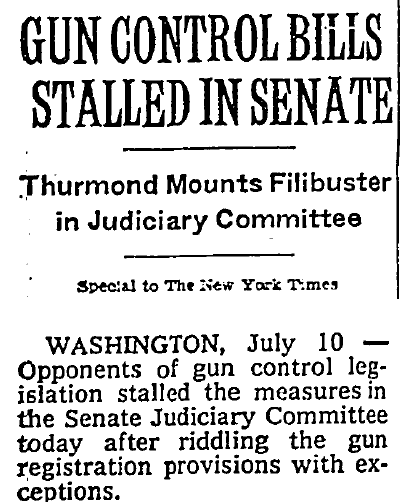
Fast forward to 1976:
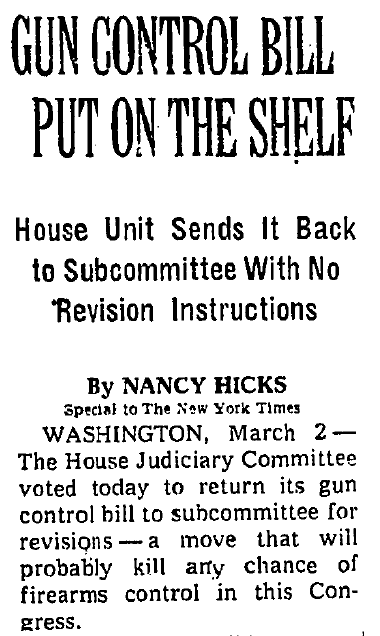
I could go on, but you get the point. Anyone see a pattern emerging? It’s 45 years later – is there any doubt we could see the exact same headlines today? Oh, wait, we already are (WSJ):
We desperately need to make some progress – the status quo is simply not acceptable. Enough is enough. We should all be enraged by what happened last week in Newtown. We should be enraged at how corporate and special interests have bought a government that is supposed to be “of the people, by the people, for the people.” I’ll get back to economics when my blood pressure normalizes. Actually, there’s not much to even report on that front – the economy appears to continue chugging along despite the best efforts of our “leaders” in DC to prevent it from doing so. Further reading: Wonkblog: Twelve facts about guns and mass shootings in the United States Harvard School of Public Health Global Socialogy (one of the best recent pieces, in my humble opinion) NRA: Willing to Make Concessions on Gun Control |
| Quentin Tarantino on Leaving the Film Business Posted: 22 Dec 2012 03:00 PM PST Oscar winning director Quentin Tarantino explains to the director roundtable guests why he wants to quit making movies. |
| QOTD: On Bias, Correlation and Objectivity Posted: 22 Dec 2012 01:30 PM PST I love the way this unfolds: Someone did a study — I have no idea if its serious or not – that suggested eating more chocolate improves a nation’s chances of producing Nobel Prize winners. One of the Nobel prize winners responded with the appropriate amount of snark:
That is hilarious! The only trouble with sarcasm is how many people seem to miss it . . .
Source: |
| THINGS THAT MAKE YOU GO HMMMMM: White Bits Posted: 22 Dec 2012 01:00 PM PST |
| Posted: 22 Dec 2012 11:00 AM PST By identifying the forces at play in the world of music and the behaviors that are driving those forces, one can identify particular patterns that support current trends. By looking forward to what the future of music may encompass, this presentation aims to provide Carhartt, with valuable insight that will help the brand as a whole, cater to the future of urban millenials.
Laura Curry Aycock on Dec 17, 2012 |
| WaPo: Why don’t bad ideas ever die? Posted: 22 Dec 2012 07:00 AM PST Why don't bad ideas ever die?
This time of year is filled with retrospectives and "best of" lists. I'd prefer a more enlightened discussion about bad ideas. Or rather, zombie ideas: the memes, theories and policies that refuse to die, despite their obvious failings. Why do we embrace the terrible, fall in love with the wrong, bet money on the fictitious? Nowhere is this truer than in the fields of economics and investing. Together they have produced a long list of thoroughly debunked ideas. Despite this, many of these zombie ideas still have a vice grip on amateurs and professionals alike. What is it about us and this intellectual voodoo? We keep repeating the same mistakes over and over. It is maddening. Let's count the ways: 1 Shareholder value: Since the early 1980s, this theory had claimed that corporate management should concentrate primarily on increasing share prices. In practice, it is fraught with problems: Short-term focus on quarterly earnings leads to a decline in long-term research and development, typically to the detriment of a company's long-term prospects. Short-termism and stock-option compensation causes management to focus on immediate quarterly returns. It has also led to earnings "management," accounting fraud and a raft of management scandals. Shareholders derive much less value than the name implies. 2 Homo economicus: A primary principle underlying classical economics, it states that humans are rational, self-interested actors possessing an ability to make objective, intelligent judgments about matters of investing and money. This turns out to be hilariously wrong. We are all too often irrational, frequently emotional and regularly engage in behaviors that work against our self-interest. Homo economicus? Try Nogo economicus. 3 Economics as a science: Consider how wrong the economics profession has been about, well, nearly everything: They misunderstood the risks of derivatives; economists developed models that assumed home prices would not fall (!). They misunderstood why the recovery from the 2001 recession produced so few jobs or why the current recovery was worse in so many ways. Oh, and despite myriad signs, they missed the worst recession since the Great Depression even as it was on top of them. The sooner they admit that their field is not a hard science, the better off we all will be.
4 Austerity: Conceived from the puritanical idea that we must pay a penance for our sins, the Austerians (as we like to call them) insist that a post-bubble economy can be cured with spending cuts and tax increases, producing a balanced budget. When the United States tried this in 1938, it helped send the nation back into recession. More recently, Greece was forced to adopt austerity measures as part of its financial-rescue terms. It pushed the country into a depression. Austerity measures in Britain and Ireland and Spain — indeed, everywhere they have been imposed in Europe — have all led to recessions. Despite the wealth of evidence showing that this is a terrible idea, it refuses to die. 5 Tax cuts pay for themselves (supply-side economics): Sometimes bad ideas start as good ones. When tax rates are so high as to cause all manner of tax avoidance strategies — think confiscatory rates of 75 to 90 percent — reducing them makes sense and can change investor behavior for the better. Where we run into trouble is when this concept gets extrapolated to an absurd degree. Claiming that any tax cut will pay for itself by producing greater economic activity has now reached that point. No, Virginia, cutting taxes 3 percent does not lead to more revenue. Get over it. 6 The efficient-market hypothesis: This is the mother of all academic zombie ideas. The concept is that markets are "informationally efficient." That lots of self-interested investors hunt down every last data point about any given asset class or stock. And pricing perfectly represents all of the given information available at the time. Therefore, no one can outperform the markets for long. Except they have. Fund managers such as Peter Lynch, Warren Buffett, Ray Dalio and Jim Simons have consistently beaten markets over such long stretches that it cannot be merely by chance. Perhaps the even bigger anomaly that this concept runs into are the all-too-regular booms and busts — the massive mispricings of assets — that economic bubbles and crashes produce. 7 Markets can self-regulate: Another example of an idea that started out reasonably enough but soon after went off the rails. After 30 years of postwar economic growth, there was a credible argument that government regulations had become too costly, time-consuming and complex. With inefficiencies holding back small businesses, paring the worst of the regulatory burden should be productive. As so often occurs, this good idea was taken to an illogical extreme. Instead of removing onerous, expensive regulations, zealots such as then-Sen. Phil Gramm (R-Tex.) argued against all regulations. Markets can regulate themselves much better than some bureaucrat or lawyer. Besides, the self-interest of companies and the efficient market would more effectively police behavior than any government agency ever could. We know how that turned out. 8 Gurus, shamans and prognosticators: Wall Street produces market wizards at a prodigious pace. It may be NYC's single-biggest export. We love experts to tell us what is going to happen in the future. Never mind that their track record is awful, we prefer the mysticism of the television guru to actual thought. The data about these experts should give us pause: The more confident an expert sounds, the more likely he is to be believed by TV viewers. Unfortunately, the more self-confident an expert appears, the worse his/her track record is likely to be. And forecasters who get one single big outlier correct are more likely to underperform the rest of the time. Why is it that we are ensnared by bad ideas? A lot of the reasons have to do with our own makeup and the structure of our society. • Fooled by randomness (a.k.a. luck): Just because something is a bad idea does not mean it cannot, through pure chance, lead to a winning investment. (It is very difficult for people to acknowledge just how lucky they got once money is made by a bad idea). • Greed and sloth: There is a ready supply of dupes waiting to be robbed, dreaming of enormous rewards for little or no work. Bernie Madoff was no different than Charles Ponzi, and yet people lined up to hand him money by the billions. • Institutional mandates: In academia, whatever the dominant paradigm of the moment is tends to drive jobs, tenure, even entire careers. Publish or perish leads to a repetition of "accepted" ideas, while outside-the-box research often finds getting published to be a challenge. • Status quo: Powerful forces are comfortable with how profitable things are, and they exert tremendous force to keep them that way. Think tanks, academia and corporate consultants create a ready constituency for old, bad ideas on their behalf. • Narratives persuade more than data: A good story is far more persuasive than data. Zombie ideas are modern fairy tales. Comprehending a data series is challenging, requiring skill, intelligence and hard work. A compelling story, on the other hand, can be understood by a child. • Incompetency: Skilled people have a greater understanding of their limitations for a given task; unskilled people do not. This is called the Dunning-Kruger effect, and it tells us that the worse we are at any given talent, the weaker our own meta-cognition about it is. • Bias: Bad ideas often conform to our erroneous world views. Consider the impact of selective perception and confirmation bias — they assuage our egos and are made to fit our prejudices. Bad ideas hang around in part because we seek them out and embrace them. • Darwinism works slowly: As a reader suggested, it often takes a while for reality to catch up with bad ideas. Consider the divine right of kings, communism and the designated hitter as bad ideas that took centuries to fall. These zombie ideas remain a stable of academia, economics and investing. We should not be surprised at this. Recall what Max Planck — who won a Nobel Prize for physics in 1918 for originating quantum theory — famously said: "Truth never triumphs — its opponents just die out. Science advances one funeral at a time." Investing and economics should be so lucky . . . ~~~ Ritholtz is chief executive of FusionIQ, a quantitative research firm. He is the author of "Bailout Nation" and runs a finance blog, the Big Picture. On Twitter: @Ritholtz. |
| Posted: 22 Dec 2012 05:30 AM PST Mayans, Lincoln, Markets
Well, guess what? The world did not end with the last entry on the Mayan calendar. How about that? I remember seeing the calendar when visiting Tikal, a monumental testament to a civilization that collapsed by over-taxing its resources. After the collapse Tikal was abandoned for centuries. Nature overwhelmed the city with tropical vines, trees, and shrubs. To the eye, a canopy of green growth replaced Tikal. Centuries later, the ruins of Tikal were discovered under the sea of green, and the excavations commenced. Tikal is a wonder of antiquity worth seeing if you can get to Guatemala, and we strongly suggest a visit. Some day, centuries hence, our grand experiment with democracy may face the fate of Tikal. We call that experiment American politics, and we watch it now in real time. It used to look like the movie depiction in Lincoln. To get a glimpse of how and why the US House of Representatives works, see this wonderful, five-star movie. Thoroughly researched for historical accuracy, its stellar performances reveal the character of Abe Lincoln and the turmoil and success that immediately followed Lincoln's re-election. Juxtapose this history to our present circumstance, and the contrast is remarkable. Obama is a re-elected president. Like Lincoln's, his opposition is in the House. In the year preceding Lincoln's reelection, the Senate had already passed the 13th Amendment. Today's Democratic party is the opposite of what it was when Democrats were trying to preserve slavery and avoid passage of the 13th Amendment to the US Constitution. At the time, Republicans were the new political force and majority. They lost (in 1856) their first attempt for the White House with Freemont. They won their first national power with Lincoln's first term. They were re-elected with a majority while the country was engaged in the Civil War and while thousands of American suffered and died. After Lincoln came the period of reconstruction. Illegalized, slavery ceased, but racism gave way slowly. In some places in the United States, it is still giving way slowly. But the country survived, and the political forces which govern us solidified. We continued to flourish, to defend ourselves in war, and to create a system of social safety on which we currently rely. We started to tax more heavily to pay for that safety. In doing so, we concentrated power in Washington and removed it from the hands of the states. It was President Lincoln who first passed the law to tax income in 1861. That first tax was replaced with a different form of income tax in 1862. In 1913, at the time of the creation of the Federal Reserve, the top income tax rate was 7%. I will leave the rest of this history to serious readers who want to find it and study it. To paraphrase the great oration of Lincoln, now we are engaged in a great national debate, determining whether this nation can balance the tension between funding the safety net and taxing income and wealth. We all agree that we cannot tax 100% of income and wealth because we will obtain zero when we do. We also agree that some safety net is a necessity of modern society. We just witnessed the horrors that occur when young people in our society fall through the safety net and act in a deranged manner. Guns will again become the focus of a huge national debate. Query: will that debate address the lack of funding for the safety net that might have caught Lanza and prevented this mass murder? In our view, the fiscal cliff issues will eventually be resolved. A middle ground will be found. Alternatively, one side will be sufficiently wearied by the political fight and the other side will find the ways to achieve sufficient votes to pass legislation. Lincoln did it. The Obama-led Democrats and the Boehner-led Republicans will do it, too. We wish our readers a merry Christmas and a celebratory New Year. We believe a political resolution will prevail because it has to. To paraphrase Lincoln again, the nation will endure and its political character will remain intact. BTW, markets will like it. Part of our American culture is the private sector and the application of capital investment. The US stock market is under-owned. We reached our target range of 1450-1550 by yearend. We are fully invested. We base that viewpoint on the assumption that any trip over the cliff is temporary. Next stop is 1600 by the middle of Obama's second term and 2000 on the S&P 500 index by the end of the decade. Low inflation, low interest rates, and a slow (but gradually accelerating) recovery are all ahead of us. Housing is recovering in over 40 states; it was deteriorating in over 40 states just three years ago. Our current account deficit has been shrinking from its peak several years ago. America is mending in its own volatile and erratic way. You can bet on it. We are.
~~~ David R. Kotok, Chairman and Chief Investment Officer, Cumberland Advisors
|
| Let’s Celebrate the Failure of the July 2011 Great Betrayal Posted: 22 Dec 2012 05:30 AM PST Let's Celebrate the Failure of the July 2011Great Betrayal
In July 2011, President Obama and Speaker Boehner reached an agreement in principle on a deal crafted to inflict $4 trillion in austerity by raising taxes modestly, slashing social spending, and beginning to unravel the safety net. The deal would have been a disaster for America. Unemployment was 9.1%. The deal would have thrown us back into a recession and caused unemployment to surge. Recessions and increased unemployment cause tax revenues to fall and increase demand for social services (e.g., for unemployment compensation) – they produce large deficits. Austerity kills jobs and frequently increases deficits. The Eurozone is the latest demonstration of this fact. We should, therefore, all be celebrating the failure of the July 2011 austerity deal. We almost committed an act of economic self-mutilation of tragic proportions. Instead, because of the failure to adopt austerity in July 2011 we followed an economic policy based on modest stimulus. As predicted by most economists (including my UMKC colleagues) that policy produced modest growth and modest reductions in unemployment. The recovery produced the sharpest reduction in budgetary deficits in modern U.S. history. The Eurozone's leaders' austerity policies forced many nations back into recession. Austerity was most draconian in the periphery where it produced Great Depression levels of unemployment, particularly for young adults. The dominant media meme about the "fiscal cliff" is that it is an insane austerity program that would force the U.S. back into a gratuitous recession and cause large increases in unemployment. Logically, that should cause the media to recognize that the far more severe austerity blows that Obama and Boehner sought to inflict on the U.S. in July 2011 at a time when our economic recovery was much weaker than it is today would have been disastrous and that we should be overjoyed that the deal fell apart. The media, however, constantly warns us of the need not to repeat the "failure" to reach the July 2011 deal. They show no sign of recognizing the logical incoherence in simultaneously warning that the fiscal cliff's austerity must be avoided lest it force the nation back into recession and that it is urgent that we adopt austerity. Media reports virtually never explain that if the July 2011 austerity deal had been finalized the results would have been catastrophic. The media is similarly incoherent when discussing (more precisely, ignoring) another key aspect of the fiscal cliff – its origins. The "fiscal cliff" is not really a cliff, but it is definitely an economically illiterate and self-destructive austerity program. That is the first key analytical aspect of the origins of the fiscal cliff – it was known to be an economically illiterate and self-destructive austerity program when it was adopted. The obvious question, which the general media studiously ignores, is why the parties agreed to the "fiscal cliff" deal when it was obvious that it would cause catastrophic damage to our economy and people. The "fiscal cliff" (austerity) deal is the deal that did not fail – it was the bipartisan deal that became law in August 2011. It is revealing that no one in the media even attempts anymore to defend the bipartisan fiscal cliff (austerity) deal. The media normally have a romantic crush on anything bipartisan, no matter how much it harms the nation. The fiscal cliff austerity deal is so obviously stupid that even the media almost universally criticize it. This should prompt three obvious questions.
The answers are:
Obama is the person in the world who benefitted most from the failure of the July 2011 austerity deal he reached in principle with Boehner. If the austerity deal had been finalized the nation would have be forced back into recession. Unemployment was 9.1% in July 2011. It would have risen sharply above 10% and it would have gone up every month in 2012 as the election approached. Obama would have been crushed by Governor Romney. The irony is that Obama tried five times in 2011 to inflict austerity on America. Had he succeeded, he would have caused grave damage to our nation. Had he succeeded in inflicting austerity he would have also destroyed his re-election chances, given the Republicans control of the U.S. Senate, slashed public services when they were most needed, and begun the process of destroying the safety net. He would have gone down in history as a grotesque failure.
Obama's first major effort to inflict austerity on the nation in 2011 was his July austerity deal in principle with Boehner. Their shared goal was a $4 trillion austerity program with mild increases in tax revenues and fierce cuts to social programs and the safety net. Obama's second effort to inflict austerity was the creation of the "fiscal cliff" austerity deal in August 2011. The premise of the August deal was that austerity needed to be inflicted on America. Debt-Ceiling Deal: President Obama Signs Bill as Next Fight LoomsBy DEVIN DWYER and SUNLEN MILLERAug. 2, 2011—U.S. Averts First-Ever Default but Economic Impact Still Uncertain
I know that these statements by Obama strike many Americans as sensible, but they betray a basic misunderstanding of economics and explain why he embraces austerity. We are a nation with a sovereign currency. Our national government is nothing like a household. "Balancing the budget" ("live within our means") in response to the Great Recession is austerity. Austerity is a disastrous policy in such circumstances because it causes nations to fall back into recession or depression. The issue is not "fair[ness]" through joint sacrifice. If "everyone" "chip[s] in" through austerity it still produces a gratuitous recession or depression. That is not "fair" – it is insane – there is no such thing as a "fair" recession. "Fighting" for "fair" austerity so that everyone suffers equally through a "fair" recession is impossible because recessions cause increased unemployment, which is inherently unfair. But the more essential point is that it is insane to cause recessions through austerity. That's the principle for which we fight at UMKC. The economic crises we face are jobs and homes. Similarly, you do not "cut" federal spending when the economy is operating well before full capacity because of a Great Recession. Obama's stated policy was to cut federal spending in 2011, but not "too abruptly." Cutting overall spending in response to a Great Recession causes gratuitous recessions, even if you make "key investments." Obama intended the prospect of the fiscal cliff's dramatic mandatory cuts in social programs to extort progressive Congressional Democrats into agreeing to inflict severe austerity by voting in favor of what Obama hoped would be massive cuts in social programs and the safety net adopted by the Congressional "super committee" created by the same bipartisan austerity deal that created the "fiscal cliff." Obama encouraged the "super committee" to inflict massive spending cuts and tax increases (super-sized austerity). Obama's fourth effort occurred during the super committee negotiations. Some members of Congress opposed the imposition of the "fiscal cliff" austerity provisions and sought to remove, delay, or reduce them. Obama intervened to block any effort to avoid or reduce the austerity inflicted by the "fiscal cliff."
Yes, President Obama "urged" the infliction of severe austerity through cuts in the safety net, massive cuts in social programs, and deliberately created and used the "fiscal cliff's" self-destructive austerity threat to extort these betrayals of the American people. His surrogates (Erskine Bowles and Alan Simpson – the co-chairs of Obama's austerity commission) pushed the "super committee" to "go big" and inflict $4 trillion in austerity. (Simpson predicted that the markets would "tank" absent such an austerity deal.) Obama urged austerity under the "logic" that a national government with a sovereign currency is "just" like a household – the most basic and common economic error in this field. The President of the United States thinks that the U.S. government is "just" like a household and should try to balance the budget ("live within our means") through austerity in response to the Great Recession. He also thinks we should seize the political opportunity, even if it had nothing to do with the budget deficit, to begin to unravel the safety net. It is this sad record that led me (and many others) to warn before the election that Obama's effort to secure a "Grand Bargain" constituted a "Great Betrayal" motivated by his desire to create his legacy. Obama's self-portrait is that he was willing to agree to sacrifice his Party's greatest accomplishments (the safety net) in order to secure a bipartisan agreement imposing austerity. The actual sacrifices, however, will be made by the elderly, the poor, and the working class, the victims of his betrayal. If Obama succeeds in producing another recession through austerity you can add the nation to the list of sacrificial victims. When the super committee failed to reach a bipartisan austerity deal in November 2011, members of Congress sought to pass legislation removing the fiscal cliff's austerity provisions. Obama's fifth effort to inflict austerity occurred when he threatened to veto any reduction in fiscal cliff austerity. Nov 21, 2011 4:52pmObama Threatens Veto on Bid to Avoid Automatic Cuts as Supercommittee Fails
Fortunately for the nation (and Obama), fate conspired to cause four of Obama's efforts to inflict austerity to fail while the fifth (the "fiscal cliff") does not begin to kick in until 2013. For opposite reasons, the Tea Party and progressive Democrats have interacted in a manner that blocked Obama's efforts to inflict austerity on the nation. (The Tea Party loves austerity, but hates even modest tax increases for the wealthy.) Obama was not an outlier in repeatedly seeking to inflict austerity on the nation in 2011: "about 100 members of Congress from both parties are urging the [super committee] to go big on the reductions, to the tune of $4 trillion." The general media did not warn about the insanity of inflicting the "fiscal cliff" austerity program on the nation. Instead, it fed the hysteria about the deficit and urged even greater austerity. The New York Times exemplifies the general response. The title of their article about the August 2011 austerity deal that created the "fiscal cliff" set the pro-austerity tone. August 2, 2011Spending Cuts Seen as Step, Not as CureThe thrust of the article was that the proponents of the August 2011 bipartisan austerity deal had to defend it against charges that it imposed too little austerity. The article also claimed that while economists were divided on the issue, most economists favored austerity. Our national debt was about to cause interest rates to surge, causing a disastrous feedback loop.
All of this was economically illiterate. Interest rates fell, as my colleagues and economists like Paul Krugman predicted. Inflicting austerity in response to a Great Recession is a superb strategy for increasing unemployment, the deficit, inequality, and debt because it reduces already inadequate private and public sector demand and causes recessions and depressions. Even the modest stimulus policy the U.S. followed despite Obama's and Boehner's best efforts to inflict austerity, proved vastly superior to the Eurozone's austerity policy that forced the Eurozone into recession and much of the periphery into Great Depression levels of unemployment. The U.S. budget deficit has fallen at the fastest rate in modern history due to the success of even the greatly inadequate stimulus program that Obama adopted before he turned against stimulus under Geithner and Daley's influence. America's problem is jobs, not the deficit. Beware of anyone who uses phrases like "down payment" when it comes to the federal deficit for they have no meaning and are designed to mislead. Reducing social spending in response to the Great Recession is austerity – not a "down payment on … deficit reduction." Indeed, it is likely to increase the deficit by causing a recession. Geithner also spoke in favor of the August deal, and he completed the pro-austerity mantra by invoking what Paul Krugman has aptly dubbed the "confidence fairy."
The confidence fairy stubbornly refuses to appear, but Geithner's faith in fairies abides. Note Obama's explanation for why he approved the August 2011 austerity program. He was delighted that the "fiscal cliff" provision imposed "a strong incentive" on Democrats to agree to inflict severe cuts in social programs and the safety net. Obama issued a formal statement embracing (1) austerity, (2) the "fiscal cliff" as a device to force Congress to inflict austerity, and (3) the claim that the federal government is just like a household and should balance its budget ("live within our means").
Austerity is not a "tough choice." It is a vicious, self-destructive policy that is the result of equal parts ignorance and inhuman indifference to the senseless suffering it causes. Obama and the nation have been saved from austerity by luck, the Tea Party's extremism, and progressive Democrats' refusal to be bullied or panicked by Obama's and the general media's hysterical and false claims about deficits and the safety net. Obama's pitch for austerity and unraveling the safety net cannot withstand even cursory review. His "logic" is:
As our Senator, Claire McCaskill, said recently: "whiplash!" I propose that we all celebrate the failure of the July 2011 Obama/Boehner deal to inflict austerity on the nation and the failure of Obama's effort to use the "fiscal cliff" to extort progressive members of Congress into supporting austerity and the unraveling of the safety net. I also propose that we send Obama on an inspection tour of Ireland, Portugal, Spain, Italy, and Greece. This visit would not involve meeting heads of state. Obama should visit each of these nations and talk with the people. We would never have to defend the nation from another effort by him to engage in the self-mutilation of our economy and people. Absent such an awakening by Obama, progressives will need to step up and save Obama from Obama, America from austerity, and the safety net from Wall Street at least one more time. |
| Posted: 22 Dec 2012 05:00 AM PST |
| FT Alphaville Podcast: Dylan Grice Posted: 22 Dec 2012 04:36 AM PST David Keohane and Izabella Kaminska are joined for FT Alphaville's Christmas podcast by Dylan Grice, until recently part of Société Générale's global strategy team, to discuss the economy in 2013, robots, patents, inflation and, perhaps most importantly, the difference between a Star Trek and a Star Wars economy.
click for audio
|
| Posted: 22 Dec 2012 03:00 AM PST Thse are my longer form journalism for your weekend reading pleasure:
What shopping do you have left?
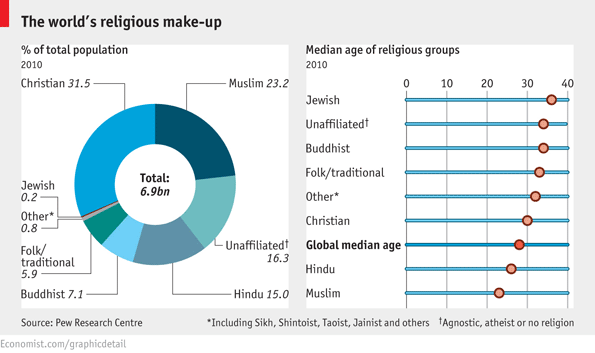
Faiths and the faithless: The world’s religious make-up |





| You are subscribed to email updates from The Big Picture To stop receiving these emails, you may unsubscribe now. | Email delivery powered by Google |
| Google Inc., 20 West Kinzie, Chicago IL USA 60610 | |



0 comments:
Post a Comment