


The Big Picture |

- Who is the Greatest American Band? Your Updated List
- Weekly Eurozone Watch – “Positive Contagion”
- Bair: Geithner’s Appointment Was `Punch in Gut’
- Why the Banks Were Thrilled About $8.5B Settlement
- Macro Polo
- Matt Miller on #@$!-Bombs: 5 Uses of Profanity in Politics
- Smart Highways
- Long Term Inflation: Wiemar, Europe, US, South America
- Yen 10.3tr Japanese stimulus plan announced
- 10 Friday AM Reads
- Your Intuition Is Deceiving You
- HSBC: Holy Sh#&, Bank Corrupt!
| Who is the Greatest American Band? Your Updated List Posted: 11 Jan 2013 03:00 PM PST Last week, I resurrected a post that asked the question “Who Is Greatest American Rock and Roll Band?” The parameters were that these were US groups, not solo artists, and they were rock & rollers. Our admittedly random selection criteria:
If we were looser in this rule, than Bruce Springsteen & the East Street Band would have topped all of the lists. By group, I mean a band that has a certain magic that occurs when the whole is greater than the sum of its parts. Think how Lennon/McCartney or Jagger/Richards produce more great work together than apart. Taking a summary of the comments, I put together a new top 10 list — it was 20 bands long.
Note this is not my list — I would replace Metallica with any of the Honorable Mentions — but rather, reflects what I pulled together from your comments. Subjectively it would be easy to swap out 5 or more names from groups 11-20 with any members of the honorable mentions below . . .
There’s much more after the jump . . .
Honorable Mention
Old School
Not Really Rock
Canadian
Not a "group"
Best of the rest |
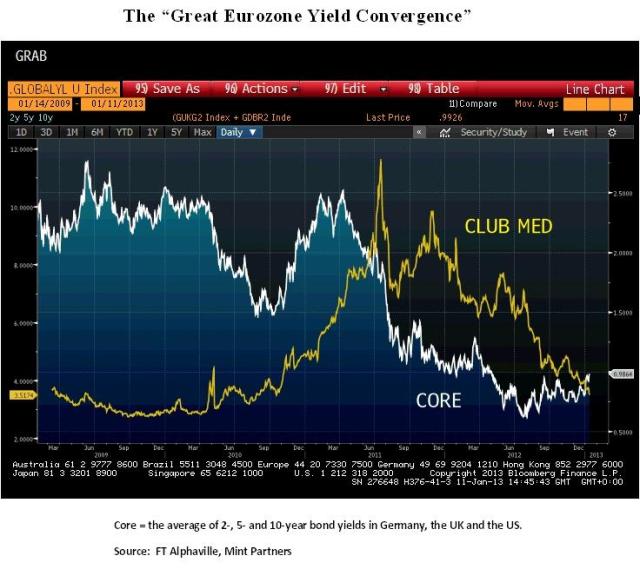
| Weekly Eurozone Watch – “Positive Contagion” Posted: 11 Jan 2013 01:30 PM PST Key Data Points
Comments
(click here if chart is not observable) |
| Bair: Geithner’s Appointment Was `Punch in Gut’ Posted: 11 Jan 2013 01:00 PM PST Former Chairman of the FDIC Sheila Bair talks about President Barack Obama’s nomination of Jack Lew to Secreatery of the Treasury.
|
| Why the Banks Were Thrilled About $8.5B Settlement Posted: 11 Jan 2013 11:12 AM PST The banks are thrilled at the latest settlement, confirming yet again their ability to break the law with impunity. Consider the following, from the litigation between Syncora Guarantee (formerly XL Capital Assurance) vs EMC Mortgage Corp, and Ambac Assurance vs vs EMC Mortgage Corp: Compare Comments made by Consultants Hired to do Foreclosure Reviews:
With comments made by Whistelblowers about due diligence on mortgages before they were securitized – full transcript attached:
I see if I can find the PDF of the full deposition; most of the transcript is after the jump
19 Q. So as I understand it, through the team leads you received directions that the clients wanted the underwriters to ignore certain defects in loans? 24 A. That is correct. 10 Q. Did you work on stated income loans at Watterson and Clayton? 23 Q. Let me go back to paragraph 17 of your declaration. Let me read the second line here. It states that: “I recall specifically one occasion when representatives of Bear Stearns (the purchaser) told my supervisors 15 Q. Do you recall any other instances? 5 Q. So it’s fair to say that even though you don’t remember any other specific occasions when you received similar instructions, that you did receive these types of instructions on a regular basis? 13 Q. Even though you may not be able to recall, as you testified, other specific examples, do you believe that you found loans like this where the stated income was not reasonable on other occasions? 11 Q. Paragraph 20 of your declaration states that: “Due diligence underwriters like myself often faced significant pressure from supervisors to review loan files quickly as possible and to avoid finding defects.” Is 3 Q. So the slogan Bear don’t care, was that a slogan which was also used by team leads? 19 Q. Now what happens to underwriters were not doing twelve hours — twelve loans per day in a twelve-hour day? 21 Q. Well, let me just turn to paragraph 20 of your declaration on page 6 that states, the second sentence: “These pressures” — and these pressures are to review loans quickly and not to find defects — “led many due diligence underwriters to simply enter into the CLAS database information found on the loan application rather than entering information from the verification documents in the loan file, as required by the protocol.” Do you see that? 22 Q. And earlier you stated that you know that relatives of Gary Barmore were also 24 engaged in 1008, 1003 underwriting? 9 Q. And you testified earlier that the comp factors that you found at the direction of the team leads were either contrived or not sufficient to overcome the defects? 12 Do you recall during your employment at Watterson and Clayton coming across documents in loan files that appeared to be fraudulent? 25 A. Usually the instructions were just go ahead and keep it moving, enter the information, we will take care of that with the investor, the seller, or we will get the document — the correct documents later. 20 A. Once we — once a lot of the documents were missing or it was prevalent that we don’t have these documents, we were told to ignore, ignore that and grade them as normal, ignore that document that was needed. 12 Q. Did you ever notice in reviewing stated income loan products at Watterson and Clayton W-2s and other tax documents that were left in the loan file? 15 Q. When you say “pull those documents out,” what do you mean by that? 14 Q. So a lot of times these documents were pulled out of the loan file and just destroyed? 24 “Supervisors and project managers repeatedly told due diligence underwriters that the loans that we were reviewing had already closed and that the borrowers had already moved into their new houses, and as such, the due diligence underwriters should not be too strict in their review.” Is that a true statement? 4 Q. Turn to paragraph 19 of your affidavit, which is on page 6. It states here basically that you were instructed that because the loans had already closed your review of those loans should not be too strict. 14 Q. So you heard it from the mouths of your team leads – 9 Q. Do you recall the name of the particular Bear Stearns representative which the team leads referenced? 19 Q. I am going to turn to paragraph 25 of your affidavit, which is on page 8. It states that — here that: “When due diligence underwriters determined that a particular loan had a defect that was not sufficiently overcome by compensating factors — resulting in a grade of 3 — supervisors would frequently change the 7 Q. In summary, just to wrap it up, is it your view that the due diligence underwriting practices at Watterson and Clayton did not accurately or properly determine whether loans complied with the underwriting guidelines? Q. I want to focus a little bit on your jobs — your job as an underwriter at both Watterson and Clayton. What is your understanding of what the role of an underwriter was at Watterson and Clayton? 16 It says here: “Importantly, in reviewing each loan, the due diligence underwriter also had to assess whether the loan met the criteria set out in the underwriting guidelines. For example, the underwriting guidelines for stated income loans required, among other things, that the borrower’s income listed on the loan application must be reasonable.” 24 A. That is correct. 10 Did you find that the guidelines that you were provided by these project leads and team leads of both Watterson and Clayton, did they always apply to the loans that you were reviewing? Q. When you say outside of the box, you are talking about a time period? 10 Q. So as I understand it, I want to make sure that the record is clear on this, that Watterson Prime and Clayton underwriters like yourself were not often provided with the guidelines which were applicable to the loans at the time they were originated? 2 A. Yes. – |
| Posted: 11 Jan 2013 10:24 AM PST The absence of meaningful negative market responses to debt ceiling dramas, Japanese inflation targeting, trillion dollar coins, and other odd and dubious politically-oriented market meddling seems to be sending reflexive signals back to capitals: all clear, continue self-destructing. The markets seem not to care, knowing that central banks have their back. Money creation can suspend nominal economic contraction and ensure rising financial markets until something, (anything!), might stir the public's imagination again and animal spirits. But while money can suspend animation, it is not and cannot replace real economic functioning. In fact, ongoing money creation is locking-in negative real economic growth and real returns in most financial assets. We think the best strategy for discretionary investors is to stay focused on the growing monetary mountain across the valley, and to not look down. This piece seeks to place the current investment environment in economic, political and social perspective. The second Chukker may break new ground for many. Bowl In: Taking the Field In spite of mostly zero-bound global interest rates, economies are stagnating because producers, consumers and investors are unwilling or unable to borrow in quantities significant enough to generate real growth. Widespread credit distribution has stalled because positive real economic growth and unlevered ROIs are simply unavailable. Political leaders and monetary authorities seem reluctant to take the hint, continuing to conjure unconventional initiatives that retard the natural tendency towards sovereign insolvencies and bank asset deterioration. We, the non-government, non-bank factors of production and investors, may only watch.
But there are two major problems for governments of indebted advance economies: 1) they have mismatched funding – while their assets are theoretically priceless and perpetual, their liabilities are not and their debt service is not covered by their income streams (taxes); 2) their shareholders and greatest resource – we, the people – provide the income. And it is our equity. Management – let's call it the political dimension – made shareholders very happy over most of the last forty years by issuing massive amounts of shares (money). We exchanged our shares back and forth, quicker and quicker, bidding up the capital base of our countries in terms of those shares. At some point, share issuance overwhelmed new capital formation. Rather than stop issuing new shares, or even buying them back, management issued ever more to us. When we revolted in 2000, management convinced us to let them create even more shares. The value of our housing rose. When we revolted again in 2008, management again convinced us to dilute our equity further ("the alternative would have been catastrophic!"). We think this parable captures the reality of the situation fairly accurately, except for one very significant thing: governments do not issue money, banking systems do, and so we have not been bailing ourselves out. Banking systems have been bailing out themselves with shareholder equity and the effect has been to transfer wealth from shareholders to banking systems. We think the silent priority of bailing out banking systems with Other People's Capital should accelerate further in 2013 given: 1) the still extreme risk of bank asset deterioration from public debt servicing constraints and; 2) the extreme concentration of global deposits held in Systemically Important Financial Institutions (SIFIs), as well as the risk of systemic contagion resulting from just one SIFI derivative-generated event.[1] Exhibit A is the noticeable loss of pretense among global monetary policy makers and market observers that unprecedented bank reserve creation (QE) is directly stimulative, and yet it remains in full force. The rationalization sold to politicians and the public seems to be that de-levering banks will ultimately lead to a new round of credit expansion, which in turn would create nominal economic expansion. This idea is not without merit. It is reasonable to expect nominal output growth stemming from asset and price inflation. But is this sufficient? No. Lost in the equation is wealth. Not wealth as in "wealthy" but wealth as in purchasing power and resources. The combination of abstract money, political economics (the art of back-testing juicy rationalizations), and emerging resource-rich economies with the temerity to be aspirational has created a global economic environment in which measuring wealth is quite a challenge. The fundamental question facing anyone with excess purchasing power today is: how am I supposed to store wealth or increase it if I can't define it? First Chukker – Thoroughly Modern Money Modern money is the third rail of economics, a notional concept, a derivative, an abstraction with no definable future purchasing power. So let's briefly define it. Money, per se, is base money (M0), which may only be created by central banks. It is comprised of physical currencies in circulation and bank reserves held on deposit at central banks. Base money did not increase much from 1971 to 2008, although other monetary aggregates such as M1, M2 and M3, did. These aggregates are comprised of credit-currencies created by banks, not central banks. Loans and deposits are conjured simultaneously at banks and become unreserved electronic currency that floats through the economy as credits and debits, used for wages, consumption, capital spending, and even savings. Simply, banks create unreserved credit (i.e., a short in base money), which is generally and erroneously perceived as base money. The base money short must eventually be covered by central banks. This "fractionally-reserved" global monetary system is analogous to the Treasury bond market in that "when-issued money" (i.e., M1, M2, and M3) trades in the economy before it is ultimately issued (as M0). In this case long before.
So, should we count our bank deposits as wealth? Presently, there are nowhere near enough bank reserves to cover bank deposits (deposits are unreserved by over 7:1). There is no need to fear bank runs, however. Were every depositor in the world to suddenly demand his or her money, central banks would easily create it with a few keystrokes. As for banks, credit-currency creation levers their balance sheets while injections of central bank base money, in the form of QE bank reserve creation, de-levers them. It is an easy leverage/de-leverage model. For everyone else, this process raises natural conflicts – especially in an already over-levered global economy in which producers, consumers and trade partners must constantly sort the value of resources, goods, services and assets. The only logical metric to value anything has become through contemporaneous agreements among bilateral counterparties that this is worth that. Thus, modern money is satisfying the requirements as units of account and media of exchange, but not the requirement as a store of future purchasing power. So, it is foolhardy to save money.
Second Chukker: The Pricing Matrix Investors must consider a more nuanced decision making metric than savers. The true driver of broad asset prices reduces to: a) the size of the total money stock and, b) its composition (i.e. its mix of base money and credit currency). (This Chukker is dense but we think insightful.)
There are two planes in the pricing matrix: inflation/deflation and leverage. The growth or contraction in the nominal quantity of money, in concert with an increasing or decreasing flow of that money stock (velocity), determines the rate of inflation or deflation, which in turn determines absolute pricing (i.e., the General Price Level or "GPL"). However, leverage levels and trends generally determine the relative pricing of assets vis-à-vis goods and services. We think understanding this relationship is the Holy Grail of secular asset pricing. The mechanics and consequences are quite clear and logical. For goods and service pricing, an item has a universal price, say $1.00, €1.32 or ¥88.15, which reflects consensus value. The item is exchanged in the world and its supply and demand shift along with preferences for it. This suggests ongoing price equilibrium for the item, higher or lower, based on population growth, innovation and reflexive availability and preferences. Keeping these variables equal, significant secular price changes of all goods and services (i.e., the GPL) – what is commonly referred to as inflation or deflation – must be derived from an exogenous input. That input is the growth rate of money. Put simply, left to their own economies demand for milk and eggs would rise and fall with population changes, temporal supply and consumer preferences. The same would be true of accounting expertise and shipping rates, as well as for digital phone and pharmaceutical manufacturing. So then why do we expect stock indexes, which are broadly comprised of phone and drug manufacturers (etc.) to appreciate more than the GPL? What produces the arbitrage that makes rational people expect low inflation and high financial asset returns? The answer is leverage in the banking system. As leverage grows, it targets assets for purchase, not milk and eggs. Consequently, asset prices move first and to a greater magnitude. Over time, as new credit-currency percolates through the system, holdings of it become smaller and more diffuse, thereby slowly bidding up non-asset (i.e., goods and service) prices. This GPL inflation process in turn benefits leveraged asset holders and banks while it is being perpetuated (higher earnings => expanding multiples => better debt coverage ratios etc.). As the gap separating levered asset (i.e., financial asset) inflation from GPL inflation widens, holders of financial assets are able to sell them at favorable rates of exchange vis-à-vis items they must purchase for consumption in the future, like milk, eggs and BMWs. The leveragers win…but they have to monetize their levered assets before there is a reversion to the mean. And that is the key. One of two things will happen if/when the levering process stops: 1) asset prices will tend to revert to levels that would prevail in the absence of leverage, and therefore collapse vis-à-vis unlevered goods and services, and/or, 2) central banks will monetize assets to maintain their artificially-elevated nominal levels and, through the simultaneous forces of de-levering the banking system, to maintain an environment that would allow nominal goods and service prices to rise again. In either instance though, asset prices are prone to contract in terms of goods and services pricing. When this occurs from natural economics (#1 above), it is popularly dubbed "deflation." When it occurs as a result of central bank intervention (#2), it is referred to as "bad inflation." The current environment is a textbook case of central bank intervention to sustain nominal asset prices in order to maintain the solvency of bank balance sheets. The cost of this intervention is goods and service inflation. All things un-levered tend to experience greater rates of price inflation than levered assets. These relative price dynamics should direct the rational investor to seek ownership of under- or un-levered assets (milk and eggs over levered assets). Thus, the true driver of relative asset prices is not necessarily inflation or deflation, but the levering and de-levering process. Leverage drives relative real asset pricing while the 'flations drive/describe overall nominal pricing with regard to goods and services. High leverage relates to high relative asset pricing and low leverage, the opposite. Back Shot – Faulty Perceptions Financial leverage is not the metric most investors see as the key determinant of relative asset price performance. As good citizen investors in levered republics we believe it is all more "economic" than that, as though there is an organic driver of value that defines broad pricing trends; as though financial asset markets rise or fall based on whether capital is being formed. And so we have back-filled our research with juicy rationalizations that circumvent reality and that perpetuate market sponsorship. This has led to weird and illogical general perceptions: a little deflation in any form is bad; a little goods and service price inflation is socially acceptable; financial asset hyperinflation is always great (!); commodity price inflation is that-which-must-not-be-named. (Such rationalizations are particularly essential to nations that are net exporters of currency claims and net importers of stuff.) The reality is that the process of levering bank system balance sheets is always good for longs and always bad for shorts (and vice versa for de-levering). Most investors today do not fear GPL inflation. The money being created is going to bank balance sheets – de-levering them and not being lent to the public. The lack of this money multiplier in the banking system, many argue, is holding down price-inflationary pressures for goods and services. So, the thinking goes, while money creation does technically threaten future price inflation, it cannot occur if it never leaves bank balance sheets. And to further combat price inflation expectations, central banks, notably the Fed, have declared they are prepared to withdraw the newly created money from the banking system were it to become a threat to price stability. This is reasonable, but by the same token it is the process of de-levering and does not support asset price inflation in real terms. The current state of play in indebted advanced economies is one of de-levering bank balance sheets while levering central bank and government balance sheets further. This process is simultaneously transferring wealth (future purchasing power) to banks from the non-bank private sector. We would guess this is being broadly tolerated because governments and the indebted public are more focused on the near term pressures of servicing their own debts, or perhaps because central banks are functionally sovereign over governments? [2]
As long as central banks have unlimited balance sheet capacity and unlimited jurisdiction to create reserves in exchange for bank assets, and as long as bank system solvency trumps central bank economic mandates (e.g., inflation, employment, etc.), and as long as politicians insist that central banks do not move to the sidelines thereby creating a Minsky moment,[3] we may rest easy that there will not be sustained deflation or aggregate system de-levering. In the modern financial system the probability of unicorn sightings seems about equal. Central banks are effectively writing puts on bank balance sheet leverage, which explains clearly the decline in market volatility and the underlying bid for financial assets. But we think most investors are not picking up the proper signal. They see low risk in the assets they have grown comfortable with over the last thirty years but they are missing the moon shot opportunity once policy makers are successful. (T-minus 10, 9, 8…) Third Chukker – Getting Silly
Speaking of monetary abstractionism, there has been recent talk of a fiscal gimmick called "The Trillion Dollar Coin," in which a platinum coin valued at $1 trillion would be created by the U.S. Mint for the Treasury Department. Treasury would then rid itself of its pesky fiscal deficit in one fell swoop by simply placing the TDC on deposit at the Fed and start writing checks. The TDC idea is a marvel of political imagination, monetary alchemy, and public ignorance (and so it seems to have legs!). As with most clever illusions, the TDC is based on sound logical footing, one in fact we have argued in favor of: asset monetization. But there is a fundamental difference separating the Fed monetizing Treasury's gold to devalue the dollar, followed by a re-pegging of dollars to gold at the higher fixed exchange rate (our idea), and assigning an arbitrary and absurd off-market value to an asset no one else is allowed to own. In declaring the coin to be worth $1 trillion, market-based discipline would be summarily dismissed. In its aftermath, twice or half the amount of global platinum could not be exchanged in the marketplace for double or half the amount of dollars. (It is reminiscent of the Weimar Germany scheme to back Papiermarks with agricultural land. Brilliant! Er, but how do its users exchange the money for the land?) Not only would it be difficult to value extant platinum, it would be almost impossible to value anything in the world (at least in dollars). Once the coin were struck, it would become obvious to the global marketplace – producers, consumers, savers, investors and trade partners – that future global purchasing power would be left exclusively in the hands of the US Treasury. Should US Dollars still be accepted in trade, Treasury would be able to simply outbid everyone on the planet for anything and everything. We suspect the Japanese Ministry of Finance would soon mint a ¥100 trillion pair of chopsticks and put them on deposit with the BoJ. They could then purchase most if not all of the oil on the market today for future consumption! We are confident oil exporters would not raise their prices because they would have the magic chopsticks as collateral. And why wouldn't all the world's treasury ministries simply create priceless flux capacitors and use them to create all the taxes needed to self-fund their governments? (To do so Ben Bernanke would have to hand over its proprietary technology – the Fed "has a technology called a printing press…") Obviously, the TDC idea is a political ploy with a targeted mission: to rid the US Treasury of its debt ceiling, which is an increasingly frequent and embarrassing public reminder of government largesse and ineptitude. Everyone knows government-led de-levering is not a serious threat. However, the irony of the scheme and its MMT[4]/liberal Keynesian promoters could not be more delicious. The scheme exposes the forty year-old charade, otherwise known as the global monetary system, better than any mind-exercise we have been able to come up with. As we considered the plan, Hunter S. Thompson's observation sprang to mind: "in a world of thieves, the only final sin is stupidity." Though the TDC idea would work from an accounting standpoint, it seems awfully unlikely Americans and the rest of the world would let the US Treasury enjoy a very visible monopoly on fraudulent monetary accounting. Fourth Chukker – A Glamour Profession One group that would certainly not tolerate the Trillion Dollar Coin idea is the global banking system, which presently enjoys a not-so-visible monopoly on fraudulent monetary accounting. Banking is the best business in the world because banks are able to lend money they and their depositors do not have and charge interest to borrowers for the privilege. If borrowers do not pay, banks may then take possession of the deadbeats' property. The infinite credit that banks are allowed to extend to the public and to governments is unreserved, yet they insist their marks put up capital as collateral. Capice? Banks lent more than they had in reserve in the 1920s but it did not work out for them in the '30s because central banks were unable to manufacture bank reserves electronically on their iPads to cover the base money short. Money was inconveniently a claim on gold at a fixed exchange rate and, even more inconveniently, there was nowhere near enough gold at the fixed rate to satisfy all claims from nervous depositors. So, bank assets (loans) deteriorated and banks became insolvent.[5] An accommodation was made in 1971, and since then there have been no restrictions on bank reserve creation. While it would be theoretically possible for central banks to allow their fractionally reserved banking systems to fail, why would they? As they are demonstrating presently, the first priority of central banks is to protect SIFI banks.
Investors should understand that banks do not care about the purchasing power of the currencies in which they make loans, just as long as their assets and liabilities are denominated in the same currency. (It's all about the vig spread!) We should be mindful of this when we consider the probability of future currency devaluation – banks would not be harmed. In fact, devaluation would strengthen the integrity of their loan books (because nominal prices of the assets securing their loan books are prone to rise). Fifth Chukker: Political & Social Considerations The political dimension will not be able to match future income and expenses to bring balance sheets into balance, not even close. It simply cannot work; not because politicians are self-serving short-termers or because banks will always pursue the best interests of their shareholders/managers, but because the underlying presumption is all wrong. The problem is pretty straight forward, as we see it. The purpose of economies is to ration resources efficiently. => Commerce is the way economies create, manage and distribute resources. => Finance is the means of funding and facilitating commerce (the proper objective of finance should be to fund real growth). => Real growth reduces to net capital formation after the cost of financing it. => Finance produces and relies on inflation and currently more inflation than capital is being produced. => Real economic activity is falling as a result. => Most people in advanced economies confuse finance for commerce. => Nominal growth is not the solution to declining economic activity; de-levering is. => Finance cannot help de-lever economies, only central bank reserve creation (QE) or debt deflation can. Pick your poison.
Capital formation through credit growth has fallen dramatically over time as economies have grown and matured, as one would expect, and yet politicians and most economists continue endorsing nominal economic growth through credit growth as the best way to alleviate current economic pressures and increase employment levels. This is a political construct, not an economic one that serves societies' long-term best interests. The political dimension, including Keynesian economic advisers across the political spectrum, continues to perpetuate an intellectual feedback loop keeping banking systems central to their economies. (Is it any wonder that it is generally perceived across economies that money, per se, is wealth – rather than as merely an indeterminate claim on resources and purchasing power?) Financial de-levering of vastly over-levered advanced economies can occur in only two ways: let systemic debt deteriorate naturally as it is starved of base money with which to service and repay it (austerity), or cover the vast base money short. Both are in force presently and generating clear winners (banks) and losers (the public and their governments). It would seem 99.9% of societies would surely find this state of affairs disagreeable were they aware. The presumption that banking systems have to be the mechanism through which economies must be funded, with credit being "created" rather than being intermediated, has been almost absolute, nary a peep among policy makers, academics, politicians and, well, Wall Street. And today when it comes to fiscal cliffs, debt ceilings, sovereign debt covenants and trade wars, there really is no political Right or Left and there are no conservative or liberal economists. There is only widespread gross negligence by those that presumably should know better. If politicians and political economists want to argue about burden sharing, the proper economic metric should be creditor vs. debtor, not rich vs. poor. Some of us may have lost confidence in modern money as a form of savings, but if we are to be honest with ourselves, we must address the most fundamental of all questions related to money: do most people in the world exchanging resources, goods and services care about saving their earned excess purchasing power for the future or are they simply content to let governments and banks determine the value of their labor and the measure of their wealth? When one thinks about it, this is not really a debate about money or economics. It is about social values and their political manifestations. An existential question: is it possible that money and the way societies treat it directly reflects how we value collective freedom and individual liberty, or is that too much of a binominal framework? Centrists in modern liberal democracies – self-identifying liberals, moderates and conservatives – tend to reject the idea that money is associated with human ideals beyond personal greed and charity. We are taught that money, per se, has no moral component (which is consistent with the idea that guns do not kill people, people do). Fringe dwellers tend to dispute such a notion. The policies of the Tea Party on the right and Occupy Wall Street on the left, for example, tend to link the treatment of money (and guns) to social morality. A European friend recently suggested to us that madness has taken over American politics. True that. But it seems more likely that American politics is merely reflecting far greater and deeper social introspection. Americans seem to be in the process of sorting themselves into groups with shared social values. Why might this be? Perhaps it is because our money no longer allows us to measure our personal industry? What is my personal economic value to society when a Nobel Laureate thinks the effect of proclaiming a trillion dollar coin would be "benign"? On the surface, Left and Right fringes have always seemed bipolar opposites in terms of their social sensibilities and views on the optimal role of government. However, it is obvious that in the current environment the fringes are infiltrating established parties with which each has historically been associated and, it seems, finding a hollow core – the parties are long of self-serving ambition and tactical expertise and short of worthwhile principles. In this, the Left and Right fringes have a lot in common. They share deep disappointment in the efficacy of government and they are increasingly agitated by their representation in it. The response of centrist elected leaders has been to revert to what they know: to secure funding from special interests with deep pockets in return for implicit favors, and then to use the funds to create a fictional narrative to appeal to the masses. As time goes on the masses are learning their representatives are providing only basal representation; enough only to keep them on the team for the next election cycle. The sad reality is that this is actually working for elected officials and their backers, but at a cost of increasing popular self-worth and identity. Governments in representative democracies are not providing representation and their policies resemble nothing close to economic problem solving. Rather, they seem to be the result of consultants' cost/benefit analyses of political capital expended vs. …what, self-serving ambition? It may be working now but the political establishment should be very worried. The rest of us, regardless of our past politics, should be very excited. Like an old married couple that can no longer talk past each other once the money runs out, competing political parties are discovering they cannot escape each other as their societies' real wealth is diminishing. It seems they are almost to the point where they might have to begin to give a shine about the people they ostensibly serve. (Look for the reincarnation of Andrew Jackson in 2016 or 2020?) Final Chukker: The End (of the) Game Discussions of fiscal cliffs and sovereign bailouts are political constructs that we think have less to do with secular macroeconomics than most observers believe. At the risk of seeming overly glib, such events have been inevitable flashpoints that had to emerge. They represent the decision surrounding debt default: should it be explicit (natural credit deterioration that demands sudden widespread austerity), or implicit (policy-administered inflation that demands the loss of perceived wealth)? The former would demand politicians and policy makers step away and let organic market forces prevail. Debt would quickly be right-sized through massive defaults, nominal output levels would drop precipitously and there would be great social expense in the near term. The latter would maintain irreconcilable debt-to-real output levels at not-so-obvious near-term social expense in perpetuity until societies implode, their economic production uncompensated in real terms. The political decision has been made several times over: do the latter, take a pass and let central banks de-lever private banks, transferring wealth to them from the public directly via transfer payments and indirectly, via inflation.
Back Shot The counter argument to our framing of the issue would be that it would be possible to work out debt imbalances over time through a prudent mix of output growth, austerity and inflation. This may be theoretically true, but it is far from likely in that sporadic periods of success would reflexively create far higher imbalances through increasing interest rates and debt service obligations. Further, and perhaps more importantly, any inclusion of true austerity would necessarily include widespread personal bankruptcies and high profile failures of sacrosanct institutions like governments and banks. Not everyone agrees. Consider the recent thoughts of Nobel economist and New York Times columnist Paul Krugman, who seems to believe that people such as QB (we presume) are unnecessarily hysterical: "Back in the 1950s three social psychologists joined a cult that was predicting the imminent end of the world. Their purpose was to observe the cultists' response when the world did not, in fact, end on schedule. What they discovered, and described in their classic book, "When Prophecy Fails," is that the irrefutable failure of a prophecy does not cause true believers – people who have committed themselves to a belief both emotionally and by their life choices – to reconsider. On the contrary, they become even more fervent, and proselytize even harder."[6] Dr. Krugman goes on to link this irrational sky-is-falling mentality to political conservatives continually calling for budget deficit reductions out of fear that the markets will force interest rates higher, which in turn would doom economic growth. As evidence he noted how the more conservative wing of Keynesian economics, as represented by the Wall Street Journal editorial page, argued in 2009 that unless budget deficits were brought down bond vigilantes would force rates higher. Not only did interest rates not increase, Krugman correctly explains, they actually fell. Krugman went on to note that the Journal argued the exact same point, again incorrectly, just a year later in 2010. Debt continued to grow, interest rates kept falling, and yet these conservative austerians remained incredulously resolute. It was time to direct his peeps to accept their lot in life, intellectual superiority: "the key thing to understand…is that the prophets of fiscal disaster, no matter how respectable they may seem, are at this point effectively members of a doomsday cult. They are emotionally and professionally committed to the belief that fiscal crisis lurks just around the corner…so we cannot and will not persuade these people to reconsider their views in light of the evidence. All we can do is stop paying attention…and it's time to stop taking them seriously." For what it's worth, we find ourselves agreeing more with Krugman about interest rates and the powerlessness of bond vigilantes than with the Wall Street Journal editorial page. (Central banks will always have more money at their disposal than the total amount of bonds outstanding.) However, we fundamentally disagree with him and other Keynesian economists (liberal and conservative), who seem to continue to believe in the legitimacy of the Phillips curve (the trade off of inflation for employment). Empirical data show clearly that increasing systemic liquidity at leverage levels approaching today's does not increase real production and employment. (Public figures should consider this when discussing false prophesying in the face of contrary evidence.) Nevertheless, we would agree with Dr. Krugman and other economists that argue in favor of far more money creation, but probably for different reasons. More and quicker trillion dollar coins and credit-currency creation would accelerate the demise of the global petro-dollar monetary system[7] so that it could be replaced more quickly by a more equitable and honest system that meritoriously benefits the factors of production within both resource-importing and resource-exporting economies. Then, we would suggest the Phillips Curve would work. To our self-identifying liberal economist friends, we are struck by the blind spot you seem to have in helping maintain and promote the current monetary system. The finance-based, inflation-based model is terribly regressive in that working class labor cannot save their wages over time in the hope of using them for future consumption, like education or retirement. And the current flimsy monetary system ensures low wage earners will always have less access to credit than higher income workers and ensure their wages lag the general rate of inflation. Is your adherence to this system born of the pride that comes with understanding a political construct bestowed only upon those with elite educations? Or, maybe you have no blind spot after all? Perhaps you see notions like trillion dollar coins as Trojan Horses capable of destroying this insidious system? We must also respectfully disagree with the platform of most self-identifying conservative economists who see every economic problem as the result of government intervention and overly confiscatory tax policies. While the more productive among us do indeed tend to be employers and the biggest tax payers, there is very little connection in most advanced economies today linking higher income with those that actually produce capital. Over the last generation we have become the beneficiaries of leveraging the economy. Emphasizing fiscal austerity now is selfish, narrow-minded and self-destructive. The bourgeoisie never survives scorched Earth economic events. In our humble opinion, the public debate occurring within socially acceptable boundaries seems more a petty political game, a senseless distraction that has swept up public intellectuals on both sides of the aisle, like the ancient Roman senate debating bread or circuses. An honest public conversation would acknowledge the current situation and likely lead to a consensus to default implicitly through inflation. Blame for past credit policies would be placed and public arguments would follow as to which segments of society would be winners and losers. Such a process would no doubt be contentious and messy, yet this is the adult conversation the public deserves. (Or better yet, maybe SIFI banks, the BIS, the IMF and the G10 could work it out before the public becomes restless?)
The response by investors was to withdraw from developed markets and to re-allocate to emerging markets where better real value was thought to exist. However, investors seem to be discovering presently that although there may be more capital growth potential in emerging economies, their public financial markets are equally subject to promotion, glamour and fraud. More importantly, emerging economies do not provide infinitely leverage-able balance sheets. Indeed they provide no direct leverage at all because their banking systems are also emerging. US dollar leverage is the basis of relative value across the world. Global leverage is enabled by a few major central banks, as one would expect in a finance-based US dollar global monetary system, and most of the visible power in the world further reduces to the purveyor of the coin of the realm: the Fed. Goal! To G7 leadership: it is time to shift the terms of the Monetary Empire before it destroys our cultures, both externally and from within.
There are no good data points in the modern era where all global economic participants simultaneously lost faith in a completely unreserved global monetary regime. It would not be in your best interests to test these logical limits and then have to start the system from scratch. But the economic sky does not have to fall and property does not have to be transferred if (when) the current monetary system converts to a more sustainable one. We would all wake up the next morning in our beds and go to work. All that would change is the numbers we place on our commerce and property would be far larger, and the amount we owe far smaller in comparison. We urge readers, policy makers, political donors and, most importantly, global investors able to influence all of the above through capital allocation, to force central banks to devalue our currencies and peg them to sovereign gold, before it is too late. The money spent to date has yet to be created. Close the gap and let us all get back to work. Kind regards, Lee Quaintance & Paul Brodsky Source: |
| Matt Miller on #@$!-Bombs: 5 Uses of Profanity in Politics Posted: 11 Jan 2013 10:19 AM PST Bloomberg’s Matt Miller reports on the use of curse words by elected officials, from Speaker Boehner to Vice President Cheney.
|
| Posted: 11 Jan 2013 09:00 AM PST Coming to the Netherlands in 2013: click for video Fact sheet after the jump
Source: Studio Roosegaarde |
| Long Term Inflation: Wiemar, Europe, US, South America Posted: 11 Jan 2013 08:30 AM PST I cringe each time I hear some inflationista — you may have met that guy who insisted there was no inflation during the 2000s as the dollar plunged 41% but now sees inflation everywhere — brings today up the Weimar Republic every chance he gets. Here is a look at long term Inflation we spoke about earlier on the US, FRANCE, JAPAN, UK and SPAIN to 1868
GERMANY to 1820 in a separate chart because of that WEIMAR REPUBLIC hyper inflation.
And for South America including, Brazil, Argentina, Chile and Peru who experienced massive inflation in the 1960's – 1980's…
Source: |
| Yen 10.3tr Japanese stimulus plan announced Posted: 11 Jan 2013 07:00 AM PST Mr Abe unveiled a Yen 10.3 tr (US$115 bn) supplementary budget, which includes a major stimulus programme. Some Yen 5tr was already earmarked to be spent and, as a result, the size of the additional stimulus programme amounts to around Yen 5 tr. Mr Abe believes that the stimulus measures will raise GDP by 2.0% and create some 600k jobs. The funds will be spent on rebuilding the region hit by the earthquake and tsunami, help improve Japanese corporate competitiveness and foster innovation and promote certain wealth creation measures, together with about ⅓ rd spent on education and healthcare. A further Yen 2.8tr will be contributed to the national pension scheme, raising the size of the supplementary budget to Yen 13.1tr. Raising Japan’s GDP by +2.0% and creating 600k jobs – I very much doubt that – more likely that it will increase GDP by between +0.5% to +0.75%, with employment rising by just 1/3rd (possibly ½) of that anticipated. GDP for the fiscal year starting 1st April 2013 could come in around +1.75%. However, these short term measures do not address Japan's fundamental problem, namely to increase long-term growth. Structural reforms are necessary, but Mr Abe has failed to address this issue. Alarmingly, the Japanese current account declined to Yen 222.4bn (US$2.5bn) in November, well above estimates of a decline of just Yen17.1bn and a reversal from the surplus of Yen 376.9 bn in October. A continuing current account deficit remains one of my key concerns for the country as, in due course, Japan will need external financing to meet its requirements. The Yen declined to around 89 to the US$ at present, though declined to Yen 89.35 at one stage, the lowest since mid 2010. Recent comments by the BoJ governor Mr Shirakawa suggest that he may accede to Mr Abe's proposal to raise the BoJ inflation target to 2.0% Some kind of employment target has also been talked about. The Nikkei, on the other hand rose by +1.4%; Chinese inflation rose to +2.5% in December, higher than the +2.3% forecast and the +2.0% in November, a 7 month high. The coldest winter in nearly 30 years raised fresh food prices. Inflation is likely to rise further, to perhaps to +3.0%, given the cold winter and price increases during the upcoming Chinese New Year holidays. The Shanghai composite declined by -1.9% on fears that rising inflation will limit the ability of the authorities to ease further. However, these look like 1 off price increases to me and inflation, whilst likely to have bottomed, should decline from a peak of around +3.0% in coming months. CPI rose by +2.6% last year, though PPI declined by -1.7%; Indian industrial production declined by -0.1% in November Y/Y (+0.1% expected), from a revised gain of +8.3% in October, though the data was impacted by holidays. South Africa was downgraded to BBB, from BBB+ by Fitch, the 2nd lowest investment grade rating, though with a stable outlook – stable outlook !!!!. Fitch cited slower growth, a wider budget deficit and increasing unemployment. Fitch also referred to "social and political tensions", which "have subdued growth" together with corruption and an ineffective government. And they have a stable outlook !!!. S&P and Moody's downgraded S Africa last year. With a budget deficit likely to come in around -5.0% of GDP, combined with weakish growth (the government's forecast is +3.0%, which looks optimistic to me), further downgrades are likely. For full disclosure purposes, I remain short the Rand; Mrs Merkel is in Cyprus to attend a meeting of conservative politicians. She will not meet the communist President, Mr Demetris. Elections are due in February and a new President is expected to be elected. She advised that Cyprus would not receive special treatment. German politicians have balked at a potential bailout of the country and its banks, as there are allegations that Cypriot banks have aided in money laundering and tax evasion, in particular on behalf of Russians. The German opposition (SPD) has advised that they will not vote for a bailout, which means that Mrs Merkel will not be able to get approval from the Bundestag, given opposition from some members of her coalition. Furthermore, the EZ disagrees with the IMF, who want Cypriot banks to be bailed out directly by the EZ and, in addition, that a debt restructuring should be concluded before they consider lending – both issues are opposed by the EZ. Cyprus was downgraded by 3 notches to Caa3 by Moody's. Watch Cyprus – the EZ may just force a debt restructuring ahead of a bailout, which could well threaten the current calm in the region. It is thought that Cyprus needs some E25bn to bail out its banks and the country, though the government suggested that they would need just E17.5bn – yeah sure. An exit of Cyprus from the EZ is also a possibility; Spanish Industrial output declined by a massive -7.2% in November Y/Y, much worse than the -4.0% expected and the -3.1% in October. Spain's problems continue; UK November manufacturing production declined by -0.3%, much worse than the rise of +0.5% expected, though better than the -1.3% in October. UK November industrial production rose by +0.3%, lower than the +0.8% expected , though better than the -0.8% in October; The US November trade deficit declined to -US$48.7bn, far higher than the -US$41.3bn expected and the revised -US$42.1bn in October. The numbers however, suggest that the US economy is improving faster than expected; Outlook Asian markets (ex China, which was -1.9% lower) closed mainly flat to higher (Nikkei was up +1.9%), with European markets flat. US futures suggest a flat open. The Euro is surging, following the ECB statement that they were unanimous in not wanting to reduce interest rates. GS has also suggested an Euro/US$ target of US$1.37. Gold is trading around US$1674, with February Brent lower at US$110.26 – finally declining. The Japanese stimulus package has weakened the Yen, in particular against the Euro – currently E118.73 and Yen88.98 against the US$. Have a great weekend. Kiron Sarkar 11th January 2013. |
| Posted: 11 Jan 2013 06:50 AM PST My morning reads:
What up this weekend?
The hottest places on Earth |
| Your Intuition Is Deceiving You Posted: 11 Jan 2013 05:40 AM PST David Brooks has a fascinating column out this morning explaining the ways our assumptions and intuition leads us astray. It is filled with interesting examples of how we often rely on crude beliefs that are not backed up by the data, and how the standard narratives are often wrong (reality has a quantitative bias). Based on research at Duke, Penn and Princeton, the significance of these findings to public policy is overwhelming. I suggest you go read the column before you do anything else this morning.
Source: |
| HSBC: Holy Sh#&, Bank Corrupt! Posted: 11 Jan 2013 04:08 AM PST Bank Wankers – HSBC HSBC proves too big to prosecute when it comes to laundering money for terrorists and Mexican drug cartels. |


| You are subscribed to email updates from The Big Picture To stop receiving these emails, you may unsubscribe now. | Email delivery powered by Google |
| Google Inc., 20 West Kinzie, Chicago IL USA 60610 | |



1 comments:
Hi! I've been following your website for a long time now and finally got the bravery to go ahead and give you a shout out from Lubbock Tx! Just wanted to mention keep up the good work!
Feel free to surf my page ; transfer rumours
Post a Comment