


The Big Picture |

- Blog Redesign: Update
- Crap: The Content Marketing Deluge
- Bernanke Tweets
- US Navy Chief Oceanographer: I Was Formerly a Climate Skeptic
- Weekly Eurozone Watch 1.18.12
- 10 Trends to Watch in Finance for 2013
- Picture of the Big Bang (a.k.a. Oldest Light in the Universe)
- 10 Weekend Reads
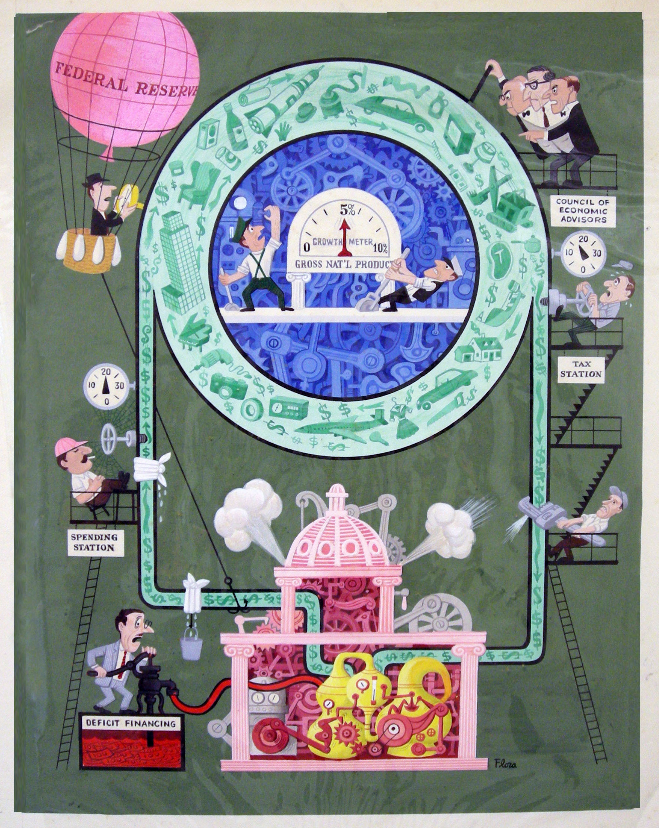
| Posted: 19 Jan 2013 04:00 PM PST I mentioned at the end of the Summer that I was beginning a site redesign. The refresh is nearly complete — the interior design is mostly done (see PDF below the jump). This is the part of the design that holds the written content and graphs. It is much cleaner, easier to read and navigate. The first post will be fully expanded, but the next 9 subsequent posts will be headline and a sentence or so. This will load MUCH faster than 10 posts with all of their graphics, charts, text, etc, having to load also. Its about a 4X speed bump. All of the current functionality — email post, print, search, RSS, etc – will also continue. (I have been getting so many RSS Scrapers I may shift back to partial RSS feed from full post to thwart the splogs). ~~~ The header and side background are still works in progress — we started with the Jim Flora art work Money Flow as the inspiration for the design (I secured the digital rights and have the original). Then we updated it into something more modern while still retaining a little retro flavor. (So far, the TBP logo is still the same). As mentioned, we are doing away with the 4 Tab design (its old and boring). In its place, we are using Icons to replace/identify the 4 subjects previously in Tabs: Think Tank, Video, BookShelf and Weekend. Click on anyone of these and you still get the full feed of that tab subject. Overall, the layout is much cleaner and lighter.
Site redesign inspired by Money Flow
Click to open PDF of interior:
Click to open graphic
>
|
| Crap: The Content Marketing Deluge Posted: 19 Jan 2013 01:00 PM PST |
| Posted: 19 Jan 2013 12:30 PM PST Here is the invitation:
Here are the not surprising results: |
| US Navy Chief Oceanographer: I Was Formerly a Climate Skeptic Posted: 19 Jan 2013 09:00 AM PST |
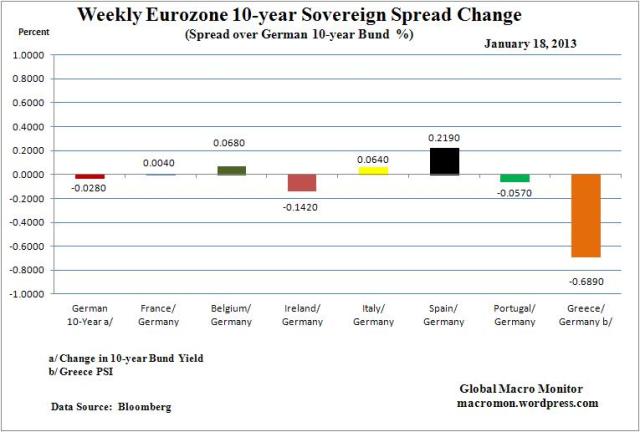
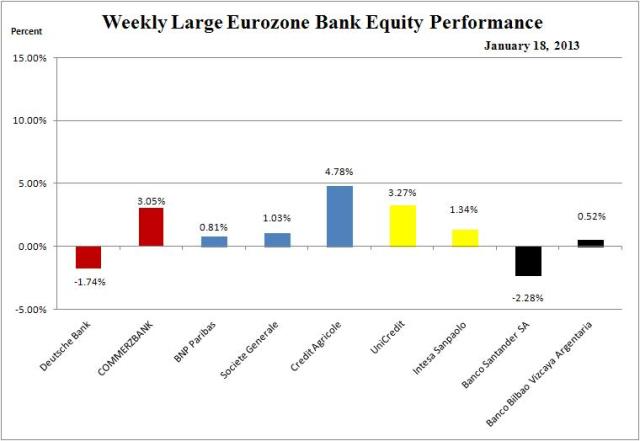
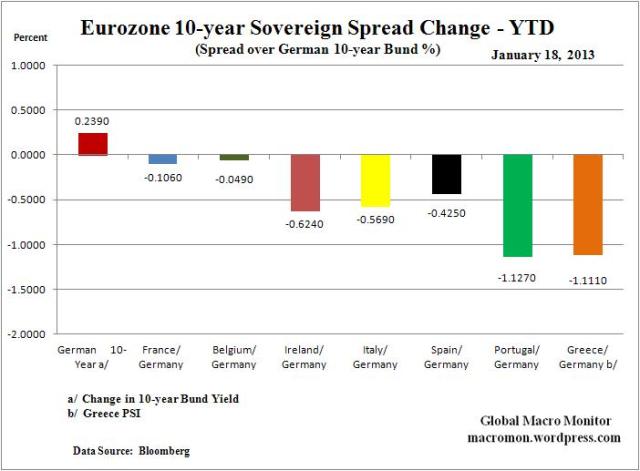
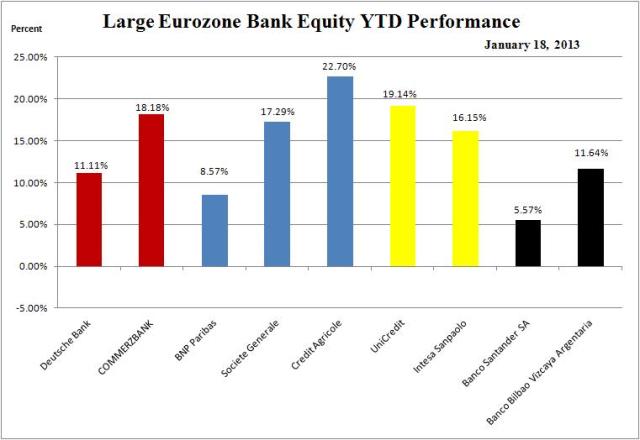
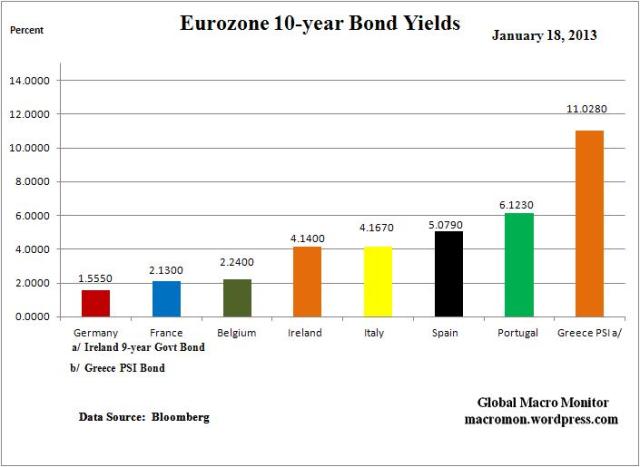
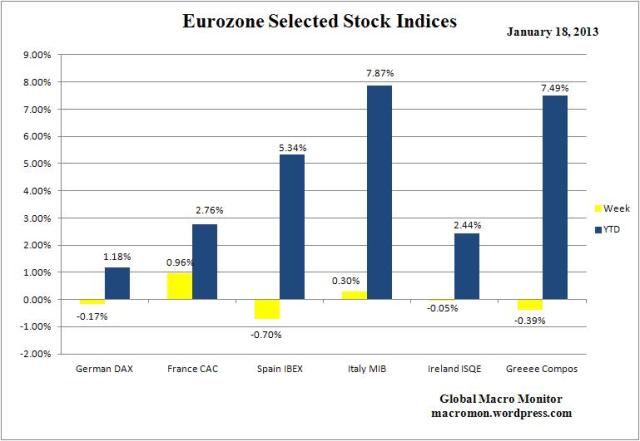
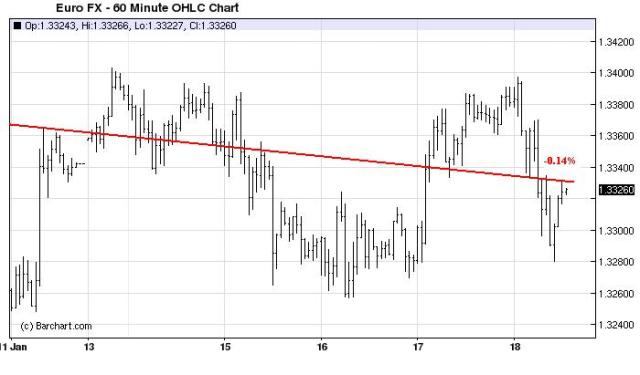
| Posted: 19 Jan 2013 08:15 AM PST Key Data Points German 10-year Bund 3bps lower;
(click here if charts are not observable) |
| 10 Trends to Watch in Finance for 2013 Posted: 19 Jan 2013 07:30 AM PST 10 trends to watch in finance for 2013
It's a winter ritual: Seers, prognosticators and other gurus tell us which stocks to buy for the year ahead, where they think the Dow will close in December and which momentous events will take place. History teaches us that the majority of these charlatans will be wrong, and the ones who get it right are mostly lucky. If you have been reading my column for any length of time, you know to ignore them. (See 2011's Forecaster Folly.) When it comes to predictions, I do the following: Note down the forecasts made this month and look back at them in a year. Repeat every year. I use my desktop calendar and an e-mail Web service called Followupthen.com to keep me on track. I started doing this almost a decade ago, and I found it terribly liberating. It will be always be instructive, and, as with the class of 2008 forecasters, occasionally hilarious. Doing this taught me to ignore the forecasts I see or read, as well as to keep the piehole in the middle of my face closed whenever anyone asks me for a forecast. I defer, saying, "I have no idea. No one does." It is fun to watch the TV anchors' heads spin like Linda Blair's in "The Exorcist." A better use of your time? Discern what's happening here and now. It's been my experience that investors spend so much time worrying about what might come next that they miss what just happened. To that end, let's look at what's driving the world of finance. Major shifts have already taken place, and if you understand what they are, it will help your financial planning. From my perspective, these are the more significant trends that will probably continue into 2013: 1. ETFs are eating everything. The revenge of John Bogle continues apace. As investors figure out that they are not good at stock-picking or managing trades, they have also learned that most professionals are not much better. Paying high mutual fund expenses to a manager who underperforms a benchmark makes little sense. This realization has led to the rise of inexpensive exchange-traded funds and indices. This "ETFication" has obvious advantages: low costs, transparency, one-click decision-making. ETFs are accessible through the stock market for easier execution, with no minimum investment required. Even bond giant Pimco recognized this trend and created an ETF version of Bill Gross's flagship vehicle, the Total Return Fund. Pimco actually charged more for the ETF than its mutual fund to prevent an exodus of investors from the world's largest bond fund. This will eventually shift. Note that Bloomberg, Yahoo Finance and Morningstar all have robust ETF sites that are free (Morningstar charges for some data). 2. The financial sector continues to shrink; advisers continue to leave large firms for independents. Since the financial crisis, Wall Street has shrunk considerably. According to the Bureau of Labor Statistics, there were about 7.76 million people employed in finance and insurance as of November. That's down almost 10 percent from the pre-crisis 2007 peak of about 8.4 million workers. Its more than the crisis: Technology and productivity gains make it easier to operate with fewer workers. My office is a perfect example: Twenty years ago, it would have taken a huge staff to manage the assets we run, handle all the administrative functions, take care of the monthly reporting and manage compliance. What would have taken two dozen people in the 1980s is easily managed by five people today. Oh, and everyone in the office is required to do research or publish commentary. That would have been impossible 30 years ago. Over the past 40 years, the financial sector over-expanded. Much of what is happening on Wall Street now reflects the process of reversing that excess capacity. 3. Increased pressure on fees and commissions.This trend predates ETFs and Wall Street shrinkage; highly paid people are being replaced with cheap software and online services. This is likely to continue for the foreseeable future. This is a very good thing for investors: Academic studies have shown that fees are a drag on returns, and lowering these costs is a risk-free way to improve your returns. 4. Hedge fund troubles.This was not a stellar year for the hedge fund industry. First, there was the issue of underperformance, with the hedgies getting stomped — they underperformed markets by 15 percent. Although being beaten by the market is part of the business, it must be tough explaining to clients why an $8 ETF outperformed a service for which they were being charged 2 percent plus 20 percent of the profit. Then there were the legal troubles and insider-trading indictments. A few high-profile closings also hurt the industry's reputation. What the industry has going for it is human nature (also known as "greed"). At the first sign of outperformance, the formerly skittish client base will come stampeding back.
5. Dispersal of financial news.As the finance industry gets smaller, the media that covers it is also shrinking. If investors are moving away from stock-picking, there is less of a need for the chattering classes to tell you all about it. That is reflected in a variety of ways: Cable television channel CNBC's ratings plummeted, and Dow Jones shuttered the 20-year-old magazine SmartMoney. At the same time, alternative sources of news are rising. Blogs continue to be a source of intelligent analysis and commentary; Twitter has become the new tape/newswire. And start-ups such as StockTwits allow traders and investors to share ideas in real time. (Disclosure: I am an investor in StockTwits.) 6. Demographics are a huge driver.I am not in the camp that believes demographics are the be-all-end-all, but one should not underestimate how significant a factor they are. The aging of the baby boomers is affecting housing (they are downsizing), job creation (they are working longer), investment planning (they have been heavy bond buyers) and generational wealth transfer (it's a-comin'). The pig is still moving through the python, and the ramifications will be felt for years. 7. The death of buy-and-hold has been greatly exaggerated.Investors have a tendency to take the wrong lesson from recent experiences, and this one is no different. Buy-and-hold investors don't have a lot to show since the market peak — 2000 or 2007 — but that is more about valuation than anything else. Since the punditocracy declared the end of buy-and-hold investing, something interesting has happened: Ten-year buy-and-hold returns became half-decent. Time has moved today's 10-year-return start date near the post-2003 dot-com bust lows (March 2003). And three-year returns have outperformed both tactical portfolios and global macro as an investment style. The lesson here is not that buy-and-hold is dead. Rather, it's that when you begin investing and the valuation you pay matter a great deal to your returns. 8. What hyperinflation? The deficit scolds have been warning for years that hyperinflation is imminent. I have been hearing these ominous warnings my entire adult life. "This is unsustainable! Inflation is about to explode!" But inflation has been rather tame, and we are not experiencing anything remotely like hyperinflation. They keep using that word "unsustainable," but with all due respect to Inigo Montoya, I do not think that word means what they think it means. 9. The bond bull market has ended/interest rates are spiking.Similar to what we keep hearing about hyperinflation, we have also been told that the bond market's bull run is over and that rates are about to go much higher. Indeed, we have been hearing this for nearly a decade. If you make the same prediction annually, you will eventually be right. Of course, that prediction will be of absolutely no value to anyone. I hereby declare that after three years of the same wrong forecast, you lose your pundit's license. After five years, you must shut it — forever. 10. The Fed still holds the system together. This is the one trend that rules them all: The Fed has held the system together with a combination of ultra-low rates and massive liquidity injections known as QE, or quantitative easing. Without this extraordinary intervention, the United States would probably be in a deep recession, home foreclosures would be considerably higher and major money-center banks would either be begging for another bailout or declaring bankruptcy. The announcement of QE4 means that this trend is likely to continue for the foreseeable future — and perhaps even further. You may not have thought all that deeply about these trends, if at all. But I can assure you that understanding these forces is much more productive than reading someone else's guesses as to what may or may not be true one year from now. ~~~ Ritholtz is chief executive of FusionIQ, a quantitative research firm. He is the author of "Bailout Nation" and runs a finance blog, the Big Picture. On Twitter: @Ritholtz. |
| Picture of the Big Bang (a.k.a. Oldest Light in the Universe) Posted: 19 Jan 2013 05:00 AM PST Where does all the stuff in the universe come from?
Explore a map of the big bang! http://www.bigbangregistry.com minutephysics is now on Google+ – http://bit.ly/qzEwc6 Minute Physics provides an energetic and entertaining view of old and new problems in physics — all in a minute! |
| Posted: 19 Jan 2013 03:45 AM PST Some longer form articles to start your weekend:
What’s up this weekend?
Undue credit |



| You are subscribed to email updates from The Big Picture To stop receiving these emails, you may unsubscribe now. | Email delivery powered by Google |
| Google Inc., 20 West Kinzie, Chicago IL USA 60610 | |



0 comments:
Post a Comment