


The Big Picture |

- iPad Mini Crushes the Nook
- Beware Upcoming Revisions; Show Me The Data.
- Trillion Dollar Coin: Posts on Legality and Constitutionality
- Trillion-Dollar Coin: Absurd or Absurdly Right?
- 10 Monday PM Reads
- Advice to Seinfeld: Embeddable Video!
- Online Learning, En Masse
- Global Trend Indicators: Equities Overbought, Yen Oversold
- FRB Atlanta Jobs Calculator
- 10 Monday AM Reads
- VIX Has Largest Weekly Down Move Since Inception
- Tour of Space Station Orbital Laboratory
| Posted: 08 Jan 2013 01:00 AM PST Bloomberg’s Sheila Dharmarajan reports that Barnes & Noble’s efforts to take on Apple’s iPad with the Nook tablet fell short with consumers. She speaks on Bloomberg Television’s “Bloomberg Surveillance.”
|
| Beware Upcoming Revisions; Show Me The Data. Posted: 07 Jan 2013 04:30 PM PST @TBPInvictus Eleven months ago, when the BLS printed the monthly jobs numbers for January 2012, a tremendous disservice was done to consumers of economic information on the internet. Whether it was done deliberately or out of ignorance, I cannot say. But it went viral – including being picked up by the MSM – despite being 100 percent inaccurate. The post was here, and included this commentary (bolds in original):
That was not remotely close to being the case. Regardless, it bounced around the internet, television, and radio like a pinball and was likely even believed by many. BR responded almost immediately (No Rick Santelli and Zero Hedge, One Million People Did Not Drop Out of the Labor Force Last Month). I corrected the record (as did many others) here, though the original source – to their discredit – never did. This is one reason I’ve always maintained that the good thing about the internet is that it gives everyone a platform. And the bad thing about the internet is that it gives everyone a platform. But such is life. Why bring this up now? Because the recent (Jan 4, 2013) NFP release contained the following note, which looks very familiar (bolds mine):
Now, I’ve got no insight into what next month’s release will look like. But I would like get in front of the possibility that an attempt might again be made (either deliberately or out of ignorance) to deceive people by spinning the numbers in ways that are simply unacceptable. So, speaking of data use and abuse, I’ve been meaning to compile a list of sources that I’ve amassed over the years. Since many folks seem to have taken a liking to rolling their own, no reason not to share the wealth of data that’s out there. The following are in no particular order, except for FRED, which is the reigning Mac Daddy of research. I’d say 90 percent or more of numbers I use come from one or more of these sites. FRED – Enough said. StatAb (Sadly, being discontinued after 133 years.) ~~~ On occasion, some of the other regional Fed bank websites, but not often. If it’s not in one of the databases above, you’re making it up. Enjoy. And feel free to drop what I may have missed in comments. |
| Trillion Dollar Coin: Posts on Legality and Constitutionality Posted: 07 Jan 2013 03:00 PM PST Trillion Dollar Coin: Posts on Legality and Constitutionality
Meanwhile, the blogosphere continued to produce more points of view on the Platinum Coin. The points of view divide into those that are very negative; either claiming that 1) using Platinum Coins would be illegal or unconstitutional, or 2) using them would be just ridiculous and financially irresponsible, and so should be avoided; and others that favor using PCS 3) either in a limited way to avoid the debt ceiling crisis, or 4) in a much more robust way, that would change the procedures underlying Federal spending, so that fiscal policies advocating austerity no longer have a political foundation in a visible and rising national debt that austerity advocates can constantly talk about fixing through "shared sacrifice." In this post I'll review new posts on legality and constitutionality.
Kevin Drum on legality Kevin Drum of Mother Jones filed his second recent post claiming that the trillion dollar coin is illegal and will be subject to challenge in Court on grounds of intent. He repeats exactly the same reasoning he used in his first post. I've already critiqued that reasoning saying that the Courts generally don't try to interpret laws based on theories about Congressional intent. The Justices aren't collective psychologists who are expert at divining the intent of the Congress. They are expert, however, at interpreting what the text of a law says, and so that is what they stick to almost all the time. A challenge to PCS based on intent isn't something any Court is likely to take up. Drum then adds:
Well,, the language of 31USC5112(k) doesn't look very tortured or "hypertechnical" either to myself or many others who have looked at this including lawyers Jack Balkin and Carlos Mucha (beowulf); but seems very plain and unambiguous. Drum is entitled to his opinion, but as he keeps saying, he's no lawyer, and his judgment about what the Courts will do based on the problem of intent isn't very plausible. What if a trillion dollar coin is used to avoid the debt ceiling, and this saves the United States from defaulting on its debts, and the world financial system from collapsing? Is it then likely that the Supreme Court will entertain any challenges to the plain language of the law based on an interpretation of intent, which would then place the Treasury in the position of having to return that trillion dollars in Fed credits, and again look default in the face? Can you see John Roberts ever voting for this? Please Kevin, give us a break! John Carney on Unconstitutionality John Carney believes that Platinum Coin Seigniorage (PCS) and the Trillion Dollar Coin are unconstitutional. The core of his argument is:
He then quotes the law authorizing PCS:
Carney goes on to talk about issues of standing recognizing that standing may be very difficult to get from the Courts and that therefore it may not be possible to challenge the law. But he still thinks that the above argument is a decisive one and that the coin seigniorage law is unconstitutional. You see the problems here, right? First, the power to physically mint coins is not a law making power, per se. In delegating this power to the Treasury and the Mint, no law making is involved. So, the principle of non-delegation of legislative power may not apply even if "intelligible principles" didn't exist. But, as we'll say they do exist anyway. Second, Congress delegated the Treasury the power to mint platinum bullion and proof coins having a variety of properties to be specified by the Secretary; but it did not delegate to the Secretary that power with respect to coins made out of other materials; or even with respect to platinum coins that are neither bullion or proof coins. So, Congress did limit the authority of the Treasury according to intelligible principles. And in the area of platinum coins what Congress has done is to delegate its authority according to "the intelligible principle" that the Secretary is to mint such coins with face values he/she deems necessary and proper. That seems like an intelligible principle to me, even though John Carney may not like the principle. Beowulf goes much further in pointing out that the Treasury Secretary's broad coin minting authority is, in fact, highly constrained by Congress. He says:
This is a pretty decisive argument about "intelligible principles" governing Treasury's responsibility to coin, isn't it? Third, Carney's using his non-delegation argument to apply against the PCS legislation is remarkably devoid of the legal context of Congress's delegation of its money power. If the Court were willing to consider such a theory in relation to PCS, then how would it avoid applying the same theory, when someone comes along who wants to challenge the constitutionality of the Fed? In creating the Fed Congress not only delegated very, very broad money creating powers without specifying intelligible principles to guide the delegation; but in addition, it created an executive institution which is independent of the Executive Branch. Surely, this is an unconstitutional delegation of its power that infringes on the rights of the Executive Branch of Government. But it is an unconstitutional delegation that no one except the President has obvious standing to challenge, as Senator Phil Hart (D-Mich) and Congressman Henry Reuss (D-WI) found during the 1970s when they were denied standing to pursue their suit against the Fed on its constitutionality. In a second post yesterday John Carney replies to the criticism that the non-delegation principle, if applicable to PCS, should apply equally well to the Fed. He says:
And Carney goes on to quote the mandate of the Fed under the Federal Reserve Act following that with the conclusion:
All that is true, but, this very explicit instruction of the Fed in the Act makes it quite clear that the Fed performs Executive functions, and the question immediately arises about whether Congress has the constitutional authority to create and maintain it as independent from the Executive Branch, especially since there is no clearer principle in the Constitution than separation of powers and the establishment of only three branches of Government. In addition, the Act establishing the Fed isn't very explicit in regulating and guiding its money creation powers. Surely it doesn't explicitly give the Fed the authority to create money out of thin air, or limit this power in any coherent way. Apart from this however, Carney's comparison between the Fed legislation and the coin seigniorage legislation is an unfair comparison, because the Fed as an institution with delegated powers should surely be compared to the Treasury as an institution with delegated powers, and then the question should be asked whether Congress has specified "intelligible principles" for both. I think the answer is clearly yes, and also that there is little to distinguish between them on these grounds. Also, the relevant and fair comparison between the Fed and the Treasury Carney should have made is in the area of money creation powers, rather than comparing the Fed as an institution with the narrow Treasury function of platinum coin minting and seigniorage authority. Once one does that; it's plain that the authority of the Fed with respect to respect to reserve and currency creation is lavish, and much less regulated and governed by the Congress in the form of "intelligible principles", than is the coinage authority of the Treasury. In fact, it is only in the area of PCS that the Treasury has anywhere near the freedom and authority that the Fed routinely exercises over reserves. So, with respect to money creation powers it seems that a much greater delegation problem, if there is one, exists between Congress and the Fed than between Congress and the Treasury. Of course, no one can be sure about what strange decisions may ensue from this Supreme Court. But the same problem exists with Carney's theory about what the Courts might do as with Drum's. That is, if the President uses PCS, cites the legislation, and then prevents a default, will the Courts really then declare the PCS legislation unconstitutional based on a vague doctrine like non-delegation which has had limited previous applicability, which would be questionable in this application, and which might have the consequence of crashing the global financial system? Somehow I doubt that John Roberts and Anthony Kennedy would join in such a ruling; and Justices Kagan, Ginsberg, Briar, and Sotomayor are even less likely to decide that way. In other words, John Carney, if it ever gets to the Supreme Court, which is highly doubtful due to standing problems, I think there's a 6-3, or perhaps even a 7-2 vote in favor of constitutionality coming up on this one. Conclusion Summing up, I think the efforts of Drum and Carney to put forward legal theories about the coin seigniorage legislation are both questionable. Drum really offers a tough argument to make stick, because the kinds of intent considerations he brings forward could be used to challenge any Act that had unintended consequences. When we realize that almost every piece of legislation has unintended consequences, it's clear that an attack based on intent would really be a difficult one to sustain in the face of the plain language of 31USC5112(k). And with respect to Carney's legal theory, that the non-delegation doctrine can be applied to coin seigniorage, it is very hard to take his theory seriously. Sure, legislation that assigns legislative powers to other branches of the Government is unconstitutional. It's also true that legislation assigning executive functions to agencies outside the Executive Branch is also unconstitutional. But what is a legislative function and what is an executive function? The boundaries between the two are often not so sharp, and some deference must be and has been given by the courts to Congress's own decisions in delegating both its own and executive functions (like the Fed's) to other agencies. So, the application of the non-delegation doctrine is a very subjective matter, and is very unlikely to be relied upon by Courts to check the coinage authority delegated to the Executive by the Congress in the clear language of the law. |
| Trillion-Dollar Coin: Absurd or Absurdly Right? Posted: 07 Jan 2013 02:00 PM PST Bloomberg’s Josh Barro and Joseph Weisenthal, Deputy Editor at Business Insider, discuss the idea of minting a trillion dollar platinum coin to reduce the United States’ debt and the function of the debt ceiling. They speak on Bloomberg Television’s “Bloomberg Surveillance.”
|
| Posted: 07 Jan 2013 01:30 PM PST My afternoon train reads:
What are you reading?
Charting China's 2013 Economic Outlook |
| Advice to Seinfeld: Embeddable Video! Posted: 07 Jan 2013 01:25 PM PST I was happy to read that Jerry Seinfeld is going to continue making 'Comedians in Cars Getting Coffee.' Jerry, one small favor — can you please make the video embeddable? If you have sponsors or advertisers, that can always be made part of the video where ever it shows up. I want to clarify for you an error int he NYT article: Sony isn’t your distributor, I am — as is anyone else who likes your comedy and has a website, Twitter account or Facebook page. Which is pretty much everyone, and that’s why you should make your video embeddable.
|
| Posted: 07 Jan 2013 10:22 AM PST More top colleges are offering free massive open online courses, but companies and universities still need to figure out a way to monetize this tool for democratizing higher education. January 6, 2013By Samantha Stark and Tamar Lewin |
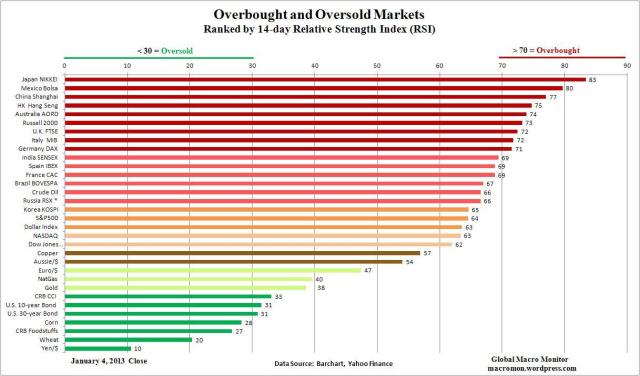
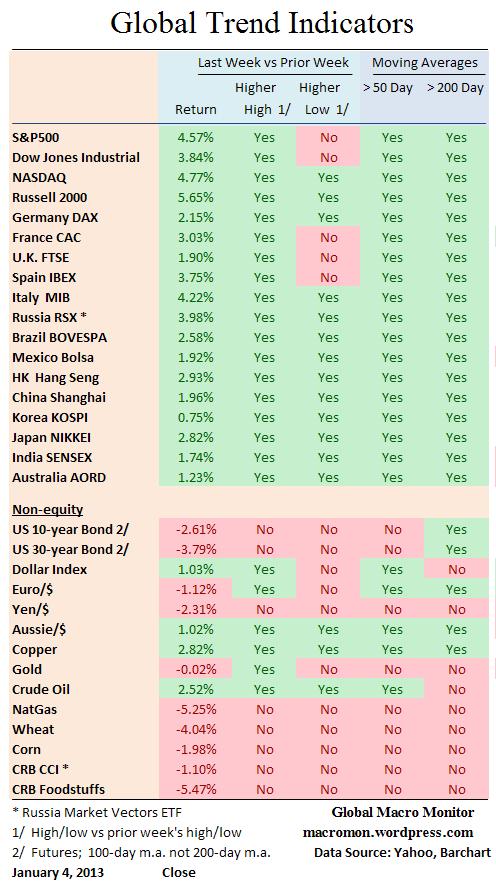
| Global Trend Indicators: Equities Overbought, Yen Oversold Posted: 07 Jan 2013 09:30 AM PST The Nikkei's 14-day Relative Strength Index (RSI) exceeds 80 and we can't recall ever seeing anything as short-term oversold — in a hard currency market — as the yen/dollar with its RSI of 10. The Russell 2000 is the most overbought of the U.S. equity indices with an RSI of 73. Should set up for an interesting week of consolidating last week's big gains.
Click chart to enlarge
(click here if chart is not observable) ~~~
(click here if tables are not observable) |
| Posted: 07 Jan 2013 08:30 AM PST click for interactive calculator
From the wonks at the Federal Reserve Bank in Atlanta, comes this very cool calculator. You enter your target unemployment rate (i.e, 6.25%) and how many months until you expect your target unemployment rate to be achieved, and the calculator tells you the average monthly change in payroll employment needed to achieve that target rate. You can also fiddle with Labor force participation rate and average monthly population growth rate. I’d like to be able to switch up two things — enter the monthly NFP gains to see how long it will take at that rate. Also, the impact of other variables on the entire employment system — GDP, Retail Sales, Corporate profits, etc. — would be another set of variables that would be interesting to visualize. |
| Posted: 07 Jan 2013 06:30 AM PST Good Monday morning. Here are my morning reads:
What are you reading?
Happy New Year? Not for Bonds |
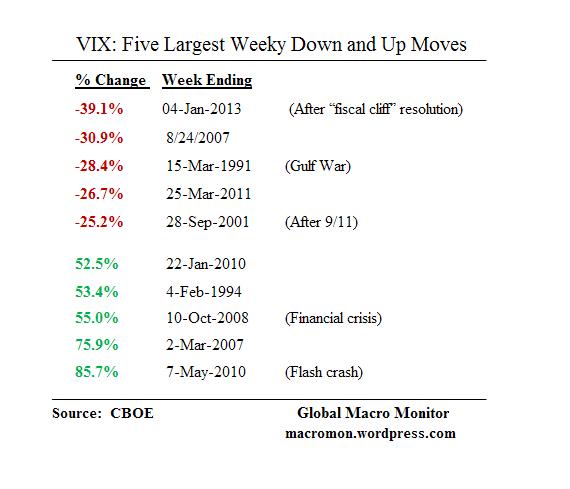
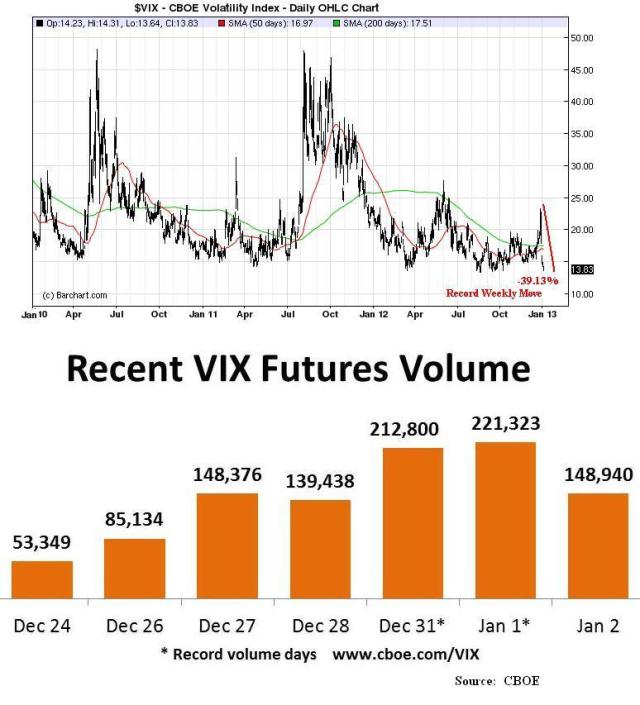
| VIX Has Largest Weekly Down Move Since Inception Posted: 07 Jan 2013 05:30 AM PST The CBOE has a nice piece out noting this week's 39.1 percent collapse in the VIX was the largest weekly percent down move since the index was launched in January 1990. The week also saw record volume days for the VIX futures. The move even exceeds the largest weekly down move on the VXO, the vol index on the S&P 100, which was the market standard volatility measure prior to January 1990. The VXO fell 37.9 percent the following week of the of the October 1987 stock market crash. Since the March '09 stock market bottom the VIX has only closed lower twice, on August 13 and 17, 2012. Note the July VIX futures contract closed the week at 21.40, 53 percent above the cash index.
The upshot? Nassim Nicholas Taleb is probably less comfortable. It's also difficult to extract much info from this move relative to the others given the rise of high frequency trading and short-term trader dominance of the markets. Furthermore, the move was likely exaggerated by the fact it happened during a major holiday shortened week with many of the big players still out and yet to begin their year. Nevertheless, some believe stocks will only return 5 percent this year and given the huge move last week the gains for the year have already been had. We don't know with certainty but our priors are this year could be bubblicious and the central banks will see to it until they can't. This could be the tipping point year where markets revolt against deficits and hyper lose monetary policy, or maybe not. For now, the markets enjoy the crack, the trend in equities is positive, and new highs are at hand. Given this week's huge move, coupled with the fact earnings season really gets going next week, it's probably not a good entry here, however. We also thought that about dollar/yen at 85, but the yen keeps repricing lower just like an imbalanced emerging market currency with high inflation. Granted it was hugely oversold, but 12 percent since November 9th? Tokyo is not Buenos Aires, Toto! At least, not yet. We always worry when central banks print money to monetize deficits and fear that money demand could collapse as holders begin to lose confidence in its future purchasing power. We have seen this happen, first hand, in many countries and have been in Brazil, for example, when there was not much food in grocery stores as locals had lost confidence in the central bank's ability to maintain the purchasing power of their currency holdings. Stocks will move higher and the currency lower as this begins. Though gold has been trading poorly and may have more downside on a technical basis, it should also begin to move as the printing presses begin to fire up. Asset picking becomes more complicated when most of the hard (well not so hard) currency central banks are expanding their balance sheets on such a massive scale. This is nitro when credit begins to expand. Though they lengthened the duration of their portfolio with Operation Twist, the Fed's balance sheet has been stable since the end of QE2. So this year should be interesting if Chairman Bernanke follows through with the announced trillion dollar asset purchase. Add that to the expected monetization the yen and Nikkei are pricing from the Bank of Japan and the potential for OMTs from the ECB with, say, a Spanish or Italian intervention, which will surely not be completely sterilized. Furthermore, credit markets are starting to heal and the monetary aggregates are growing at annual rate well in excess of nominal GDP growth. That's, more yield/return chasing liquidity. Could be wrong, but think we're in for some Fireworks!
(click here if charts are not observable) |
| Tour of Space Station Orbital Laboratory Posted: 07 Jan 2013 05:00 AM PST In her final days as Commander of the International Space Station, Sunita Williams of NASA recorded an extensive tour of the orbital laboratory and downlinked the video on Nov. 18, just hours before she, cosmonaut Yuri Malenchenko and Flight Engineer Aki Hoshide of the Japan Aerospace Exploration Agency departed in their Soyuz TMA-05M spacecraft for a landing on the steppe of Kazakhstan. The tour includes scenes of each of the station’s modules and research facilities with a running narrative by Williams of the work that has taken place and which is ongoing aboard the orbital outpost. Departing Space Station Commander Provides Tour of Orbital Laboratory |
 Enthusiasm for using




| You are subscribed to email updates from The Big Picture To stop receiving these emails, you may unsubscribe now. | Email delivery powered by Google |
| Google Inc., 20 West Kinzie, Chicago IL USA 60610 | |



0 comments:
Post a Comment