


The Big Picture |

- Scorecard: How Many Rights Have Americans REALLY Lost?
- Succinct Summation of Weeks Events (Feb 19 2013)
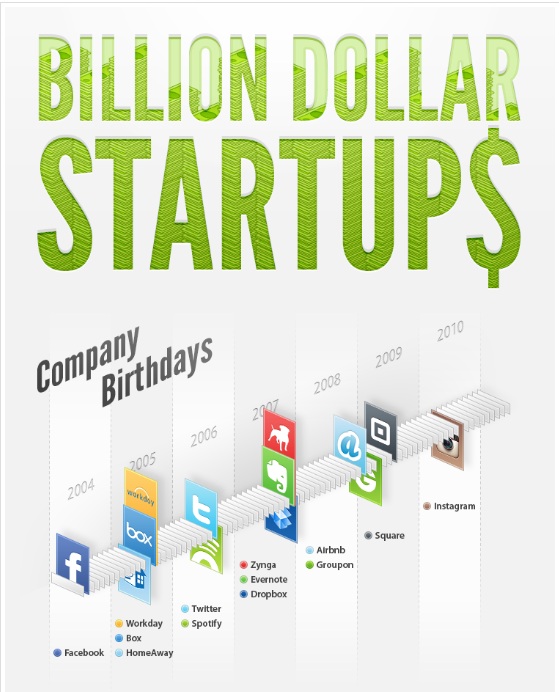
- Billion Dollar Startups
- Elasticity, Markets, Wealth Effects
- YTD 2013 Major Index Performance
- Italian voting intentions unpredictable
- 10 Friday AM Reads
- TDS: Steven Brill on Why Medical Bills Are Killing Us
- European HFT Fee Coming; USA Next?
- Primary Dealers’ Waning Role in Treasury Auctions
- Massive New Tunnels Under NYC
- O’Shaughnessy, Ritholtz Discuss Investing Outlook
| Scorecard: How Many Rights Have Americans REALLY Lost? Posted: 22 Feb 2013 10:30 PM PST
How Many Constitutional Freedoms Do We Still Have?Preface: While a lot of people talk about the loss of our Constitutional liberties, people usually speak in a vague, generalized manner … or focus on only one issue and ignore the rest. This post explains the liberties guaranteed in the Bill of Rights – the first 10 amendments to the United States Constitution – and provides a scorecard on the extent of the loss of each right. First Amendment The 1st Amendment protects speech, religion, assembly and the press:
However, the government is arresting those speaking out … and violently crushing peaceful assemblies which attempt to petition the government for redress. A federal judge found that the law allowing indefinite detention of Americans without due process has a "chilling effect" on free speech. And see this and this. The threat of being labeled a terrorist for exercising our First Amendment rights certainly violates the First Amendment. The government is using laws to crush dissent, and it's gotten so bad that even U.S. Supreme Court justices are saying that we are descending into tyranny. For example, the following actions may get an American citizen living on U.S. soil labeled as a "suspected terrorist" today:
And holding the following beliefs may also be considered grounds for suspected terrorism:
Of course, Muslims are more or less subject to a separate system of justice in America. And 1st Amendment rights are especially chilled when power has become so concentrated that the same agency which spies on all Americans also decides who should be assassinated. Second Amendment The 2nd Amendment states:
Gun control and gun rights advocates obviously have very different views about whether guns are a force for violence or for good. But even a top liberal Constitutional law expert reluctantly admits that the right to own a gun is as important a Constitutional right as freedom of speech or religion:
The gun control debate – including which weapons and magazines are banned – is still in flux … Third Amendment The 3rd Amendment prohibits the government forcing people to house soldiers:
Hey … we're still honoring one of the Amendments! Score one for We the People! 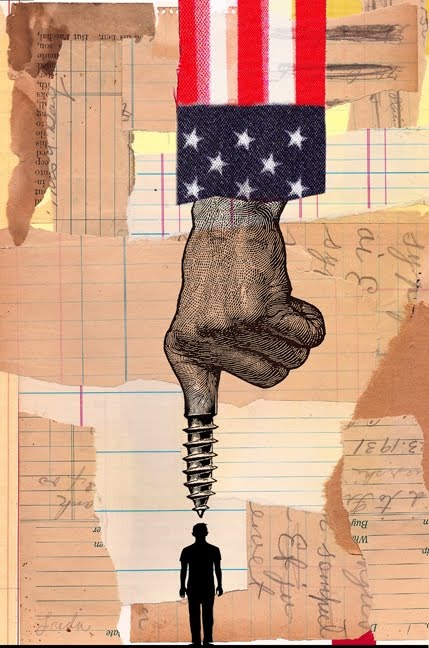 Painting by Anthony Freda: www.AnthonyFreda.com. Fourth Amendment The 4th Amendment prevents unlawful search and seizure:
But the government is flying drones over the American homeland to spy on us. Senator Rand Paul correctly notes:
Paul introduced a bill to "protect individual privacy against unwarranted governmental intrusion through the use of unmanned aerial vehicles commonly called drones." Emptywheel notes in a post entitled "The OTHER Assault on the Fourth Amendment in the NDAA? Drones at Your Airport?":
Many police departments are also using drones to spy on us. As the Hill reported:
Even without drones, Americans are the most spied on people in world history:
RT notes:
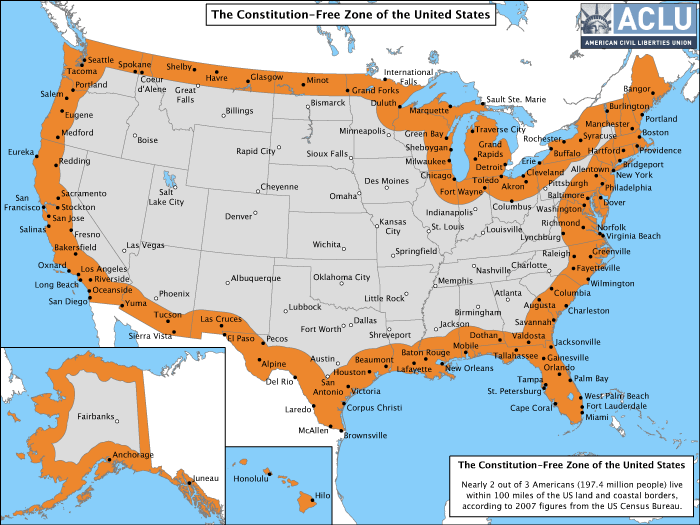
Fox news notes that the government is insisting that "black boxes" be installed in cars to track your location. The TSA has moved way past airports, trains and sports stadiums, and is deploying mobile scanners to spy on people all over the place. This means that traveling within the United States is no longer a private affair. (And they're probably bluffing, but the Department of Homeland Security claims they will soon be able to know your adrenaline level, what you ate for breakfast and what you're thinking … from 164 feet away.) And Verizon has applied for a patent that would allow your television to track what you are doing, who you are with, what objects you're holding, and what type of mood you're in. Given Verizon and other major carriers responded to at least 1.3 million law enforcement requests for cell phone locations and other data in 2011, such information would not be kept private. (And some folks could be spying on you through your tv using existing technology.) Of course, widespread spying on Americans began before 9/11 (confirmed here and here. And see this). So the whole "post-9/11 reality" argument falls flat. And the spying isn't being done to keep us safe … but to crush dissent and to smear people who uncover unflattering this about the government … and to help the too big to fail businesses compete against smaller businesses (and here). In addition, the ACLU published a map in 2006 showing that nearly two-thirds of the American public – 197.4 million people – live within a "constitution-free zone" within 100 miles of land and coastal borders:
The ACLU explained:
Computer World reports today:
Wired pointed out in 2008 that the courts have routinely upheld such constitution-free zones:
Fifth Amendment The 5th Amendment addresses due process of law, eminent domain, double jeopardy and grand jury:
But the American government has shredded the 5th Amendment by subjecting us to indefinite detention and taking away our due process rights. The government claims the right to assassinate or indefinitely detain any American citizen on U.S. citizen without any due process. And see this. As such, the government is certainly depriving people of life, liberty, or property, without due process of law. There are additional corruptions of 5th Amendment rights – such as property being taken for private purposes. The percentage of prosecutions in which a defendant is denied a grand jury is difficult to gauge, as there is so much secrecy surrounding many terrorism trials. Protection against being tried twice for the same crime after being found innocent ("double jeopardy") seems to be intact.
Sixth Amendment The 6th Amendment guarantees the right to hear the criminal charges levied against us and to be able to confront the witnesses who have testified against us, as well as speedy criminal trials, and a public defender for those who cannot hire an attorney:
Subjecting people to indefinite detention or assassination obviously violates the 6th Amendment right to a jury trial. In both cases, the defendants is "disposed of" without ever receiving a trial … and often without ever hearing the charges against them. More and more commonly, the government prosecutes cases based upon "secret evidence" that they don't show to the defendant … or sometimes even the judge hearing the case. The government uses "secret evidence" to spy on Americans, prosecute leaking or terrorism charges (even against U.S. soldiers) and even assassinate people. And see this and this. Secret witnesses are being used in some cases. And sometimes lawyers are not even allowed to read their own briefs. Indeed, even the laws themselves are now starting to be kept secret. And it's about to get a lot worse. True – when defendants are afforded a jury trial – they are provided with assistance of counsel. However, the austerity caused by redistribution of wealth to the super-elite is causing severe budget cuts to the courts and the public defenders' offices nationwide. Moreover, there are two systems of justice in America … one for the big banks and other fatcats, and one for everyone else. The government made it official policy not to prosecute fraud, even though fraud is the main business model adopted by Wall Street. Indeed, the biggest financial crime in world history, the largest insider trading scandal of all time, illegal raiding of customer accounts and blatant financing of drug cartels and terrorists have all been committed recently without any real criminal prosecution or jail time. On the other hand, government prosecutors are using the legal system to crush dissent and to silence whistleblowers. And some of the nation's most powerful judges have lost their independence … and are in bed with the powers-that-be. Seventh Amendment The 7th Amendment guarantees trial by jury in federal court for civil cases:
As far as we know, this right is still being respected. However – as noted above – the austerity caused by redistribution of wealth to the super-elite is causing severe budget cuts to the courts, resulting in the wheels of justice slowing down considerably.  Painting by Anthony Freda: www.AnthonyFreda.com Eighth Amendment The 8th Amendment prohibits cruel and unusual punishment:
Indefinite detention and assassination are obviously cruel and unusual punishment. The widespread system of torture carried out in the last 10 years – with the help of other countries – violates the 8th Amendment. Many want to bring it back … or at least justify its past use. While Justice Scalia disingenuously argues that torture does not constitute cruel and unusual punishment because it is meant to produce information – not punish – he's wrong. It's not only cruel and unusual … it is technically a form of terrorism. And government whistleblowers are being cruelly and unusually punished with unduly harsh sentences meant to intimidate anyone else from speaking out.
Ninth Amendment The 9th Amendment provides that people have other rights, even if they aren't specifically listed in the Constitution:
We can debate what our inherent rights as human beings are. I believe they include the right to a level playing field, and access to safe food and water. You may disagree. But everyone agrees that the government should not actively encourage fraud and manipulation. However, the government – through its malignant, symbiotic relation with big corporations – is interfering with our aspirations for economic freedom, safe food and water (instead of arsenic-laden, genetically engineered junk), freedom from undue health hazards such as irradiation due to government support of archaic nuclear power designs, and a level playing field (as opposed to our crony capitalist system in which the little guy has no shot due to redistribution of wealth from the middle class to the super-elite, and government support of white collar criminals). By working hand-in-glove with giant corporations to defraud us into paying for a lower quality of life, the government is trampling our basic rights as human beings. Tenth Amendment The 10th Amendment provides that powers not specifically given to the Federal government are reserved to the states or individual:
Two of the central principles of America's Founding Fathers are:
Today, most Americans believe that the government is threatening – rather than protecting – freedom … and that it is no longer acting with the "consent of the governed". And the federal government is trampling the separation of powers by stepping on the toes of the states and the people. For example, former head S&L prosecutor Bill Black – now a professor of law and economics – notes:
Indeed, the federal government is doing everything it can to stick its nose into every aspect of our lives … and act like Big Brother. Conclusion: While a few of the liberties enshrined in the Bill of Rights still exist, the overall scorecard of the government's respect for our freedom: a failing grade. |
| Succinct Summation of Weeks Events (Feb 19 2013) Posted: 22 Feb 2013 12:30 PM PST Succinct Summation of Weeks Events (February 19 2013) Positive:
Negatives:
|
| Posted: 22 Feb 2013 11:30 AM PST |
| Elasticity, Markets, Wealth Effects Posted: 22 Feb 2013 11:06 AM PST Elasticity, Markets, Wealth Effects
An excellent piece of research by Neal Soss and Henry Mo of Credit Suisse may be found in the February 13th US Economics Digest. They used classical economic theory to examine the “elasticity” of changes in housing values and changes in the stock market with respect to personal consumption. They also examined the relationship of changes in disposable personal income to consumption. This superb work warrants discussion and examination. The implications for the recovery of the US economy and movements in our financial markets are profound. Let us get into the meat of their research. Soss and Mo examined two periods of time. The first sample period runs from 1Q93 to 2Q07. The second sample period also starts with 1Q93 and goes to 3Q12. By using these two sample periods, the Credit Suisse economists have been able to separately estimate the influence of the financial crisis on the elasticities they examine. They found that the elasticity estimates of consumption with respect to housing wealth dropped from 0.05 in the '93-'07 period to 0.033 across the longer, '93-'12 one that includes the financial crisis. In the case of stock market wealth, the elasticity dropped from 0.015 to 0.011. In both cases, the results indicate that the positive characteristics of wealth effects have been diminished by the financial crisis. This is intuitive and consistent with our own observations. It results from the fact that we had two simultaneous shocks in the crisis period.
First, stock prices plummeted during the financial crisis and continued into a severe bear market that ended in March 2009. Simultaneously, housing values fell throughout the US in a pervasive and protracted decline. The decline in housing was bigger than just a cyclical adjustment. The credit mechanism that supports housing transactions was damaged. Subsequent events tightened credit standards and raised down payments, making this housing cycle a prolonged, self-perpetuating decline followed by a gradual, tepid recovery. The conclusions are simple. The rise in housing prices that we are currently experiencing in more than 40 states and the increase in the stock market value that we have witnessed since the March 2009 bottom have contributed little to additional personal consumption. The wealth effects have been diminished. They are measurable, thanks to the Credit Suisse analysis, and that measuring stick can now be used for some market forecasts and prognostications. Compare the wealth effects with disposable-income elasticity, and we can see how dramatic the difference is between the two time periods the authors studied. Prior to the financial crisis, the elasticity of disposable income with respect to real personal consumption expenditure per capita was 0.943. In other words, almost 95 percent of additional income resulted in personal consumption expenditures. People made more money and spent it. During the financial crisis, though, income levels declined. In addition, people were scared and raised their savings rates. For the extended, '93-'12 period, including the financial crisis, the elasticity level reached 0.99. That is, under present circumstances nearly 100 percent of income in the US is spent on personal consumption, when it is adjusted into real terms. Translating that result into the distinction between wealth effects that have been diminished and income effects that have been increased explains why the US economic recovery is continuing at the present slow pace. Take the issue that we have harped on for some time: the two-percent payroll tax hike. That is a direct impact on 134 million working Americans. It takes two percent of their first $113k in annual pay and removes their ability to spend it. One of the most horrible political decisions made by President Obama, the Democratic leadership in the Senate, and Republican leadership in the House was that two-percent payroll tax restoration. The Credit Suisse research validates that view. Additionally, compare $125 billion in annual taxation of American payrolls with the current development involving the gasoline tax increase. That gas hike piles on top of the payroll tax. Every penny in the gasoline price equates to about a $1.25 billion consumption tax that is directly applied to the personal income of the US gasoline consumers. We now have an additional $50 billion gasoline hike tax being applied annually – assuming the price of gasoline remains constant for the rest of the year. How can we expect the US economy to grow more robustly when we have taxed away the margins of real disposable income and then piled on a large new energy cost as a “double whammy”? Washington’s tax policy dealt the first blow to the economic recovery by hiking taxes on working Americans. It dealt a second blow by taxing wealthy Americans. And it has dealt a third blow with a failed energy policy. The failures of Washington are bearing withered fruit. It is quite possible that the economic growth rate of the US in the first half of 2013 may fall below a one-percent annual rate. What does this mean for stock markets? What does it mean for the housing recovery? We know both have been in an upward trend. In order to estimate the effects of the shifts in elasticities the Credit Suisse study identifies, we can roughly suggest that the stock market could add trillions in value and not trigger as much consumption expenditure as the two-percent payroll tax hike inhibits. Think about it this way. If the elasticity of a stock market value change is 0.01 and the elasticity of an income change is 0.99, you get nearly 100 times more consumption spending from earned income than you do from stock market added wealth effect. And, to make matters worse, we have just raised taxes on both stock market investors and on earned income workers. We do not know whether the stock market is going to rise or fall. We have our estimates and believe we are in a bull market that is of a longer-term nature and is driven, in part, by the current very low interest rate policies being applied by the central banks of the world, including our Federal Reserve. We think the Fed's policy will remain in place for several more years, because the economy is growing so slowly. Therefore, we expect the US stock market to move substantially higher as this decade progresses. We can also estimate that such a rise in stock prices will not trigger very much additional real consumption. The elasticity calculations done by Credit Suisse support this conclusion. Furthermore, if we do not see substantial, accelerating, and intensifying consumption, it becomes hard to project accelerating inflation rates for the goods and services that are being consumed. It takes rising demand to get price accelerators in place. Our conclusions are these. The stock market may go much higher, but the wealth effects that could trigger inflationary pressure will be very limited. Housing prices will rise but will have much further to go before they trigger inflationary pressure. There is a lot of room for upside movement in asset prices, while inflationary pressures will remain muted due to suppressed consumption. Stay long stocks: the bull market is not over. Stay in the bond market; interest rates are not ready to go "shooting up." Emphasize Munis. AND THOROUGHLY RESEARCH EACH AND EVERY CREDIT. At very low interest rates, you do not get paid well for taking credit risk. ~~~ David R. Kotok, Chairman and Chief Investment Officer |
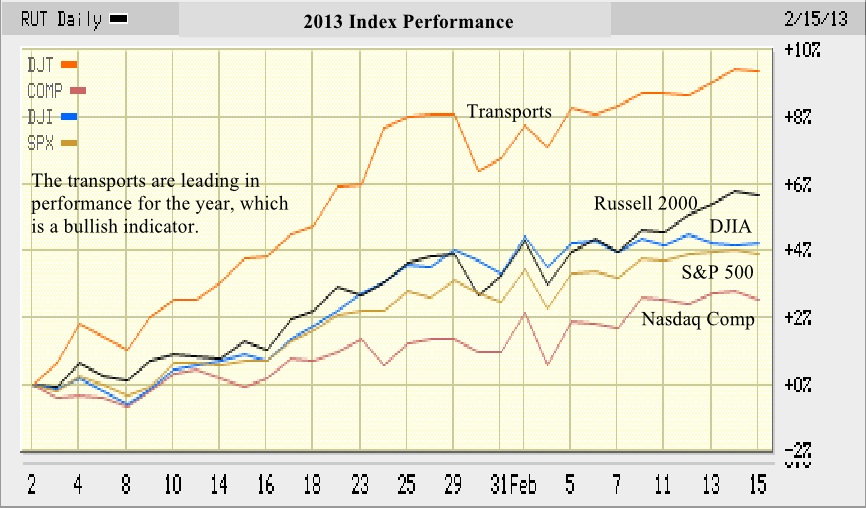
| YTD 2013 Major Index Performance Posted: 22 Feb 2013 09:00 AM PST Click to enlarge
Bob Dickey shows the above chart of major indices (February 19, 2013). You may be surprised to see how strong the Transports are, how weak the Nasdaq has been, and the relative strength of small caps over big S&P500 and even bigger Dow Industrials, since the year began
|
| Italian voting intentions unpredictable Posted: 22 Feb 2013 08:47 AM PST Kiron Sarkar is starting a subscription service for his newsletter, commencing on Monday 25th February 2013. Until then, his newsletters will remain free of charge. As his newsletters will remain free of charge until Friday 22nd February, the subscription process on his website www.sarkargm.com will only be open from 4.00pm GMT on Friday 22nd February ie after he sends out the last free newsletter. Please check out Kiron's new website. A job well done. http://sarkargm.com/
Australia: RBA governor Mr Stevens suggests that the A$ was not seriously overvalued (though he was "surprised" that it had not declined by more) and that a higher rate would be necessary for some kind of intervention. He also hinted that Australian interest rates were on hold for the moment (he stated that they are at an "appropriate level"), as the RBA believes that the impact of recent rate cuts has not fully flowed through the economy. Finally, Mr Stevens was more upbeat on the Chinese economy. The A$ rallied on his comments to a Parliamentary Committee today; Australia: Ms Gillard's Labour Party had once proposed to achieve a balanced budget, though the Treasurer Mr Swan now admits that the revenue shortfall this year will amount to A$5.9bn (US$6.0bn). A definite whoops. Current polls suggest that the Labour Party is at 44%, with the Liberal-National party coalition on 56%. Labour, for the present, is losing support. General elections have been called for September, an incredibly long notice period – quite probably designed to stop a premature collapse of the Labour government earlier. (Source Bloomberg); Japan: A Reuters article asks "what do you buy the nation that already seems to have everything". Well, its Japan they are talking about, unsurprisingly. Japan is planning to spend US$107bn over the next 15 months (yep US$107bn in the next 15 months – no typo). The Japanese PM wants to spend the money on infrastructure, basically yet more bridges to nowhere – Hmmmmm. Japanese infrastructure is already amongst the best in the world !!!! For comparison purposes, Reuters adds that US$107bn is approximately 25% of the worlds infrastructure spending needs annually. However, total Japanese spending is proposed to be much more than the US$107bn and if Abe has his way (will not happen), he proposes to spend US$2.16 trn over 10 years !!!!!. Someone has been at the Saki bottle for far too long, me thinks. The Nikkei closed +0.7% up today; China: Chinese new home prices rose in 53 of the 70 cities tracked in January M/M, marginally below the 54 in December. Prices in 10 cities declined, while prices were flat in 7 cities. On a Y/Y basis, prices rose in 53 cities in January, as opposed to just 40 in December China: There is some evidence (as yet unconfirmed) that the slowdown in China last year was more severe than thought initially and that the rebound from late last year somewhat weaker than thought. I will be writing on this issue in coming months – I must admit, I'm getting more and more concerned about China, in particular in H2 this year. Mr Stephen Green, the economist at Standard and Chartered Bank, suggests that Chinese growth last year may well have been some 2 percentage points lower than the official number – he suggests around 5.5%. There is much debate about this issue, though its more of a speculative nature, at present. Whilst still impossible to prove, a number of us have believed for quite some time that Chinese official GDP data is "overstated", mainly due to over-optimistic reporting by the regions, which admittedly the Central authorities do try and correct. The Shanghai Composite closed some -0.5% lower today and nearly -5.0% this week. Time to become cautious, I believe; Italy: Italian elections are coming up this Sunday/Monday. The situation remains highly uncertain. The newswires suggest that more and more Italians may decide to support the former comedian Mr Beppe Grillo, as a protest vote – he has suggested that Italy establishes a 20 hour working week by the way !!!!. Furthermore, he is apparently taking more votes away from the left leaning parties, rather than from the right. Mr Berlusconi has also focused on Mr Grillo recently, suggesting that Mr Grillo may indeed be a threat. Once again, just too much speculation, rather than informed comment around at present to be able to form a view. However, the result of the election will move markets; Spain: The EU has forecast that Spain's budget deficit will come in around -10.2% last year, declining to -6.7% this year (the previous target was just 3.0% for this year by the way), though rising to -7.2% next, unless the government implements further austerity measures – some chance (the PM is proposing to introduce some fiscal stimulus), especially following the corruption allegations which the Spanish PM and the ruling party are facing. Debt to GDP is expected to rise to 95.8% this year and to 101.0% next !!!!. Pray tell me how Spain repays this level of accumulated debt. I can't see it I must say, without a debt restructuring of some sorts. The Spanish PM, Mr Rajoy, had reported that Spanish debt to GDP would come in below 7.0% for 2012 – this number excludes bank bailout costs. However, I recall that in 2011, Spain final budget deficit came in much higher than the initially announced number – as I result, I will wait for a while – Spanish data has proven to be somewhat "variable" shall I say; Germany: The (most important) German February IFO index (business confidence index) came in (you guessed it) much better than expected, at 107.4, as opposed to 104.2 previously and 104.9 expected, a 10 month high. All elements of the IFO index exceeded expectations. The current conditions component rose to 110.2, from 108.0 previously, with the business climate index at 107.4, as opposed to 104.0 previously. Analysts continually forecast lower numbers for Germany. The reality is that German industry has successfully managed to export to non EU markets, including EM's, in particular. In addition, little discussed amazingly, a large inflow of immigrants are flooding into Germany, supporting construction activity and domestic consumption. My well informed German friends tell me that net immigration into Germany could amount to 500k per annum over the next few years. The head of the IFO institute, Mr Sinn suggests that German GDP will rise by +0.7% this year, almost double a number of other forecasts. However, I believe that Germany will do even better – GDP in excess of +1.0% is certainly possible (+1.25%?). The Euro spiked following the IFO data, though has pared its gains – I continue to be bearish the Euro and am short the Euro against the US$. The EU released its revised 2013 GDP and debt forecasts subsequently (see below); EZ: The EU's latest EZ 2013 GDP forecast was lowered materially to a recessionary (yet again) -0.3%, from a marginal growth of +0.1% forecast previously – the 2nd consecutive annual GDP decline and the 3rd in the 5 years. 7 EZ counties are expected to contract this year, namely Portugal, Italy, Spain, Greece, Cyprus, Slovenia, and the (currently AAA rated) Holland. The forecast suggests that it is much more likely that Holland will be downgraded this year. The details are hugely important. German 2013 GDP is expected to be just +0.5%, lower than the +0.8% previously (wrong in my humble view – it will be better), with France barely growing – the EU's forecast is +0.1%, from +0.4% previously. The French outlook looks much more problematical and a contraction in French GDP this year is becoming increasingly more likely. Aggregate EZ debt to GDP is expected to rise to 95.1% this year, the highest since the Euro was introduced. Once again France looks bad. The French budget deficit is expected to rise to +3.7% this year (the current target is 3.0%, though the French have admitted that they will not meet it) and, furthermore, is forecast to rise to +3.9% in 2014 !!!!. EZ unemployment is expected to rise to +12.2%, from +11.8% previously forecast and +11.4% last year. Greek and Spanish unemployment is set to rise to around 27% this year, with Portugal around 17% !!!!! The Euro declined (surprisingly modestly at present, though admittedly most expected a downgrade) following the announcement. Lets wait to see how France responds (though we all know that they will not stick to their original commitment of a budget deficit of just 3.0% of GDP this year), with the inevitable German backlash. Relations between Germany and France are going to deteriorate much, much more. The EU is to set up a Commission to decide whether France should be given more time. Off course the Commission will give France more time – they have already accepted that a number of other EZ countries will miss their targets. Standard EU bureaucratic nonsense; EU: Fines imposed by the EU are set to rise to US levels. The EU warns that it could impose fines amounting to 10% of a bank's global turnover if a bank is found to be guilty of rate rigging in respect of the LIBOR scandal, which has expanded into rate fixing allegations in respect of Yen, Euro interbank rates and Swiss franc denominated swaps. Going to be painful for banks worldwide, but as is always the case with the EU, this issue will take time and yet more time to resolve – maybe, there will be a surprise this time, but don't hold your breath; EU: European banks (356 of them) are to repay just E61.1bn back to the ECB in respect of the 2nd LTRO, much lower than the E120bn to E150bn expected. The ECB lowered collateral requirements ahead of the 2nd LTRO which, as a result, meant that weaker banks borrowed in the 2nd round, as opposed to the 1st – the most likely explanation for the lower repayment. The news should be Euro negative as it implies less of a tightening than expected. In addition, the lower than expected return suggests that weaker banks are still finding it a problem to borrow in the wholesale market, though the impending Italian elections (and the possible resulting uncertainty) could have forced banks (particularly Italian banks) to become more cautious; UK: The BoE and the PBoC are in discussions to agree a 3 year Sterling/Yuan swap agreement to help trading in the currency. Good news for London, which will become an offshore Yuan trading hub; US: A majority (54%) of Americans want Congress to postpone the implementation of the sequester. However, 40% are in favour of the sequester taking place – surprisingly large. US polls, commissioned by Bloomberg also reveal that public support for President Obama is improving (55%), rather than for the Republicans (35%). Politicians should be sensitive to such polls. Does that mean some sort of deal/fudge is likely? (Source Bloomberg); US: January existing home sales rose by +0.4% (+9.1% Y/Y), to an annualised rate of 4.92mn units. The median price of a single-family existing home rose by +12.6% Y/Y. The number of existing homes available for sale declined to 1.71mn, the lowest since December 1999. I continue to believe that the US residential home sector will continue to improve, which will positively impact the US economy; US: The US Government confirmed the US Department of Agriculture forecasts that corn, wheat and soybean prices, in particular, could decline following last years drought. Corn prices could decline by around ⅓ rd, with soya 25% lower. The forecast is subject to weather conditions remaining benign. If food prices decline materially, EM's, in particular, will benefit, as their inflation basket is materially impacted by food (and energy) prices, in particular; Canada: Canadian retail sales declined by -2.1% M/M in December, much worse than the decline of -0.3% expected and the marginally upwardly revised +0.3% previously. Pretty weak numbers. Canadian January CPI rose by just +0.1% M/M, as opposed to +0.2% expected and -0.6% previously. As retail sales are weak and CPI coming in below expectations, rates should be on hold; Outlook Asian markets recovered from yesterday's sell off (ex Chinese markets), as have European markets. Interestingly French and Italian markets are outperforming their EZ counterparts. US markets are around +0.5% higher. The Euro, having tried to rise, is back below US$1.32 – currently US$1.3170. The short term (2 year) US Treasury/German bund differential has increased to around +12 bps higher for US Treasuries, which will favour the US$. The Yen is flat at Yen 93.26. Sterling continues to recover somewhat and is currently trading around US$1.5261. The A$ is firmer at US$1.0311, following Mr Stevens comments today. Spot gold is trading around US$1577, with April Brent up to US$114.36 – still far too high. I continue to believe that the Italian elections will move markets next week and remain cautious to negative the equity markets, given the increased uncertainty. However, Italian markets are outperforming other European bourses today !!!!. Normally its bad to bet against the locals. Just too risky to play the markets though. In addition, some info I'm getting relating to China makes me cautious. Have a great weekend. Kiron Sarkar 22nd February 2013 ~~~ Important Notice This newsletter will become a fee based subscription service, starting on Monday 25th February 2013 at www.sarkargm.com To avoid potential subscribers from subscribing too early, while the newsletter remains free of charge, (which will be the case up to and including Friday 22nd February), the subscription process will only be open from 4.00pm GMT (11.00am EST) onwards, on Friday 22nd February, ie after the last free newsletter is sent out.
|
| Posted: 22 Feb 2013 06:40 AM PST My morning reads:
What are you reading?
Goldman Sachs: Hedge Funds Most Bullish on Stocks Since 2007 |
| TDS: Steven Brill on Why Medical Bills Are Killing Us Posted: 22 Feb 2013 06:00 AM PST In this exclusive, unedited interview, Steven Brill explains the large discrepancy between what hospitals charge and what medical services actually cost. (06:25) Steven Brill Extended Interview Pt. 1 ~~~ In this exclusive, unedited interview, journalist Steven Brill examines the enormous profits reaped by the not-for-profit health care industry. (04:23) Exclusive – Steven Brill Extended Interview Pt. 2 ~~~ In this exclusive, unedited interview, Steven Brill warns against the combination of profit motive and no accountability that characterizes the health care industry. (03:57) Exclusive – Steven Brill Extended Interview Pt. 3 |
| European HFT Fee Coming; USA Next? Posted: 22 Feb 2013 05:48 AM PST A potential game changer in the world of High Frequency Traders is coming soon to Europe, and potentially, to the USA. In 2014, fees on financial trading will begin. Rates will range from 00.1% to 00.01% for trades over €10,000 Euros, depending upon the traded asset. Under existing lack of HFT rules, High Frequency Traders exert a tax on all other investors. This is due to the corrupt relationship they have with exchanges such as the NYSE and NASDAQ. HFT firms pay these exchanges to co-locate their servers, to see orders before the public, and to front run them. They also allow them to send millions of spoof orders per minute, canceling and re-offering them. This stresses the entire plumbing of the electronic markets, raising costs form everyone else. While some have incorrectly described this as adding liquidity, the Flash crash taught us that’s nonsense. Here are the HFT fee details:
If American regulators were smart — something we know they are not — the USA would join Europe in pursuing this same goal. In the meantime, the HFT tax steals money from long term investors. It’s time to stop this nonsense.
Source: |
| Primary Dealers’ Waning Role in Treasury Auctions Posted: 22 Feb 2013 05:30 AM PST Primary Dealers' Waning Role in Treasury AuctionsMichael Fleming and Sean MyersOn December 12, 2012, primary government securities dealers bought just 33 percent of the new ten-year Treasury notes sold at auction. This was one of the lowest shares on record and far below the 68 percent average for ten-year notes reported in this 2007 study by Fleming. In this post, we examine recent data on the buyers of Treasury securities at auction to understand whether the December 12 results are part of a trend and, if so, what explains it. Who Buys Treasuries at Auction? As shown in the chart below, the December 12 auction results are indeed part of a larger trend, with primary dealers' share of purchases of new securities declining sharply during the 2007-09 financial crisis and not fully recovering since. Primary dealers thus bought 70 percent of new Treasury issuance over the period preceding the Lehman Brothers bankruptcy filing (May 5, 2003, to September 14, 2008), but only 56 percent for the post-Lehman period (September 15, 2008, to June 30, 2012). For nominal ten-year notes, the comparable decline is even sharper, from 71 percent to 53 percent.The decline in the share of primary dealer purchases at auction has been offset by increased purchases by other dealers and brokers (from 4 percent to 8 percent), investment funds (from 8 percent to 18 percent), and foreign and international investors (from 11 percent to 13 percent). Other investors, including depository institutions, pension funds, and individuals, have consistently accounted for about 3 percent to 6 percent of purchases over time. Do Changing Ownership Patterns Explain the Change in Purchases? One simple explanation, but one not supported by the evidence, is that dealers' decreased share of purchases reflects a changing pattern of ownership. In fact, as shown in the next chart, primary dealers' ownership of Treasury securities has actually increased over the post-Lehman period. Dealers were thus net short 1.4 percent of marketable Treasuries on September 10, 2008, but net long 1.2 percent of supply on June 27, 2012. Changes in How Treasuries Are Purchased What Explains the Shift in Purchasing Patterns? A second hypothesis is that dealers have become more risk averse since the financial crisis, so they're demanding greater compensation for buying Treasuries at auction and selling them to other investors. A third is that other investors have increased their purchases at auction for other reasons, and are less willing to compensate dealers for intermediating new supply. For example, low interest rate volatility in the current low-rate environment may be reducing demand for dealer intermediation. We attempt to distinguish between these hypotheses in two ways. First, we look at the extent to which prices of Treasury securities sold at auction are lower than contemporaneous secondary market prices. Such underpricing has been examined in several studies, such as this 2007 paper by Goldreich. Second, we examine the extent to which secondary market prices are pressured lower around Treasury auctions because of the new supply, as described in this 2011 study by Lou, Yan, and Zhang. We'd expect the degree of underpricing and price pressure to be greater if it's dealer behavior that's prompted the change in purchasing patterns, lesser if other investors' behavior has led to the change, and the same if the revision of auction rules explains the change. Looking at two-year notes, we find that the notes' prices at auction have tended to be higher than contemporaneous secondary market prices in the post-Lehman period. (We focus on two-year notes because they were offered on a frequent and consistent basis, near the end of each month, over our sample period, facilitating the comparison between the pre- and post-Lehman periods. We plan to look at other notes in future work.) In particular, auction yields were 0.2 basis point lower than contemporaneous secondary market yields in the September 2008 to June 2012 period (lower yields imply higher prices), compared with 0.5 basis point higher in the May 2003 to August 2008 period (excluding the January 2007 to March 2008 period, for which we're missing data). We further find that prices of the most recently issued two-year note have, if anything, tended to react less strongly to the issuance of new two-year notes in the post-Lehman period. The chart below shows the secondary market yield of the two-year note on auction day minus the average yield one day before and after auction, two days before and after auction, and so on. Yields on auction days do tend to be higher than yields on adjacent days in both the pre- and post-Lehman periods, consistent with prices being pressured lower on auction days. However, in the post-Lehman period, the differences are actually smaller for the days immediately adjacent to the auction day; they're of similar magnitude for days further away from the auction. The evidence here is thus more consistent with other investors proactively increasing their participation at auction, and with the technical rule change perhaps having some effect, and not with dealers becoming more risk averse and demanding greater compensation for intermediating new supply. Results of the ten-year-note auction on December 12 also fit this pattern better. The note was sold at a yield of 1.65 percent, 2 basis points below the 1.67 percent yield in the secondary market at the time, suggesting that the low level of dealer purchases wasn't attributable to low dealer demand, but rather to high demand by other investors. Disclaimer
Sean Myers, a former undergraduate intern at the Bank, is a student at the University of North Carolina at Chapel Hill. |
| Posted: 22 Feb 2013 05:00 AM PST |
| O’Shaughnessy, Ritholtz Discuss Investing Outlook Posted: 22 Feb 2013 03:30 AM PST Jim O’Shaughnessy, the chairman and chief executive officer of O’Shaughnessy Asset Management, and Barry Ritholtz speak with Bloomberg’s Carol Masser:
click for audio 19 Feb 2013 |
 Painting by Anthony Freda: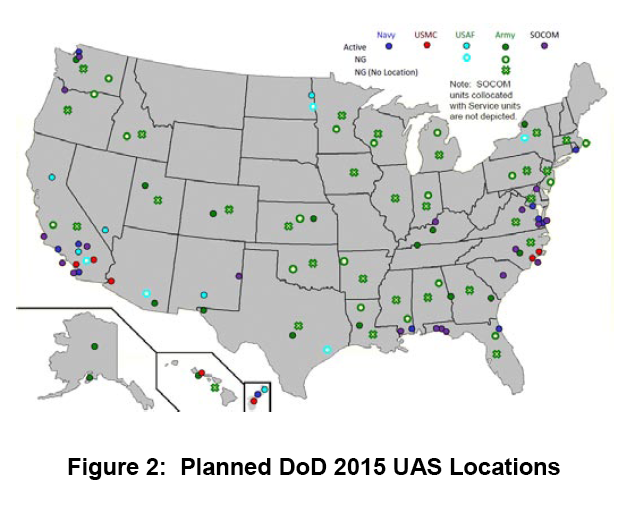






| You are subscribed to email updates from The Big Picture To stop receiving these emails, you may unsubscribe now. | Email delivery powered by Google |
| Google Inc., 20 West Kinzie, Chicago IL USA 60610 | |



0 comments:
Post a Comment