


The Big Picture |

- TBP Guide to Car Leasing & Buying
- Why So Blue . . . ?
- 10 Tuesday PM Reads
- ‘Markets continue to weaken following Italian elections’
- Case-Shiller Home Price Indices: Home Prices Closed Out a Strong 2012
- James Grant on Economy, Gold, Price of Accommodation
- Marty Lipton on Activist Hedge Funds
- 10 Tuesday AM Reads
- Grey Poupon “The Lost Footage”
- Historical Echoes: Cash or Credit? Payments and Finance in Ancient Rome
- A Declaration of Love for the 1962 Maserati Sebring
- Using Game Theory to “Solve” Government Spending
| TBP Guide to Car Leasing & Buying Posted: 26 Feb 2013 04:30 PM PST I mentioned yesterday morning that I had a) two cars coming off lease at the same time; b) I’ve been doing lots of shopping at various dealers; c) car financing was pretty attractive. This post expands on that discussion. Allow me to share what I have learned over the past few weeks. I feared car buying was going to be an ordeal, but I discovered it didn’t have to be. To avoid this fate, you must: Do your homework, understand the negotiation process, and be moderately flexible. These are my 10 steps to better auto shopping:
1) Set Up Your Online Shopping Identify: Get a Google Voice account (its free) then get a LeeMail account (its free). These are the only numbers/addresses you use until you decide which car you are getting from which dealer. Both of these can be easily set to specifically block any emailer or caller — meaning you never hear from them again. Trust me on this: If you don’t set up both of these up front, you will be harangued by car dealers for the rest of your natural lives (and possibly beyond).
2) Do your homework: Before you ever step foot on a dealer’s lot, you need to figure out a few things:
Here is an example: One of our cars must be an AWD 4 door, 5 passenger. We made a flexible list that included: Acura RDX/MDX/ZDX, Audi A6/A7, BMW 535x, BMW X5, Infiniti FX35, Infiniti G, Infiniti M37x, Lexus RX350, Mercedes E350, Range Rover Evoque, Volvo XC90, VW Toureg. All had 4 doors, were available in AWD. Prices ranged from mid $30s on the low end to over $70k fully optioned.
3) Buy or lease? Most people should own, not lease cars. Its better not to pay for just the most expensive years of a depreciating asset. The exception is if you can lease with pre-tax dollars — if you own (or are senior enough in) a company, than a lease may be a great deal. But without that tax advantage, the numbers favor owning.
4) Know Your Price Range and Approximate Cost of Cars: All of the cars I mentioned have extensive websites where you can build and price vehicles. You end up with MSRP. With overall rates so cheap, the cost of financing a car for purchase is as low as its ever been. That reduces a key cost of auto shopping. If you lease, you want to do Sign & Drive. If the car is stolen or totaled, the down payments are also lost — so it pays to roll as much as you can into your monthly fee.
5) Understand Factors Which Impact Pricing: The cost of any given car is a function of its retail price (MSRP), specific programs dealers are running, financing, what is hot or not, and other factors. Seasonal contrarians take note: Convertibles tend to be more negotiable in December/January/February (they are just sitting on lots) the same is true with AWD trucks in June/July/August. New/Old Models: When models change, there are deals to be had. A brand new model means there are not a lot of used ones to be sold — and many dealers make more from their used cars than they do from their new ones. For example, this month, Lexus’ new RX350 SUV had really good lease deals (2013 RX350 AWD $429mo/27mos. $3,779 due at signing) — because they want some used ones to sell in 2015. Also look at cars that are being replaced: Acura’s MDX is being upgraded, so is Infiniti’s G37AWD sedan. The deals: 2013 MDX 6 Speed auto $439 per month for 36 months,$2499 total due at signing; Infiniti G37 Sedan AWD with Premium Package: $299/month Lease for 24 months, $2,699 initial payment. Their sale prices were also significantly discounted. The hot sellers — Audi A7 — is pretty much full boat. And the leases were even worse. (Pass). Then there are the klunkers: The overpriced, slow-selling BMW 5 series Gran Turismo is rumored to be cancelled soon; if that happens, they will go on mad sale. A similar BMW 3 series GT — the shape works much better on the smaller car — arrives this summer. Watch for deals then.
6) Be aware of the sales routine: If you followed steps 1-5, you know the approximate cost of the car, plus the options you want, and how that prices it. There seem to be three prices: 1. MSRP; 2. A reasonable percentage off of it; 3. Rock bottom price. My experience has been that 10-12% below MSRP is very doable without wasting too much time. You can probably get to 15% or even more off of MSRP — but its a very time consuming game. My time has value, and I have better things to do with my weekends. The longer you go back and forth with them, the more you can get off. Why do they start at full MSRP? The first price is going to be kinda high — its full retail, and the only reason they do this is a surprisingly high percentage of customers accept it. So they always offer MSRP. Some people hate haggling are embarrassed to look poor. I prefer the opposite tack — I always look at a medium nice car and sigh wistfully: “I wish I could afford that car.” Or: “My wife would never let me buy a car like that.” NEVER show off to a salesperson; instead, always make them feel your pain. (Paying for kids college? Killed in the market? Let them know!)
7) Understand the buying/leasing math: The purchase math is simple: Negotiated cost of car plus financing expenses. For leases, its more complicated: What you are paying for is your usage of the car (as configured), plus finance costs. And, you have to add in what left over when you return the car — the residual. That is the purchase price if you want to buy it at the end of the lease. The low rates help drive deals, but as I learned, the manufacturer’s offers have a huge impact. Here are two example’s of similarly priced cars that show how the deals shake out. They are instructive:
The Audi was a better purchase deal (~9% below MSRP) but 53% of the purchase price is way to high for a lease. The Z4 was an okay buy, but as a lease it is a good deal.
8) Use Online Salespersons: I asked several dealers for quotes on cars. If they ignored my request for an emailed quote and called, I held that against them. Different dealers have differing demands for specific cars. Some of the deals were very competitive . A few years ago, we got a fantastic deal from a Greenwich CT Infiniti.
9) Go to Competing Dealerships: Don’t be afraid to cast a wide net. I looked at the same make cars from dealers in Parsippany, NJ to Greenwich, Connecticut to Smithtown, Long Island. The same marque in tony Manhasset (Nassau County) Long Island was not particularly pleasant or reasonably priced. In blue color Suffolk, in Smithtown, the dealers were pleasant with much better prices. Its about an hour between the two shops. Some do the idiotic “let me speak to my manager” and leave you there for 15 minutes; others for 2 minutes, others not at all. It totally paid off shopping far and wide.
10) Use a car buying service: That was the suggestion for people who are too busy or intimidated or who simply dont want to be bothered. Readers made lots of good suggestions here as to what services they liked. Leading suggestions: USAA, Credit Unions, and (mulitple recommendations) CostCo.
The bottom line is that when you walk into a dealer without sufficient prep — asymmetric information — it will be advantage dealer. Overcome that disadvantage by becoming knowledgeable. Take advantage of the embarrassment riches the internet offers to even the odds up.
|
| Posted: 26 Feb 2013 02:00 PM PST |
| Posted: 26 Feb 2013 01:30 PM PST My afternoon train reads:
What are you reading?
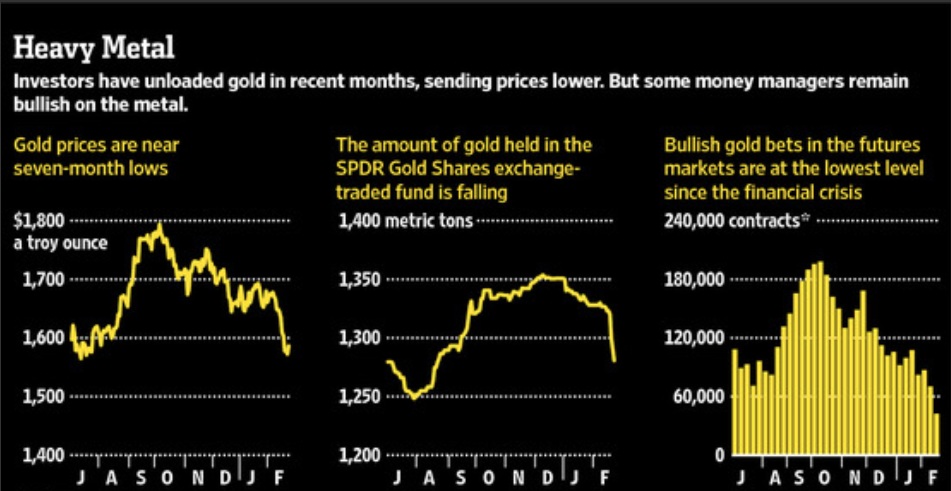
Big Investors Differ on Gold’s Prospects |
| ‘Markets continue to weaken following Italian elections’ Posted: 26 Feb 2013 11:17 AM PST Kiron Sarkar’s subscription service for his newsletter commences today Monday 25th February 2013. To subscribe, go to sarkargm.com.
Australia Australian deputy governor Mr Guy Debelle states that the A$ is not high enough to justify intervention. However, he added that the RBA could reduce interest rates if necessary. With even the RBA talking about currencies, do you really think that the G7/G20 statement about countries not competing to reduce the value of their currency is for real – Yep, I thought not;
Japan Japanese policy is to increase inflation to 2.0%, though no time period has been provided. However, long bonds (30 year) yields are lower – 1.88%, with the 10 year at 0.69%. Yes, you could argue that the lower yield reflects the impending BoJ policy of buying long dated JGB's, but it could (in my opinion does) also reflect the fact that the market also does not believe that the BoJ can increase inflation to 2.0% any time soon. However, the decline in yields also suggests that the amount of bonds to be purchased by the BoJ will be enormous. As a result, with the 3 major Central banks, the FED, the ECB (in spite of denying it) and the BoJ, in effect, printing money, markets should react positively in due course given the flood of liquidity and once the uncertainty in the EZ subsides. In addition, the Yen carry trade will be back, with a vengeance. It looks as if the main opposition party, the DPJ, will be supporting the appointment of Mr Kuroda, if as expected, he is chosen by PM, Mr Abe to head up the BoJ. Mr Abe needs the support of the Upper House, which he does not control, to ensure that his candidate. The candidate will be announced this Thursday; * SNIP * ~~~ Important Notice This newsletter is now a fee based subscription service, effective yesterday. More details at www.sarkargm.com
|
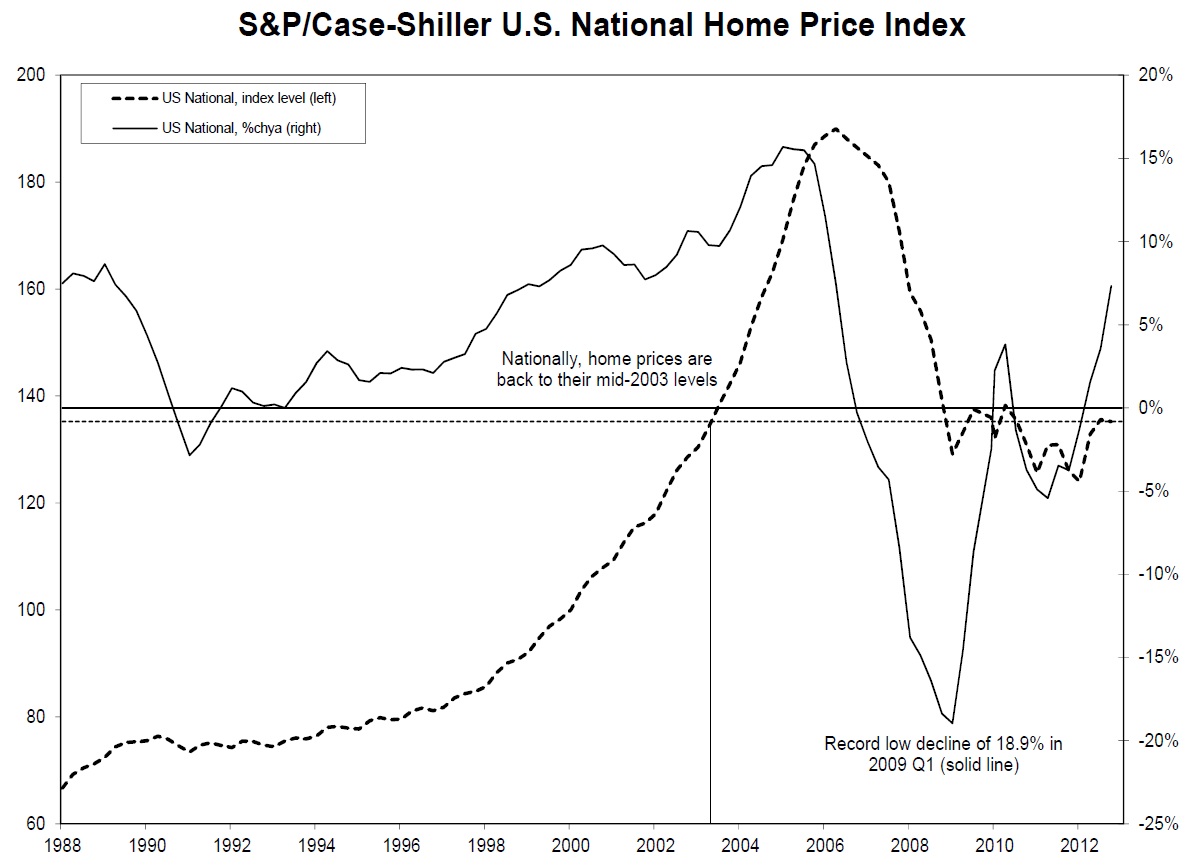
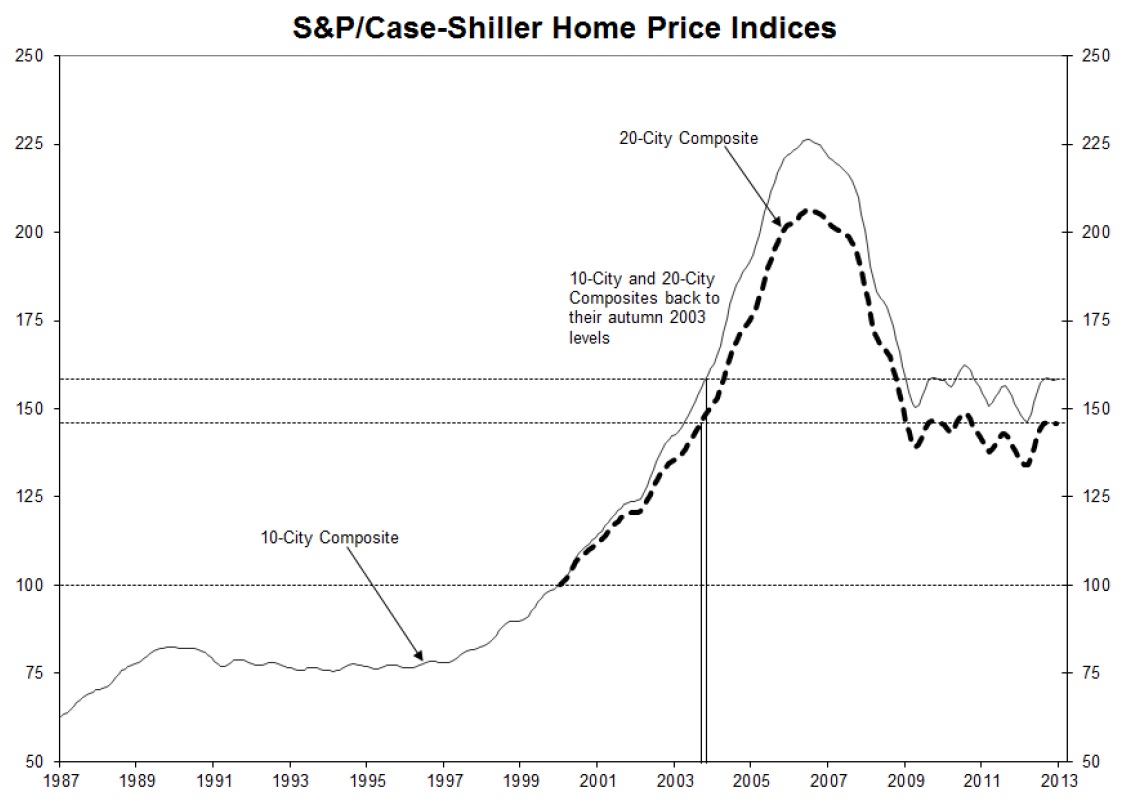
| Case-Shiller Home Price Indices: Home Prices Closed Out a Strong 2012 Posted: 26 Feb 2013 10:00 AM PST Data through December 2012 for the S&P/Case-Shiller Home Price Indices showed that all three headline composites ended the year with strong gains. The national composite posted an increase of 7.3% for 2012. Some of the year end transactions were to lock in the low capital gains rates before they changed on January 1, 2013. The 10- and 20-City Composites reported annual returns of 5.9% and 6.8% in 2012. Nineteen of the 20 MSAs posted positive year-over-year growth – only
Source: |
| James Grant on Economy, Gold, Price of Accommodation Posted: 26 Feb 2013 10:00 AM PST James Grant, publisher of Grant’s Interest Rate Observer, talks about global central bank policy and the outlook for automatic U.S. federal spending cuts set to begin March 1. Grant, speaking with Tom Keene, Sara Eisen, Michael McKee and Scarlet Fu on Bloomberg Television’s “Surveillance.” also talks about the U.S. economy and the Federal Reserve’s policy on quantitative easing.
~~~ Fed Action to Prompt Return to Gold Standard |
| Marty Lipton on Activist Hedge Funds Posted: 26 Feb 2013 08:00 AM PST Our quote of the day:
Interesting take from a well respected corporate lawyer. . . |
| Posted: 26 Feb 2013 07:01 AM PST My morning reads for this lovely Tuesday:
What are you reading?
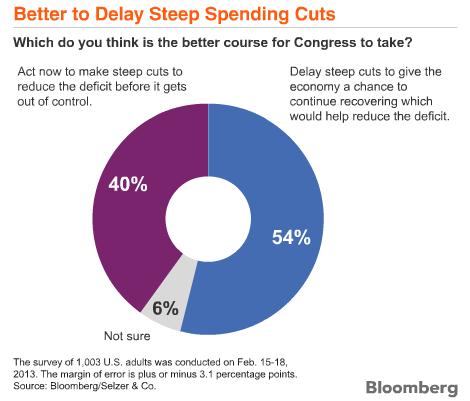
Americans Back Spending-Cut Delay Amid Budget-Deal Push |
| Grey Poupon “The Lost Footage” Posted: 26 Feb 2013 06:30 AM PST Discover what really happened after one fine gentleman passed another fine gentleman a jar of GREY POUPON. Recently discovered under mysterious circumstances, this “lost footage” uncovers all of the suspense, greed, revenge and savory pork loin that was meant for the original commercial.
Behind the scenes interviews The Distinguished Gentleman’s Outtake |
| Historical Echoes: Cash or Credit? Payments and Finance in Ancient Rome Posted: 26 Feb 2013 05:30 AM PST Historical Echoes: Cash or Credit? Payments and Finance in Ancient Rome
Imagine yourself a Roman citizen in the 1st Century B.C. You've gone shopping with your partner, who's trying to convince you to buy a particular item. The thing's pretty expensive, and you demur because you're short of cash. You may think that back then such an excuse would get you off scot-free. What else can you possibly do: Write a check? Well, yes, writes the poet Ovid in his "Ars Amatoria, Book I." And since your partner knows it, you have no way out (the example below shows some gender bias on Ovid's part. Fortunately, a few things have changed over the past 2,000 years):
In a previous Historical Echoes post, we describe some of the characters in early Roman high and low finance. Here, we look at their modus operandi.
Large sums of money changed hands in Roman times. People bought real estate, financed trade, and invested in the provinces occupied by the Roman legions. How did that happen? Cicero writes, in Epistulae ad Familiares 5.6 and Epistulae ad Atticum 13.31, respectively: "I have bought that very house for 3.5 million sesterces" and "Gaius Albanius is the nearest neighbor: he bought 1,000 iugera [625 acres] of M. Pilius, as far as I can remember, for 11.5 million sesterces." How? asks historian H. W. Harris (in "The Nature of Roman Money")–"mechanically speaking, did Cicero pay three and half million sesterces he laid out for his famous house in the Palatine . . . . That would have meant packing and carrying some three and half tons of coins through the streets of Rome. When C. Albanius bought an estate from C. Pilius for eleven and half million sesterces, did he physically send the sum in silver coins?" Harris' answer is: "Without much doubt, these were at least for the most part documentary [i.e., paper] transactions. The commonest procedure for large property purchases in this period was the one casually alluded to by Cicero [De Officiis 3.59] . . . 'nomina facit, negotium conficit' . . . provides the credit [or 'bonds'–nomina], completes the purchase." What exactly are these nomina?–from which, by the way, comes the term "nominal," so commonly used in economics. In his Ph.D. dissertation "Bankers, Moneylenders, and Interest Rates in the Roman Republic," C. T. Barlow writes (pp. 156-7): "An entry in an account book was called a nomen. Originally the word meant just that–a name with some numbers attached. By Cicero's day . . . [n]omen could also mean "debt," referring to the entries in the creditor's and the debtor's account books." And this "debt was in fact the lifeblood of the Roman economy, at all levels . . . nomina were a completely standard part of the lives of people of property, as well as being an everyday fact of life for a great number of others" (Harris, p. 184). Pliny the Younger writes, for example, (in Epistulae 3.19): "Perhaps you will ask whether I can raise these three millions without difficulty. Well, nearly all my capital is invested in land, but I have some money out at interest and I can borrow without any trouble." For concreteness, say that some fellow, Sempronius, owes you one million sesterces. You–or in case you're a wealthy senator, or eques, your financial advisor (procurator–Titus Pomponius Atticus was Cicero's)–would record the debt in the ledger. What if you suddenly needed the money to buy some property? Do you have to wait for Sempronius to bring you a bag with 1 million sesterces? No! As long as Sempronius is a worthy creditor (a bonum nomen [see Barlow, p. 156]; in the modern parlance of credit rating agencies, a triple-A creditor), you'd do what Cicero says: transfer the nomina, strike the deal. For example, Cicero writes to his financial advisor Atticus (Ad Atticum 12.31): "If I were to sell my claim on Faberius, I don't doubt my being able to settle for the grounds of Silius even by a ready money payment." As Harris (p. 192) observes: "Nomina were transferable, and by the second century B.C., if not earlier, were routinely used as a means of payment for other assets . . . . The Latin term for the procedure by which the payer transferred a nomen that was owed to him to the seller was delegatio." So, we've seen that Romans could settle payments by transferring nomina. But was there a market for nomina, just like there's one today in, say, mortgage-backed securities? According to both Barlow and Harris, the answer is yes. They claim that the Romans took the transferability one step further and essentially turned "mere entries in account books" into "negotiable notes" (see Barlow, p. 159, and Harris, p. 192). Not everyone agrees. The economic historian P. Temin ("Financial Intermediation in the Early Roman Empire") also reports evidence of assignability of loans, opening the possibility of "wider negotiability, but," he adds, "we do not have any evidence that it happened" (p. 721). Yet some indirect evidence is there. For instance, the idea of negotiable notes appears to be well understood by Roman jurists, such as Ulpian (The Digest of Justinian XXX.I.44): "A party who bequeaths a note bequeaths the claim and not merely the material on which the writing appears. This is proved by a sale, for when a note is sold, the debt by which it is evidenced is also considered to be sold." What if you had to transfer money to somebody in a different part of the globe? As the Roman dominions expanded into Greece, Spain, North Africa, and Asia, Roman finance actually faced this logistical problem. If you're in Rome and want to, say, finance Caius' mines in Thapsus, North Africa, how do you get him the money? He needs the silver to buy material, slaves, and other things, but you're naturally very reluctant to see your money sail away for Africa, as the chances of it getting there aren't that high (see pirates, shipwrecks, etc.). "Permutatio, the transfer of funds from place to place through paper transactions, was Rome's great contribution to ancient banking" (Barlow, p. 168). It worked as follows: The publicani were private companies in charge of tax collection in the provinces (as well as many other tasks; see "Publicani," by U. Malmendier). They had a branch in Rome and one in Thapsus. So, you'd give them the silver in Rome (or transfer them some nomina) and they'd divert some of their tax collection in North Africa to Caius. This is also how the Republic would finance its public spending overseas. Since taxes were collected throughout the provinces, by trading claims on taxes Romans could transfer funds across the globe–or at least to the part of the globe they had conquered. Interestingly, some historians measure the sophistication of Roman finance "by the extent banks were present" (Temin, p. 719). While it is true that we have no evidence of a 1st Century B.C. Wells Fargo, this may not necessarily imply lack of sophistication. Prior to the Great Recession in the United States, a large chunk of financial intermediation didn't involve banks–it went through the "shadow banking system." Roman high finance "functioned primarily on the basis of brokerage" (K. Verboven, "Faeneratores, Negotiatores and Financial Intermediation in the Roman World," p. 12), and hence was a bit like a proto-shadow banking system, as we suggest in our prior post. Like the shadow-banking system in the United States, it was fragile. Going back to our earlier example, we note that if whomever you want to buy property from starts wondering about the creditworthiness of Sempronius, she will not accept his nomina in payment and will want cash. That'll force you to call in the loan to Sempronius, who in order to pay you will call in his loan to Titus, and so on. But financial crises in ancient Rome are the subject of a future post. We are grateful to Cameron Hawkins of the University of Chicago for help navigating the literature. |
| A Declaration of Love for the 1962 Maserati Sebring Posted: 26 Feb 2013 05:00 AM PST Spectacular:
Some details:
Source: Classic Driver |
| Using Game Theory to “Solve” Government Spending Posted: 26 Feb 2013 04:15 AM PST
The famous Russell Long quote above reflects a basic truth about politics: Many people want other people’s taxes to go up, but not their own. The same is true for spending: Other programs are wasteful, but not our favorites. City dwellers find agricultural supports wasteful, Farmland dwellers think the same of subsidized mass transit. Programs in other people’s districts are expensive and unnecessary, but those in ours are crucial and required. This is no way to run a country. If we were smart, we would apply our understanding of human nature to resolve spending and tax issues. Game theory* is a study of strategic decision making — how “conflict and cooperation between intelligent rational decision-makers” leads to certain outcomes. Basic game theory could help us with these issues, if we think about it intelligently. How? By stopping the taxing and spending cuts of that fellow behind the tree — and instead force people to raise their own taxes and cut their own spending. If I were advising the President of the United States, I would make the following suggestion: He should announce a 20% spending cut over the next 10 years. Create a panel — Treasury Secy, Veep, House Speaker, Senate Leader, FOMC rep — to oversee the effort, but with one crucial twist. Instead of the usual cutting, the twist is to use each State’s Congressional delegation must decide what gets cut. Both of a states Senators and all of the Congressmen form a working group to decide how federal revenues, benefits, expenses and costs that flow TO THEIR OWN STATE will be cut. There would be 50 state working groups elect their own leaders, determine what their own priorities are. If they want to do polls or surveys, its up to them. They get no budget for this, it comes out of their own congressional staffing budgets. There is no fellow behind the tree any more. Each state delegation determines their own residents’ fate. The CBO determines how much money flows to each state from the Federal Government. This includes entitlements like Social Security and Medicare, spending on Education, as well as Defense Contracts and other financing. It this includes FEMA. Each of the 50 state delegations reports back to our original panel, who works together to reflect all of this in one coherent budget. (No earmarks allowed) Any group that fails to submit a plan simply gets across the board budget cuts gets. (You can consider a 5% penalty for those who fail to submit a plan). All of this literally forces a balanced budget cut by making personal sacrifices — not dumping it on other people. It eliminates the hypocrisy of deficit peacocks who vote for every budget buster and then disingenuously present themselves as concerned about debt. But most of all, we find out the priorities for government spending by the people of this nation — and their elected representatives. Don’t like military spending? Cut it in your own state. Against Social Security? Cut aid to the elders in your own State. Have a problem with FEMA? Opt out of it. One of the biggest problems with wrestling the Federal Budget under control is the tendency for it to be so abstract — its all about that other fellow. A simple solution to a complex issue. What do you think?
_______________ * Roger B. Myerson (1991). Game Theory: Analysis of Conflict, Harvard University Press, p. 1. Chapter-preview links, pp. vii-xi. |




| You are subscribed to email updates from The Big Picture To stop receiving these emails, you may unsubscribe now. | Email delivery powered by Google |
| Google Inc., 20 West Kinzie, Chicago IL USA 60610 | |



0 comments:
Post a Comment