.

{2} GoogleTranslate (H)

English French German Spanish Italian Dutch Russian Portuguese Japanese Korean Arabic Chinese Simplified

Our New Stuff

{3} up AdBrite + eToro

Your Ad Here

Tuesday, June 11, 2013

The Big Picture

The Big Picture


Polar Landscape Porn: Antarctica, A Year On Ice

Posted: 11 Jun 2013 02:00 AM PDT

Government Built Spy-Access Into Most Popular Consumer Program Before 9/11

Posted: 10 Jun 2013 10:30 PM PDT

NSA Built Back Door In All Windows Software by 1999

In researching the stunning pervasiveness of spying by the government (it's much more wide spread than you've heard even now), we ran across the fact that the FBI wants software programmers to install a backdoor in all software.

Digging a little further, we found a 1999 article by leading European computer publication Heise which noted that the NSA had already built a backdoor into all Windows software:

A careless mistake by Microsoft programmers has revealed that special access codes prepared by the US National Security Agency have been secretly built into Windows. The NSA access system is built into every version of the Windows operating system now in use, except early releases of Windows 95 (and its predecessors). The discovery comes close on the heels of the revelations earlier this year that another US software giant, Lotus, had built an NSA "help information" trapdoor into its Notes system, and that security functions on other software systems had been deliberately crippled.

The first discovery of the new NSA access system was made two years ago by British researcher Dr Nicko van Someren [an expert in computer security]. But it was only a few weeks ago when a second researcher rediscovered the access system. With it, he found the evidence linking it to NSA.

***

Two weeks ago, a US security company came up with conclusive evidence that the second key belongs to NSA. Like Dr van Someren, Andrew Fernandez, chief scientist with Cryptonym of Morrisville, North Carolina, had been probing the presence and significance of the two keys. Then he checked the latest Service Pack release for Windows NT4, Service Pack 5. He found that Microsoft's developers had failed to remove or "strip" the debugging symbols used to test this software before they released it. Inside the code were the labels for the two keys. One was called "KEY". The other was called "NSAKEY".

Fernandes reported his re-discovery of the two CAPI keys, and their secret meaning, to "Advances in Cryptology, Crypto'99″ conference held in Santa Barbara. According to those present at the conference, Windows developers attending the conference did not deny that the "NSA" key was built into their software. But they refused to talk about what the key did, or why it had been put there without users' knowledge.

A third key?!

But according to two witnesses attending the conference, even Microsoft's top crypto programmers were astonished to learn that the version of ADVAPI.DLL shipping with Windows 2000 contains not two, but three keys. Brian LaMachia, head of CAPI development at Microsoft was "stunned" to learn of these discoveries, by outsiders. The latest discovery by Dr van Someren is based on advanced search methods which test and report on the "entropy" of programming code.

Within the Microsoft organisation, access to Windows source code is said to be highly compartmentalized, making it easy for modifications to be inserted without the knowledge of even the respective product managers.

Researchers are divided about whether the NSA key could be intended to let US government users of Windows run classified cryptosystems on their machines or whether it is intended to open up anyone's and everyone's Windows computer to intelligence gathering techniques deployed by NSA's burgeoning corps of "information warriors".

According to Fernandez of Cryptonym, the result of having the secret key inside your Windows operating system "is that it is tremendously easier for the NSA to load unauthorized security services on all copies of Microsoft Windows, and once these security services are loaded, they can effectively compromise your entire operating system". The NSA key is contained inside all versions of Windows from Windows 95 OSR2 onwards.

***

"How is an IT manager to feel when they learn that in every copy of Windows sold, Microsoft has a 'back door' for NSA – making it orders of magnitude easier for the US government to access your computer?" he asked.

We have repeatedly pointed out that widespread spying on Americans began prior to 9/11.

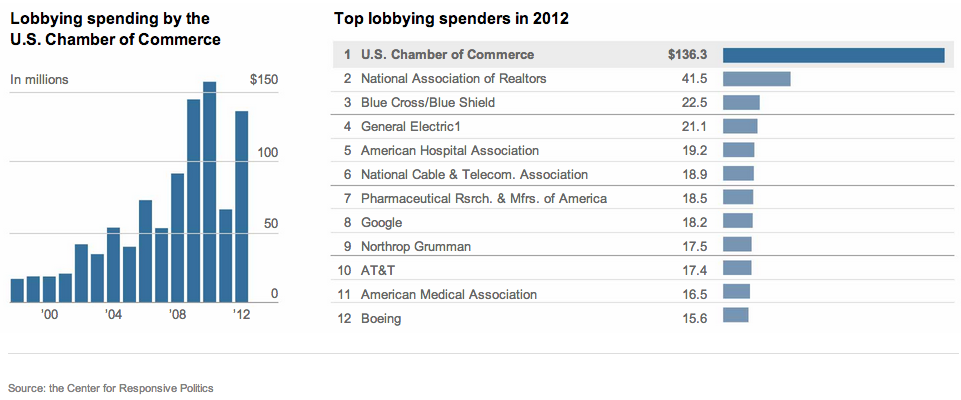
Discuss: Biggest Lobbying Spenders in the U.S.

Posted: 10 Jun 2013 04:00 PM PDT

Click to enlarge
Graphic

Source: NYT

Apple Is Not Alone

Posted: 10 Jun 2013 02:00 PM PDT

The Examined Life

Posted: 10 Jun 2013 11:30 AM PDT

Click to enlarge
Chart

Source: Economist

On Meredith & Monica

Posted: 10 Jun 2013 08:00 AM PDT

@TBPInvictus

It was, I guess, a rude awakening for me when I realized, many years ago, that most of the talking heads I saw on TV had no idea what the hell they were talking about. The sooner one learns that lesson, the better. So, take it from me (and BR, who says the same thing): Figure out who’s on their game and who isn’t; who’s got an agenda and who doesn’t. Stick with those who are consistently good and occasionally great, jettison the money-losers and ideologues. Finance is not the place for one-hit-wonders. (How do you wind up with a small fortune on Wall St? Start with a large one. Or follow the money losers because they deliver a message you want to hear, not one that will make you money.)

Now, to be clear, there’s a difference between being wrong and being ignorant (though some folks are often both). And there’s yet another, more insidious category: those who deny they’ve ever been wrong, gloss over their mistakes, don’t learn from them, or perhaps pretend they never happened. Being wrong is one thing, staying wrong is another; there’s nothing wrong with the former, everything wrong with the latter.

My jaw about hit the floor last year when I caught Niall Ferguson claim that a sudden, large spike in Federal payrolls was stimulus related when it was actually Census related. I’d never held him in particularly high esteem, but that gaffe just cemented my view of him little more than a cue to change channels.

In the past few days, I (sadly) happened to witness more of the same – this time from Meredith Whitney and, separately, Monica Crowley.

Ms. Whitney was on the tube defending and re-writing her call in December 2010 that there was going to be a debacle in the muni bond market. To the best of my knowledge, Ms.Whitney has twisted, distorted, and re-shaped her 60 Minutes comments six ways to Sunday, never being enough of a mensch to acknowledge that she was, indisputably, wrong – an admission for which I’d respect her. Instead, I’ve lost all respect for her inability to come to terms with this one horrific call (notwithstanding whatever else she may have gotten right or (mostly) wrong).

Here was Ms. Whitney with Steve Kroft in December 2010 (emphasis mine):

“There’s not a doubt in my mind that you will see a spate of municipal bond defaults,” Whitney predicted.

Asked how many is a “spate,” Whitney said, “You could see 50 sizeable defaults. Fifty to 100 sizeable defaults. More. This will amount to hundreds of billions of dollars’ worth of defaults.”

Municipal bonds have long been considered to be among the safest investments, bought by small investors saving for retirement, and held in huge numbers by big banks. Even a few defaults could affect the entire market. Right now the big bond rating agencies like Standard & Poor’s and Moody’s, who got everything wrong in the housing collapse, say there’s no cause for concern, but Meredith Whitney doesn’t believe it.

“When individual investors look to people that are supposed to know better, they’re patted on the head and told, ‘It’s not something you need to worry about.’ It’ll be something to worry about within the next 12 months,” she said.

I respect the fact that Whitney went out on a limb and made a bold call. I really do. As she makes the rounds to peddle her new book, she should own up to the fact that her call was dead wrong instead of trying to re-write and distort what she plainly said.

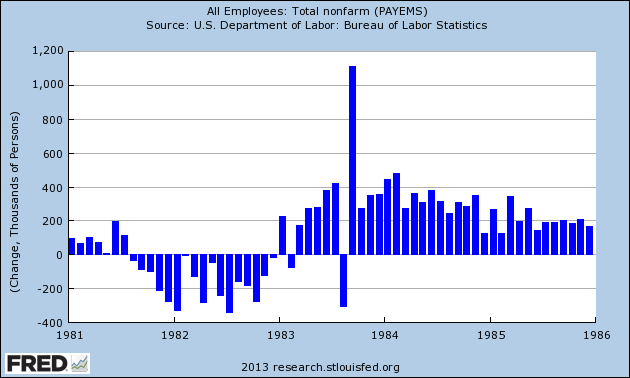
No, the Reagan recovery did NOT produce 1.1 million jobs in one month

Which leaves Monica Crowley who, while dumping on Friday’s jobs report (1:07) invoked…wait for it…the Reagan recovery and the “fact” (not really a “fact”) that “…we had one month in the Reagan recovery, 1.1 million new jobs created in a single month…”. It’s possible, of course, that Crowley got her misinformation from National Review, which was apparently peddling that line a couple of years ago. Sadly, the former paper of record for Wall St. – the Wall St. Journal – also had no problem lying about the 1983 report, and that may well have been the point of origin:

As it happens, the biggest one-month jobs gain in American history was at exactly this juncture of the Reagan Presidency, after another deep recession. In September 1983, coming out of the 1981-82 downturn, American employers added 1.1 million workers to their payrolls, the acceleration point for a seven-year expansion that created some 17 million new jobs.

And so a talking point – having no basis in fact – is born, and continues to make the rounds.

Of course, not recognizing that number, it was off to the BLS archives for me, to find out what was going on. I suspected I had an inkling, and my hunch proved spot-on.

As BLS originally reported (so no revisions here; emphasis mine):

Nonagricultural payroll employment rose by 735,000 in September to 90.5 million, seasonally adjusted. About 675,000 of this increase, however, represented the return of employees to payrolls following settlement of strikes, chiefly that of communications workers. [Ed note: Without doing the requisite digging, I'll assume future revisions eventually took the number to >1MM.]

Here’s what that period in time looked like, and what Ms. Crowley was referring to (note the precipitous decline in the month prior to the spike up – that’s the workers being laid off the payrolls):

one million jobs

BLS, prior month:

The number of employees on nonagrlcultural payrolls fell by 410,000 in August to 89.8 million, seasonally adjusted. However, the establishment survey data were significantly affected by a nationwide strike of some 700,000 communications workers.

The point here being that during this period we were generally printing between 200k – 400k nonfarm payroll jobs per month, which is certainly admirable enough. Ms. Crowley could have said as much and been done with it instead of pushing a bogus 1.1MM number. So, either she was unaware of the circumstances surrounding that anomalous print, or chose to forge on ahead with information she knew to be misleading – neither scenario reflects well – for Ms. Crowley, National Review, or the Journal. So let’s put this one to bed, shall we?

Update (June 10): Replaced the line graph with a bar graph, a more appropriate choice under the circumstances.

10 Monday AM Reads

Posted: 10 Jun 2013 07:00 AM PDT

My 10:03 Acela to Boston morning reads:

• Forecast Calls for Volatility (WSJ)
• Why the Fed Hates the Word 'Tapering' (Real Time Economics) see also Look For Fed to Taper Talk of 'Tapering' (Barron’s)
Brett Arends: Why Wall Street loses its mind every summer (MarketWatch)
• Josh two fer:
…..-The Doomer Biz Hits the Clearance Aisle (The Reformed Broker)
…..-Why the Super-Rich Love Bubbles (The Reformed Broker)
• 4 reasons Bernanke may be world’s best central banker (USA Today)
• Median CEO Pay Rises to $9.7 Million in 2012 (AP) but see Labor’s Falling Share, Everywhere (Conversable Economist)
• WWDC 2013 Expectations (Daring Fireball)
• Silent War (Vanity Fair)
• Apple to Revamp iPhone Software, Ending Product Funk (Bloomberg) see also Apple Enters Net Radio's Busy Field (NYT)
• Before and After: A Satellite Captures Damage and Recovery from Superstorm Sandy (Time)

What are your reading?


AAII allocation cash levels fell to lowest in over 2 years
Chart
Source: The Short Side of Long

Resigning from the Professional Undertaking of Coin Flipping

Posted: 10 Jun 2013 04:15 AM PDT

I love this quote that manages to combine elements of Uncertainty, Existentialism and Agnosticism:


“I have resigned from the professional undertaking of coin flipping. I am not here to tell you where golds gonna be. I have no idea. That’s my existentialism. I am a student of uncertainty. I have no idea where the stock market is going to be. So when I am creating trades in my portfolio for my clients, I am agnostic. I just want to enhance the probability that I make money come what may . . . ”

-Hugh Hendry, of Eclectica Asset Management


Video clip here : Buttonwood, November 26, 2012

Full video here


Is the Information Technology Revolution Over?

Posted: 10 Jun 2013 03:00 AM PDT

.

0 comments:

Post a Comment

previous home Next

{8} chatroll


{9} AdBrite FOOTER

{8} Nice Blogs (Adgetize)