


The Big Picture |
- Has Household Wealth Recovered?
- The Government Actually Spied On Bad Guys Before 9/11
- Does Math Exist or Is It a Human Creation?
- Congress is Less Popular than Lice, Colonoscopies or Nickelback
- Where the Wealthy Folk Are
- 10 Sunday Reads
- 2014 Aston Martin Vanquish (Convertible)
| Has Household Wealth Recovered? Posted: 24 Jun 2013 02:00 AM PDT Household Wealth: Has It Recovered?
Adjusting for inflation, population growth, and a risk-free real interest rate shows there is still a substantial gap between the peak of household wealth in 2007 and the level today. The 2012:Q4 flow of funds data released on March 7, 2013, by the Federal Reserve reported that the net worth of households and nonprofit organizations rose to $66.1 trillion.1 Taking this as a measure of household wealth, the financial press reported that household wealth had risen to within 2 percent of its previous (pre-recession) peak in 2007:Q3. Determining whether households are nearly as wealthy now as then is complicated. Hard-to-measure factors, such as human capital, the distribution of wealth, and the tax liabilities of the wealthy, could be considered in a more extensive analysis. Here, I make a determination that depends on some factors more easily measured—population growth, inflation, and a risk-free real interest rate. The risk-free real interest rate matters because it determines how large the flow of future real consumption guaranteed from a given amount of wealth can be. I use the chain price index for personal consumption expenditures (PCE) to deflate nominal household wealth. I also divide total wealth by the population of the United States. To account for changes in the real interest rate, I assume a representative household that wants a constant monthly income for the next 10 years. The household invests in a 10-year annuity indexed for inflation with no default risk. The inflation-adjusted risk-free real interest rate is measured by the rate on long-term Treasury inflation-protected securities (TIPS). Annuity payments are similar to mortgage payments. For example, when a bank makes a 10-year conventional fixed-rate mortgage loan, it receives a fixed amount each month for 120 months, at which time the mortgage is paid off and monthly payments end. An annuity pays the holder in a similar fashion. The table shows the different measures of household wealth—the interest rate on long-term TIPS and the per capita levels of real PCE—for three particular quarters: 2007:Q3, when the flow of funds measure of household wealth peaked; 2009:Q2, when the recession ended and that measure troughed; and 2012:Q4, the most recent quarter for which the data are available. As shown in the first column, aggregate household wealth in 2012:Q4 was $66.1 trillion, 26 percent higher than the end-of-recession level and only 2 percent lower than the 2007 peak. After adjusting for population growth, it is still 23 percent higher than the 2009 trough but 6 percent lower than the pre-recession peak. Inflation has been modest, but it makes real wealth appear even lower today. Per capita real household wealth in 2012:Q4 was just 14 percent above the 2009 trough and 15 percent below the 2007 peak. The TIPS interest rate in 2007:Q3 (the fifth column in the table) was 2.38 percent—near its 2.35 percent end-of-recession trough—but fell to –0.09 percent in 2012:Q4. (For simplicity, as shown in the table, I assume that the rate was zero in 2012:Q4.) Based on the TIPS interest rate, the annuity value of household wealth in 2012:Q4 was just 1.7 percent above its end-of-recession trough but still 24 percent below its 2007 peak. An interesting observation emerges when the artificial 10-year annuity is compared with the monthly average of per capita real PCE. The comparison shows that monthly income from household wealth would have been 77 percent of per capita real PCE in 2007:Q3, just 60 percent by the end of the recession, and an even lower 58 percent by 2012:Q4. Although flow of funds data suggest household wealth has nearly rebounded to its pre-recession peak, adjusting for inflation, population growth, and a risk-free real interest rate shows there is still a substantial gap between the peak of household wealth in 2007 and the level today. Note 1 See line 42 in the March 7, 2013, data release for the Balance Sheets of Households and Nonprofit Organizations; http://www.federalreserve.gov/releases/z1/Current/z1r-5.pdf. |
| The Government Actually Spied On Bad Guys Before 9/11 Posted: 23 Jun 2013 10:30 PM PDT The Bush and Obama Administrations' Justification for Mass Surveillance Has Been DEBUNKEDPreface: The Bush and Obama administrations both claimed that spying on Americans was justified by 9/11. Specifically, they said that they could have caught one of the 9/11 hijackers living in San Diego if they could have spied on phone calls on American soil. However – as demonstrated below – that claim is totally false. Investigative journalist ProPublica notes:
The reality is different. Initially, an FBI informant hosted and rented a room to Mihdhar and another 9/11 hijacker in 2000. Investigators for the Congressional Joint Inquiry discovered that an FBI informant had hosted and even rented a room to two hijackers in 2000 and that, when the Inquiry sought to interview the informant, the FBI refused outright, and then hid him in an unknown location, and that a high-level FBI official stated these blocking maneuvers were undertaken under orders from the White House. As the New York Times notes:
So mass surveillance of Americans isn't necessary, when the FBI informant should have apprehended the hijackers. Moreover, the NSA actually did intercept Mihdhar's phone calls before 9/11. We reported in 2008:
We asked top NSA whistleblower William Binney – a highly-credible 32-year NSA veteran with the title of senior technical director, who headed the agency's digital data gathering program (featured in a New York Times documentary, and the source for much of what we know about NSA spying) – what he thought of the government's claim that mass surveillance of Americans would have caught Mihdhar and prevented 9/11. Binney responded:
Indeed, widespread spying on Americans began before 9/11 (confirmed here, here, here and here. And U.S. and allied intelligence heard the 9/11 hijackers plans from their own mouths:
But even with all of that spying, the government didn't stop the hijackers … even though 9/11 was entirely foreseeable. ProPublica notes:
In other words, the NSA had the technical ability and legal authority to intercept calls between Midhar and Yemen before 9/11 … and it actually did so. In reality – despite the government continually grasping at straws to justify its massive spying program – top security experts say that mass surveillance of Americans does not keep us safe. Indeed, experts say that mass surveillance interferes with catching bad guys. |
| Does Math Exist or Is It a Human Creation? Posted: 23 Jun 2013 04:00 PM PDT Math is invisible. Unlike physics, chemistry, and biology we can’t see it, smell it, or even directly observe it in the universe. And so that has made a lot of really smart people ask, does it actually even EXIST?!?! Similar to the tree falling in the forest, there are people who believe that if no person existed to count, math wouldn’t be around . .at ALL!!!! But is this true? Do we live in a mathless universe? Or if math is a real entity that exists, are there formulas and mathematical concepts out there in the universe that are undiscovered? Or is it all fiction? Whew!! So many questions, so many theories… watch the episode and let us know what you think! Is Math a Feature of the Universe or a Feature of Human Creation? | Idea Channel | PBS Hat tip boingboing |
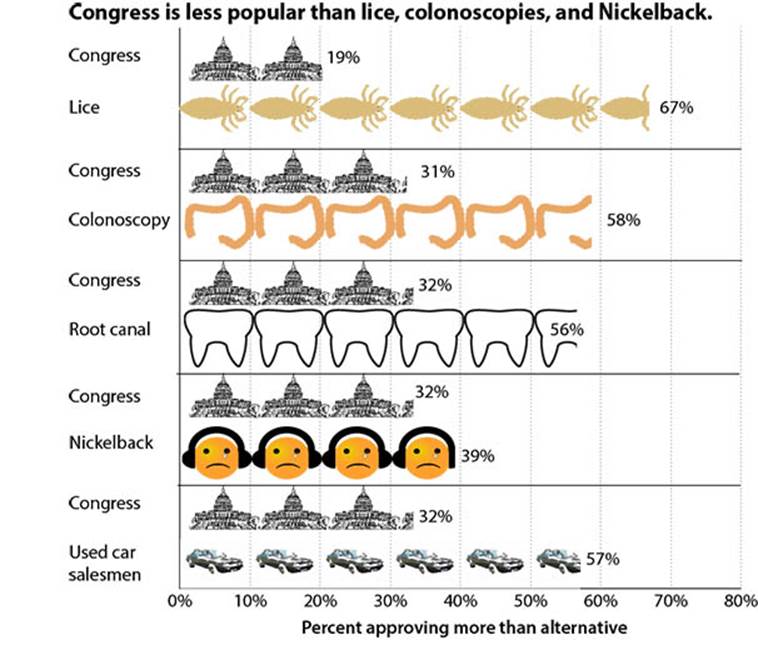
| Congress is Less Popular than Lice, Colonoscopies or Nickelback Posted: 23 Jun 2013 02:30 PM PDT I Tweeted this the other day, but decided it needed to be on the blog: Click to enlarge |
| Posted: 23 Jun 2013 09:00 AM PDT
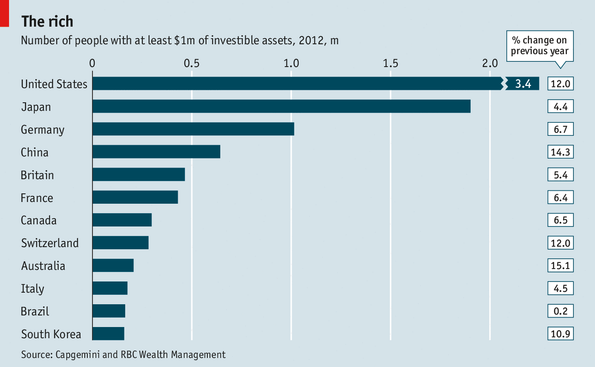
There are 12 million people on the planet that had investible assets of more than $1 million dollars. Collectively, this group controls $46.2 trillion dollars (2012). A quarter of them live in America (3.4m); followed by almost a sixth in Japan (1.9m) and a twelfth in Germany (over 1m). China and Great Britain round out the top 5. All data via The Economist.
|
| Posted: 23 Jun 2013 06:00 AM PDT Good Sunday Morning! Yet another glorious day, a streak that is increasingly destined to end. If you are stuck indoors today, well then we have some items for your reading pleasure:
Whats for brunch? |
| 2014 Aston Martin Vanquish (Convertible) Posted: 23 Jun 2013 03:00 AM PDT
Behold the 2014 Aston Martin Vanquish Volante in all its convertible glory. Like its hard top twin, the convertible Vanquish boasts a
Yours for the low, low price of $297,995
Looks nice in white:
The hard top has a menacing look to it:
video after the jump
|






| You are subscribed to email updates from The Big Picture To stop receiving these emails, you may unsubscribe now. | Email delivery powered by Google |
| Google Inc., 20 West Kinzie, Chicago IL USA 60610 | |



0 comments:
Post a Comment