


The Big Picture |
- It Only Takes $20 Million to Start a Public Bank
- Choose Yourself by James Altucher
- Home Building Improving But Still At Low Levels
- The Smartest Man in Europe
- 10 Weekend Reads
| It Only Takes $20 Million to Start a Public Bank Posted: 08 Jun 2013 10:30 PM PDT 40% of the World's Banks are Publicly OwnedEllen Brown – author of Web of Debt, and the soon-to-released book The Public Banking Solution gave some stunning statistics at last night's Public Banking Institute conference:
University of Maryland political science professor Gar Alperovitz – former Legislative Director in the U.S. House of Representatives and the U.S. Senate, and Special Assistant in the Department of State – also spoke at the Public Banking conference. Alperovitz said that the "bottom up" approach of public banking will work faster than breaking up or nationalizing the banks. Why? Because if you break them up, they'll just regroup and then take over the system again. (We obviously have to break up the giant banks as well) Alperovitz notes that there is a "massive new economy movement" moving from the ground up. For example:
Alperovitz ended on this inspiring note:
A member of Iceland's parliament pointed out that Iceland's main banks used to be public, but that the politicians let them be privatized a few years before the crisis. Matt Taibbi also spoke at the conference. Taibbi said that things have gone wrong because people haven't been paying attention to what the big financial players have been doing:
Taibbi also says:
Taibbi noted that a Federal Reserve bank found that you would need at least 70,000 to 80,000 people to audit one of the big banks to the extent that small banks are audited. He says that the big banks themselves can't even audit their own operations. They don't know how interconnected and intertwined they are, or what operations they're really engaged in. Taibbi said we are in a dire situation:
However, he notes that we have more power than we realize, because – underneath their air of invincibility – the big banks are very fragile and "extraordinary vulnerable". Every time there is any bad publicity, any expose about what they're really doing, any question that the government won't unconditionally and forever prop them up, investors flee from their stock and their market cap plummets. Taibbi said:
Taibbi supports public banking as a better alternative … because it is much more transparent than the current American banking system. |
| Choose Yourself by James Altucher Posted: 08 Jun 2013 02:00 PM PDT Choose Yourself by James Altucher The world is changing. Markets have crashed. Jobs have disappeared. Industries have been disrupted and are being remade before our eyes. Everything we aspired to for "security," everything we thought was "safe," no longer is: College. Employment. Retirement. Government. It's all crumbling down. In every part of society, the middlemen are being pushed out of the picture. No longer is someone coming to hire you, to invest in your company, to sign you, to pick you. It's on you to make the most important decision in your life: Choose Yourself. New tools and economic forces have emerged to make it possible for individuals to create art, make millions of dollars and change the world without "help." More and more opportunities are rising out of the ashes of the broken system to generate real inward success (personal happiness and health) and outward success (fulfilling work and wealth). This book will teach you to do just that. With dozens of case studies, interviews and examples–including the author, investor and entrepreneur James Altucher's own heartbreaking and inspiring story–Choose Yourself illuminates your personal path to building a bright, new world out of the wreckage of the old.
|
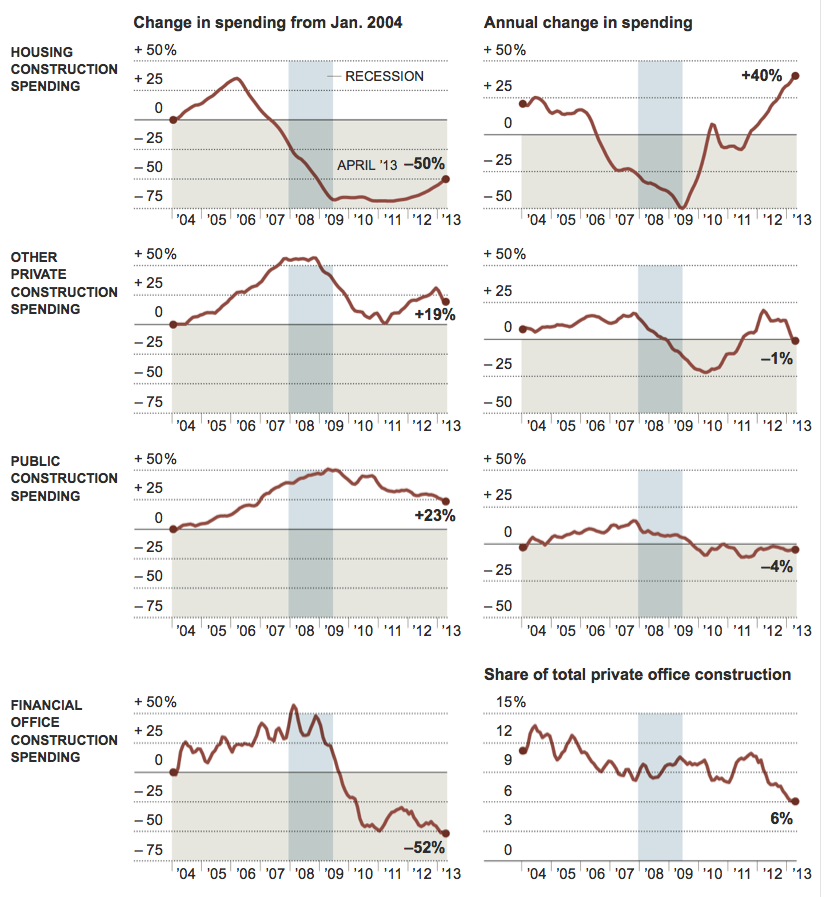
| Home Building Improving But Still At Low Levels Posted: 08 Jun 2013 10:00 AM PDT Construction Improves, Yet Is Still Historically Low
Norris:
Why do we keep shooting ourselves in our collective national foot?
Source: |
| Posted: 08 Jun 2013 06:30 AM PDT I have been reading this (for lack of a better word) series from Byron Wien for many years. I remain unsure if The Smartest Man in Europe actually exists or if it is a clever ruse that allows Wien to say things at arm’s length that perhaps he would not be able to if he had to sign at the bottom (and initial here, here . . . and here). Even if The Smartest Man in Europe is a mere literary device, it works well. I find the insights to be atypical, though I sometimes disagree with swaths of it. Regardless of whether or not this is a fictional person, it works well as a piece of commentary. The piece is quite long, and you should definitely head over to Barron’s to read it in its entirety. However, I am becoming increasingly interested in the contrarian idea of a European recovery. investors hate Europe, and that has me licking my lips. We have exposure through a few ETFs and Global allocation models — and as of June 1, we now have a 15.44% exposure to Europe — and that might tick higher eventually. Here is Byron Wien:
Good stuff, regardless of whether its from the Smartest Man in Europe, or just a clever old codger here in the United States . . .
Source: |
| Posted: 08 Jun 2013 03:30 AM PDT Good Saturday morning. What you need is a restful, recharging weekend. To send you in that direction, may I suggest you spend some time with these longer form journalism pieces? They will inform, entertain and educate you. Feed your brain:
What are you doing this weekend?
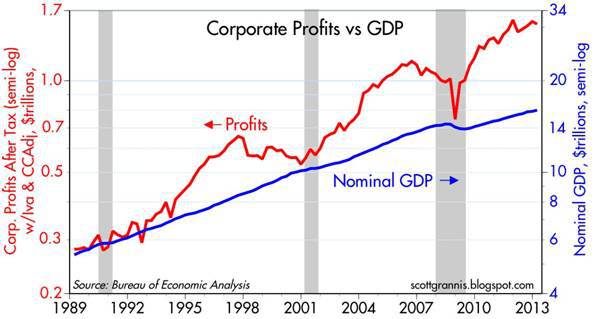
Profit cycle vs GDP |
| You are subscribed to email updates from The Big Picture To stop receiving these emails, you may unsubscribe now. | Email delivery powered by Google |
| Google Inc., 20 West Kinzie, Chicago IL USA 60610 | |



0 comments:
Post a Comment