| Economic Volatility and Financial Markets: The Case of Mortgage-Backed Securities Posted: 09 Jul 2013 02:00 AM PDT |
| Everything You Wanted to Know about Spying, But Were Afraid to Ask Posted: 08 Jul 2013 10:30 PM PDT Spying: The Big Picture If you've been too busy to keep up with the spying scandal, here's an overview:  |
| ProPublica: The Magazine Posted: 08 Jul 2013 04:30 PM PDT I have been a fan and supporter of ProPublica from is early day; the following announcement is via ProPublica: The Magazine: Today, we are launching ProPublica: The Magazine. Each month, subscribers to ProPublica: The Magazine will get a handful of hand-picked stories delivered to their iPhones and iPads, in an experience suited to reading them: one at a time, clean typography, strong images, and no unnecessary distractions. ProPublica: The Magazine is designed for focused reading at your convenience. Krista Kjellman Schmidt, who edits ProPublica: The Magazine, writes, “We hope we’ve made it an ideal way to read ProPublica’s journalism.” We hope so, too. In its first five years, ProPublica has produced indispensable reporting on the key stories of our time: the financial crisis and its repercussions, Hurricane Katrina, America’s military efforts since 9/11, health care, energy, government surveillance. As a nonprofit that committed to investigative journalism just as others were backing away, ProPublica knows that in-depth reporting and great storytelling are not always enough. People need journalism that holds those with power accountable, and information that galvanizes change in government and society. Subscriptions are free, and the free download comes with an issue featuring ProPublica coverage of guns and drones, plus an unforgettable series of stories, by Sebastian Rotella, about a boy that survived a Guatemalan military massacre. I first heard a version of this story on This American Life. To sit back and focus on the article, look at pictures of those involved, and read Rotella’s followup coverage gave me a fuller understanding of the personal and political dimensions of this story. ProPublica: The Magazine is 29th Street’s first free subscription title. We are as committed as ever to finding ways for writers to sell subscriptions to their audience. Still, we think a free subscription fits the mission of many publishers and institutions. If you think it would help you, please drop us a note. And if you’ve been curious about 29th Street Publishing’s magazines but hesitant to subscribe, now you have no excuse. I can’t think of a more worthwhile publication to subscribe to than ProPublica: The Magazine.

 |
| 10 Monday PM Reads Posted: 08 Jul 2013 01:30 PM PDT My afternoon train reading: • The computers that run the stock market (CNNMoney)
• A Portfolio That’s as Simple as One, Two, Three (WSJ)
• Consumers Boost Borrowing (Real Time Economics) see also It's Not Just 'Jobs,' It's the Kind of Jobs That Matters (Moneybeat)
• S&P to court: Reasonable investors wouldn't rely on our 'puffery' (MarketWatch)
• Audi to Zappa See Trade Talks as Chance to Cut Rules (Bloomberg)
• Good Urban Design Losing in Miami Beach (World Property Channel)
• How Spitzer as comptroller could impact Wall Street (MarketWatch) see also Sex Scandal, Just Another Spitzer Campaign Event (Bloomberg)
• China's Great Rebalancing Act (The Diplomat)
• Top iOS apps and games go free ahead of App Store’s fifth anniversary (Verge) see also The Only Smartphones Worth Buying Right Now (Business Insider)
• Scientists find black hole bonanza (CNN)
What are you reading? The bond fund outflow, charted
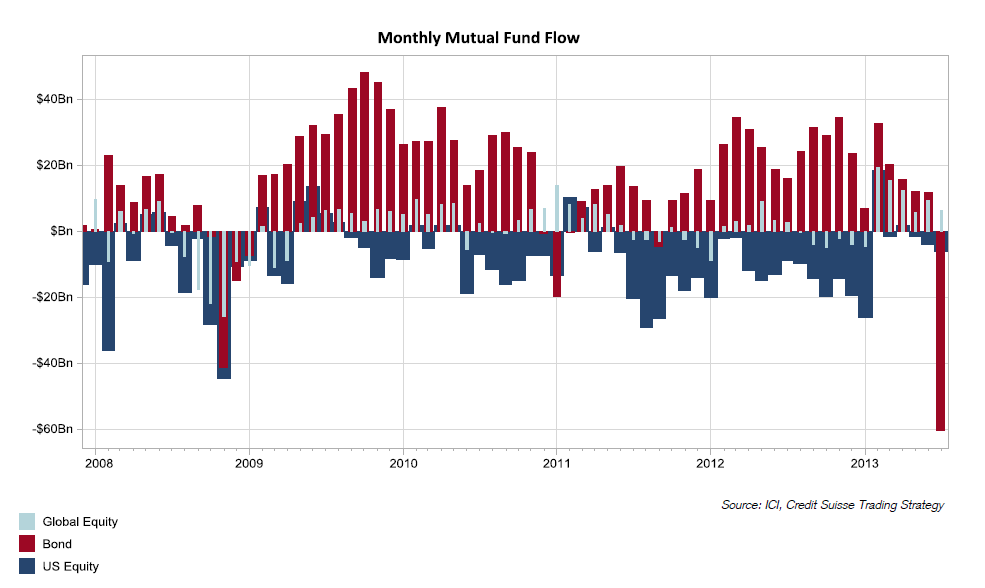
Source: FT Alphaville  |
| An Investor’s View of the World Posted: 08 Jul 2013 11:00 AM PDT |
| Tax Havens Posted: 08 Jul 2013 09:00 AM PDT |
| 10 Monday AM Reads Posted: 08 Jul 2013 07:00 AM PDT My morning reads: • Praying for an Immaculate Rotation from Bonds to Stocks (Barron’s) see also Short Looks Beautiful to Bond Investors (WSJ)
• What Bear Market? Japan Stocks Are Surging Again After Big Fall (Moneybeat)
• Why We Underestimate Risk by Omitting Time as a Factor (Bloomberg) see also Correlation and Causation (Seeking Wisdom)
• The need for less speed (Tim Harford)
• Rock Legends Guides to Eurocrisis (ECR Research)
• A Portfolio That’s as Simple as One, Two, Three (WSJ)
• Do the inflationistas really believe what they say? (Noahpinion)
• The Best $500 Billion the United States Has Ever Spent (Motley Fool/NBC) see also Will Clinton Be Our Eisenhower? (Economic Principals)
• I Don't Care Whether You Trust me; I Won't Add You to my LinkedIn Network (LinkedIn)
• Yes, Kickstarter raises more money for artists than the NEA. Here's why that's not really surprising (Wonkblog)
What are you reading? 2013′s Top Stocks…So Far
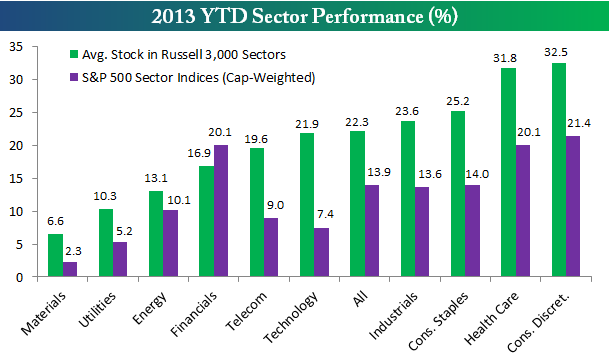
Source: Bespoke  |
| Forecasting the Future is Hard; Forecasting Markets is Even Harder Posted: 08 Jul 2013 04:30 AM PDT Time for an important lesson with someone else picking up the tuition costs: It is the Meredith Whitney story, and it is instructive to those of us who work in finance and occasionally engage the media. Any of you who might think an outrageous call is the way to achieve lasting fame and fortune on Wall Street, Ms. Whitney’s story might be an instructive tale of warning. After a good (but far from unique) downgrade on Citigroup in 2007, Ms. Whitney found herself thrust into the spotlight. The former Oppenheimer analyst launched the Meredith Whitney Advisory Group two years later, with a full staff and 30 top tier blue chip clients. Less than 5 years later, she has lost half her client base, is down to 1 full time employee, and won’t comment to Greg Zuckerman of the WSJ in a story that is about her. I don’t want to pile on — at this point, it would just be cruel — but it might be instructive to see where things went amiss. Anytime we have an opportunity to learn from someone elses mistakes, it is incumbent upon us to do so. What can we learn from Ms. Whitney story? I see five lessons that I would take from her unfortunate experiences: 1. Leveraging a call into a new business is challenging: History is replete with examples of one hit wonders who never turned out any thing beyond that pop song. There are too many to list here in music (Wikipedia arranges them by decade). In finance, some of the names who made a great call, but then failed to follow that are well known. The poster child is Elaine Garzarelli who improbably called the 1987 crash*, only to never repeat that feat or anything like it. Others might put Nouriel Roubini in that camp, but he has created a firm that seems to operational, and regardless seems to have a career otherwise. And who was that copycat analyst who forecast QCOM running to $2000? He tried to take a page from Henry Blodget’s playbook of calling Amazon to $400 — and failed. 2. Media buzz is not a business model: Regardless, these outrageous calls (right or wrong) are not what the VCs would describe as “a sustainable business model.” It generates some buzz, some attention, some media headlines. But the attention span of the American public (and therefor the media) is notoriously short. It’s like a drug with a fast developing tolerance. If you want to stay in the spotlight, you have to take bigger and bigger doses, which in media terms translates into more and more outrageousness. That increases the odds that you will eventually blow up spectacularly. 3. Stick to what you do best: Whitney was a bank analyst, and she (somehow) believed that qualified her to discuss municipal bond finances. Her December 19 2010 call on 60 Minutes — predicting "hundreds of billions of dollars" of municipal defaults within 12 months — failed to pan out. Instead, defaults fell. Bt she rocked the muni bond market, caused headlines for months — even as the prediction was falling flat on its face. She was apparently operating outside of her comfort zone, in a huge market she had little expertise in. The response was not swift but it was savage: Professionals questioned her analysis as well as her motives. (In our ThinkTank, David Kotok repeatedly called her out on her sloppy, sensationalistic non-analyses). Well established muni bond players were deeply offended by her blase disruption of a serious market. She failed to consider that Munis pay for things like roads, and bridges and hospitals and schools. Perhaps a corrollary lesson is “Be wary who you piss off .” 4. Make sure your firm is filled with happy workers: Some of her former staff’s comments in the WSJ article are catty. They complain about her work habits; They note she often is “working” from Bermuda where she owns a home on a resort. These sorts of reveals usually come from an angry and underpaid staff. The people who work for you are the ones who make you look good. If you don’t treat the right, don’t be surprised if they respond in kind (karma is a bitch). 5. Add value to your clients: But the bottom line is her $100,000 annual fee simply did not pay for itself. Not only is that on the high end — more than double what shops like Ned Davis Research charges — it did not seem to create much in the way of actionable or value added work product. Pricey, seemingly useless research is not what the Street needs more of . . .
Developing a sustainable, scalable finance model that adds value to clients should be job one for all new finance start ups. 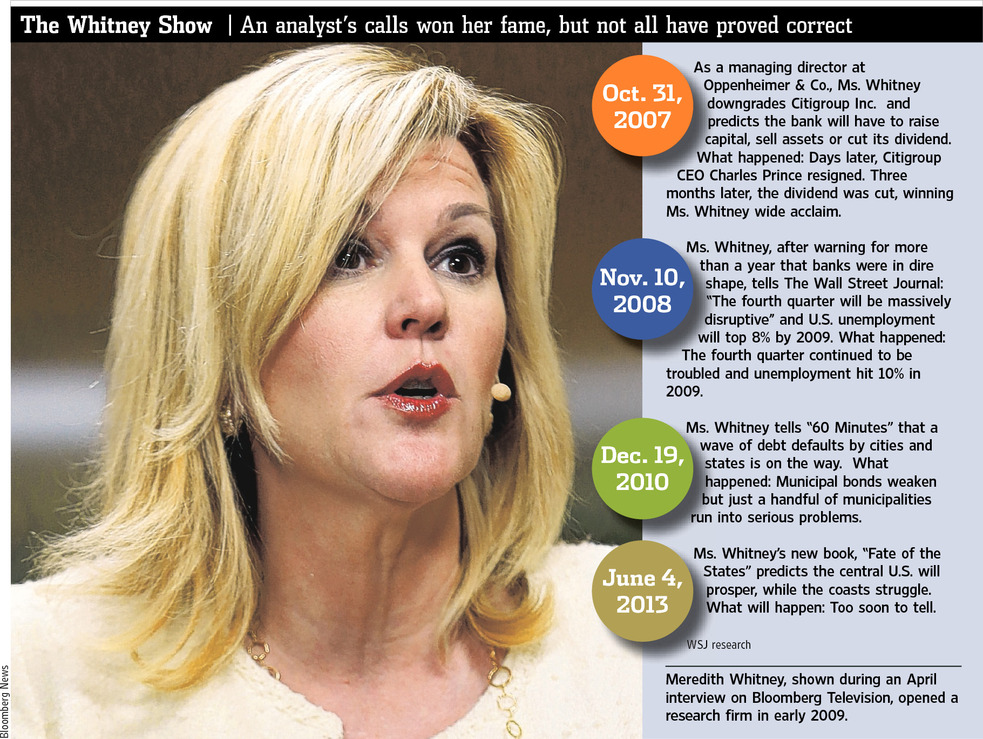
Source:
Clients Come, Go at Research House
Greg Zuckerman
WSJ, July 7, 2013
http://online.wsj.com/article/SB10001424127887323689204578570354180830628.html See also:
How Meredith Whitney Deals with Haters (TRB) ______________ * I am aware that there is a contingency who believe that even that call is suspect.  |
| Institutional Investors Don’t Trust the Exchanges Posted: 08 Jul 2013 03:00 AM PDT Exchanges Live In Glass Houses
Joe Saluzzi, Sal Arnuk
Themis Trading, July 2, 2013 
The head of US Market Regulation for Nasdaq, John Zecca, just published a one page article titled "A Level Playing Field For Surveillance" . In his article, Mr. Zecca is calling for increased surveillance of dark pools. Specifically, Mr. Zecca states: "To ensure overall market integrity, it is critical to subject all trading venues, including regulated exchanges and dark pools, to the same rigorous transparency and market surveillance standards. Because ATSs are not obligated to provide FINRA with full information on their order book activity, FINRA does not receive as much data from dark pools and other ATSs as it gets from exchanges. As a result, there are opportunities to enhance FINRA's surveillance of these market centers. Exchanges must file their operating rules with the SEC, but dark pools only have to provide a description of their order handling process, their customer base and their subscriber requirements. Most regulators agree that the quality of surveillance cannot vary by venue. Transparency and complete information aggregated across markets is the best remedy to protect investors." Considering that almost 40% of stocks trade off exchange, we agree with most of what Mr. Zecca calls for in his article. But at the same time, we can't help but wonder if the rise of dark pool trading was actually caused by the stock exchanges themselves. Many institutional investors are frustrated by the games that currently go on at the exchanges. They are frustrated by the constant penny jumping and flickering quotes that do not provide any real liquidity. They are frustrated by the endless amount of fee changes that exchanges file for to encourage rebate arbitrage in the hopes of increasing their market share. They are frustrated by the seemingly unlimited order type combinations which allow for queue jumping. They are frustrated that information on their own orders is being packaged and sold in exchange proprietary data feeds to HFT traders. To make matters worse, institutional investors feel that they can't trust the exchanges. And why should they. Within the last year, three exchanges have been fined over $20 million by the SEC for regulatory infractions. Rather than seeing exchanges as protectors of their order flow, institutional investors now fear information on their order flow is being leaked by the exchanges. Is it any wonder that institutional investors have turned to dark pools as a way to try to protect their order flow? While we agree with Mr. Zecca and Nasdaq that more surveillance is necessary for dark pools, we also think that their words would carry much more weight if they lead by example and stopped some of the shenanigans that have been going on at the lit venues. Otherwise, as the old saying goes, people in glass houses shouldn't throw stones. - See more at: http://blog.themistrading.com/exchanges-live-in-glass-houses/#sthash.NUODova7.dpuf http://blog.themistrading.com/exchanges-live-in-glass-houses/  |






0 comments:
Post a Comment