


The Big Picture |
- Currency Markets Are Rigged
- League of Denial
- What We Can Learn From These Motivational Quotes
- The Obamacare Portfolio
- 10 Weekend Reads
- Federal Reserve Tools for Managing Rates and Reserves
| Posted: 12 Oct 2013 10:30 PM PDT U.S. Justice Department Opens Criminal Probe Into Currency Market ManipulationCurrency markets are massively rigged. Bloomberg reports today:
(Don't get too excited. The Justice Department has announced it will go easy on big banks, and always settles prosecutions for pennies on the dollar … a form of stealth bailout. It is also arguably one of the main causes of the double dip in housing. Indeed, the government doesn't even force the banks to admit any guilt as part of their settlements.) It's not just currency markets. As shown below, big banks have manipulated virtually every market – both in the financial sector and the real economy – and broken virtually every law on the books. Interest Rates Are ManipulatedInterest rates are rigged:
Derivatives Are ManipulatedThe big banks have long manipulated derivatives … a $1,200 Trillion Dollar market. Indeed, many trillions of dollars of derivatives are being manipulated in the exact same same way that interest rates are fixed: through gamed self-reporting. Oil Prices Are ManipulatedOil prices are manipulated as well. Gold and Silver Are ManipulatedThe Guardian and Telegraph report that gold and silver prices are "fixed" in the same way as interest rates and derivatives – in daily conference calls by the powers-that-be. Energy Markets Are ManipulatedThe Federal Energy Regulatory Commission says that JP Morgan has massively manipulated energy markets in California and the Midwest, obtaining tens of millions of dollars in overpayments from grid operators between September 2010 and June 2011. Commodities Are ManipulatedThe big banks and government agencies have been conspiring to manipulate commodities prices for decades. The big banks are taking over important aspects of the physical economy, including uranium mining, petroleum products, aluminum, ownership and operation of airports, toll roads, ports, and electricity. And they are using these physical assets to massively manipulate commodities prices … scalping consumers of many billions of dollars each year. Everything Can Be Manipulated through High-Frequency TradingTraders with high-tech computers can manipulate stocks, bonds, options, currencies and commodities. And see this. Manipulating Numerous Markets In Myriad WaysThe big banks and other giants manipulate numerous markets in myriad ways, for example:
The Big PictureThe big picture is simple:
|
| Posted: 12 Oct 2013 03:00 PM PDT • Frontline's landmark 'League of Denial' (Columbia Journalism Review) |
| What We Can Learn From These Motivational Quotes Posted: 12 Oct 2013 01:00 PM PDT
by Nicole Elmore on May 10, 2013 This presentation was created by Nicole Elmore, Business Consultant & Marketing Strategist |
| Posted: 12 Oct 2013 06:30 AM PDT On Investing: The Obamacare portfolio
Investors are best off when they leave their party affiliation and partisan views behind. I've said it before: "Washington, I'm here to tell you, politics and investing don't mix. Your politics are killing you in the markets." Keeping your emotions — those primitive, thoughtless impulses — out of your portfolio has been a consistent theme of mine. Lately, that theme has reasserted itself over the issue of the Affordable Care Act, also known as Obamacare. Regardless of your views of this legislation, if you want to be a successful investor, you must find a way to approach the process objectively. I don't care if you are Sen. Ted Cruz and that in your day job you believe that the law is a job killer, the bane of the economy or the worst legislation the country has produced. When it comes to managing your portfolio, you need a cool objective approach. I'll give you three reasons: macro, psychology and opportunity costs. We start with macro, or the strategy of investing based on political and economic trends across countries. Making specific investments from a 30,000-foot view is exceedingly difficult. There are myriad moving parts, all of which interact with the economy and corporate profits in a complex and unpredictable way. Elements can change suddenly. Politics are fluid, alliances constantly shifting and public opinion malleable. The political macro analysis often turns out to be less of a true investing idea and more of wishful thinking. Former International Monetary Fund economist Mark Dow has pointed out that even the best hedge fund managers using the macro approach have done poorly. We call this the curse of the macro tourists, in which formerly talented fund managers ignore valuation and earnings data to build an investment thesis around big macro themes. There are simply too many unknowns and, to be blunt, way too much cognitive bias for this strategy to succeed these days. Indeed, emotional investing is rarely successful. Anyone with an intense emotional interest ignores data and facts that disagree with their views. The brain's tendency to more easily forget that which we disagree with also works to fool these folks. Cognitive bias is a source of systematic errors to investors of all political persuasions – and it leads to under-performance. Advice for Ted Cruz Regardless of Cruz's fiery oratory or partisan affiliation, after a long day of standing on his feet (21 hours!), when he sits down to review his portfolio, he should put his politics aside for the sake of objectivity. If you want to be smart investors you should consider all aspects of how the insurance mandate of law will affect different sectors of the economy (including the companies within those sectors). This is simply an objective approach. When the health-care law was passed, my team did just that: We sat down to discuss exactly what impact it might have. Not the politics or the electoral implications, but what result this was likely to have in the real world. We came to several conclusions:
What's that you say? Hospitals are mandated to give away free services? Yes. In response to some earlier bad behavior from hospitals called "patient dumping," a mandate for unfunded medical care was created and signed into law by President Ronald Reagan in 1986. The Emergency Medical Treatment and Active Labor Act (EMTALA) said, "Hospitals provide care to anyone needing emergency healthcare treatment regardless of citizenship, legal status or ability to pay." That's right, Reagan created a universal coverage mandate, forced the private sector to pay for it, thereby creating the world's most expensive, least efficient health-are program. Hospitals hated it, the poor and indigent took advantage of it, and prices were jacked up in response to it. Eventually, the costs spread to everyone else. Given that history, it is no surprise that hospitals were quietly pleased with Obamacare. After the Supreme Court ruled on the legality of the new rules in June 2012, hospital stocks rallied. It should come as no surprise: They get to remove a huge cost that they had no ability to control. They also get a massive number of new paying customers. And they now have some control over who their patients will be. So we considered all of these issues objectively. Once we put aside our emotions, the investments were obvious. If I could have sat with Cruz three years ago, here is what I would have suggested that he do with his portfolio:
Regardless of your viewpoint, the broad Healthcare Index has done well since the March 2009 lows — and has done nothing but go up since the Supreme Court's ruling on Obamacare. The politics of Obamacare are complex, confusing and partisan. The investing theses — and results — have been anything but. ~~~ Ritholtz is chief investment officer of Ritholtz Wealth Management. He is the author of "Bailout Nation" and runs a finance blog, the Big Picture. Follow him on Twitter at @Ritholtz. |
| Posted: 12 Oct 2013 04:00 AM PDT My longer form, Saturday morning, weekend reads:
What are you doing this weekend?
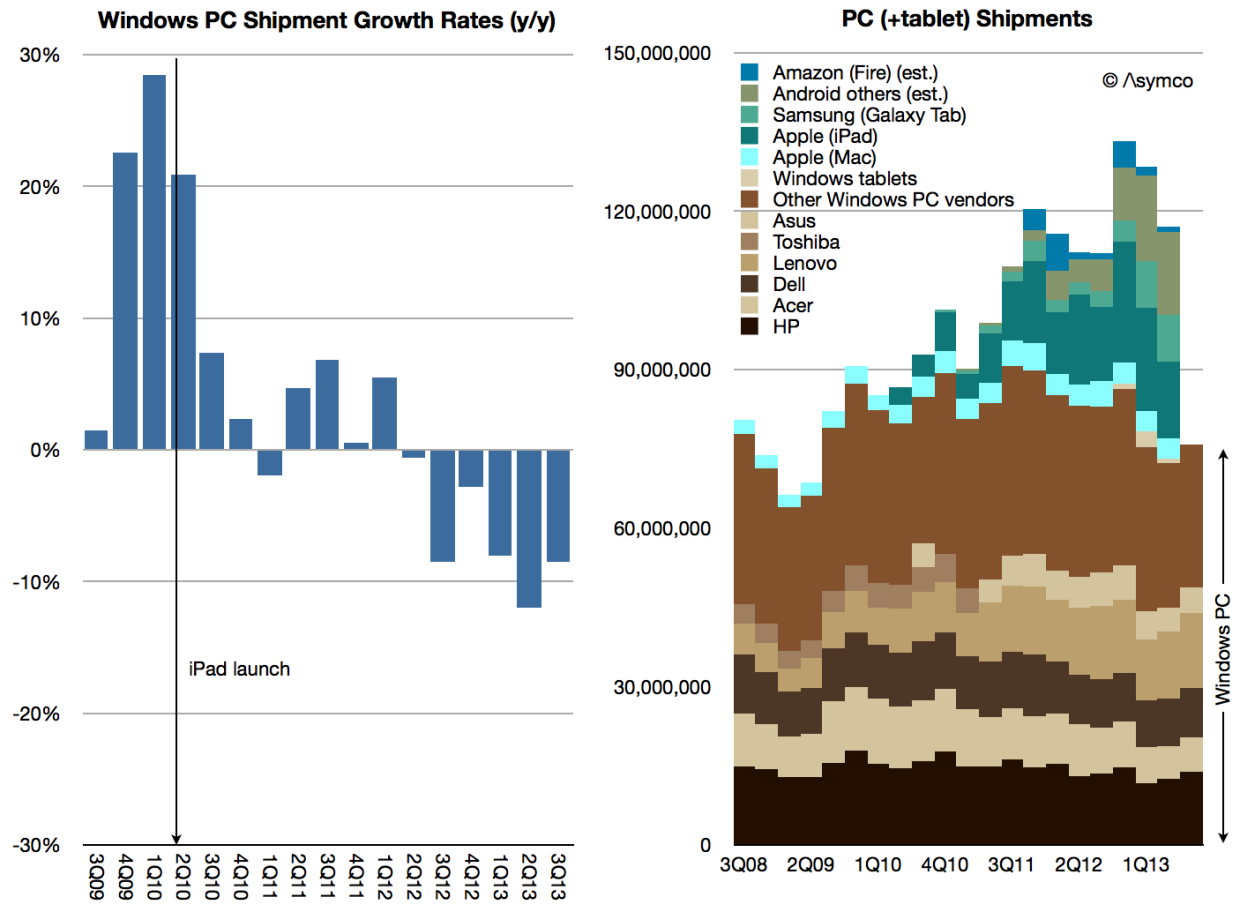
PC Shipments versus PC + Tablet Shipments
|
| Federal Reserve Tools for Managing Rates and Reserves Posted: 12 Oct 2013 02:00 AM PDT |
| You are subscribed to email updates from The Big Picture To stop receiving these emails, you may unsubscribe now. | Email delivery powered by Google |
| Google Inc., 20 West Kinzie, Chicago IL USA 60610 | |



0 comments:
Post a Comment