


The Big Picture |
- How Bad Was It? The Costs and Consequences of the 2007–09 Financial Crisis
- Privacy and Civil Liberties Oversight Board Says NSA Spying Is ILLEGAL AND UNNECESSARY
- 10 Thursday PM Reads
- If Company Market Caps = Countries’ Listed Firms
- The Bull Market Ends (or Is It Just a Correction?)
- 10 Thursday AM Reads
- Winnipeg: 45 Below 0°F
| How Bad Was It? The Costs and Consequences of the 2007–09 Financial Crisis Posted: 24 Jan 2014 02:00 AM PST |
| Privacy and Civil Liberties Oversight Board Says NSA Spying Is ILLEGAL AND UNNECESSARY Posted: 23 Jan 2014 10:30 PM PST Privacy and Civil Liberties Oversight Board – Which Congress Made An Independent Agency in 2007, But Which Just Became Operational – Says NSA Spying Is ILLEGAL AND UNNECESSARYMajor New Voice Slams NSA SpyingExperts – including congress members say that the NSA's spying program is illegal. Officials in the legislative, judicial and executive branches of government all say that the mass surveillance on Americans is unnecessary:
A major new voice has just weighed in to agree: the Privacy and Civil Liberties Oversight Board, which Congress made an independent agency in 2007, and which only recently became fully operational. As the New York Times reports:
|
| Posted: 23 Jan 2014 02:30 PM PST My afternoon train reading:
What are you reading?
Nest Becomes Google’s Latest Billion Dollar Acquisition
|
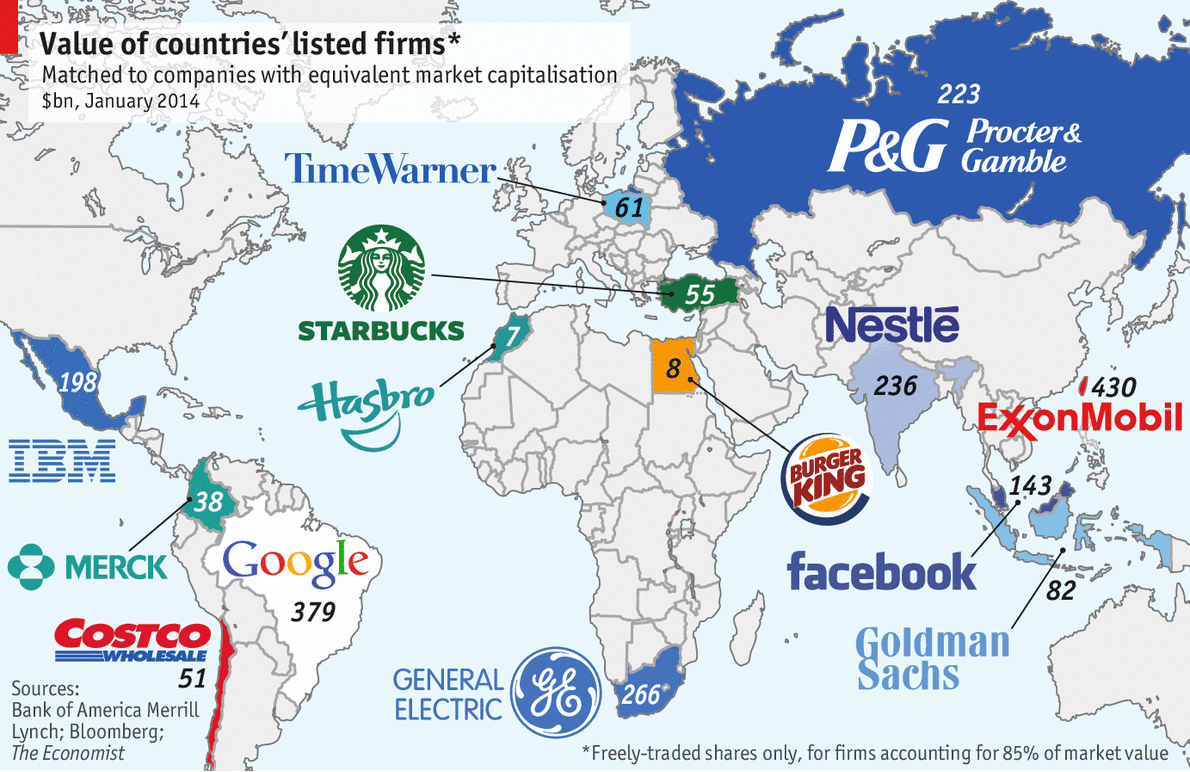
| If Company Market Caps = Countries’ Listed Firms Posted: 23 Jan 2014 11:30 AM PST This map matches the value of an entire countries' listed firms (in total) versus the cap of a single company.
|
| The Bull Market Ends (or Is It Just a Correction?) Posted: 23 Jan 2014 09:00 AM PST We awoke this morning to see futures deep in the red. Over the past two weeks, markets seem indecisive, unable to make much progress. Lots of days began with positive trades, only to roll over and fall into losses. Several days that began in the red closed negative, though usually off their worst levels. Last week's big ugly Monday is still fresh in many traders' minds. Might this be the start of the long-awaited, overdue correction? There certainly have been plenty of catalysts that could hasten a 10 percent drop or worse. Earnings season has begun rather inauspiciously. There have been several high profile disappointments — IBM, Best Buy, Intel and Citigroup come to mind. On the other side of the world, China is slowing, with January manufacturing Purchasing Managers’ Index falling to a 6-month low and breaking 50 (49.6). New orders, exports, employment and backlogs all showed declines. On top of that, HSBC reports that China continues to face a cash shortage within its financial system (why does that sound so familiar?). All this takes place against the backdrop of the U.S. Federal Reserve taper. The first step toward removing the bond-buying program was put into place last month, with the next step possibly coming as soon as the two-day Open Market Committee meeting next week. An unusually accommodative monetary policy is beginning to come to the natural end of its unnatural life. Indeed, the degree of stimulus has been so enormous that it might take three full years or even longer to fully unwind it. Congress has exhibited no interest in post-recession fiscal stimulus — unlike in prior recessions -– so perhaps the FOMC 's slow withdrawal is a mixed blessing.
|
| Posted: 23 Jan 2014 06:30 AM PST Good morning. My morning train reading:
|
| Posted: 23 Jan 2014 04:00 AM PST Exactly one year ago today, I thought it might be fun to speak at a CFA conference in Winnipeg. In January. In the least hospitable major city in North America that is not in Alaska. Read this: See also: An investor’s worst enemy? Their brain (The Globe and Mail) |

| You are subscribed to email updates from The Big Picture To stop receiving these emails, you may unsubscribe now. | Email delivery powered by Google |
| Google Inc., 20 West Kinzie, Chicago IL USA 60610 | |



0 comments:
Post a Comment