


The Big Picture |
- The 2009 Recovery Act: Directly Created and Saved Jobs Were Primarily in Government
- The Hidden History of Mass Surveillance
- How Brain Electro-stim Improves Cognitive Functions
- A 100-Year Legacy of World War I
- A Matter of Time (and Distance)
- 10 Sunday Reads
- Kiron Sarkar’s Weekly Report 28th June 2014
- What Is the St. Louis Fed Financial Stress Index?
| The 2009 Recovery Act: Directly Created and Saved Jobs Were Primarily in Government Posted: 30 Jun 2014 02:00 AM PDT |
| The Hidden History of Mass Surveillance Posted: 29 Jun 2014 10:30 PM PDT What Americans Need to Know About the History of Spying
Americans are told that we live in a "post-9/11 reality" that requires mass surveillance. But the NSA was already conducting mass surveillance prior to 9/11 … including surveillance on the 9/11 hijackers. And top security experts – including the highest-level government officials and the top university experts – say that mass surveillance actually increases terrorism and hurts security. And they say that our government failed to stop the Boston bombing because they were too busy spying on millions of innocent Americans instead of focusing on actual bad guys. So why is the government conducting mass surveillance on the American people? 5,000 Years of History Shows that Mass Spying Is Always Aimed at Crushing DissentFor thousands of years, tyrants have spied on their own people in order to crush dissent. Keith Laidler – a PhD anthropologist, Fellow of the Royal Geographical Society and a past member of the Scientific Exploration Society – explains:
The Encyclopedia of Espionage, Intelligence and Security notes:
The BBC notes:
The U.S. Supreme Court noted in Stanford v. Texas (1965):
By "libel", the court is referring to a critique of the British government which the King or his ministers didn't like … they would label such criticism "libel" and then seize all of the author's papers. The Supreme Court provided interesting historical details in the case of Marcus v. Search Warrant (1961):
And see this. General warrants were largely declared illegal in Britain in 1765. But the British continued to use general warrants in the American colonies. In fact, the Revolutionary War was largely launched to stop the use of general warrants in the colonies. King George gave various excuses of why general warrants were needed for the public good, of course … but such excuses were all hollow. The New York Review of Books notes that the American government did not start to conduct mass surveillance against the American people until long after the Revolutionary War ended … but once started, the purpose was to crush dissent:
The East German Stasi obviously used mass surveillance to crush dissent and keep it's officials in check (and falsely claimed that spying was necessary to protect people against vague threats.) In 1972, the CIA director relabeled "dissidents" as "terrorists" so he could continue spying on them. During the Vietnam war, the NSA spied on Senator Frank Church because of his criticism of the Vietnam War. The NSA also spied on Senator Howard Baker. Senator Church – the head of a congressional committee investigating Cointelpro – warned in 1975:
This is, in fact, what's happened … Initially, American constitutional law experts say that the NSA is doing exactly the same thing to the American people today which King George did to the Colonists … using "general warrant" type spying. And it is clear that the government is using its massive spy programs in order to track those who question government policies. See this, this, this and this. Todd Gitlin – chair of the PhD program in communications at Columbia University, and a professor of journalism and sociology – notes:
Mass surveillance is also being conducted to stop peaceful boycotts. Glenn Greenwald notes that the list of people targeted for mass surveillance by the American government have included:
And the head of the NSA's digital communications surveillance program, a high-level NSA executive, the NSA whistleblower who was the source of the New York Times' groundbreaking expose on spying and Edward Snowden have all said that NSA spying is about crushing dissent … not protecting us from terrorists. A Key Characteristic of FascismNaomi Wolf notes that mass surveillance is one of the 10 key characteristics of fascism:
The Constitution Society points out:
Glenn Greenwald writes:
Even the quintessential defender of the status quo for the powers-that-be – Cass Sunstein – notes that benevolent rulers don't need to spy on their own people like tyrants do:
End Note: For ease of reading, we deleted the footnotes from the two Supreme Court opinions. |
| How Brain Electro-stim Improves Cognitive Functions Posted: 29 Jun 2014 05:00 PM PDT |
| A 100-Year Legacy of World War I Posted: 29 Jun 2014 02:00 PM PDT Click for full coverage. |
| A Matter of Time (and Distance) Posted: 29 Jun 2014 09:00 AM PDT @TBPInvictus here:
A quick note on where I think technology might take us in the very near future. We’re well into the age of electronic toll collection systems (E-ZPass, etc.), the convenience of which is indisputable. These systems provide users with electronic tags – mounted on windshields and associated with specific vehicles – that register their passage through tolls and automatically deduct the appropriate amount from a prepaid account. The downside of this technological advance has been the virtual elimination of the job of “toll collector.” (I tried to scrounge up an employment series for “Collector, Toll,” but it seems BLS doesn’t drill down quite that deep, and “Cashier” is way too broad a category. I will update this post should I find the data.) One local bridge no longer has any toll collectors whatsoever. Payment is made either via E-ZPass or “Toll by Mail,” a process by which a photo of the vehicle’s license plate is snapped and a bill subsequently mailed to the registered owner. Traffic flows very smoothly and there are rarely delays. Back to the electronic toll collection system: The system registers your entry and exit points along with the time of entry and exit; these are always detailed on your monthly statement. So: You enter the thruway at Point A and exit at Point B. Let’s say it takes you one hour to travel the 85 miles from Point A to Point B. You see where this is going? The system is already in place to determine – very easily, in fact – whose average speed exceeded the lawful limit and by how much. A citation could subsequently be issued. The use of electronic toll collection systems as a tool for law enforcement – and deterrent – purposes is simply a matter of time and, well, distance. As with the now-ubiquitous red-light cameras, no points could be assessed on these violations, as it would be virtually impossible to determine who was behind the wheel. My guess is that no one would trade off the convenience of E-ZPass for the opportunity to speed with impunity and immediately lose all that “saved” time sitting in a queue waiting to pay the toll. The benefits here are twofold (in order of importance):
It’s obvious, of course, that this concept would, in one broad stroke, cover thousands of miles of highways, whereas a stationary trooper sitting roadside with a radar gun has much more limited efficacy. I am most definitely, most vehemently, against government surveillance and intrusion into our lives. I am, however, for increased highway safety and minimizing the senseless loss of life on our roadways. Secondarily, speeding costs our economy over $40 billion/year (2004 data). There will be some challenges if/when my vision becomes reality. But they will be beaten back and the state, as it usually does, will prevail. Very uncharacteristically, I’ll be okay with that in this case. Update: Seeing some comments about various ways in which the scheme I laid out can be defeated, and they’re valid. However, let’s not make the perfect the enemy of the good. Sure, there are always work-arounds, and no system is ever flawless. That said, I do think this will ultimately be deployed and will ultimately be effective in achieving its objective. |
| Posted: 29 Jun 2014 06:00 AM PDT Pour a cup of coffee, butter that bagel, and cozy up with my Sunday morning reads:
What are you reading?
Has the developed world stopped waging trade wars?
|
| Kiron Sarkar’s Weekly Report 28th June 2014 Posted: 29 Jun 2014 04:00 AM PDT The Japanese PM announced details of his plans to stimulate economic growth. Whilst highlighting the key issues which need to be addressed, his proposals were sketchy, with a lack of concrete measures and unlikely to result in stronger growth anytime soon. Chinese June PMI was better than expected, reflecting mainly, I believe, the increase in spending by the government. However, with spending brought forward into H1, the question remains as to what happens in the 2nd half of the year. The government is hoping that the economy will pick up, though I suspect that it will have to increase its stimulus programme. In a reversal from previous comments, Mr Carney, the governor of the Bank of England (BOE), tried to dampen down the prospect of an early rise in interest rates, stating that there was still slack in the system, as wage increases were lower than expected. However, real wages are expected to increase and I suspect that UK interest rates will have to be raised sooner than the BoE would prefer, most likely in Q1 2015, though late this year is a possibility if the economic data remains strong. Sterling dipped following Mr Carney's comments, though I believe will remain firm in coming months, in particular against the Euro. There is a possibility that the EU will increase sanctions against Russia next week. Germany seems to be pressing to impose sanctions on Russia unless it implements a peace plan by Monday 30th June. Italy is opposed to additional sanctions. With the continued problems in Iraq, geopolitical risks are increasing. These risks are impacting Europe more so than the US. US housing data continues to improve, following the slow, though weather affected, earlier months this year. Consumer confidence is also improving, as unemployment declines. I continue to believe that the US economy will recover strongly from the particularly weak Q1 GDP reading and that the US$ will strengthen, in particular against the Euro. In addition, I suspect that inflationary pressures are being underestimated and that the FED will have to raise rates earlier than currently anticipated by markets. Admittedly, consumer spending is not as robust as anticipated, though should pick up during the year. US bond yields closed lower on the week, with the 10 year at 2.53%. The much weaker revised Q1 GDP data, together with weaker than expected personal spending and increased geopolitical risks contributed to the decline in bond yields. US Existing home sales rose by +4.9% in May to an annualised rate of 4.89 mn, better than the annualised rate of 4.65 mn in April and the forecast of 4.73 mn homes. Housing data is improving from a slow start this year. US May durable goods orders declined by -1.0%, worse than the unchanged level expected and the increase of +0.6% in April. However, orders ex defense and aircraft, a better reflection of business spending, increased by +0.7%, as opposed to a decline of -1.0% in April and better than the rise of +0.5% expected. Importantly, the report indicated that inventories are being rebuilt which will be positive for Q2 GDP. Consumer confidence rose to 85.2 in June, higher than May's revised 82.2 and the forecast of 83.5. It is the highest reading since January 2008. Both the current situation and future expectations components improved. Personal incomes rose by +0.4% in May, in line with expectations, whilst personal consumption expenditures (PCE) rose by just +0.2%, below the rise of +0.4% expected. The price index for PCE increased by +0.2%, the same as in April. Excluding food and energy, the FED's preferred measure for inflation, the core PCE index rose by +0.2% or +1.5% Y/Y. The US will allow the export of ultra-light crude oil for the 1st time in 40 years. 2 companies were granted export permits and shipments may start as early as August. Initial jobless claims came in at 312k, slightly below the previous weeks 314k. The 4 week moving average was 314.25k as opposed to 312.25k. Europe The particularly disappointing French data reconfirms the serious problems affecting the country and with no indication of a solution at present. The government’s forecast of GDP growth of +1.0% this year look particularly optimistic, as does its budget deficit estimate of 3.8% of GDP. Interestingly, the EZ PMI data suggests that disinflationary pressures are easing and that input prices are rising at the fastest rate since last November. German CPI increased to +1.0% Y/Y in June, up from +0.9% Y/Y in May. Mr Draghi has hinted that the ECB will keep interest rates at low levels until the end of 2016. He stated that banks will have access to unlimited liquidity until the end of 2016, which should be taken as a signal by markets. (Source Bloomberg). The German business confidence index (the IFO index), declined to 109.7 in June, its lowest level this year and down both from 110.4 in May and the forecast of 110.3. The current conditions component was unchanged at 114.8, though the expectations component declined for a 2nd month to 104.8, down from 106.2 in May. The German economy is expected to slow appreciably this Q, though recover in Q3. The domestic economy, together with construction, remains strong. EZ consumer and business confidence declined to 102 in June, from a revised 102.6 in May and below the rise to 103 expected. Increased tensions in the Ukraine, combined with the strength of the Euro were cited as the main reasons for the decline. Mr Carney, the governor of the BoE, suggested that there was more spare labour capacity than thought previously, which has accounted for the lower than expected wage increases. However, he expected real wages to rise in coming months, as unemployment continues to decline. Mr Carney's comments suggest that the BoE is reluctant to raise interest rates too early. However, the BoE remains concerned about large property price increases, which they state was due to a lack of supply of housing. Sterling declined following his comments. In an attempt to curb home price increases, the Financial Policy Committee of the BoE has imposed certain curbs on mortgage lending, though the restrictions were not as great as was anticipated. As requested by Mr Putin, Russian lawmakers voted overwhelmingly to cancel the option to use force in the Ukraine to support pro Russian separatists. The Ukraine, Georgia and Moldova have signed partnership agreements with the EU, which bind the 3 countries more closely economically and politically to the EU. The agreement is certainly not one that Russia wanted and Mr Putin has warned of grave consequences. The EU has set Russia a deadline of 30th June to implement a peace plan in eastern Ukraine or face increased sanctions. Japan CPI, excluding fresh food, rose by the fastest rate in 32 years, exclusively due to the sales tax increase in April. Core CPI was up +3.4% Y/Y in May, in line with estimates. May household expenditure declined by -8.0% Y/Y, as a result of the sales tax rise and higher inflation, whilst wages are not being increased to compensate for the higher prices. Wages, excluding overtime and bonuses, fell for the 23rd month in April. China Kiron Sarkar |
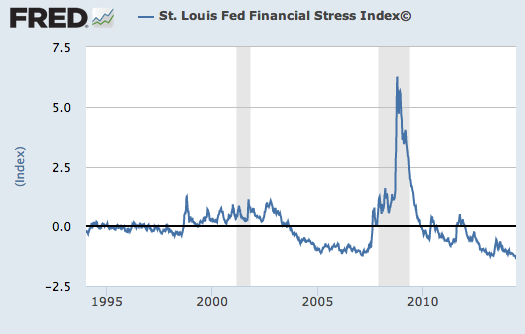
| What Is the St. Louis Fed Financial Stress Index? Posted: 29 Jun 2014 02:00 AM PDT For the week ending June 6, the St. Louis Fed Financial Stress Index (STLFSI) rose to -1.256 from -1.289. The latter is currently the lowest level on record for the index, which goes back to December 1993. The recent increase in the index was the first in the past five weeks, and the index has been below zero for more than two years (127 weeks). But what does all of this mean?
In the aftermath of the financial crisis, arguments arose over how to monitor financial market developments, with measurement of "stress" in the market being a likely requirement of any regulator engaging in such monitoring. However, there are many ways to monitor financial stress. For example:
In an attempt to avoid focusing on a single indicator at the expense of others, economists and analysts created composite indexes of several of these indicators. In early 2010, the St. Louis Fed created the STLFSI, which uses 18 weekly data series to measure financial stress in the market. Weekly series are used to have a more "real-time" index to measure rapid changes in the market. However, the tradeoff of having a higher-frequency index is greater volatility and potentially more noise. The STLFSI is constructed from seven interest rate series, six yield spreads and five other indicators.1 Each of these variables captures some aspect of financial stress. Accordingly, as the level of financial stress in the economy changes, the data series are likely to move together. How should the index be interpreted? The average value of the index, which begins in late 1993, is designed to be zero. Thus, zero is viewed as representing normal financial market conditions. Values below zero suggest below-average financial market stress, while values above zero suggest above-average financial market stress. Each week, the St. Louis Fed provides a news release based on the STLFSI. The news release includes details for the following:
Notes and References 1 See the STLFSI Key for a list of data series used in the index. For more details on the construction of the STLFSI, see the appendix to the January 2010 issue of the St. Louis Fed's National Economic Trends. Source: Federal Reserve of St. Louis |


| You are subscribed to email updates from The Big Picture To stop receiving these emails, you may unsubscribe now. | Email delivery powered by Google |
| Google Inc., 20 West Kinzie, Chicago IL USA 60610 | |



0 comments:
Post a Comment