


The Big Picture |
- Higher Education: Are you ready for the next frontier?
- Mad Max: Fury Road
- 15 Rules for Spotify
- What if You Were the World’s Greatest Trader® ?
- 10 Weekend Reads
| Higher Education: Are you ready for the next frontier? Posted: 03 Aug 2014 02:00 AM PDT |
| Posted: 02 Aug 2014 05:00 PM PDT Coming in 2015 |
| Posted: 02 Aug 2014 01:00 PM PDT 1. You will delete your MP3s. Just like you tossed your 8-tracks and cassettes, you’ll get rid of your MP3s, all your iTunes purchases, kaput, evaporate, just like that. It will happen when you get a new computer, which isn’t as frequent as before, but the truth is we’re moving to flash storage and it’s more expensive and you get less and you haven’t got room for your music files, never mind the inclination to listen to them. Just like you wanted the biggest iPod but are satisfied with the smallest iPhone, you won’t find it necessary to pay extra for more flash storage even when the price comes down, whether it be in computers or mobile handsets. Because everything will be stored in the cloud or delivered to you when requested. Hoarding MP3s is like hoarding hieroglyphics, who wants an ancient format no one can read? Especially when it’s just bits and bytes! Eighteen years, that’s how long a format lasts. LPs… 1964, the advent of the Beatles, to 1982, the advent of the CD. The CD… 1982 to 2000, when usurped by the MP3. MP3s? By 2018 they’re HISTORY! 2. Plays will be the metric. Just like radio shifted to spins, how much someone listens to your music will be the only thing that’s important, furthermore, listens get you paid. This will be a revolution, a good one, the SoundScan era is history, sales charts make no sense. Companies ramp up the publicity for an initial sales week that media publicizes, all to do it again the next week for new records. This reduces the chances of something sticking. Whereas when plays becomes the metric, we’ll instantly see what has stuck. Just because it was released last week or six or nine months ago, it won’t matter, because we’ll see people are actually playing it. And that which is heavily-hyped but left unplayed…beware. 3. Media will promote spins. Yahoo already lists the top ten Spotify tracks every week. In the future, a media outlet will still talk about number one, but not how many albums or digital singles were sold, but how many plays it got. It’ll be like YouTube, on Spotify there’s a counter too, you can see how you stack up. Suddenly data is not hidden, it’s there for all to see. And the truth will be that the blockbuster era will continue. We’ll see huge winners and a sea of also-rans. We’ll be on the outlook for that which is making huge gains. It will all be based on data, as opposed to today’s smoke and mirrors. 4. Payouts will be high. It’s all about scale. Once we wean everyone from MP3s, once everybody pays for music, whether it be monthly or baked into the subscription, a huge pot of money will be generated, 69% of which will go to rights holders. So, if you’ve got an ancient, poor-paying label deal, the company will get most of it. If you’re striking a new major label deal…think about what you’re giving up, recorded music revenue, in exchange for the company’s ability to spend and muscle and make you a star. You can stay independent and keep all the money, but your chance of rising above is diminished, especially in this world of overwhelming input. 5. It’ll be mobile. Spotify develops for mobile first. Not only will you have a smartphone, chances are it will be large, because it will be your primary screen, where you shop and dial-up your music, you want to be able to see and make sense. Think of your handset as the new iPad, just a little bit smaller. 6. Discovery will be in the Spotify app. It’s all about the real estate, you don’t want to jump around. You’ll roam around Spotify the same way you roamed around the record store, but inventory will be much greater and access will be instant. If your company is a recommendation engine not aligned with a streaming service, good luck! 7. Pandora survives. Or is bought and merged. But if it survives, its impact will be marginalized over time, because we live in an on demand world, the future is on demand, not wait and see. Pandora is too valuable to be purchased by Spotify. And it’s hobbled not only by royalty payments, but the fact it’s not worldwide. In other words, you might love Pandora the way you loved your BlackBerry, as in temporarily. 8. iHeart Radio stalls. It’s not on demand. As for listening to your terrestrial station on the Internet… Pandora eclipses that, there are fewer commercials. Clear Channel’s digital play is not revolutionary enough, it was billed as a Pandora killer when Pandora was not the correct target. 9. Passive listening. That’s what radio is. Spotify’s got a component. There’s a market for that. But not run by algorithms, but people. Which is why SiriusXM is so successful, all those people paying to get rid of commercials on their music stations (as well as Howard Stern.) In other words, Clear Channel is in a bind. Promoting a legacy system without legs. If you don’t think terrestrial radio will be diminished, you’re still listening to AM. 10. You will share Spotify playlists. We live in a sharing economy. You’ll send songs. This is a good thing, this is how we break bands. And inboxes won’t be cluttered-up with MP3s, waiting for them to download, eating up space, getting lost in spam folders, however expect to be spammed by wannabes, just like they have done forever in the Internet era. 11. Sound quality will improve. It’s all about bandwidth. And LTE is faster than many people’s home connection. And mobile providers are already pondering an even faster generation. The faster the bandwidth, the fatter the pipe, the higher the quality. Remember, there was no YouTube before broadband. 12. Data charges are irrelevant. Not only did T-Mobile just obviate them for music services, Spotify synchs all playlists so no signal is needed, the “streams” live on your handset, just like files. So even if you’ve got no cell signal, you’ve got your music. 13. It’s not about Spotify. It’s about streaming. Google’s new service could be the winner, but let’s hope not, because it pays less. Or maybe a reinvigorated Apple Beats. One thing is for sure, one service will dominate, it’s where we’ll all go, because we want to share, we don’t want to be left out. So you might like Rdio or Deezer, but if you send a link and someone can’t play it, that’s not gonna work. 14. Exit strategy. Just like Apple bought Beats, Facebook or Google or Amazon or even Microsoft might by Spotify. Don’t forget, Google bought Motorola and Microsoft bought Nokia. If you can’t compete, you buy. 15. Bottom line. Don’t get depressed, it’s all about the music. Make a good tune and these services are your bitch. They allow you to reach the whole world instantly. And if you haven’t, maybe you weren’t meant to. Maybe you’re not that talented, maybe you make niche music. But as people see what succeeds, it will spark their creativity. They’ll see the high standard, they’ll see what’s left field that breaks through. The only problem we have today is everyone’s got a voice, and those who don’t win complain, whereas we didn’t used to hear from them. Ignore them. Focus on the winners. Spread the word about them. And know that if your identity is based on liking something no one else does, chances are you’re going to live a very lonely life.
~~~ – |
| What if You Were the World’s Greatest Trader® ? Posted: 02 Aug 2014 07:00 AM PDT So you're the world's greatest trader®? Taxes will fix that.
Imagine the following: You, the investor, believe you have an uncanny skill at picking stocks. You set up an online trading account and begin to buy and sell. As it turns out, you are quite good. You pour more money into your brokerage account and up your trading. After the first year, you look at your results: You have trounced the indexes. You snicker at your friends who invest passively in low-cost, low-turnover indexes. You keep at it, year after year trouncing the Standard & Poor's 500-stock index. Over the long haul, you beat that benchmark substantially — in some years, you gain 30, 40, even 50 percent more than the SPX gains. You track your returns in a spreadsheet to see just how well you have done. Over 24 years, you tally up gains and losses. The markets are up, on average, about 9.3 percent annually. You, the World's Greatest Trader®, do much better — 40 percent better. That's better than most of today's hedge funds. It is certainly better than most average mom-and-pop investors. How did you do vs. your friends the passive indexers? About the same. Wait, how on Earth is that possible? You trounced the indexes, you crushed the benchmarks, you are the greatest! How could this possibly happen? In a word, taxes. Traders pay a healthy tax of 30 percent or more on short-term capital gains. (See spreadsheet at right). Effectively, you lose the benefits of compounding on one-third of those gains. Over time, this has a tremendous impact on your net returns. Imagine that 24 years ago, your best friend invested $10,000 in the S&P 500 and held on through last year. He would have amassed $76,266. That number includes taxes paid annually on whatever dividends came his way at the highest taxable bracket. Compare that with you, the World's Greatest Trader®. Had you put that $10,000 into a trading account that same year and annually crushed the S&P 500 by 400 basis points, you would have amassed an after-tax return of only $69,197. In other words, your passive-index buddy would have beaten you, the World's Greatest Trader®, by about 10 percent. (Note that I am ignoring all of your trading costs.) Now imagine the same sort of trading account; only this time, add in a retail stockbroker's commission. The outcome is utterly absurd. (How are any of these folks still in business?) The number-crunching for this analysis comes from Michael Batnick, whose blog is (humbly) called the Irrelevant Investor. He is also, not coincidentally, my firm's director of research. When he first ran the numbers, he spent a few hours scratching his head in astonishment. We tried hard to pick holes in it. Sure, it's well established that passive beats active most of the time before taxes. Once we added in the big slice of the pie to Uncle Sam, active trading began to look downright silly. Makes you wonder why anyone would engage in such a ridiculous hobby! How can the big boys do this? Mutual firms and hedge funds have a huge advantage that you, the individual investor, do not. They are a business. As such, they pay taxes on their total net gains. Losing trades offset winning trades dollar for dollar. Their investors also pay taxes on their net returns (not on each winning trade). This is why they can get away with this sort of active trading. Their tax bite is much, much smaller. As an individual investor, you get to carry forward a grand total of $3,000 a year in losses to offset those gains. Sizable portfolios in the 2008-2009 crash lost millions of dollars. Folks who sold at the bottom in 2009 lost anywhere from 40 to 60 percent. They'd better watch their blood pressure and cholesterol if they want to carry those financial crisis losses forward for the next 150 years or so. Long-term investors who use an asset-allocation model have another advantage over active traders: tax-loss harvesting. It's a product of the latest software innovations. Even when it was being done previously (which it often wasn't), it was an inefficient act of guesswork, as well as a commission-generating sales tool. Today, it's a precise process to efficiently capture tax losses at the touch of a button. How it works: Any asset-allocation portfolio will see various asset classes gain and lose relative to their model weighting (e.g., 60/40 stocks and bonds). It's a good idea to rebalance quarterly. Rebalancing back to your original weightings has been shown to add 75 to 150 basis points of additional returns over the long term, at no additional cost or risk. It is the closest thing to a free lunch that Wall Street has to offer. Thanks to new software, investors can harvest some of their tax losses to offset capital gains during the rebalancing process. I like the program iRebal, which was bought by TD Ameritrade in 2006. It is both powerful and flexible. But there are lots of others on the market, and if you use an online broker, you probably have access to one for little or no cost. What about the World's Greatest Trader®? He has two choices: He can quit his job to open a hedge fund, or he can invest in an asset-allocation model using broad indexes or ETFs, rebalancing regularly. The choice is his. Next time: the World's Greatest Market-Timer®. ~~~ Ritholtz is chief investment officer of Ritholtz Wealth Management. He is the author of "Bailout Nation" and runs a finance blog, the Big Picture. Twitter: @Ritholtz.
|
| Posted: 02 Aug 2014 04:30 AM PDT Good Saturday morning! Pour yourself a stiff cup of Joe, and get for our long form weekend reads:
What’s up for the weekend?
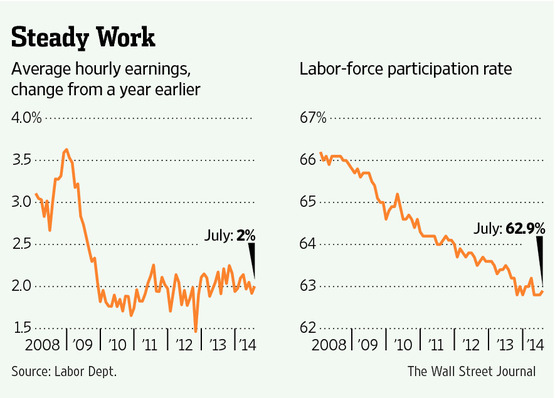
With Jobs, It’s the Taking Part That Counts
|
| You are subscribed to email updates from The Big Picture To stop receiving these emails, you may unsubscribe now. | Email delivery powered by Google |
| Google Inc., 20 West Kinzie, Chicago IL USA 60610 | |



0 comments:
Post a Comment