


The Big Picture |
- The Value of a College Degree
- Secret Playbook of Internet Trolls
- Joan Rivers on Graham Norton Show
- 10 Thursday PM Reads
- How Much Business Investment Is the Right Amount?
- Mapping the Spread of Drought Across the U.S.
- 10 Thursday AM Reads
- The Nude Picture Scandal
- Longest Bull Market?
| Posted: 05 Sep 2014 02:00 AM PDT The Value of a College Degree
This post is the first in a series of four Liberty Street Economics posts examining the value Not so long ago, people rarely questioned the value of a college degree. A bachelor's degree was seen as a surefire ticket to a career-oriented, good-paying job. Today, however, many people are uncertain whether going to college is such a wise decision. It's easy to see why. Tuition costs have been rising considerably faster than inflation, student debt is mounting, wages for college graduates have been falling, and recent college graduates have been struggling to find good jobs. These trends might lead one to believe that college is no longer a good investment. But when you dig into the data, is this really true? This week, we examine the value of a college degree in a four-part blog series. In this first post, we do the basic math and show that despite what appears to be a set of alarming trends, the value of a bachelor's degree for the average graduate has held near its all-time high of about $300,000 for more than a decade. To estimate the value of a bachelor's degree, we measure the costs and benefits for the average college graduate—calculations outlined in detail (with appropriate caveats) in our recent article in the New York Fed's Current Issues series. The costs of college are the average tuition and fees paid by undergraduates plus the "opportunity costs," or the wages one gives up while in school, estimated as the average wages of someone with only a high school diploma. The benefit of college is the "college wage premium"—the extra wages one can expect to earn having obtained a college degree, estimated as the average wage of college graduates compared with the average wage of those with only a high school diploma, summed up over a working life of more than forty years. To come up with a dollar figure for the value of a bachelor's degree, we use the concept of net present value (NPV). The NPV captures the flow of the costs and benefits of going to college over time. During the first four years, the costs of college result in a negative cash flow, followed by a positive cash flow that is received over one's working career (the college wage premium), taking the time value of money into account (meaning that future years are "discounted" at a standard rate of 5 percent, because money earned in the future is worth less than money in hand today). The chart below plots the NPV for a bachelor's degree between 1970 and 2013, calculated using our methodology and expressed in 2013 constant dollars. We estimate that the value of a college degree fell from about $120,000 in the early 1970s to about $80,000 in the early 1980s, before more than tripling to nearly $300,000 by the late 1990s, where it has remained, more or less, ever since. Despite drifting down somewhat in the aftermath of the Great Recession, the value of a bachelor's degree has remained near its all-time high. Another way to assess the value of a college degree is to see how long it takes to break even on the upfront investment. Here, we use the discounted cash flows that feed into our NPV calculation to determine the first year in which the sum of annual cash flows turns positive. The chart below plots the number of years required to recoup the cost of a bachelor's degree earned between 1970 and 2013. The time required to recoup the costs of a bachelor's degree has fallen substantially over time, from more than twenty years in the late 1970s and early 1980s to about ten years in 2013. So despite the challenges facing today's college graduates, the value of a college degree has remained near its all-time high, while the time required to recoup the costs of the degree has remained near its all-time low. Of course, it's possible that some part of what we estimate as the value of a college degree isn't driven by the skills an individual acquires while in college: people who earn a college degree may simply differ in their innate skills and abilities from those who don't obtain a degree. Maybe some college graduates would have earned higher wages even if they had never gone to college. Separating out these two effects in research studies is extremely difficult. Still, while we can't rule out the possibility that this type of selection is at work, it seems likely that at least on average, the value of a bachelor's degree remains substantial. Why has the value of a college degree remained so high even while tuition has been rising and the wages for college graduates have been falling? The primary reason is that the wages of high school graduates have also been falling, reducing the opportunity costs of going to school and keeping the college wage premium near its all-time high. While our estimates make it seem like college always pays handsomely, that may not always be the case for everyone. Our next blog post will look at what happens to the value of college when it takes five or six years to complete a degree instead of four. Our third post will show that when we look at the distribution of wages for college graduates, college actually does not appear to have paid off for a sizable fraction of those who made the investment. To wrap up the blog series, our final post will examine whether there are any recent signs of improvement in the labor market for college graduates. Disclaimer
|
| Secret Playbook of Internet Trolls Posted: 04 Sep 2014 10:30 PM PDT Pleased to meet you - The Rolling Stones
What's Confusing You Is the Nature of Their Game
The reason that Internet trolls are effective is that people still don't understand their game. There are 15 commonly-used trolling tactics to disrupt, misdirect and control internet discussions. As one interesting example, trolls start flame wars because – according to two professors – swearing and name-calling shut down our ability to think and focus. And trolls will often spew divisive attacks so that people argue against each other, instead of bad actions and policies of the powers-that-be. For example, trolls will:
Yesterday, the alternative news site Common Dreams caught a troll using scores of different user names to spew anti-Semitic bile. (Common Dreams discovered that the same troll was behind the multiple user names by tracking their IP addresses. And the troll confessed to Common Dreams.) The troll is a "a Jewish Harvard graduate in his thirties who was irritated by the website's discussion of issues involving Israel". He posted anti-Semitic diatribes – such as Hitler should have finished the job and killed all Jews – using one alias. Then – a couple of minutes later – he'd post an attack on the first poster using a different alias, claiming that criticism of Israel is the same thing as anti-Semitism. (Note: Holocaust survivors and Israeli ministers say it's not.) Why would a Jew post vile anti-Semitic comments? Because normal people are offended by – and don't want to be associated with – pure, naked anti-Semitism, and so they will avoid such discussions. If the discussion was originally criticizing a specific aspect of Israeli policy, the discussion will break down, and the actual point regarding policy will be lost. Similarly, anti-Semitic posts weaken websites by making them seem less reputable. Indeed, Common Dreams says that the troll's anti-Semitic comments drove away many of that site's largest donors … dealing a severe blow to its continued viability. That's exactly what trolls spewing anti-Semitic bile are trying to do: shut down logical discussion and discredit and weaken sites which allow rational criticism of policy. It is well-known that foreign governments and large companies troll online. See this, this this, and this. For example, the Israeli government is paying students to post pro-Israeli comments online. And American students are also attempting to influence internet discussion. While the Common Dreams troll claims that he's not sponsored by the state of Israel, government agencies have manipulated Internet discussion for years. This includes the use of multiple "socket puppet" aliases. The potential for mischief is stunning. Unless we learn their game … |
| Joan Rivers on Graham Norton Show Posted: 04 Sep 2014 04:30 PM PDT Joan Rivers died today at age 81. She jokes about women aging with Graham Norton on BBC One: 2000 The Graham Norton Show (starts at 5:00) 2008 The Graham Norton Show (starts at 4:23) May 9, 2009 2010 Nov 30, 2012 |
| Posted: 04 Sep 2014 01:30 PM PDT My afternoon train reads:
What are you reading?
|
| How Much Business Investment Is the Right Amount? Posted: 04 Sep 2014 11:30 AM PDT
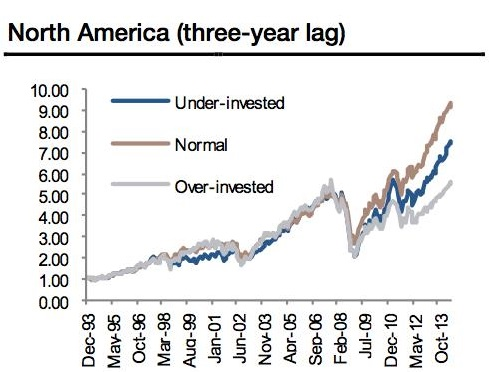
Andrew Lapthorne, a quantitative strategist at Societe Generale SA, recently looked at the correlation between business investment and individual stock prices, in a report titled "How does too much or too little investment affect a company's stock price?". Some of their results were surprising: Stocks of companies that over- or underinvest get punished in Europe and North America. However, in Japan, firms don’t seem to suffer as much for the consequences of their investments.
|
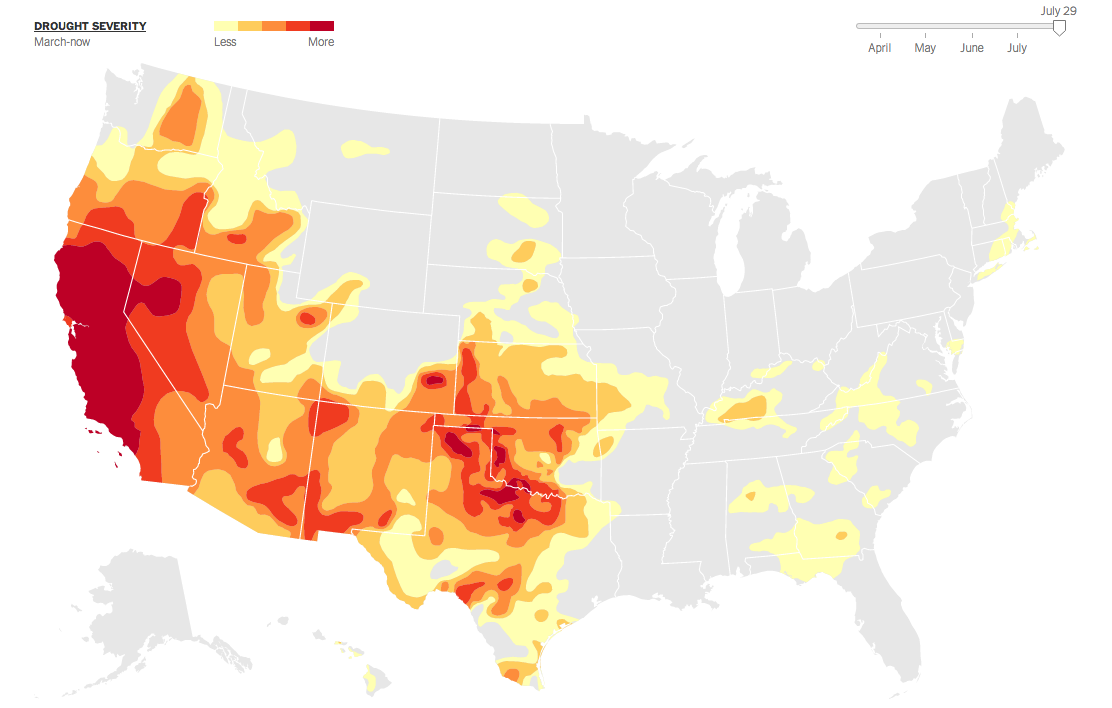
| Mapping the Spread of Drought Across the U.S. Posted: 04 Sep 2014 10:30 AM PDT Click for an interactive, and slightly alarming, drought map. |
| Posted: 04 Sep 2014 06:25 AM PDT I’m back in the saddle after a day off the grid. We’re bringing you today’s reads from an undisclosed location:
|
| Posted: 04 Sep 2014 05:30 AM PDT How dumb can you be? Excoriate Perez Hilton, come down on 4chan, but what I want to know is why these celebrities have nude photos on their phones to begin with? Maybe I grew up in the dark ages, when you had to go to the porn shop to buy European magazines to see naked ladies, when it was a breakthrough when “Penthouse” printed pictures of women below the waist. But despite being aged, a veritable antique, I’m fully aware that if you don’t want anybody to know anything, don’t put it on the Internet! No, let me restate that. If you’re going to do anything illicit, do it alone, in the bathroom, in the dark. Is it any wonder the public is interested in nude photos of celebrities? Isn’t that what they’re selling? There aren’t that many unattractive actors and actresses in America. No, you won the gene derby, you worked on your craft and you made it. Congratulations! But do you have to be so dumb? I mean exactly why do you need to take nude photos of yourself to begin with? When did that become the highest form of art? Ain’t that America, where sex is taboo, but you flaunt your naked body nonetheless. I mean which way do we want it, European style, with naked boobies on the beach, or buttoned-up puritanical? Oh, of course I feel sorry for Jennifer Lawrence and Kate Upton and the rest of the cadre whose names I don’t recognize. But it really makes me wonder if they live in the real world. Are they so busy flying private and staying at the Four Seasons that they don’t know what’s going on? There’s a camera in every store.. There’s a camera in the taxi. There’s a black box in your car. And I believe we should definitely be debating privacy. But when I can go online and see a list of everywhere I’ve ever lived, the residence of my ex-wife, even the assets owned by my long deceased dad, I don’t enter anything in a field that I don’t want everybody to know. Kind of like addresses… Want to buy something illicit on the Internet? Don’t ship it to your home. That data is there…FOREVER! Kind of like Jennifer Lawrence’s nude pics. We’ve had leaked sex tapes, we’ve been living in this Internet era for nearly two decades, and suddenly we’ve got actresses stunned that their data isn’t safe? You never got your phone stolen? You’ve never lent it to another to take a picture? If you’re famous, no one’s ever snapped a photo of you without asking first? Hell, this has happened to me, and my fame can fit in a thimble compared to that of Jennifer Lawrence and Kate Upton. That’s the society we live in. As for iCloud… Read this story: “The Police Tool That Pervs Use to Steal Nude Pics From Apple’s iCloud”: http://www.wired.com/2014/09/eppb-icloud/ Furthermore, Google keeps your search history. So when you’re at home, surfing porn, know that you are not alone, big brother is watching. So what are we gonna do about this? SELF-POLICE! This was a crisis on Facebook a few years back. Drunken pics of college students went on their permanent record and prevented them from getting jobs. Did we beat up the corporations for using this data? Hell, we couldn’t even get Facebook to give an adequate response. No, we educated ourselves and stopped posting that information. A big activity became scrubbing photos from Facebook the night after a party. Everybody woke up. Why can’t the actresses involved in this scandal wake up? The last time I checked I had a body. Not that I’m proud of it. But I’m not taking naked photos of it and sending it to my girlfriend, because then they’d exist. On my phone, in the cloud, on my computer. If someone wanted to blackmail or humiliate me… And I’m not demanding my girlfriend send me these photos either. I can get enough of her live. Come on, Snapchat is all the rage because it evaporates, however imperfectly, and famous people get a pass for taking permanent photos and being astounded they leaked? THAT’S HOW THE INTERNET WORKS! Perez Hilton has proven he’s got no morals. He’s a product of the Internet era, where personal fame is everything. Your brand trumps your talent and if you cross the line you apologize. But if we stopped clicking on the links, he’d go out of business. But we can’t help ourselves. Because we’re animals, human beings, with curiosity and desire. We love gossip because it’s about us, people. We’re evaluating others’ fashion choices and word choices and love choices all the time, frequently modeling ourselves after them. Furthermore, the Internet is filled with nobodies posting their own naked photos in an effort to get famous. Just Google your favorite predilection, photos and videos will come right up. But no, the famous are inviolate. Anthony Weiner resigns from Congress because he doesn’t understand Internet privacy and makes poor choices but Hollywood is immune? Hogwash.
~~~ – |
| Posted: 04 Sep 2014 04:00 AM PDT The longest bull market for the S&P 500 since 1950 lasted 9 ½ years (actually 2,388 trading days). The current bull market (which began on 3/09/09) has lasted 1,375 trading days (through Friday 8/22/14), or 1,013 trading days short of the longest bull since 1950. During the final 1,013 trading days of its 9 ½ year bull run, the S&P 500 gained +135% , i.e., change of the raw index not including the impact of reinvested dividends. The S&P 500 consists of 500 stocks chosen for market size, liquidity and industry group representation. It is a market value weighted index with each stock’s weight in the index proportionate to its market value (source: BTN Research). |

| You are subscribed to email updates from The Big Picture To stop receiving these emails, you may unsubscribe now. | Email delivery powered by Google |
| Google Inc., 20 West Kinzie, Chicago IL USA 60610 | |



0 comments:
Post a Comment