


The Big Picture |
- Why Does the U.S. Support Saudi Arabia, Sponsor of Islamic Terrorism?
- Charlie Rose: Apple’s Jony Ive & Marc Newson on Design
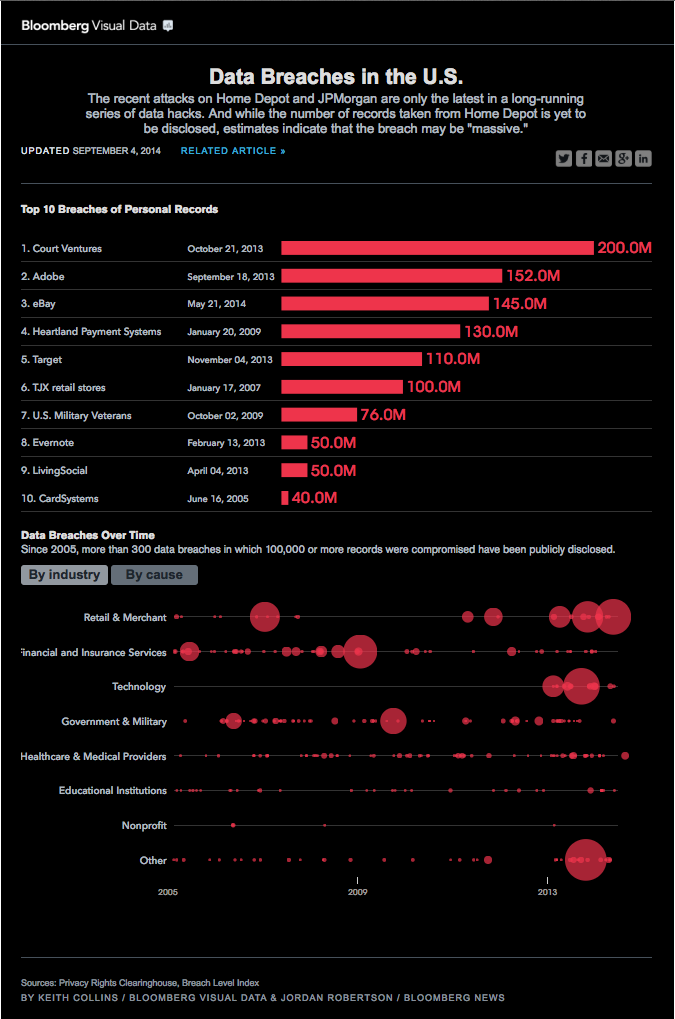
- Data Breaches in the U.S.
- 10 Sunday Reads
- Sugar?
| Why Does the U.S. Support Saudi Arabia, Sponsor of Islamic Terrorism? Posted: 07 Sep 2014 10:30 PM PDT Why Does the U.S. Support a Country which was FOUNDED With Terrorism … and Is Still the MAIN SOURCE of Islamic Terrorism Today?
America Has Sold Its Soul for OilA U.S. congressman for 6 years, who is now a talking head on MSNBC (Joe Scarborough) says that – even if the Saudi government backed the 9/11 attacks – Saudi oil is too important to do anything about it: This is not an isolated incident. It is a microcosm of U.S.-Saudi relations. By way of background, former MI6 agent Alastair Crooke notes that Saudi Arabia was founded with terrorism:
Frontline notes:
U.S. presidents have been extremely close to the Saudi monarchs ever since. The Progressive notes:
The Independent headlines "Iraq crisis: How Saudi Arabia helped Isis take over the north of the country":
As we've extensively documented, the Saudis and the U.S. backed the radical "madrassas" in which Islamic radicalism was spread. Indeed, the U.S. is backing the most radical Muslim terrorists in the world: the Salafis, who are heavily concentrated in Saudi Arabia, while overthrowing the more moderate Arabs. Postscript: And you know the barbaric beheadings by ISIS? The Saudis do that in spades. In the first half of August, there were 19 beheadings, including one for "sorcery". The 345 reported executions between 2007 and 2010 were all carried out by public beheading. Sometimes, Saudi courts order the accused to be beheaded … and then have the severed body be crucified. |
| Charlie Rose: Apple’s Jony Ive & Marc Newson on Design Posted: 07 Sep 2014 04:00 PM PDT On “Charlie Rose,” a conversation with Apple Senior Vice President for Industrial Design Jony Ive and designer Marc Newson in New York ahead of their nonprofit RED auction taking place at Sotheby’s.
|
| Posted: 07 Sep 2014 09:00 AM PDT |
| Posted: 07 Sep 2014 05:00 AM PDT Good Sunday morn. Start your day out with some “After” reads:
What’s for brunch ?
ECB’s Move Causes Euro to Plunge
|
| Posted: 07 Sep 2014 03:30 AM PDT Sugar? So for this weekend's missive, we want to take a different approach to addressing these issues. At the risk of being a preacher, here goes. It seems to me that the political wrangling over Obamacare is somewhat misfocused. The handwringing over underfunded health and retirement benefits is heavy on opinion about money and mostly ignores personal responsibility. The funding and budgetary issues are huge and seemingly intractable. There are associated problems with taxation, spending levels, drug costs, regulations about hospital care, and a myriad of additional details. Those are valid public concerns. And they introduce the politician to the quick fix solution while under the corrupting influence of money or power. All of these concerns drive policy makers to make decisions that seek to address the challenges – without confronting their underlying causes. The US is currently spending approximately 17% a nearly $18 trillion GDP on healthcare. End of decade projected spending levels range from $4.5 to $5.5 trillion. Imagine, the United States may be devoting one of each five dollars of GDP to healthcare. We spend a higher percentage on healthcare than other mature economies do. We spend large sums on redundant efforts and defensive structures that are aimed at deflecting litigation against practitioners. We squander massive resources. Most of us who have personally experienced encounters with our healthcare system and have acquired our own versions of substantiation. Meanwhile, we continue to evolve a population of obese and sick people as we ratchet up the amount we spend on healthcare. So projections that indicate we will spend over 20% of GDP within a decade seem reasonable. Maybe we will reach 20% sooner. Do we ever stop and examine the real underlying causes of our healthcare problem? Might it be possible to do things differently and thereby reduce this massive and growing expenditure and huge political controversy? Perhaps, the answer is yes. Over the past four months, I paid careful attention to the eating habits of my fellow Americans as I traveled to multiple cities and regions throughout the US. I kept some logs. During some stretches of the trip I ate no sugar-laden foods, drank no liquids jacked up with fructose, and carefully watched my caloric intake, diminished sugar consumption and the composition of what I ate. I tried to eat thoughtfully, mindfully and healthfully. At other times I would fall into the unhealthy behaviors I saw around me. The 300 calorie coffee cake washed down with sweetened coffee is a prime example. A snack other than nuts or a banana on an airplane is easily obtained from the flight attendant and it is loaded with poisons. Two minutes of reading the label is all the research one needs to perform the screening. After two to four days of "being bad," I found that I experienced more fatigue and a change in health-related indicators such as the acuteness of arthritic symptoms. When I changed my diet back to one that was more thoughtful, a reversal occurred within two to four days – I would find myself with more energy and get better sleep. I would be more attentive, productive, and constructive when I had a purposeful lower intake of sugar and a higher intake of fiber and vegetables with natural fats and proteins that were not prepared in a factory. I became my own case study of one. I began to talk about this with others. I found that they had experienced similar results. Some had changed their eating habits because they wanted to live better and healthier. They tended to experience positive results quickly, so they persisted and got even healthier. Others tried but had difficulty persisting and lapsed back to old habits. I consulted Christine Schlesinger, a geriatric nurse practitioner and specialist in diabetes education and nutrition. She helped direct me to the YouTube presentations you're about to see if you take the time to get to the bottom of this email. She has a large library of them. They discuss diet, nutrition, and mindful eating. With her help I was able to winnow the video presentations to the four that are at the bottom of this missive. There were many to choose from. After viewing them, I decided to scrap the large task of accumulating all the anecdotes I have personally amassed over the last few months into a data set. The data set is already there for you to see. The first video features Dr. Terry Wahls, a multiple sclerosis survivor who was able to effect a dramatic recovery through dietary changes. She tells her story as a physician, patient and illustrates a successful outcome due to dietary change. The purpose of starting with her presentation is to demonstrate that people can achieve a new level of understanding and act upon it to change behaviors for the betterment of their health and wellbeing. Obviously, Dr. Wahl's experience is anecdotal, and it is certainly true that complex and chronic diseases, like MS, cannot always be cured by an improved diet. What is key for this conversation is that this is a case study of a very determined person, and it shows us that such positive outcomes are possible. The second presentation, by CNN's Dr. Sanjay Gupta, is a short excerpt from 60 Minutes. It discusses the toxicity of sugar. The third presentation examines the quantity of sugar in our diets, how it is measured, and how our behavior has eroded over time through consuming it. (Note that the measurements of sugar intake are performed on people eating so-called "healthy" and "recommended" diets.) The fourth presentation is especially powerful. I believe it will appeal to my colleagues and friends in the financial markets and data-related professions. Economists are data driven. So here it is. Pediatric endocrinologist Dr. Robert H. Lustig's 1.5-hour presentation is backed up by solid data. He is an excellent presenter who shares his political opinions and develops assertions about policy. The clarity of his presentation is outstanding. He demonstrates one alternative route to solving what sometimes seems to be an impossible healthcare-related fiscal and behavioral problem. We strongly suggest watching the presentation offered by Dr. Lustig – or at the least the first 40 minutes of it. All the data needed to reach good decisions about healthcare policy and personal behavior is presented there. The information we need to improve our health and reduce our healthcare costs, both personally and as a society, is at hand. The only thing that is left is some personal and political decision making and action. Ask someone who is diabetic if that is a preference. The answer is no. Ask one who is overweight if that is a desired condition. The answer is no. Some are determined to do something about it. Others wait for one reason or another. It seems to me that most of the people I know would prefer to be healthier. Why do so many of us persist in unhealthy behaviors until some medical shock occurs or we just gradually become debilitated? What are the triggers for positive change? It took a medical shock for me to wake up. Maybe that is the only way. Maybe there is a survivor bias in the data of the mindful and healthful. The others are dead. We don't know. But we do know that there are answers right in front of us if we make the effort to know. If we did, we could make this healthcare problem more manageable. If we don't solve the problem, the trend is apparent. My fear is that the US will end up spending over 20% of its hard-earned income on healthcare. Our nation will become fatter, less healthy, and more sugar-addled. Our politicians will go on protecting certain sectors of the agricultural community at the expense and health of the entire nation. We will not raise taxes on toxic foods nor reduce our consumption of them. If we continue to subsidize them, we will get an unhealthy result. We will cram ourselves into airplanes and be increasingly uncomfortable, demanding that the seats get bigger! And all the while we will find our good health and quality of life slipping away, and we will say goodbye to loved ones years too soon. We are on a present course that is unhealthy, unsustainable, and demoralizing. The problem is not limited to funding sources, deficits, and budgets reflecting more than a trillion dollars a year spent to treat lifestyle-related diseases. The link takes you to a NY Times story about it. The problem is also about the quality of our individual lives. Sensitize the American population, change eating habits, and we'll get healthier. The fiscal issues will begin to solve themselves. To summarize, the present course is a failed one. More government rules. More money spent. More insurance cost. More lawyers engaged. Less personal responsibility. Less knowledge. And finally, more poor health. I'm afraid that I tend to be cynical and don't expect the American public to change its habits overnight. More likely, we will get sicker, more obese, and demand more from politicians who will promise us what they can't deliver. But I also argue that better personal and societal health is within our reach if we make the effort. Lastly, we can't expect much help from the mainstream media, dominated as it is by advertising from those who would sell us sugar and manufactured food. Yet the truth of our situation is available, free of charge. Here are the four videos. Bon appétit! http://tedxtalks.ted.com/video/TEDxIowaCity-Dr-Terry-Wahls-Min https://m.youtube.com/watch?v=ELTldYccY1U https://m.youtube.com/watch?v=GkOJUMt6xSk https://m.youtube.com/watch?v=dBnniua6-oM ~~~ David R. Kotok, Chairman and Chief Investment Officer |





| You are subscribed to email updates from The Big Picture To stop receiving these emails, you may unsubscribe now. | Email delivery powered by Google |
| Google Inc., 20 West Kinzie, Chicago IL USA 60610 | |



0 comments:
Post a Comment