.

{2} GoogleTranslate (H)

English French German Spanish Italian Dutch Russian Portuguese Japanese Korean Arabic Chinese Simplified

Our New Stuff

{3} up AdBrite + eToro

Your Ad Here

Tuesday, November 18, 2014

The Big Picture

The Big Picture


Inflation Experience and Inflation Expectations: Dispersion and Disagreement Within Demographic Groups

Posted: 18 Nov 2014 02:00 AM PST

MiB Suggested Guests for 2015: A List

Posted: 17 Nov 2014 05:00 PM PST

On Saturday, I asked for your suggestions for potential guests for Masters in Business here, and on Twitter as well.

Here is what you suggested:

Blog reader suggestions:

Sam Zell, Scott Simon, Jean Marie Evaillard

Tim Cook of Apple Co seems an obvious call and, although I hear he's not particularly publicity hungry

Craig Jelinek of Costco would be interesting IMO.

Christine Hefner. She may have just a little to offer.

USAF Major General Jack Weinstein. If you can get him……

I don't suppose you could ever get Jeremy Grantham?

Steve Leuthold, Ned Davis, Stanley Druckenmiller, Seth Klarman

Elon Musk (how he sees the future- transportation- autos and mass transit, AI, space exploration)
Bill Gates (view on challenges for the developing world- which solutions work/which doesn't)
Jack Ma (view on China, competition in ecommerce, value/role for shareholders)
Larry Page and/or Eric Schmidt (view on driverless cars, expansion into other technology, etc.)

Jimmy Page as long as he brings along Jack White.

Soros? Buffett?

Mark Dow, Hank Paulson, Bezos, John Malone

And I Second: Elon Musk, Bill Gates, Jack Ma

Jerry Seinfeld, Stephanie Pomboy

Another vote for Grantham, please.
Howard Marks.
Ray Dalio

Stanley Druckenmiller

Would love to hear from managers:
- Peter Lynch (Would LOVE to hear this one)
- Seth Klarman

As well as authors:
- William Bernstein of "Intelligent Asset Allocator" fame
- Michael Lewis
- Burton Malkiel

Ray Kurzweil
"Ray Kurzweil has been described as "the restless genius" by The Wall Street Journal, and "the ultimate thinking machine" by Forbes. Inc. magazine ranked him #8 among entrepreneurs in the United States, calling him the "rightful heir to Thomas Edison," and PBS selected Ray as one of 16 "revolutionaries who made America," along with other inventors of the past two centuries. He is considered one of the world's leading inventors, thinkers, and futurists, with a 30-year track record of accurate predictions."

Seth Klarman,
J Grantham
P Singer
Jared Diamond
G Popovich

1) Elon Musk for his obvious business & technology insights. But also for his views on artificial intelligence.

2) Ray Kurzweil for his general technical & business insights, but also for his views on artificial intelligence and "The Singularity".

Twitter Suggestions:

Sheryl Sandberg, Ginni Rometty, Susan Wojcicki, Mary Barra, Angela Ahrendts, Melinda Gates; ….

Checklist Manifesto, @Atul_Gawande

Lou Gerstner

William K Black

Bob Brinker

Henry Blodget

Paul Tudor Jones, Jeremy Grantham, Peter Thiel

Hugh Hendry

Henry Jarecki

Michael Porter, Andy Lo, Richard Grinold

Doug Kass

Leon Cooperman

David Einhorn

Charlie Munger

Warren Buffett

Asness

Booth

Howard Marks

Michael Milken

Seth Klarman

T. Boone Pickens, Jim Dondero, David Booth, Jim Rogers

Alan Mulally, Boo-Keun Yoon, Gap Han Yoon, Jeff Immelt, Ferdinand Piech or Winterkorn, Sergio Marchionne

Dan Loeb

Costco CEO
Warren Mosler. Seth Klarman. Sheila Bair. William Black.

Bruce Greenwald, Jean-Marie Eveillard, Marty Whitman, Irving Kahn, Charlie Munger, Didier Sornette, Joel Greenblat, Andrew Lo.

Cashin, Dalio, Kass, Tom Barrack.

Edward Thorp
Seth Klarman

Victor Niederhoffer, Monroe Trout, Van K. Tharp, Meb Faber, Wes Gray, Eric Topol, Ed Seykota, Neil Howe,James Altuchr

Kahneman

Soros, James Montier, Jim Grant.

Jim Koch, founder of Sam Adams

David Dreman.

Julian Robertson


10 Monday PM Reads

Posted: 17 Nov 2014 02:30 PM PST

My afternoon train reads:

• What the Islamic State's currency tells us about the bloody origins of money (Quartz) see also Hedge Funds Cut Gold Bets in Fastest Exit This Year (Bloomberg)
• Time for a 'melt-up': the coming global boom (Reuters)
• Bad vs. Basic: Kip McDaniel on identifying the bad and the basic in the competition for the finite asset pools that are moving away from risk. (Chief Investment Officer)
Krugman: Japan Through the Looking Glass (NY Times) see also Abe's choice between recovery and fiscal sustainability (Gavyn Davies)
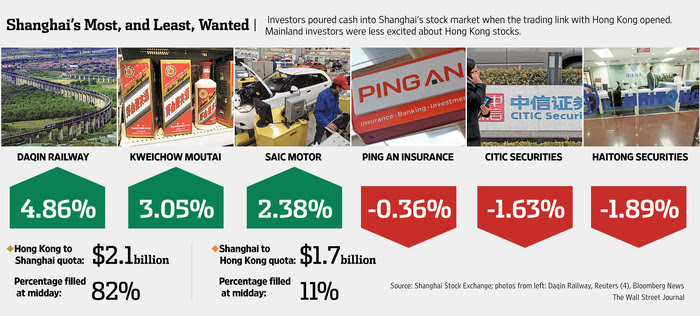
• Money Surges Into Shanghai Stocks on Stock Connect’s First Day (WSJ)
• The hard truth about Americans’ retirement options (LA Times) see also The astonishing rise in wealth inequality, in one gif (Vox)
• Pandering Your Wealth Away (Motley Fool)
• The SEO Dominance of Zillow (Priceonomics)
• Six Banks to Pay $4.3 Billion in First Wave of Currency-Rigging Penalties (Bloomberg)
• Cartography's Favourite Map Monster: the Land Octopus (Big Think)

What are you reading?


Money Surges Into Shanghai Stocks on Stock Connect’s First Day


Source: WSJ


BBRG TV: Breaking Down 1.5 Billion Bonus Pool at Pimco

Posted: 17 Nov 2014 12:45 PM PST

Pimco paid its former CEO Bill Gross a bonus of about $290 million in 2013, a year in which his Total Return Fund trailed a majority of peers, according to documents provided to Bloomberg View by someone with knowledge of Pimco's bonus policies. Bloomberg's Bloomberg View Columnist Barry Ritholtz speaks on "Bloomberg Surveillance." His opinions are his own.

Source: Bloomberg, Nov. 14 2014

Common Mythconceptions

Posted: 17 Nov 2014 11:00 AM PST

History of the Wealth Gap in Europe and America

Posted: 17 Nov 2014 07:30 AM PST

Last week, we reported the ungodly sums of money the top executives at Pimco made. We also noted the obsession we have with tracking other people's wealth.

Perhaps I painted with too broad a brush when I described this as an American pastime; to be more accurate, it is a hobby of the moneyed classes in general and on Wall Street in particular. My apologies to the rest of America, onto whom I unfairly projected this unseemly preoccupation.

Still, endeavoring to understand how the current circumstances evolved is a worthwhile undertaking. Wealth, public policy and economic inequality developed along two very different paths in Europe and the U.S. That is where we begin our discussion this morning.

I’m going to overly generalize and exaggerate a bit here to make a point about how society evolved in the U.S. and on the Continent.  Modern Europe had a 1,000-year head start on America. By the time the first European explorers were taking tentative steps on the shores here, Europe had become a well-developed feudal society. If you want to consider extreme levels of income inequality, consider the distribution curve of property ownership in that system.

Typically, the feudal lord or king owned, well, everything. Serfs were allowed to work the land, and most of the bounty went to the crown. They could hunt in the royal fields and forests, providing the appropriate tax was paid. The king provided some sort of justice as well as protection from marauding hordes. In exchange for these royal gifts, one only had to promise undying fealty, a willingness to be conscripted into the military for both needed defense and the occasional foreign involvement, or anything else at His Majesty's or His Lordship’s discretion. Let's not even discuss the right of primae noctis.

Continues here

10 Monday AM Reads

Posted: 17 Nov 2014 04:30 AM PST

Once more into the breach, with the latest morning train reads:

• The Folklore of Finance: Beliefs That Contribute to Investors' Failure (NY Times)
• Why the US has the most powerful currency on the planet (Quartz) see also The Inflation News Just Got Better (MoneyBeat)
• Abe's choice between recovery and fiscal sustainability in Japan (FT)
• Borrowers, Beware: The Robo-signers Aren't Finished Yet (NY Times) see also The Unfinished Suburbs of America, post housing-boom. (The Atlantic)
• IEA Suggests Oil Prices Rout Could Continue Unless Output Cut (WSJ)


Continues here


Get It: Art of McCartney

Posted: 17 Nov 2014 03:30 AM PST

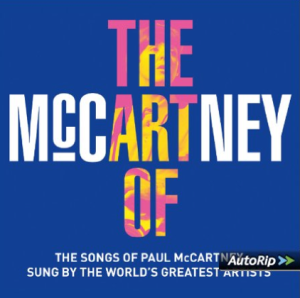
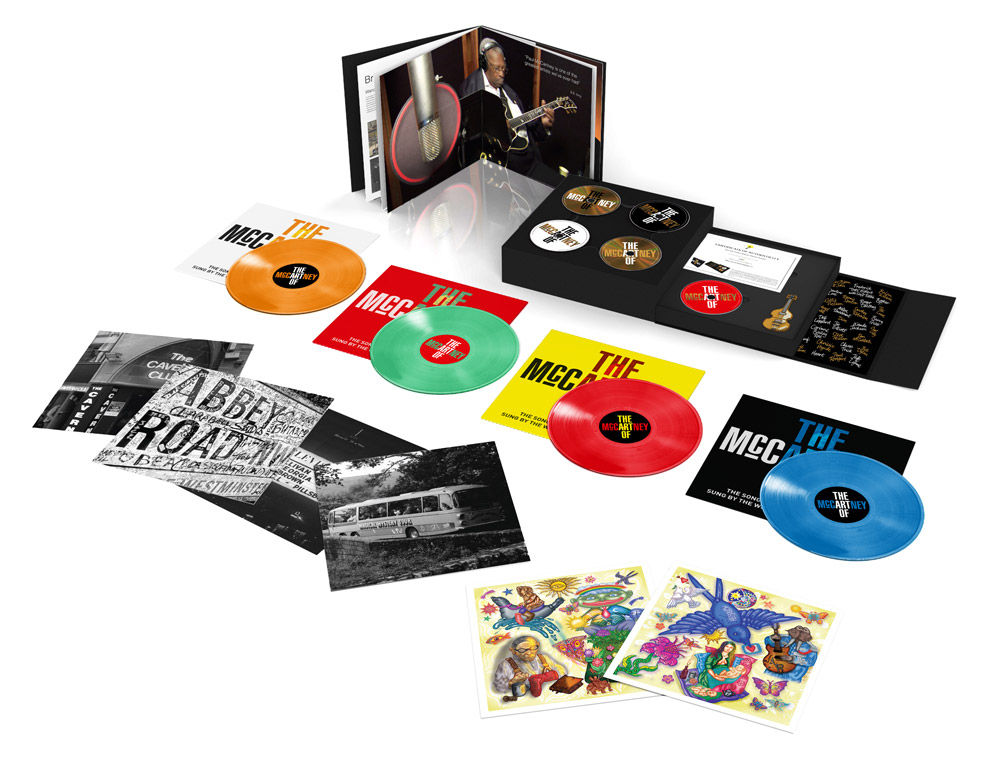
The Art of McCartney

After streaming this all for the past 4 days, I just ordered the new “Art of McCartney” 2 CD/1 DVD set from Amazon.

The list of artists doing covers of Beatles/Wings/McCartney songs is fantastic:

Disc 1
1. Maybe I’m Amazed Billy Joel
2. Things We Said Today Bob Dylan
3. Band on the Run Heart
4. Junior’s Farm Steve Miller
5. The Long and Winding Road Yusuf
6. My Love Harry Connick Jr.
7. Wanderlust Brian Wilson 4:17
8. Bluebird Corinne Bailey Rae
9. Yesterday Willie Nelson
10. Junk Jeff Lynne
11. When I’m Sixty-Four Barry Gibb
12. Every Night Jamie Cullum
13. Venus and Mars / Rock Show Paul Stanley & Gene Simmons
14. Let Me Roll It Paul Rodgers
15. Helter Skelter Roger Daltrey
16. Helen Wheels Def Leppard
17. Hello Goodbye The Cure feat. James McCartney

Disc 2
1. Live and Let Die Billy Joel
2. Let It Be Chrissie Hynde
3. Jet Robin Zander & Rick Nielsen
4. Hi Hi Hi Joe Elliott
5. Letting Go Heart
6. Hey Jude Steve Miller
7. Listen to What the Man Said Owl City
8. Got to Get You Into My Life Perry Farrell
9. Drive My Car Dion
10. Lady Madonna Allen Toussaint
11. Let ‘Em In Dr. John
12. So Bad Smokey Robinson
13. No More Lonely Nights The Airborne Toxic Event
14. Eleanor Rigby Alice Cooper
15. Come and Get It Toots Hibbert with Sly & Robbie
16. On the Way B. B. King
17. Birthday Sammy Hagar
18. C Moon (Amazon Exclusive) Robert Smith
19. Put It There (Amazon Exclusive) Peter Bjorn And John

I bet this will be a monster.


Source: Amazon.

2015 Is Shaping Up to Be a “Turkey” of a Year for the U.S. Economy and Stock Market

Posted: 17 Nov 2014 03:00 AM PST

2015 Is Shaping Up to Be a "Turkey" of a Year for the U.S. Economy and Stock Market
Paul L. Kasriel
November 17, 2014

 
On November 24, 2013, I penned a piece entitled "Unless the Fed Goes Cold Turkey on Us, Expect a Bountiful Economic Harvest for Thanksgiving 2014". In it I argued that 2014 would be a good year for the U.S. economy and U.S. risk assets, such as equities, because I expected a year of robust growth in "thin-air" credit, i.e., the combined credit created by the Federal Reserve and the U.S. depository institution system, primarily commercial banks. Although thin-air credit has not grown as rapidly as I had projected, largely because the Fed tapered its securities purchases more aggressively than I had assumed, still, thin-air credit grew at a relatively robust pace for most of the past 12 months. And, despite a weather-induced weak first quarter of economic activity, the economy has performed quite well since Thanksgiving 2013. In the 12 months ended October 2014, U.S. car and light truck sales clocked in at 16.2 million units, the highest 12-month unit-sales volume since June 2007. In both September and October 2014, the unemployment rate for those covered by state unemployment insurance programs stood at a seasonally-adjusted level of 1.8% — the lowest unemployment rate since May 2006. In October 2014, the ISM-Manufacturing production index stood at 64.8, its highest level since May 2004. For the week ended November 14, 2014, the Wilshire 5000 stock market index, a proxy for all U.S.-traded equities, reached a record high and was up 13.3% from its year-ago weekly average. In the aggregate, then, I think it safe to say that we have enjoyed a bountiful economic harvest here in the U.S. in the past year.


If relatively robust growth in thin-air credit was a major factor accounting for 2014's bountiful U.S. economic harvest, as I believe it was, then 2015's "harvest" is likely to be considerably less bountiful. Growth in thin-air credit has already begun to decelerate and is on course to further decelerate in 2015. As mentioned above, the Fed curtailed its purchases of securities more aggressively than I had reckoned a year ago and ended its purchase program in October 2014. Although bank credit has grown considerably faster than I had anticipated, it is not fast enough to compensate for the slowdown in the growth of Fed thin-air credit.


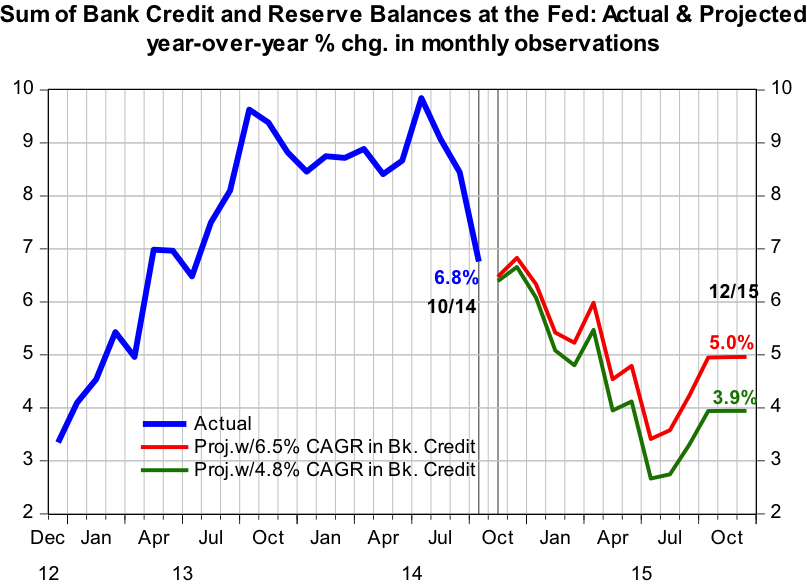
Plotted in the chart below are actual and projected monthly observations of year-over-year percent changes in the sum of commercial bank credit and reserves held by these banks and other depository institutions at the Federal Reserve. The actual data are through October 2014, with the projections running from November 2014 through December 2015. There are two separate projections, both of which assume that reserves held at the Fed (the Fed's contribution to thin-air credit) remain constant at the actual October level. When the Fed is not engaged in a quantitative easing (QE) policy, reserves of depository institutions held at the Fed typically grow less than 1% annually. In the 12 months ended October 2014, bank credit grew by 6.5%. So, in the first projection of thin-air credit growth, I assume that bank credit increases each month at a compound annual growth rate (CAGR) of 6.5% and reserves held at the Fed remain constant. In the 3 months ended October 2014, bank credit increased at a CAGR of 4.8%. So, in the second projection of thin-air credit growth, I assume that bank credit increases each month at a CAGR of 4.8% and, again, reserves held at the Fed remain constant.


2015+Turkey+of+a+Year


After reaching a recent peak in growth of 9.8% in July 2014, year-over-year growth in thin-air credit decelerated to 6.8% in October 2014. A deceleration in growth of three percentage points in three months is severe in and of itself. But, wait. There is more, or less, as the case may be. With reserves at the Fed constant, if bank credit increases at a CAGR of 6.5% going forward, its October 2014 year-over-year increase, then the year-over-year growth in thin-air credit, i.e., the sum of bank credit and reserve balances at the Fed, will further decelerate to 5.0% by December 2015. With reserves at the Fed constant, if bank credit increases at a CAGR of 4.8%, its CAGR in the three months ended October 2014, then the year-over-year growth in thin-air credit will decelerate to 3.9% by December 2015. To put all of these growth rates into context, the median year-over-year change in monthly observations of the sum of bank credit and reserve balances at the Fed from December 1977 through December 2006 was 7.4%.

As U.S. thin-air credit growth is on track to slow in 2015, thin-air credit growth in the eurozone and in Japan is likely to accelerate as the European Central Bank and the Bank of Japan step up their QE programs. These foreign QE programs could indirectly stimulate U.S. exports. But the dominant factor affecting the U.S. economy in 2015 will be below-normal growth in U.S. thin-air credit. So, as you gather your family around you on Thursday, November 27, to give thanks for our bountiful 2014 economic harvest, bear in mind that next year's harvest is likely to be a "turkey" in comparison.


Paul L. Kasriel
Econtrarian, LLC
Senior Economic and Investment Adviser
Legacy Private Trust Co. of Neenah, WI
econtrarian@gmail.com

.

0 comments:

Post a Comment

previous home Next

{8} chatroll


{9} AdBrite FOOTER

{8} Nice Blogs (Adgetize)