


The Big Picture |

- Is Cyprus Too Small To Fail?
- Dubai’s Iconic Skyline as You Rarely See It
- U.S. vs Standard & Poors
- Reflections On a Major Debacle
- 10 Tuesday PM Reads
- Cyprus – A Total Fiasco
- The State of the News Media 2013
- More Homes Return to Positive Equity
- Fifth-Year Rally Precedents
- Ritholtz on Cyprus, Apple, Strategists & GOP
- 10 Tuesday AM Reads
- Contagious: How to Make Things Go Viral
| Posted: 20 Mar 2013 02:00 AM PDT
These were the words of the U.S. ambassador to Bulgaria spoken to us during the country's staccato political ejaculations which eventually drove the country into hyperinflation in the late 1990′s. It was on the same trip to Sophia that a senior central bank official looked us in the eye and said they would not let the government default. The government had lost the confidence of the markets to meet its debt obligations even though it had an independent central bank. Bulgaria faced a choice to either default or monetize its bond maturities. Unlike Russia who chose default over hyperinflation in 1998, Bulgaria monetized the debt payments causing one of the worst hyperinflations in post-war history. The economic chaos eventually resulted in a currency board FX/monetary regime. This is a lesson to the modern monetary theorists who believe governments with independent central banks can't default. History shows when governments get into trouble with their local currency debt they have to make a political choice on who will take the pain. The Russians chose to inflict the pain on David Tepper, his hedge fund buddies, and rest of the creditors, many of whom were foreigners. Bulgaria chose the domestic population through hyperinflation. Fast forward to Cyprus 2013 who today rejected the depositor bail-in scheme as part of its EU bail-out. This is a game changer. Just when we thought Cyprus may have hit bottom, they keep digging. We hope the government has a Plan B — i.e., Russian bail-out, etc. — as the 6-10 deposit tax will look golden to depositors if Cyprus decides to/is forced out of the Eurozone. The EU could also cave and soften up the terms of the bailout, but wouldn't this increase the political contagion to other countries? If Greece, for example, sees Cyprus voting down unpalatable measures forcing a Troika retreat and softening of terms, wouldn't they try and do the same? The Cyprus rejection of the bail-out deal really complicates matters and significantly increases uncertainty. How and when will they get the banks back open? Could this be the tipping point where Germany and the rest of northern Europe's commitment to the Euro experiment begins to falter? Will a Plan B resemble that of Argentina's forced conversion of confiscated bank deposits into BONEX during 1980′s?
The financial resources needed to solve Cyprus are so small one would think the powers that be will not let the country fall into the abyss and increase the risk of taking much of Europe with it. In other words, Cyprus is too small to fail. This does raise the question, however, is Cyprus, like Lehman, the problem or just the symptom of larger issues? If not Lehman, who? If not now, when? Tough to currently see the path to a decent outcome now and have no idea where this is going. Does feel like more turbulence coming. We've buckled up. video after the jump
Cyprus rejects Eurogroup’s savings levy and bailout deal The Cypriot parliament has rejected the EU/IMF bailout for the country’s banks. Support for the deal, which would have involved a one-off charge on all deposit accounts in the country, ebbed away almost as soon as it was announced on Saturday at the Eurogroup meeting. Before rejecting the package Cypriot MPs had already decided to exempt any savers with 20,000 euros or less in their accounts, but this was not enough to gain support. The Eurogroup said the charge was justified because Cyprus has allowed its banking sector to mushroom, Iceland style, into a monster that is more than twice the size of the rest of the economy, and has sucked in so much foreign money, much of it Russian, that foreign deposits account for 37% of all savings in Cyprus. The Cypriots countered by saying they have a right to build up a services sector which they accuse Germany of wanting to destroy, and that they are being targeted because of ongoing disagreements with Moscow that the EU should work out elsewhere. The European public has not failed to notice the one big fact to emerge from this latest crisis in the Eurozone. That is, no-one’s money appears safe any more, unless its stuffed under the mattress. The implications for the EU’s already hard-pressed banking system are obvious. A collapse in confidence at this stage of the game could prove fatal for the entire European project. Yet although the Cypriot “no” vote appears to have struck a blow for ordinary people it plunges the country into a deeper crisis, one that could have serious repercussions for the rest of Europe.  |
| Dubai’s Iconic Skyline as You Rarely See It Posted: 20 Mar 2013 01:00 AM PDT |
| Posted: 19 Mar 2013 10:30 PM PDT  |
| Reflections On a Major Debacle Posted: 19 Mar 2013 04:00 PM PDT 10-Year Iraq War Anniversary: What We've Learned In the Past Decade
Preface: Many experts and alternative writers pointed out the false justifications and huge downsides before the Iraq war started. I know for a fact that many letters and phone calls were made to Congress in an attempt to stop the war. And the protests against the Iraq war were the largest protests in history. Yet the politicians plowed ahead with the disastrous war and refused to listen to the facts … or the will of the people. The Iraq war started 10 years ago. This is a roundup of the facts that have been documented about the debacle in the last decade. The War Was Planned Long Before 9/11The American government planned the Iraq war long before 9/11. Former CIA director George Tenet said that the White House wanted to invade Iraq long before 9/11, and inserted "crap" in its justifications for invading Iraq. Former Treasury Secretary Paul O'Neill – who sat on the National Security Council – also says that Bush planned the Iraq war before 9/11. Top British officials say that the U.S. discussed Iraq regime change even before Bush took office. In 2000, Cheney said a Bush administration might "have to take military action to forcibly remove Saddam from power." And see this and this. Indeed, neoconservatives planned regime change in Iraq – and throughout the Middle East and North Africa – 20 years ago. Weapons of Mass Destruction and 9/11Everyone knew that Iraq did not possess weapons of mass destruction (update here). U.S. officials are guilty of war crimes for using 9/11 as a false justification for the Iraq war. Indeed, the entire torture program was implemented in an attempt to justify the Iraq war. American officials considered lettering Saddam should down a U.S. or UN plane, in order to provide a false justification for war. Saddam allegedly offered to leave Iraq if the U.S. would call off the war … but we refused. We wanted to invade. The Real ReasonNo wonder … As even the top Republican leaders have admitted, the Iraq war was – in fact – for oil. War CrimesThe U.S. engaged in a systematic program of torture in Iraq, which rounded up innocent farmers, reporters, old people and children. People were murdered and sexually abused as part of the torture program. The American military widely used depleted uranium in Iraq, which can cause cancer and birth defects for decades (see this, this, this, this, this and this). Chemical weapons were used in Falluja, which greatly increased the rate of birth defects. The Pentagon sent in one of the main US creators of the death squads in El Salvador to set up paramilitary death squads and torture centers in Iraq. (And Iraqis are worse off now than before the Iraq war. Christians are more widely persecuted than under Saddam.) Cost: $5-6 Trillion DollarsNobel prize winning economist Joseph Stiglitz estimated in 2008 that the Iraq war could cost America up to $5 trillion dollars. But a new study by Brown University's Watson Institute for International Studies says the Iraq war costs could exceed $6 trillion, when interest payments are taken into account. Given that top economists say that war is bad for the economy, the Iraq war is one of the primary reasons for our current economic problems. The War Has Hurt America's National SecurityNational security experts – including both hawks and doves – agree that waging war against Iraq and other Middle Eastern countries has weakened America's national security and increased terrorism risks. See this, this, this, this, this, this, this and this.  |
| Posted: 19 Mar 2013 01:30 PM PDT My afternoon train reads:
What are you reading?
Workers Saving Too Little to Retire  |
| Posted: 19 Mar 2013 01:00 PM PDT Kiron Sarkar's his newsletter can be subscribed to here sarkargm.com. This is a free excerpt . . . ~~~ I summarise below (in note form), the current situation in Cyprus. Background:
Current situation:
Kiron Sarkar ~~~ Kiron's daily newsletter can be accessed on his website www.sarkargm.com 19th March 2013  |
| The State of the News Media 2013 Posted: 19 Mar 2013 12:00 PM PDT |
| More Homes Return to Positive Equity Posted: 19 Mar 2013 11:00 AM PDT Click to enlarge
 |
| Posted: 19 Mar 2013 09:00 AM PDT Click to enlarge
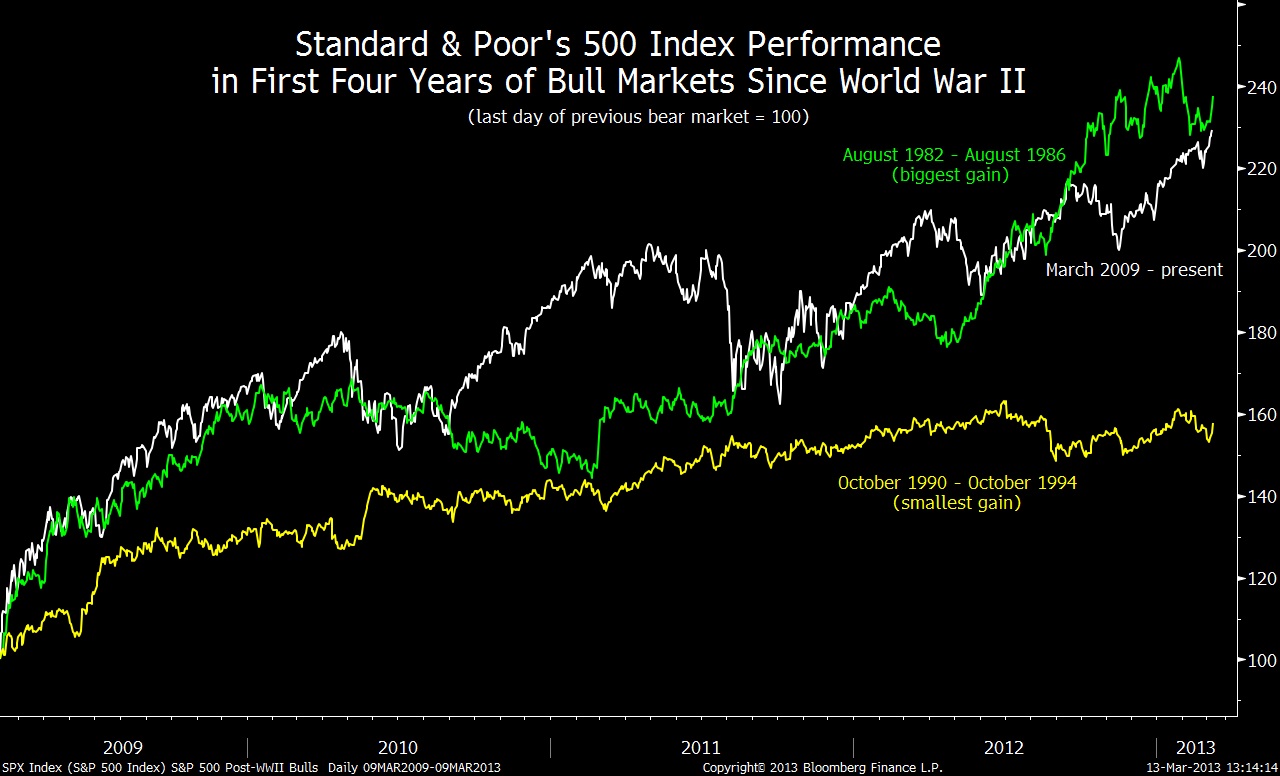
How have markets done in the 5th year of a bull run? The chart above comes from Jeffrey Kleintop, LPL Financial's chief market strategist. The bull market that began in March 2009 is the seventh to last at least four years since World War II. Of those seven, only four ran for five years or more, with an average gain of 22%. The four-year gains ranged from 58% in October 1990, to 138% in August 1982. Before getting too excited, note that this is an exceedingly small sample set, one that is barely better than even money (57%). One other noteworthy factoid: David Wilson of Bloomberg notes that two and one half months into the new year, “the S&P 500 has yet to retreat for more than two days in a row this year.” That is a helluva streak just begging to be broken . . .
Source:  |
| Ritholtz on Cyprus, Apple, Strategists & GOP Posted: 19 Mar 2013 07:30 AM PDT Barry Ritholtz, chief executive officer at FusionIQ, and Brian White, an analyst at Topeka Capital Markets, talk about possible cash strategy for Apple Inc. and the company’s growth outlook. They speak with Tom Keene, Sara Eisen and Scarlet Fu on Bloomberg Television’s “Surveillance.”
If video does not load. click link on each Bloomberg White, Ritholtz on Apple’s Growth, Market Strategy ~~~ Douglas Holtz-Eakin, president of the American Action Forum and a former Congressional Budget Office director under President George W. Bush, speaks about the outlook for the Republican Party and the 2016 presidential election. He talks with Tom Keene and Sara Eisen on Bloomberg Television’s “Surveillance.” Barry Ritholtz, chief executive officer of FusionIQ, also speaks. Holtz-Eakin on Republican Party, 2016 Election ~~~ Jacob Kirkegaard, a research fellow at the Peterson Institute for International Economics, talks about the proposed levy on bank deposits in Cyprus and its impact on Europe’s sovereign-debt crisis. He speaks with Tom Keene on Bloomberg Television’s “Surveillance.” Barry Ritholtz, chief executive officer at FusionIQ, also speaks. Kirkegaard Sees ‘No Immediate’ Cyprus Contagion  |
| Posted: 19 Mar 2013 06:45 AM PDT My morning reads:
What are you reading?
More Homeowners Dig Out  |
| Contagious: How to Make Things Go Viral Posted: 19 Mar 2013 06:00 AM PDT
"Jonah Berger is as creative and thoughtful as he is spunky and playful. Looking at his research, much like studying a masterpiece in a museum, provides the observer with new insights about life and also makes one aware of the creator’s ingenuity and creativity. It is hard to come up with a better example of using social science to illuminate the ordinary and extraordinary in our daily lives." -Dan Ariely, James B. Duke professor of psychology and behavioral economics at Duke University and bestselling author of Predictably Irrational. "Why do some ideas seemingly spread overnight, while others disappear? How can some products become ubiquitous, while others never gain traction? Jonah Berger knows the answers, and, with Contagious, now we do, too.” -Charles Duhigg, author of the bestselling The Power of Habit "Jonah Berger knows more about what makes information 'go viral' than anyone in the world." -Daniel Gilbert, Harvard College Professor of Psychology at Harvard University and author of Stumbling on Happiness “A provocative shift in focus from the technology of online transmission to the human element and a bold claim to explain ‘how word of mouth and social influence work . . . [to] make any product or idea contagious.” -Kirkus Reviews "Think of it as the practical companion to Malcolm Gladwell's The Tipping Point." -Tasha Eichenseher Discover "Contagious contains arresting — and counterintuitive — facts and insights. . . . Most interesting of all are the examples Berger cites of successful and unsuccessful marketing campaigns." -Glenn C. Altschuler The Boston Globe "An infectious treatise on viral marketing. . . . Berger writes in a sprightly, charming style that deftly delineates the intersection of cognitive psychology and social behavior with an eye toward helping businesspeople and others spread their messages. The result is a useful and entertaining primer that diagnoses countless baffling pop culture epidemics." -Publishers Weekly
video after the jump
Jonah Berger Knows How to Make This Video Go Viral If video does not load, click here  |












| You are subscribed to email updates from The Big Picture To stop receiving these emails, you may unsubscribe now. | Email delivery powered by Google |
| Google Inc., 20 West Kinzie, Chicago IL USA 60610 | |



0 comments:
Post a Comment