.

{2} GoogleTranslate (H)

English French German Spanish Italian Dutch Russian Portuguese Japanese Korean Arabic Chinese Simplified

Our New Stuff

{3} up AdBrite + eToro

Your Ad Here

Thursday, March 21, 2013

The Big Picture

The Big Picture


The Bankers’ New Clothes

Posted: 21 Mar 2013 03:15 AM PDT

The Bankers’ New Clothes: What’s Wrong with Banking and What to Do about It

This book is next up in my queue. It looks to be a primer on why big, highly leveraged banks are bad for the economy.

The reviews are outstanding; full chapter 9 after the jump. The book’s site is here; Amazon page here.


Reviews:

More than four years after the financial meltdown devastated the economy, our banking system remains resistant to reform and riddled with risk. The Bankers' New Clothes challenges us to question the status quo and to think anew about the transformative changes in banking that are needed to serve the public interest. This work should spur a long-overdue debate on real banking reform."

-Phil Angelides, chairman of the Financial Crisis Inquiry Commission

The Bankers' New Clothes underscores that there is perhaps no reform more important and central to a stable financial system than capping the ability of financial institutions to take excessive risks using other people's money.

-Sheila C. Bair, former chair of FDIC and author of Bull by the Horns

The Bankers' New Clothes accomplishes the near impossible by translating the arcane world of banking regulation into plain English. In doing so, it exposes as false the self-serving arguments against meaningful financial reform advanced by Wall Street executives and the captured politicians who serve their interests. This revelatory must-read shreds bankers' scare tactics while offering commonsense reforms that would protect the general public from unending cycles of boom, bust, and bailout.

-Neil Barofsky, author of Bailout

Bankers have sold us a story that their risky practices are the necessary cost of a dynamic system. Admati and Hellwig expose this as a misguided and dangerous lie, and show how banks can be made more stable–if less profitable for the bankers themselves–without sacrificing economic growth. This brilliant book demystifies banking for everyone and explains what is really going on. Investors, policymakers, and all citizens owe it to themselves to listen.

-Simon Johnson, coauthor of 13 Bankers

A clearheaded antidote to the ill-advised snap reactions to the financial crisis, The Bankers' New Clothes carefully counteracts arguments that the banking system is now more secure. With direct and rigorous analysis, Admati and Hellwig lay bare the ongoing misinformation about modern banks, and show what remains wrong with banking. This book is the voice shouting that the bankers are still not wearing any clothes. We should listen.

-Frank Partnoy, author of Infectious Greed

I like this book. The Bankers' New Clothes explains in plain language why banking reform is still incomplete, contrary to what lobbyists, politicians, and even some regulators tell us.

-Paul Volcker, former chairman of the U.S. Federal Reserve and the U.S. Economic Recovery Advisory Board


Full chapter after the jump . . .


Sweet Subsidiaries

CIA & FBI: Cheney Lied About 9/11 Hijacker

Posted: 21 Mar 2013 12:00 AM PDT

Cheney Caught In Another Major Lie

Everyone knew that Iraq did not possess weapons of mass destruction (update here).

Dick Cheney admits that he lied about 9/11.

MSNBC recently noted that these two facts are intertwined:

Mark Rossini, was then an FBI counter-terrorism agent detailed to the CIA. He was assigned the task of evaluating a Czech intelligence report that Mohammed Atta, the lead 9/11 hijacker, had met with an Iraqi intelligence agent in Prague before the attack on the World Trade Towers.

Cheney repeatedly invoked the report as evidence of Iraqi involvement in 9/11. "It's been pretty well confirmed that he [Atta] did go to Prague and he did meet with  a senior official of the Iraqi intelligence service in Czechoslovakia  last April," Cheney said on Meet the Press on Dec. 9, 2001.

But the evidence used to support the claim–a supposed photograph of Atta in Prague the day of the alleged meeting—had already been debunked by Rossini. He analyzed the photo and immediately saw it was bogus: the picture of the Czech "Atta" looked nothing like the real terrorist. It was a conclusion he relayed up the chain, assuming he had put the matter to rest.

Then he heard Cheney endorsing the discredited report on national television. "I remember looking at the TV screen and saying, 'What did I just hear?' And I–first time in my life, I actually threw something at the television because I couldn't believe what I just heard," Rossini says.

Rossini gave MSNBC an example in an interview for the documentary Hubris:

Mohammed Atta was a sleight guy … barely 5'5 or 5'6, and skinny.  The guy in the photograph was muscular, thick, and had a neck like the size of two of my necks.  And I thought, "that's not Mohammed Atta in the photograph!"  But I sent it to the lab anyway, knowing that would put it to rest.

McClatchy confirmed in 2009:

Former senior U.S. intelligence official familiar with the interrogation issue said that Cheney and former Defense Secretary Donald H. Rumsfeld demanded that the interrogators find evidence of al Qaida-Iraq collaboration…

For most of 2002 and into 2003, Cheney and Rumsfeld, especially, were also demanding proof of the links between al Qaida and Iraq that (former Iraqi exile leader Ahmed) Chalabi and others had told them were there."

It was during this period that CIA interrogators waterboarded two alleged top al Qaida detainees repeatedly — Abu Zubaydah at least 83 times in August 2002 and Khalid Sheik Muhammed 183 times in March 2003 — according to a newly released Justice Department document…

When people kept coming up empty, they were told by Cheney's and Rumsfeld's people to push harder," he continued."Cheney's and Rumsfeld's people were told repeatedly, by CIA . . . and by others, that there wasn't any reliable intelligence that pointed to operational ties between bin Laden and Saddam . . .

A former U.S. Army psychiatrist, Maj. Charles Burney, told Army investigators in 2006 that interrogators at the Guantanamo Bay, Cuba, detention facility were under "pressure" to produce evidence of ties between al Qaida and Iraq.

"While we were there a large part of the time we were focused on trying to establish a link between al Qaida and Iraq and we were not successful in establishing a link between al Qaida and Iraq," Burney told staff of the Army Inspector General. "The more frustrated people got in not being able to establish that link . . . there was more and more pressure to resort to measures that might produce more immediate results."

"I think it's obvious that the administration was scrambling then to try to find a connection, a link (between al Qaida and Iraq)," [Senator] Levin said in a conference call with reporters. "They made out links where they didn't exist."

Levin recalled Cheney's assertions that a senior Iraqi intelligence officer had met Mohammad Atta, the leader of the 9/11 hijackers, in the Czech Republic capital of Prague just months before the attacks on the World Trade Center and the Pentagon.

The FBI and CIA found that no such meeting occurred.

Postscript:  Indeed the entire torture program was implemented in an attempt to justify the Iraq war.  And the 9/11 Commission was set up with false torture testimony.  More background on the Iraq war.

Discuss: True Cost of Iraq War

Posted: 20 Mar 2013 04:30 PM PDT

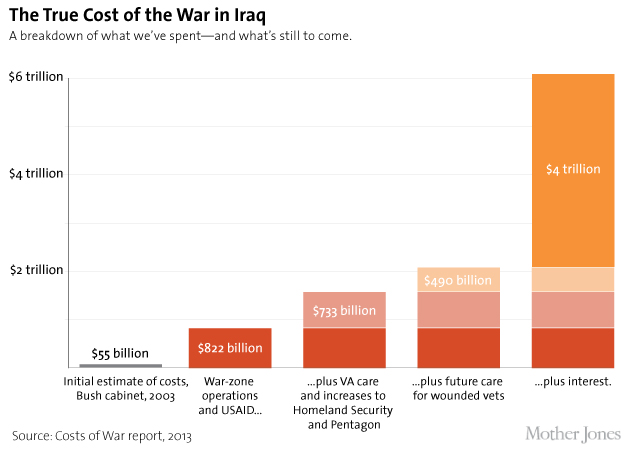
Bush Lowballed Us on Iraq by $6 Trillion

Source: MoJo


Discuss


10 Midweek PM Reads

Posted: 20 Mar 2013 01:30 PM PDT

My afternoon train reading:

Shiller: The global economy is trapped in a painful austerity-induced slump of our own making  (Project-Syndicate)
• JPMorgan is not a farmer: House Agriculture Committee will hold a markup session today on seven bills designed to gut derivatives regulations passed in the Dodd-Frank financial reform law. (Salon)
• Civil Engineers Echo Obama Calling for Infrastructure Fix (Bloomberg)
• The Magic of 3 Percent GDP Growth (Businessweek)
• Why renters are still driving America’s building boom (Fortune) see also Today's Forecast: Sunny With a Chance of a Housing Bubble (Bloomberg)
• Greed Not So Good: the fundamental problem with free market capitalism (They gave us a republic)
• Google Is Eating The Internet (Phil Pearlman)
Humanity Leaves the Solar System: 35 Years Later, Voyager Offically Exits the Heliosphere (Time)
• Warming Has Doubled Risk of Katrina-like Storm Surges (Climate Central)
• The Brilliance of the Dog Mind (Scientific American)

What are you reading?


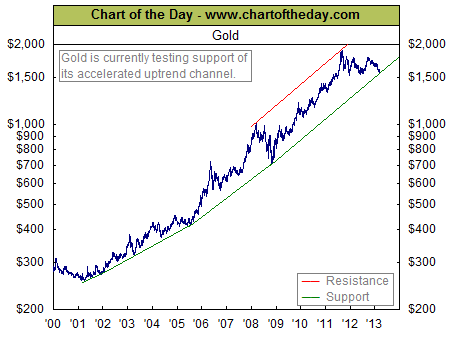
Its Do or Die Time for Gold

Source: TRB

Analysis: March 2013 FOMC Statement

Posted: 20 Mar 2013 12:30 PM PDT

David Merkel of Aleph Blog does an outstanding job analyzing the key points of the FOMC statement changes:


January 2013 March 2013 Comments
Information received since the Federal Open Market Committee met in December suggests that growth in economic activity paused in recent months, in large part because of weather-related disruptions and other transitory factors. Information received since the Federal Open Market Committee met in January suggests a return to moderate economic growth following a pause late last year. Shades GDP view up.
Employment has continued to expand at a moderate pace but the unemployment rate remains elevated. Labor market conditions have shown signs of improvement in recent months but the unemployment rate remains elevated. Shades their view enmployment up.  So long as discouraged workers increase, this is a meaningless statement.
Household spending and business fixed investment advanced, and the housing sector has shown further improvement. Household spending and business fixed investment advanced, and the housing sector has strengthened further, but fiscal policy has become somewhat more restrictive. New fiscal policy comment, but it should read, "fiscal policy has become somewhat less loose."
Inflation has been running somewhat below the Committee's longer-run objective, apart from temporary variations that largely reflect fluctuations in energy prices. Longer-term inflation expectations have remained stable. Inflation has been running somewhat below the Committee's longer-run objective, apart from temporary variations that largely reflect fluctuations in energy prices.  Longer-term inflation expectations have remained stable. No change.  TIPS are showing flat inflation expectations since the last meeting. 5y forward 5y inflation implied from TIPS is still near 2.86%.The FOMC is wrong on inflation.
Consistent with its statutory mandate, the Committee seeks to foster maximum employment and price stability. Consistent with its statutory mandate, the Committee seeks to foster maximum employment and price stability. No change. Any time they mention the "statutory mandate," it is to excuse bad policy.
The Committee expects that, with appropriate policy accommodation, economic growth will proceed at a moderate pace and the unemployment rate will gradually decline toward levels the Committee judges consistent with its dual mandate. The Committee expects that, with appropriate policy accommodation, economic growth will proceed at a moderate pace and the unemployment rate will gradually decline toward levels the Committee judges consistent with its dual mandate. Emphasizes that the FOMC will keep doing the same thing and expect a different result than before. Monetary policy is omnipotent on the asset side, right?
Although strains in global financial markets have eased somewhat, the Committee continues to see downside risks to the economic outlook. The Committee continues to see downside risks to the economic outlook. Shades down their views of the global financial markets.
The Committee also anticipates that inflation over the medium term likely will run at or below its 2 percent objective. The Committee also anticipates that inflation over the medium term likely will run at or below its 2 percent objective. No change. CPI is at 2.0% now, yoy, so that is quite a statement.
To support a stronger economic recovery and to help ensure that inflation, over time, is at the rate most consistent with its dual mandate, the Committee will continue purchasing additional agency mortgage-backed securities at a pace of $40 billion per month and longer-term Treasury securities at a pace of $45 billion per month. The Committee is maintaining its existing policy of reinvesting principal payments from its holdings of agency debt and agency mortgage-backed securities in agency mortgage-backed securities and of rolling over maturing Treasury securities at auction. To support a stronger economic recovery and to help ensure that inflation, over time, is at the rate most consistent with its dual mandate, the Committee decided to continue purchasing additional agency mortgage-backed securities at a pace of $40 billion per month and longer-term Treasury securities at a pace of $45 billion per month.  The Committee is maintaining its existing policy of reinvesting principal payments from its holdings of agency debt and agency mortgage-backed securities in agency mortgage-backed securities and of rolling over maturing Treasury securities at auction. No change.Does not mention how the twist will affect those that have to fund long-dated liabilities.Wonder how long it will take them to saturate agency RMBS market?Operation Twist continues.  Additional absorption of long Treasuries commences.  Fed will make the empty "monetary base" move from $3 to 4 Trillion by the end of 2013. 
Taken together, these actions should maintain downward pressure on longer-term interest rates, support mortgage markets, and help to make broader financial conditions more accommodative. Taken together, these actions should maintain downward pressure on longer-term interest rates, support mortgage markets, and help to make broader financial conditions more accommodative. No change.
The Committee will closely monitor incoming information on economic and financial developments in coming months. The Committee will closely monitor incoming information on economic and financial developments in coming months. No change. Useless comment.
If the outlook for the labor market does not improve substantially, the Committee will continue its purchases of Treasury and agency mortgage-backed securities, and employ its other policy tools as appropriate, until such improvement is achieved in a context of price stability. The Committee will continue its purchases of Treasury and agency mortgage-backed securities, and employ its other policy tools as appropriate, until the outlook for the labor market has improved substantially in a context of price stability. No real change.
In determining the size, pace, and composition of its asset purchases, the Committee will, as always, take appropriate account of the likely efficacy and costs of such purchases. In determining the size, pace, and composition of its asset purchases, the Committee will continue to take appropriate account of the likely efficacy and costs of such purchases as well as the extent of progress toward its economic objectives. Maybe they are hedging a little here – if they get close to their objective, they might start  to reduce policy accommodation?
To support continued progress toward maximum employment and price stability, the Committee expects that a highly accommodative stance of monetary policy will remain appropriate for a considerable time after the asset purchase program ends and the economic recovery strengthens. To support continued progress toward maximum employment and price stability, the Committee expects that a highly accommodative stance of monetary policy will remain appropriate for a considerable time after the asset purchase program ends and the economic recovery strengthens. No change.Promises that they won't change until the economy strengthens.  Good luck with that.
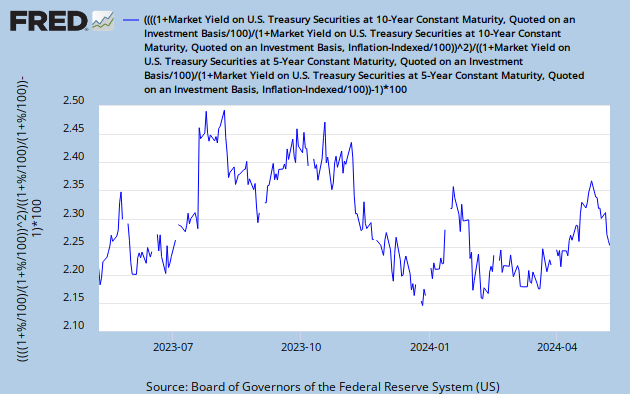
In particular, the Committee decided to keep the target range for the federal funds rate at 0 to 1/4 percent and currently anticipates that this exceptionally low range for the federal funds rate will be appropriate at least as long as the unemployment rate remains above 6-1/2 percent, inflation between one and two years ahead is projected to be no more than a half percentage point above the Committee's 2 percent longer-run goal, and longer-term inflation expectations continue to be well anchored. In particular, the Committee decided to keep the target range for the federal funds rate at 0 to 1/4 percent and currently anticipates that this exceptionally low range for the federal funds rate will be appropriate at least as long as the unemployment rate remains above 6-1/2 percent, inflation between one and two years ahead is projected to be no more than a half percentage point above the Committee's 2 percent longer-run goal, and longer-term inflation expectations continue to be well anchored. Not a time limit but economic limits from inflation and employment.Just ran the calculation – TIPS implied forward inflation one year forward for one year – i.e., a rough forecast for 2014, is currently 2.32%.  Here's the graph.  The FOMC has only 0.18% of margin in their calculation if they are being honest, which I doubt.
In determining how long to maintain a highly accommodative stance of monetary policy, the Committee will also consider other information, including additional measures of labor market conditions, indicators of inflation pressures and inflation expectations, and readings on financial developments. In determining how long to maintain a highly accommodative stance of monetary policy, the Committee will also consider other information, including additional measures of labor market conditions, indicators of inflation pressures and inflation expectations, and readings on financial developments. No change.
When the Committee decides to begin to remove policy accommodation, it will take a balanced approach consistent with its longer-run goals of maximum employment and inflation of 2 percent. When the Committee decides to begin to remove policy accommodation, it will take a balanced approach consistent with its longer-run goals of maximum employment and inflation of 2 percent. No change.
Voting for the FOMC monetary policy action were: Ben S. Bernanke, Chairman; William C. Dudley, Vice Chairman; James Bullard; Elizabeth A. Duke; Charles L. Evans; Jerome H. Powell; Sarah Bloom Raskin; Eric S. Rosengren; Jeremy C. Stein; Daniel K. Tarullo; and Janet L. Yellen. Voting for the FOMC monetary policy action were: Ben S. Bernanke, Chairman; William C. Dudley, Vice Chairman; James Bullard; Elizabeth A. Duke; Charles L. Evans; Jerome H. Powell; Sarah Bloom Raskin; Eric S. Rosengren; Jeremy C. Stein; Daniel K. Tarullo; and Janet L. Yellen. No change
Voting against the action was Esther L. George, who was concerned that the continued high level of monetary accommodation increased the risks of future economic and financial imbalances and, over time, could cause an increase in long-term inflation expectations. Voting against the action was Esther L. George, who was concerned that the continued high level of monetary accommodation increased the risks of future economic and financial imbalances and, over time, could cause an increase in long-term inflation expectations. Esther George takes up the thankless task of telling the FOMC that they are doing more harm than good.


Comments

  • Notable: they mention that fiscal policy is less accommodative.  Also, some new language leaves room for policy gradualism.
  • Not so notable: they shade up their views on GDP and employment, and shade down their views on global financial market stability.
  • I really think the FOMC lives in a fantasy world.  The economy is not improving materially, and inflation is rising. Note that the CPI is close their 2.5% line in the sand.  TIPS-implied inflation 1X1 (one year ahead for one year) is 2.32%, and 5X5 is around 2.86% annualized.
  • Current proposed policy is an exercise in wishful thinking.  Monetary policy does not work in reducing unemployment, and I think we should end the charade.
  • In my opinion, I don't think holding down longer-term rates on the highest-quality debt will have any impact on lower quality debts, which is where most of the economy finances itself. When this policy doesn't work, what will they do?
  • Also, the investment in Agency MBS should have limited impact because so many owners are inverted, or ineligible for financing backed by the GSEs, and implicitly the government, even with the recently announced refinancing changes.
  • The key variables on Fed Policy are capacity utilization, unemployment, inflation trends, and inflation expectations.  As a result, the FOMC ain't moving rates up, absent increases in employment, or a US Dollar crisis.  Labor employment is the key metric.
  • GDP growth is not improving much if at all, and the unemployment rate improvement comes more from discouraged workers.


Question for Dr. Bernanke

Every liability is someone else's asset.  Aren't you doing nothing by trying to hold long term interest rates lower?

Where the Nation’s Highest Earners Live

Posted: 20 Mar 2013 12:00 PM PDT

click for interactive graphic

Source: Washington Post

Report from Paris – 2 (2013)

Posted: 20 Mar 2013 11:00 AM PDT

Report from Paris – 2 (2013)
David R. Kotok
Cumberland Advisors, March 20, 2013 (4:00pm, Paris)

See Part 1 Report from Paris (2013)


Just 20 months ago the three largest banks in Cyprus passed the European 'stress tests' with flying colors,” reports Ron DeLegge of ETFguide.

The latest estimates are 16 billion euros needed, and that number is rising daily. This will get worse.

When we planned this trip to Paris and Dubai, we had no idea that the Eurogroup would launch an unprecedented attack on bank depositors, banks, central banks, and the banking system of the entire Eurozone. But they did.

We boarded flights from Sarasota to New York and then to Paris as the news unfolded regarding the "tax," called a "stability levy," on depositors in Cypriot banks. Depositors of €100,000 or less were to have a levy of 6.7 percent confiscated from their bank deposits. Above €100,000, it was to be 9.9 percent.

The proposal triggered an uproar and runs on ATMs, and then it fizzled in the Cypriot parliament as a result of the public outcry. The unfolding situation has been a mad scramble ever since. Issues, limits, amounts, back-up credit if there are runs, emergency liquidity provisions, small-saver exemptions, corruption reporting, preservation of national deposit guarantees, and a hundred other issues are being resolved.

Every one of the official commentaries characterized the response as a "one-off" event, declaring that this would not happen again and justifying this action as necessary in order to avoid an outcome certain to be even worse. During secret weekend meetings, the Eurogroup, finance ministers of the Eurozone, and other powerful leadership concluded that they could take portions of bank deposits from everybody – foreign or domestic, small or large – and confiscate them. They could confiscate them because of a crisis resulting from their own failure to supervise and regulate one of the member central banks that is part of the Eurosystem. They did that, and the consequences are going to be enormous.

We have reached our conclusions about the banking crisis now in the Eurozone following this action and following the previous action in which private-sector debt holders of Greek sovereign debt were essentially "screwed."

Unless there are systemic changes for the better, you cannot trust a Eurosystem deposit in a Eurosystem bank in a Eurosystem country. Unless there are systemic changes, you cannot trust and depend on sovereign debt promises of a Eurozone country. Unless there are systemic changes, the Eurosystem, Eurozone debt, and Eurozone bank exposure now carry a risk premium of some amount. That risk will vary by country, bank, and structure. In every case, there is a premium.

In the case of countries whose policies and behaviors have been exemplary during the crisis, the premium will be quite small. Finland is a good example of a euro-system, Eurozone, and EU member country that continues to manage its monetary and economic affairs with complete credibility and reliability. We would expect no visible impact on Finnish banks, debt, and financial market structure.

Germany is the largest weight in the Eurozone. It is also operated in a disciplined fashion. We do not expect much impact there.

But the farther you go into the financially weaker peripheral countries in Europe, the worse the risk premium is going to get. Cyprus is one obvious case study; Greece is another.

The question is, what will the impacts be on marginal countries? Some are trying to improve the state of their economic affairs. Does the action in Cyprus make it harder for Portugal to turn around and improve? Is this a setback for Ireland? What happens in Spain, where the banking system is under stress and the economy under double stress? The political mess in Italy renders the questions huge.

When you consider the total debt and total size of the troubled countries in the Eurosystem and the Eurozone, you can reach only one conclusion. This system is sick. Its political leaders are making a crisis situation worse by making decisions that they claim to be single events, and without a pattern or overall policy approach. No one believes them anymore. No depositor who is capable of avoiding this exposure will seek the exposure. Instead, depositors will seek alternatives.

Taxation rates in some countries, such as France, are driving wealth and entrepreneurial spirit out of the country. In other places, political uncertainty is so high that it impairs any advancement in growth or economic recovery. For the entire Eurozone, we would expect in 2013 that the growth rate will be near zero.

Some of the unemployment characteristics in various countries have reached levels that have no precedent and are destabilizing. In some countries the unemployment rate among youth is over 50 percent. In most countries the unemployment rate is measurable in double digits.

Europe's leaders, in our view, continue to make bad decisions. In doing so, they make bad matters worse.

We have not reached this painful conclusion without careful research. We have had a series of meetings in Paris with money managers, central bankers, investors, and academics. All of our meetings here were private. In the candor of those private discussions, we come away with the most troubled view we have had of the Eurozone, the experiment in this single-currency block, and the market structures in Europe. This is a place in trouble. Courses of action that evidence more flailing than forethought are not making things any better.

We will soon leave for Dubai for the Global Interdependence Center event, the latest in the GIC Banking Series, this time focused on challenges and opportunities in the Middle East. Our comments on March 26, 2013, will subsequently be posted on Cumberland's website along with our slides. Interested readers will be able to track this at www.cumber.com.

For investors, we would strongly recommend that careful consideration be given to exposures in the Eurozone, the Eurosystem, the European Economic Community, and the European Union. Things have changed. Watch closely for bank runs. Also watch use of Emergency Liquidity Assistance (ELA), and watch how the European Central Bank (ECB) reviews value of collateral. Lastly, watch out for new capital controls in Cyprus. They will signal a death knell for cross-border money flows.

~~~

David R. Kotok, Chairman and Chief Investment Officer, Cumberland Advisors

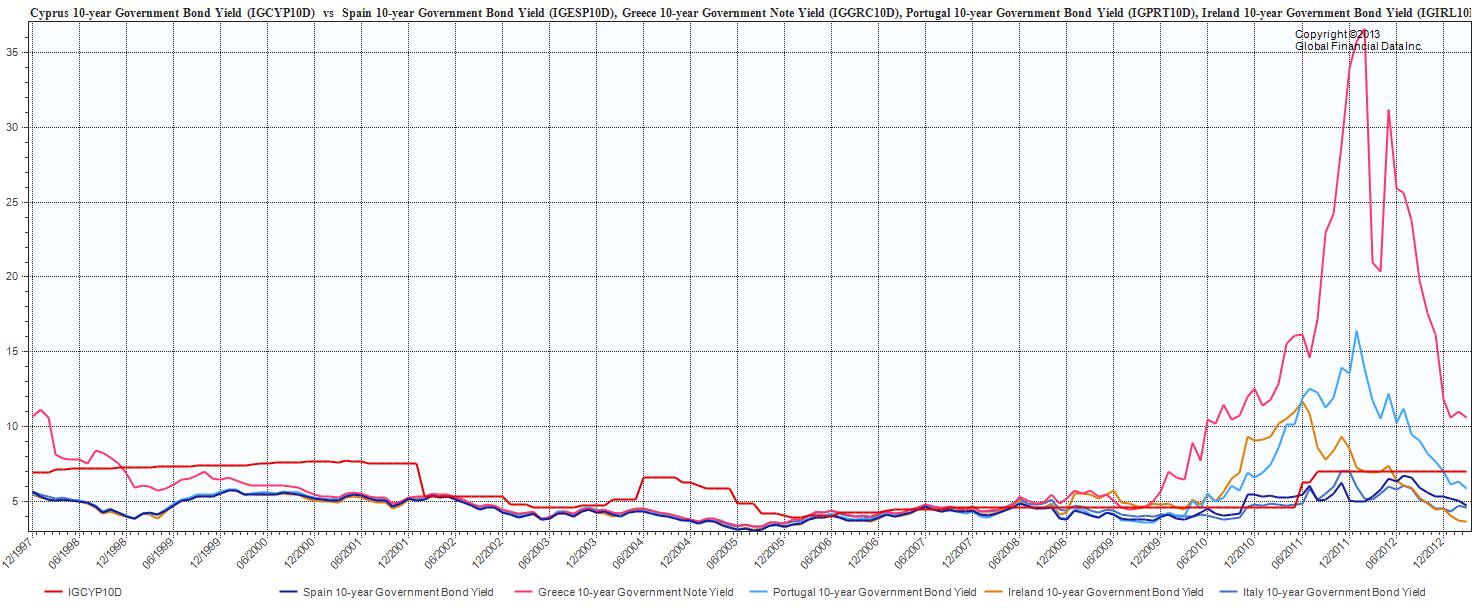
Chart: Eurozone PIIGS + Cyprus

Posted: 20 Mar 2013 09:00 AM PDT

Click for ginormous chart


Pretty interesting look at the 10 yr bonds of the Eurozone PIIGS plus Cyprus.

With so much speculation about the future of Cyprus, one wonders what happens if one collapses, what will happen to the rest. Thus far, it appears to be of little or no consequence.


Source:
Ralph M Dillon
www.globalfinancialdata.com

10 MidWeek AM Reads

Posted: 20 Mar 2013 07:00 AM PDT

My morning reads:

• 5 Reasons to Like (But Not Love) Stocks (Barron’s)
• Bond crash dead ahead: tick, tick … boom! (MarketWatch)
• Finally, Economists Acknowledge That They’re Biased (Forbes )
• Lesson Learned After Financial Crisis: Nothing Much Has Changed (DealBook)
• Professor Monti and the bubble (VOX) see also A Cypriot Nobelist Is ‘Appalled’ by the Proposed Bailout Bank Tax (Businessweek)
• The real investment lesson of the Iraq war (MarketWatch)
• Why Voters Trust the GOP with Their Tax Dollars… (The Fiscal Times)
• Is Immigration Reform At The Tipping Point? (Talking Points Memo)
Ezra Klein: I supported the Iraq War, and I'm sorry.  (Bloomberg) see also Waste, fraud and abuse commonplace in Iraq reconstruction effort (The Center for Public Integrity)
• Belgian mathematician rewarded for shaping algebra (nature)

What are you reading?


TBTF

What Really Drives Market Sentiment?

Posted: 20 Mar 2013 04:00 AM PDT

I mentioned last week that bullish sentiment was getting a bit frothy. After a few weeks of record highs, expectations that stock prices will continue rising had surged.

Not quite an extrapolation of recent trends into infinity, but getting there.

This morning, I wanted to address the flip side of that — Bearish sentiment (expectations that stock prices will fall in the near future). This Pessimism remains above historical average.

As I noted all the way back in 2009, this is the most hated rally in Wall Street history. Many participants are unable to pry their eyes from the wreckage in the rear view mirror. This impacts their psychology, investment posture, and allocations.

Consider the initial over-reaction to Cyprus. The swiftness in which the bearish commentariat erupted over the weekend was a wonder to behold. It also was far more revealing of the bears own confirmation bias than anything it said about the circumstances in Cyprus itself.

Some have made a big deal of the January inflows into equities — the biggest in years — as a sign of the top. Perhaps a little context might help put this into perspective: The $20 billion dollars added to U.S. stock funds in 2013 pales when compared to the over $600 billion in outflows from equity funds over six years though 2012. It is also less than half of $44 billion that flows to fixed-income managers in 2013 (ICI).

Thus, we have a market which remains disliked, under-owned by investors, not unreasonably priced, with few alternatives to equities. (Does that sound like the recipe for a market crash to you?)

Let me be clear about one thing: I am not implying in any way an organic rally. The normal 20-30% pullback we might have seen as the economy slowed and earnings weaken has been thwarted by Swingin’ Uncle Ben & His No Limit Orchestra. Any concerns I may have had about a pre-recession 30% correction was shelved once QE4 became imminent. The Fed is erring on the side of doing too much this go round, versus their 1930s error of doing too little.

Perhaps this thwarting of normal cycles accounts for some of the angst we see amongst the bearish contingency. Maybe they will eventually be proven right after missing a 146% move off of the March 2009 lows — a hollow victory at best.

In the meantime, it is helpful to understand what it is that is driving sentiment, in the context of the larger picture.


Note: With this post, I am breaking out Psychology and Sentiment into two distinct categories.


Previously:
The Most Hated Rally in Wall Street History (October 8th, 2009)

Strategists Most Bearish on Equities since 1985 (August 1st, 2012)

.

0 comments:

Post a Comment

previous home Next

{8} chatroll


{9} AdBrite FOOTER

{8} Nice Blogs (Adgetize)