


The Big Picture |

- Open Thread: Federal Reserve
- Trend & Technicals: “The Pain Trade is Higher”
- 10 Thursday PM Reads
- U.S. Business Cycle: Yo-Yo Years
- 10 Worst Corporate Accounting Scandals
- Achuthan: U.S. Recession Began Middle of 2012
- Current Market Rally is 6th Best Since 1929
- 10 Thursday AM Reads
- Is There a Rental Supply Glut?
- Organic Organization Chart
- World Is In a Recession (Go about your business as usual)
- An Infinite Amount of Money
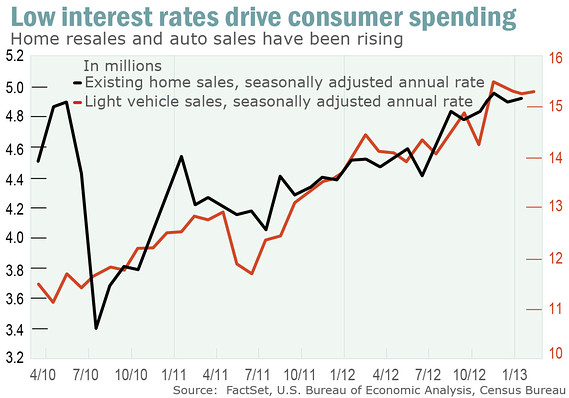
| Posted: 07 Mar 2013 04:43 PM PST Tonite, let’s have a little fun with our subject, being the Fed: How much is the Fed driving markets? What about the Economy — how much impact is the FOMC having on auto purchases? Home sales & refis? GDP? ~~~ What say ye?  |
| Trend & Technicals: “The Pain Trade is Higher” Posted: 07 Mar 2013 03:23 PM PST Chris Verrone, head of technical analysis at Strategas Research Partners, talks about the outlook for the U.S. stock market and investment strategy. Verrone said the Standard & Poor's 500 Index may climb past its all-time high by June, following the Dow Jones Industrial Average in setting a new record this year. He speaks with Tom Keene and Michael McKee on Bloomberg Radio's "Surveillance."
 |
| Posted: 07 Mar 2013 01:30 PM PST My afternoon train reads:
What are you reading?
Low Interest Rates Drive Consumer Spending  |
| U.S. Business Cycle: Yo-Yo Years Posted: 07 Mar 2013 11:45 AM PST |
| 10 Worst Corporate Accounting Scandals Posted: 07 Mar 2013 11:30 AM PST |
| Achuthan: U.S. Recession Began Middle of 2012 Posted: 07 Mar 2013 11:16 AM PST Lakshman Achuthan, co-founder of the Economic Cycle Research Institute, talks about the U.S. economy. Achuthan speaks with Tom Keene and Sara Eisen on Bloomberg Television’s “Surveillance.” John Silvia, chief economist at Wells Fargo Securities LLC, also speaks.
 |
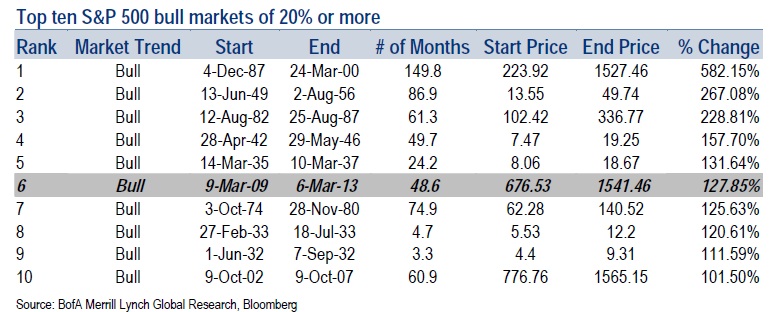
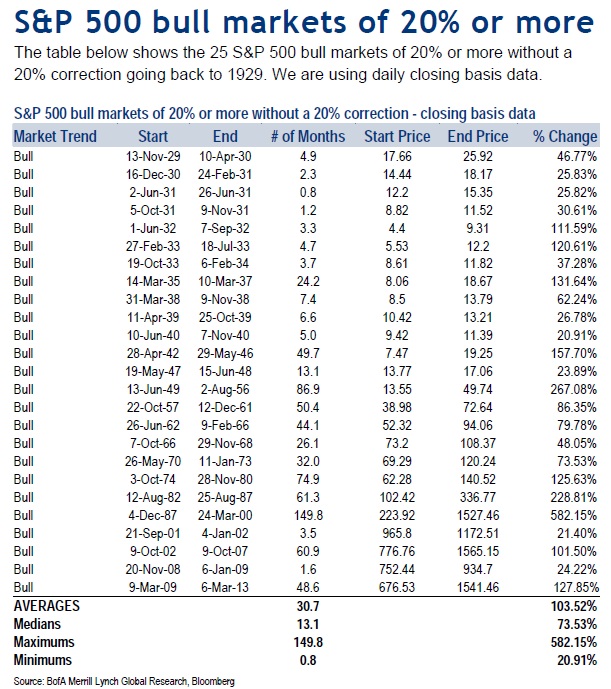
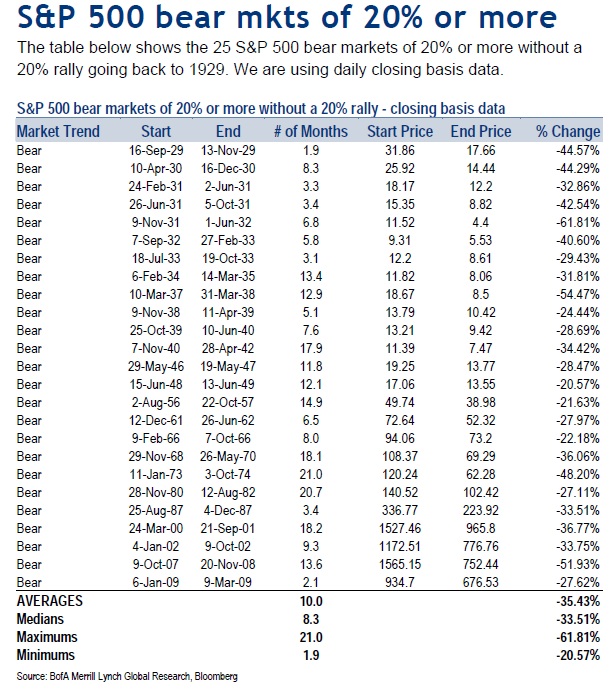
| Current Market Rally is 6th Best Since 1929 Posted: 07 Mar 2013 08:30 AM PST The S&P 500 rally dating back to March 2009 is the 6th best rally since 1929:
click for larger tables
Full tables of past Bull and Bear markets after the jump . . .
S&P 500 Bull; & Bear Markets of 20% or More:
Big Bulls
Big Bears
 |
| Posted: 07 Mar 2013 07:00 AM PST My morning reads:
What are you reading?
Bad-News Bears Crash the Party  |
| Is There a Rental Supply Glut? Posted: 07 Mar 2013 05:30 AM PST Summary…”If you buy it, they may not rent it…at the price you thought or need” A side of the “flood of investors sucking up all the supply” story that nobody is talking about…weakening rental demand. Phoenix cap rates projected to be between 1.75% and 4% at present (unless you do all the maintenance yourself). With caps this low, one may as well buy INTC or lever up 10 year notes at 1.9% and take far less risk than buying the tail end of a Twist-induced housing market short squeeze on the verge of a ‘consolidation’. Weak national rental demand — relative to the flood of rental single family and multi-unit supply coming on line – is a potential 2013 US housing market theme that will take it’s toll on landlords, REITs, institution investors, house prices, price/rent ratios, relative affordability, loan default & mod redefault rates (as the millions on the default fence or in high leverage mods decide it’s better to de-lever and rent), and ultimately the full blown housing recovery thesis now fully factored into every macro economic and investment models out a decade into the future. Do you remember looking at ‘opportunity fund’ capital raising slide decks a couple of years ago? A central thesis to the ‘buy and rent’ trade was not only historic low rates forever but millions upon millions more foreclosures for the next several years and all of those former homeowners needing a place to rent. On the rates side, they nailed it. But on the rental demand side, the exact opposite happened. As every insti and private investor – domestic and foreign – was buying up all low-end and distressed house in the country the banks and government made 8 million loan mods and workouts turning homeowners into renters of their own home. And they made it virtually illegal to foreclose too boot. As foreclosures hit a pre-crisis low in 2012 rental demand has been by and large dictated by good ol macro economic factors such as jobs, income, tax rates, energy costs etc, none of which are screaming in the direction of more demand and higher rents.
So, in short the “buy and rent” trade has turned into one in which you have to fight the government for the demand, which is something nobody factored into the ‘investment’. On the contrary, most have stable and linear 3% to 4% annualized rent increase factored in. If rents drop 15% in the first half of 2013 (from the back half of 2012), which is a number I simply picked from my model range of -5% to -25%, everything changes literally overnight. The present lack of ‘for sale’ supply could easily turn into supply wave quickly reversing the past years’ upward house price trajectory. Some will say, ‘that’s great, the market is starved for supply’. Yes, it’s starved for specific lower-end and/or distressed ‘investor’ supply. It’s extremely questionable that if a wave of rehabbed former investor rentals were to hit the market as resales whether first-timer and repeat organic (or investor) demand would be there in kind. Some will then think of all the stories you read daily of ’40 offers on every house and organic buyers not being able to buy’. This is happening. But from most all the Realtors I talk to, it’s the same 37 investors bidding cash pushing out the 3 organic bidders that need loans in order to buy. So bottom line, a wave of rehabbed resales from panicked investors shuttering supply could quite possibly be met with meager first-timer and organic demand. In media and sell side housing market reports that refer to the investor landlord/renter nation ‘movement’ everybody takes for granted ‘if they buy it, it will automatically rent at market rates’. In fact, most never even talk about the rental demand side of the equation because they assume it’s a ‘given’. But that’s not the case, at least in Phoenix. There is so much rental supply on the market — and coming on line — that landlords are in full blown price cutting wars. Moreover, aggressive landlords have loosened rental guidelines to accept virtually anybody with a cashiers check and heartbeat. Bottom line: A flood of institutional and private investor landlord buyers have shredded the inventory in Phoenix, Las Vegas, CA and several other of the more legacy distressed regions around the nation. For quite some time there have been bidding wars with investors paying 10% to 20% over “appraised value” looking at cash-flow yield as the primary metric and real ‘value’ way down the list of factors. But the story has taken a major left turn at least in Phoenix, which is the first market I am studying closely. In short, as rental supply reaches record highs, rental demand is falling pervasively. This, while Phoenix house sales demand have been negative on a YoY basis for several months now with January down double-digits.
I think there is a strong chance that we could all of a sudden see for-sale inventory levels rising sharply and prices dropping in the ultimate whip-saw event this spring/summer that ‘nobody saw coming’. Throughout history investor and first-time buyer demand has been known to ‘vanish’ literally overnight. Legacy distressed markets markets like Phoenix all around the country have been supported by these cohorts for years. And with over TWO-THIRDS OF all mortgage’d households in Phoenix unable to sell and rebuy (due to epidemic negative and effective negative equity, credit, or income problems) the repeat buyer cohort will not be able to catch this market as it drops. Recent, First-Hand Phoenix Rental Market Experience I have some friends in the Phoenix “skirts”, Chandler, AZ to be exact. Chandler AZ (like Gilbert and Mesa) is a burb of Phoenix known for overbuilding, foreclosures, a ton of single family houses etc. But it’s also known for it’s family bias, decent schools etc. Areas like this are where investors have swarmed to buy and rent single family houses. Reports typically generalize the Phoenix outskirts as “Phoenix”. My friends recently had a third kid and needed a new house so went out looking last summer. They are significantly underwater in their present house but their Realtor promised them it would be no problem to rent out their house after they bought the new one. So, they went housing shopping beginning in July. Every house they liked there were multiple offers, most all from investors. They couldn’t get an offer even looked at for months because they were not a cash buyer…they had a contingency that the purchase price and appraised value had to jive… they could not pay 15% over appraised value like Blackrock does…they are NOT paying with other people’s money…you get my point here. Finally, they found a “HUD” foreclosure (HUD resales generally have “no investor” provisions), were first to bid, and got the house. They moved in a few weeks ago. After they spent a bunch of money fixing up their old house they put it up for rent hoping to get someone in quickly because they technically can’t afford the new house without the rental income. The day they listed their old house for rent they considered their “move” complete. Little did they know the stress was just beginning. “Still, no calls on our rental” To set the stage properly their old house is “worth” about $120k. They initially put it up for rent at $1100/mo. After expenses and at a 90% occupancy rate this would equate to about a 5% cap rate. Not great, but not a killer. This is of course if they got $1100 a month. But they didn’t…not even close. The first week the rental ad ran no calls came. So, they lowered their rental price by 10% the second week. Still, no calls. They lowered their price by 15% the third week and a couple of calls came but it was from people wanting to “make an offer”. This weekend they lowered the price by 20% — to $875 — and they got 2 calls. While $875 still works for them they are beginning to panic. Last week they talked to their Realtor extremely concerned about the lack of rental demand. He replied “the market has changed dramatically in the past 6 months. There is a flood of rental supply and not enough renters so there is a price cutting war by landlords just to get people in”. If they end up getting $800/mo that’s about a 2-cap. Note, a 5-cap is a rate of return far too low for most insti investors, a 2-cap is a non-starter for all but the investors who have to deploy capital (typically other people’s capital) in order to get a paycheck. Anyway, my friend’s house is in the rental sweet spot, which makes this story even more pertinent to the rental investor community. That’s because as you go higher in house price/value rents don’t keep up, so cap rates fall. Like everything else in the housing sector since even before the crash happened…a key piece of the story is being left out of all the sell side research and financial press “housing recovery” stories. In the case of Phoenix — and most likely most other heavily distressed regions turned ‘investor havens’ throughout the nation — it looks like the missing piece of the story is the lackluster demand for the mega-supply and nowhere remotely close to the rental returns investors had hoped for unless you bought the right property in a relatively small window that slammed shut in early 2012. Rental Supply Glut will Promote Increase in Strategic Loan Defaults & Mod Redefaults Another consequence of the surge in rental supply and drop in rental rates should be a rise in loan defaults and mod redefaults. In Phoenix for example over 60% of the mortgage’d population is underwater or effectively underwater, many living with high LTV and DTI mods. Many of these Zombie homeowners simply find it easier to pay their 2% to the bank or for a HAMP mod than to finally de-lever through foreclosure or short sale and move their families, change schools etc. However, if all of a sudden houses similar to theirs are popping up in the neighborhood for lease without the expense of taxes, insurance, and maintenance it will absolutely push borrowers on the default fence or struggling every month with high DTI mods out of their houses into rentals. In closing… I have believed for a long time that the activity in Phoenix — and regions with similar ‘investor activity around the nation — was a short squeeze…a trade…nothing “durable”…on the back of Twist and 1.5% 10s. This due to a variety of fundamental factors least of which is that over 60% of all mortgage’d homeowners in the region are underwater ‘Zombies’ (not enough equity to sell and rebuy) and at least a third of those who aren’t Zombies don’t have the credit or income necessary to sell and rebuy; and the mortgage mod bubble further preventing the all-important repeat buyer cohort from selling and rebuying. I have also believed for a long time that the lack of foreclosures — and the mortgage mod/workout bubble — would ultimately be a killer for those hoping to rent houses to distressed borrowers. Of course, that’s because the banks and gov’t let all these potential borrowers rent their owns houses from them a 2% interest only for 5 years. And this is exactly how it’s playing out. I will be going to Phoenix shortly in order to meet with several brokers and new-era “landlords” but until then I wanted to get this theme out to you. Best Regards, Mark Hanson www.MHanson.com  |
| Posted: 07 Mar 2013 05:00 AM PST OrgOrgChart Autodesk Research The OrgOrgChart (Organic Organization Chart) project looks at the evolution of a company’s structure over time. A snapshot of the Autodesk organizational hierarchy was taken each day between May 2007 and June 2011, a span of 1498 days. Each day the entire hierarchy of the company is constructed as a tree with each employee represented by a circle, and a line connecting each employee with his or her manager. Larger circles represent managers with more employees working under them. The tree is then laid out using a force-directed layout algorithm. From day to day, there are three types of changes that are possible: Instead of recomputing the full layout each day, we animate the transitions from one day to the next. In this version of the video, each second corresponds to approximately 1 week of activity. If you have any questions, please contact me via email (http://www.autodeskresearch.com/peopl…) or on Twitter (@JustinMatejka). You can view more details about the video on the project page: http://www.autodeskresearch.com/proje…  |
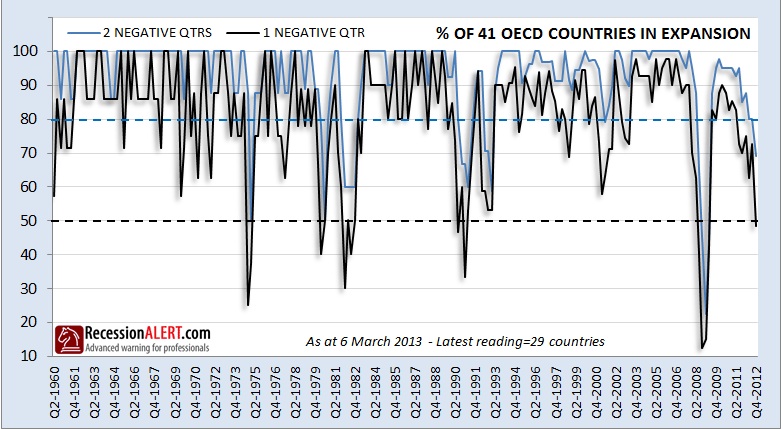
| World Is In a Recession (Go about your business as usual) Posted: 07 Mar 2013 04:27 AM PST Click to enlarge
My pal Lakshman Achuthan was just on Bloomberg TV, defending his 2013 (and 2012) recession call. While I respectfully disagree, I understand his point: The current environment is a typical feeble post-credit crisis recover. Indeed, we are in a Fed driven economy, and but for their interventions, we in the USA would very likely already be in a recession. As I have have stated to many times, but for the Fed, equity markets would likely be 20-30% lower (and I may be too optimistic with those numbers). But the key takeaway, based on the chart above from Recession Alert, is that the rest of the world IS ALREADY IN a recession. Indeed, more than half of the 41 OECD member nations are in economic contractions — and have been since Q4 2012. Here is the bizarre twist: As I will explain in this weekend’s WaPo column, this hardly matters for equities. In fact, markets correct before official recessions, primarily because contractions typically show up in earnings long before they do in the economic data . . .
 |
| Posted: 07 Mar 2013 03:00 AM PST An Infinite Amount of Money
An Infinite Amount of Money |






| You are subscribed to email updates from The Big Picture To stop receiving these emails, you may unsubscribe now. | Email delivery powered by Google |
| Google Inc., 20 West Kinzie, Chicago IL USA 60610 | |



0 comments:
Post a Comment