


The Big Picture |

- Weekly Eurozone Watch
- Minyanville’s Fireside Chat w/Todd Harrison & Barry Ritholtz
- Succinct Summation of Week’s Events (10/26/12)
- Milliseconds matter
- Fusion Equity Market Review (10/25)
- A Closer Look GDP Data
- US Q3 GDP better than expected
- 10 Friday AM Reads
- GDP better thx to defense spending
- Gentlemen, Start Your DeLoreans
| Posted: 26 Oct 2012 02:00 PM PDT
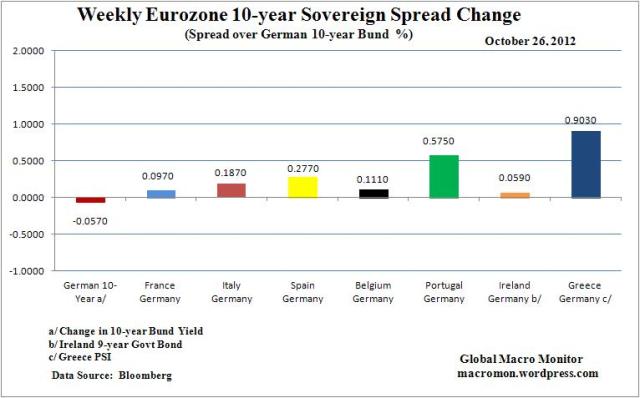
Key Data Points Comments The Euro Working Group (EWG) of eurozone finance ministry officials will meet Monday to review the country's aid package;
|
| Minyanville’s Fireside Chat w/Todd Harrison & Barry Ritholtz Posted: 26 Oct 2012 01:00 PM PDT
|
| Succinct Summation of Week’s Events (10/26/12) Posted: 26 Oct 2012 12:30 PM PDT Succinct summation of week’s events: Positives:
Negatives:
|
| Posted: 26 Oct 2012 11:30 AM PDT click for larger graphic
Source: |
| Fusion Equity Market Review (10/25) Posted: 26 Oct 2012 10:00 AM PDT |
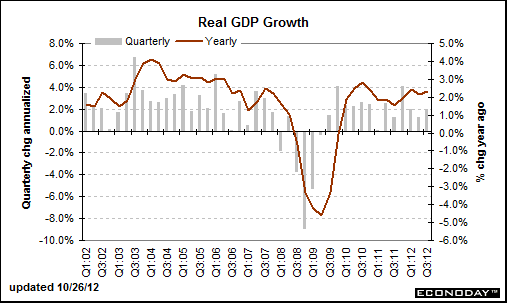
| Posted: 26 Oct 2012 09:15 AM PDT Adventures in confirmation bias: The GDP data this morning was a deep sigh of relief for those people who fear a recession may be coming. I don’t have that sense of relief. Perhaps its my own bias, but the details of the GDP report reveal not an organic growth period in a healthy recovering economy, but rather a tepid post-credit crisis expansion highly dependent on government largesse and Federal Reserve accommodation. It is about what we should expect: Below-trend growth, as the economy gradually heals, individual and bank balance sheets slowly improve, and the excesses of the prior cycle get wrung out of the system. Consider the major factors within this GDP report:
By my numbers, half of the GDP gains came from Fed/Uncle Sam. The slowdown in Europe and Asia are pressuring economic activity; the drought took away some of the gains, and without that, we should have seen some more strength. Overall, this report suggests that we are not yet in recession, yet, but are barely above stall speed — more like a 1.5% GDP ex-government interventions and drought. The improvements we are seeing seem to be driven mostly by Fed and government intervention. The key question, in light of the mediocre earnings season, is how long the propping up can continue.
Sources: http://www.bea.gov/newsreleases/national/gdp/2012/pdf/gdp3q12_adv.pdf |
| US Q3 GDP better than expected Posted: 26 Oct 2012 07:30 AM PDT Japanese consumer prices fell for a 5th consecutive month in September – prices, ex fresh food, fell by -0.1% Y/Y, though by less than the estimate of -0.2%. The data will add pressure on the BoJ to expand its monetary easing policies next week. Reports suggest that the BoJ will downgrade the outlook of the Japanese economy at its meeting next week (30th October). The Japanese government added a small stimulus programme today – some US$9.4bn. It cannot do any more,as the opposition is blocking its ability to raise funding; The disgraced Mr Bo has been expelled from the Chinese National People’s Congress, removing his immunity from prosecution. The next step will be for the authorities to press charges – the FT reports that the government has a 98% conviction rate. Its only 2 weeks to the Congress, which may not be enough time to try Mr Bo ahead of it;
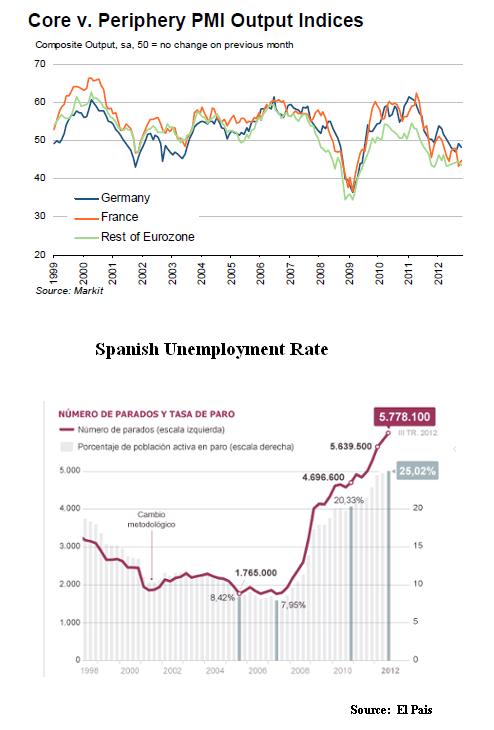
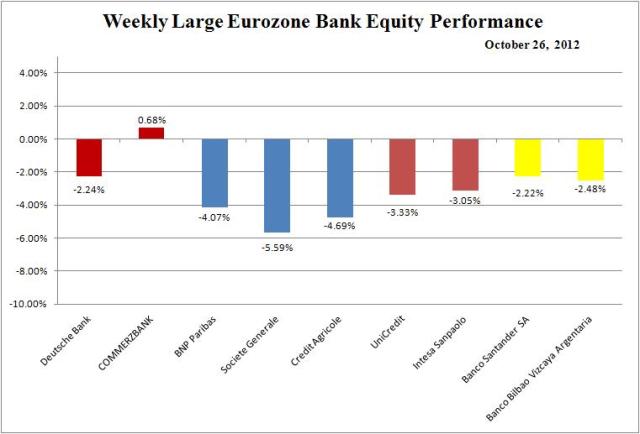
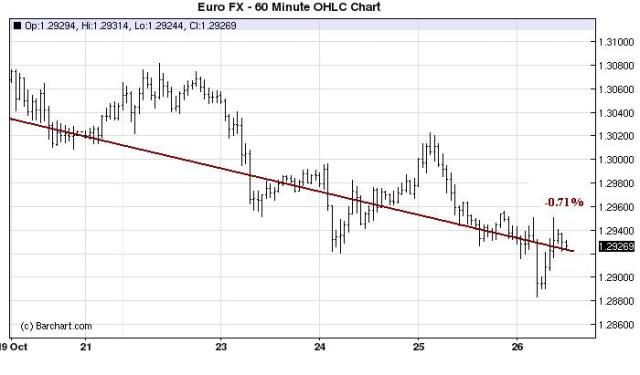
The New York Times reports that the extended family of Chinese Premier Mr Wen Jiabao has accumulated some US$2.7bn of assets. Chinese authorities blocked the New York Times Chinese-language web site in China and, intermittently, its English language version. Too late comrades – the news is out; South Korea’s economy grew by +1.6% Y/Y (+0.2% M/M) in the 3rd Q, the slowest pace in 3 years and below the +1.7% expected. Exports slowed, capex declined and domestic consumption weakened. Consumer confidence declined to a 9 month low. The South Korean economy is expected to grow by +2.4% this year and the government has forecast that GDP will rise by +3.0% next year – sounds optimistic; South African finance minister Mr Pravin Gordhan promised to freeze spending, for the 1st time since 1998. However with unemployment rising to 25% and increased unrest amongst workers, combined with rising debt levels, yesterday’s budget failed to address the country’s problems. Both Moody’s and S&P have downgraded the country in the last month. The ANC promises radical reforms at its next meeting in December – Hmmmmm. The finance minister raised its budget deficit to 4.8% of GDP, from 4.6% for the year ending 31st March 2013 and forecast that the deficit would be 4.5% for the next fiscal year. Growth was cut to +2,.5% this fiscal year (+2.7% previously) and 3.0% (+3.7% previously). Further credit downgrades are likely – Fitch were negative on South Africa today. I remain short the Rand. (Source Bloomberg); Germany is pushing its plan to offer Greece a 2 year extension to meet its target to bring down its budget deficit to 3.0%. Mr Assmussen of the ECB suggests that the EZ buys Greek bonds, which are trading at a discount, to reduce the overall level of debt, though such buy backs wont make enough of a difference. In addition, Greek politicians have yet to agree to implement the austerity measures, proposed by the Troika. The leader of the Democratic Left party, Mr Kouvelis wants changes to the labour measures proposed by the Troika. The Greek finance minister has publicly rejected any changes before the reforms are discussed in Parliament. The EZ are trying to finalise plans ahead of the EZ finance ministers meeting on the 13th November. The 2 year delay for Greece to meet the deficit targets will result in Greece requiring an addition E20bn through to 2016 – other estimates are higher, at E30bn. Finland and Holland will need to be persuaded to allow a 2 year extension, but will certainly not agree to providing more funding. All these grand plans will fail sooner rather than later. Greece will default and Mrs Merkel’s plan of trying to kick this particular can down the road (well at least until after her general election in September next year) will fail; Italian business confidence unexpectedly declined in October to 87.6, from 88.3 in September and lower than the rise to 88.7 expected. Recent economic data has been positive and today’s data will be a disappointment. The economy is expected to decline by -2.4% this year. The IMF forecasts that Italian GDP will decline by -0.7% next year; Spanish unemployment hit 25.02% in the 3rd Q, up from 24.6% in the 2nd Q and, unfortunately, with no signs of declining. Unemployment has tripled since 2007, according to Bloomberg. Cant see any upside and yet the Spanish PM, Mr Rajoy continues to dither – he will have to seek a bail out at some stage. Plans to set up a bad bank are in doubt – basically Spain remains a complete mess; German consumer confidence rose to 6.3, from an (upwardly revised) 6.1, better than the forecast of 5.9; Interesting developments in Finland. The FT reports that the Finns are thinking about exiting the Euro. I have to say that this sounds far fetched at the moment. However, they are considering setting up a parallel currency, something which has been considered by the Greeks; S&P has downgraded BNP, citing increased economic risks in France. In addition, the ratings agency cut the outlook to negative of 10 other major French banks, including Soc Gen and Credit Agricole. How long before France is downgraded – a near certainty in 2013, in my view. S&P adds that though the French economy has been relatively stable, its resilience has been reduced as “the constraints of a relatively high public debt, reduced external competitiveness, and persistent high unemployment, are being aggravated in our view by the ongoing eurozone crisis, a more protracted recession across Europe and lower domestic growth prospects”. A definite whoops. (Source FT); Intrade’s odds on President Obama remaining President has risen marginally to 61.5%; 9 more banks have been subpoenaed by the New York attorney-general in respect of the LIBOR scandal; US 3rd Q GDP came in at +2.0% on an annual basis, higher than the +1.8% forecast and +1.3% in Q2. Better consumer spending, gains in residential construction and an increase in government spending helped, whilst declining exports and lower business investment were negatives. The rate of growth would have been better if were not for the drought in the Midwest. Consumer spending rose by +2.0%, from +1.5% in Q2. Real disposable income came in at +0.8% Y/Y, the least since end 2011. The savings rate fell to 3.7%, from 4.0%. Outlook Asian markets closed lower, with the Shanghai composite declining by the most in 5 weeks (-1.7% lower), due to earnings disappointments. European markets were mainly lower, but the better US GDP data resulted in a turnaround, with markets higher at present. US futures suggest a flat open. The Euro is flat, currently around US$1.2932 – improved following the release of the US GDP data – counter intuitive. Gold is trading at US$1715, with oil at US$108.72. The IMF is questioning whether it is sensible for Portugal (lead by a Conservative government) to continue to impose additional austerity measures. They argue that the further spending cuts, combined with higher taxation are making the situation worse. Social unrest is increasing as is opposition to the measures. Expect this argument to spread across a number of countries in the EZ. It is clear that austerity by itself, without some kind of growth measures, is not going to survive as an economic policy for the EZ much longer (3 to 6 months, I would guess) which, when changed, will be positive for markets. OK, better US GDP data, but its not enough in my view. Far too much uncertainty out there. I remain cautious in respect of the equity markets. Have a great weekend. Kiron Sarkar 26th October 2012 |
| Posted: 26 Oct 2012 07:00 AM PDT My end of the week, morning reads:
What are you reading?
5% Declines During Current Bull Market |
| GDP better thx to defense spending Posted: 26 Oct 2012 05:13 AM PDT GDP in Q3 rose 2.0%, better than expectations of 1.8% and an improvement from the 1.3% rise in Q2. Nominal GDP was up by 4.8%, well above the estimate of 3.9% as the Price Deflator was up by 2.8%, the 2nd most gain since Q3 ’08 and higher than the forecast of 2.1%. Personal Spending was up by 2%, actually a touch less than expected. Gross Private Investment was up by .5%, below the gain seen in Q2 as spending on equipment and software was flat after solid gains in previous quarters. Residential construction picked up some of that slack with a 14.4% rise. Trade was a modest drag as exports fell 1.6% while imports were lower by just .2%. Federal Government spending looks like the main driver of the better than expected headline print as it rose by 3.7% led by a 13% gain in defense spending. Spending at the state and local level fell by a .1%. Inventories were a tiny drag as they rose less than the gain seen in Q2. Real final sales, taking out the inventory influence, rose by 2.1% vs 1.7% in Q2 and 2.4% in Q1. Bottom line, 2% growth is about in line with the average seen over the past three years of 2.1% but the deceleration in trend is evident as the economy grew 2.4% in ’10, 1.8% in ’11 and averaging 1.8% in ’12. Mathematically, GDP should grow at population growth + productivity. Population is growing by 1% and productivity just 1% vs the 30 yr average productivity growth of 2.2%. We need more savings and investment for this, not more borrowing and spending pushed by gov’t monetary and fiscal policy. |
| Gentlemen, Start Your DeLoreans Posted: 26 Oct 2012 05:00 AM PDT Gentlemen, Start Your DeLoreans
It seems engines are revving and it may be time to go forward to the past. Earlier this month, a large and well respected asset manager that has begun taking positions in gold expressions issued a report in which it began to justify gold's relative value. One metric it used was comparing the quantity of currency in the world to the quantity of gold. The report concluded that using this metric, the relative value of gold would be about $2,500/ounce, a significant premium to its current spot price. The analysis posited gold's value upon a return to the gold standard, posing the question: "what if the entire world's gold were used to back the global supply of fiat currency?" It then explained that there are approximately $12.5 trillion of physical and electronic global currency reserves and in excess of 155,000 metric tons (tonnes) of above-ground gold (which would imply a price of approximately $2,500/ounce if current global bank reserves were to be backed by gold). As you know, we agree fully with the concept of finding one's value bearings on gold by pricing its quantity vis-à-vis the quantity of reserves (as per our Shadow Gold Price); however, we thought it important to explain the flaws in the method used above, and to augment it in a way we feel better portrays gold's present value. First, we do not think $12.5 trillion in global base money is the relevant figure to use as the numerator. The only reason there would be a conversion from a fiat monetary system to a gold standard would be continuing financial pressures, specifically pressure from the commercial marketplace to deflate the value of systemic credit. This credit-deflation dynamic began in 2008, and has been forcing global central banks to print more base money (bank reserves) with which to service and repay that credit. In a global monetary system in which the future purchasing power of currencies is respected and the system is generally perceived as solvent, there would be no need for a conversion to a fixed exchange rate (a gold standard). So, any discussion of conversion must presume further stress weighing on the marketplace; the ongoing perception of endless money creation that threatens further purchasing power loss. A gold standard would be demanded by global commercial counterparties and savers. Central banks and their treasury ministries would ultimately be forced to cap such fears by "fixing" the exchange value of their currencies to gold. So the numerator in the calculation should not be the current level of base money, but the amount of unreserved credit in the system (i.e. global bank assets). (Fiat currencies are largely credit currencies, created primarily in the banking system as unreserved loans that create offsetting deposits in kind.) Thus, we think the most appropriate benchmark to use as the numerator in the calculation would be global bank assets – about $100 trillion – not $12.5 trillion in global base money. Second, for gold to be money in a gold standard overseen by governments, the denominator used must be official gold holdings – not total above-ground gold in the world. Otherwise, the mechanism of a gold standard – the ability to exchange a government-sponsored currency for gold interchangeably at a fixed rate – would not work. As per the World Gold Council, about 31,000 tonnes of gold is held in official hands (only about 20% of total above-ground reserves). Central banks have no legally or ethically enforceable claim on the balance of the 155,000 tonnes, which is held in private hands. This implies that the denominator in the calculation would have to be much closer to 31,000 tonnes than 155,000 tonnes. So, we agree with the logic of dividing base money by gold holdings to find gold's "intrinsic value" (as per Bretton Woods and our Shadow Gold Price), but we believe the reasonable value upon conversion to a gold standard would be many multiples higher than $2,500/ounce. We are heartened that some of the world's largest and most sophisticated financial asset investors are beginning to consider money and gold stocks into their present value analyses for currencies, and in turn into their portfolio allocations. We believe allocations to gold will increase substantially as investors previously dedicated to stocks and bonds progress in their analysis. Speaking of Transmissions… Herewith a reiteration of our proposal of a transmission mechanism to a fully-reserved banking system, gold standard and fully-funded federal debt in the US: 1) The Fed purchases all existing bank assets via the creation of base money on a one-to-one basis (i.e. deposits are replaced with base money which reduces bank leverage to 1) 2) Banks are commensurately required to lend only against time deposits they can source (banks become credit intermediaries, not creators) 3) Simultaneously, the Fed purchases Treasury's gold at a price which would fully fund Treasury's outstanding debt (yes, unfunded liabilities remain unaddressed) 4) The Fed then guarantees the exchange value of its existing base money liabilities against the gold it then holds in reserve (a classical gold standard) Theoretically, the notional size of the existing money stock would remain stable so there would be no diminution of purchasing power by existing currency holders. The wealth redistribution that would occur at revaluation would be from current non-gold asset holders to gold holders, which is a byproduct of bank system deleveraging regardless of whether it is market-driven or policy administered. While some continue to argue that the US can only get its fiscal house in order by running trade and/or budget surpluses, it would seem the US's official gold stock could be revalued to the extent that no trade or budget surplus is necessary as any sort of precondition. Going forward, of course, if the US were to allow trade and budget deficits to persist, it would lose its gold in the process and the credibility of the dollar would decline in sympathy. Practicalities The Fed would pay for Treasury's gold at a price high enough to provide the proceeds to Treasury to pre-refund ALL of its debt. At the current U.S. bank asset to base money ratio, that number would be about 5 to 6 times the current spot price. In the aftermath of the dollar's devaluation against gold, it clearly would behoove the Fed to support gold as its own reserve base going forward. In aggregate, bank assets are marked at a premium to market value so banks would gladly dump their assets as marked. Banks would then have incentive to offer rates of return and maturity terms to depositors that are commensurate with the banks' lending opportunities (as things should be). Fears of US Treasury paper free-falling into a bottomless pit in response to the dollar devaluation are unfounded as these liabilities immediately become fully-funded by Treasury's gold sale to the Fed. There would be no domestic or foreign public/private bids required. In theory, the bank assets/loans the Fed would purchase could be marked down 90% if need be and still not impact the solvency of the Fed. The Fed could simply bid gold up X times to maintain its capital cushion. (After all, the Fed is the monopoly supplier of base money.) Some have argued that such a policy maneuver would put incremental pressure on non-US entities that have borrowed in USD terms. We disagree as the USD money stock that supported that debt originally would be unchanged in terms of its quantity. Only the mix between base and credit/deposit money has changed. Some have also argued that US Treasury paper would be susceptible to ratings agency downgrades as a result of these actions. Hogwash. Nothing would have occurred except an exchange of base money from the Fed to Treasury and gold from Treasury to the Fed. Thus, if anything, Treasury paper would be upgraded immediately as Treasury payments would be immediately defeased by the newly acquired base money proceeds from the gold sale to the Fed. As Marty McFly said; "I guess you guys aren't ready for that yet. But your kids are gonna love it." Kind regards, |



| You are subscribed to email updates from The Big Picture To stop receiving these emails, you may unsubscribe now. | Email delivery powered by Google |
| Google Inc., 20 West Kinzie, Chicago IL USA 60610 | |



0 comments:
Post a Comment